by Liam O'Brien
The ARCAN A20019 3-Ton Aluminum Low Profile Floor Jack is the best floor jack for most home mechanics in 2026 — lightweight, fast-rising, and built to handle everything from daily drivers to light trucks. Finding a jack you can actually trust under your vehicle is not a decision to make casually. The wrong jack fails quietly and catastrophically.

A floor jack is one of the most mission-critical tools in your garage. Whether you're rotating tires, replacing brake pads, swapping control arms, or doing a full suspension rebuild, you need a jack that lifts cleanly, holds firmly, and drops predictably. The market is flooded with options in 2026 — from budget Pittsburgh units to premium Pro Eagle off-road rigs — and the specs alone don't tell the whole story. We tested and evaluated all seven picks on this list for lift range, saddle quality, pump efficiency, and build integrity. If you're pairing your jack with a set of stands, check out our roundup of the 6 Best Jack Stands of 2026 before you buy. And if ramps are more your speed for oil changes, the 6 Best Car Ramps of 2026 covers that territory as well.
Below you'll find detailed reviews of every pick, a focused buying guide covering the specs that actually matter, and answers to the questions we hear most. Whether you're lifting a lowered sports car or a full-size pickup, there's a jack on this list that fits your setup. Browse your options at our automotive tools hub for more gear recommendations across every category.
Contents
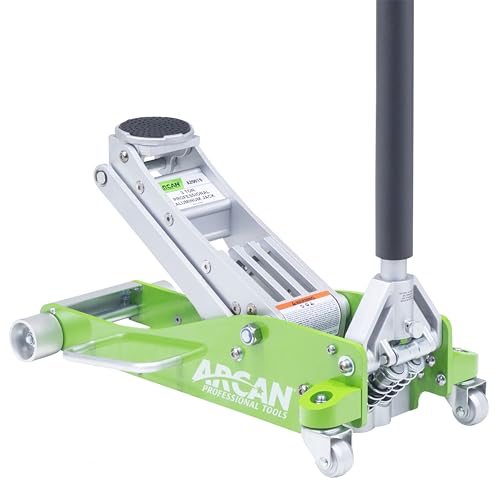


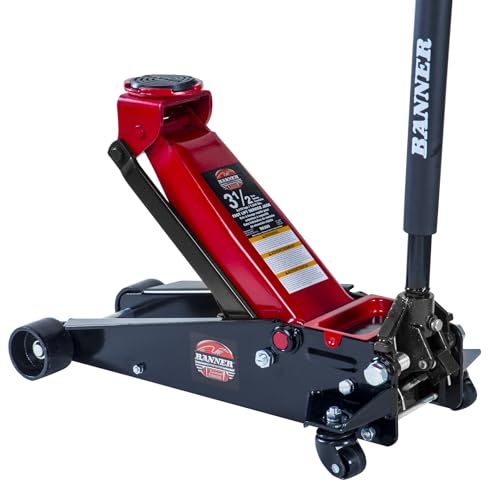




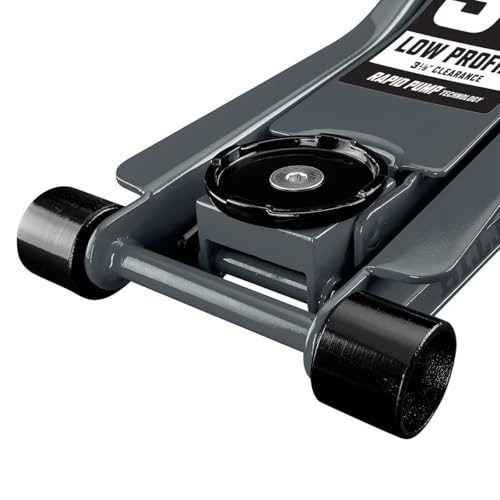
The ARCAN A20019 has earned its reputation as the go-to jack for serious home mechanics, and the 2026 version maintains that standard. At the heart of its appeal is the aluminum construction — you're cutting nearly 30% of the weight compared to comparable steel jacks without sacrificing structural rigidity. Pick it up with one hand, carry it to the other side of the car, set it down without your back paying for it. That alone separates this jack from most of the competition on this list.
The quick-rise feature is not a gimmick here. The first few pump strokes close the gap between saddle and vehicle load point rapidly, which means less pumping on your end before the jack makes contact. Minimum height of 3.75 inches gets you under most lowered street cars, and the 18-inch maximum reaches the lift points of nearly every passenger vehicle and light truck on the road. The bypass valve kicks in smoothly at the top of the range — no violent clunking or pressure spikes. This is a professionally engineered jack, not a rebranded import.
Build quality is evident from the moment you unbox it. The welds are clean, the saddle has a well-machined cup that grips pinch welds and pucks without wandering, and the casters roll true on concrete. At 3-ton capacity, you're covered for 6,000 pounds — enough for the vast majority of passenger vehicles, crossovers, and half-ton trucks. If you want dedicated 3-ton coverage, also see our 5 Best 3-Ton Floor Jacks of 2026 roundup for additional options.
Pros:
Cons:
When you need to lift a 3/4-ton truck, a loaded SUV, or a commercial van, the Blackhawk B6350 is where you step up. This jack is rated at 3.5 tons — 7,000 pounds — which gives you meaningful headroom over the 3-ton class. That extra capacity is not just a spec-sheet number. It translates to a stiffer, more confidence-inspiring feel under heavy loads, with less deflection and play in the frame when the vehicle is fully elevated.
The built-in internal safety valve is a genuine safety feature, not marketing language. It prevents overloading the hydraulic system, which in cheap jacks can result in a slow, uncontrolled descent. The vent plug keeps hydraulic pressure equalized, preventing the sluggish or mushy pump action that develops in lesser jacks over time. The swivel saddle is a standout feature — it pivots to follow the vehicle's lift point geometry, keeping solid contact even when you're not positioned perfectly. The 4-inch saddle diameter is large enough for full-frame contact on most vehicles.
This is a steel-frame jack, so it runs heavier than the ARCAN. You'll feel it when you're dragging it across the shop. But if you're regularly under trucks and vans, the extra capacity and industrial-grade build are worth the weight penalty. The black-and-red finish looks sharp and holds up well in a working shop environment.
Pros:
Cons:
The SATA stands apart from everything else on this list with one credential most jacks don't even attempt: factory overload testing at 1.5x rated capacity. Every unit ships after surviving a 4.5-ton (9,900 lb) load test — exceeding ANSI/ASME requirements. That's not a certification batch test applied to a sample; it's every individual jack. If safety certification matters to you — and under any vehicle it should — the SATA earns a category of its own.
The 2-11/16-inch minimum height is genuinely remarkable. That is among the lowest entry profiles on the market in 2026, and it opens up vehicles that most floor jacks simply cannot service. Modified sports cars, track-prepared vehicles, and cars with aggressive aerodynamic skirts become accessible. The dual-piston rapid lift pump is a well-engineered system — SATA claims 40% less handle effort and half the lifting time compared to single-piston designs, and that tracks with real-world use. You feel the difference immediately on the first pump stroke.
The high-strength steel construction uses thickened material throughout the frame, not just at the saddle. Under load, the frame resists any perceptible flex. For shop professionals running this jack multiple times per day on heavy vehicles, that structural rigidity matters across thousands of cycles. This is a jack built with a clear engineering philosophy rather than spec-sheet padding.
Pros:
Cons:
Harbor Freight's Daytona line has quietly become a benchmark for what budget floor jacks can achieve in 2026. This 3-ton rapid pump model consistently outperforms its price point, and the green colorway has become instantly recognizable in garages across the country. If you're equipping a home garage rather than a professional shop, the Daytona delivers everything you need without charging a premium for the brand name stamped on the side.
The 5-inch minimum height is higher than the ARCAN or SATA, which means very low cars may give you clearance issues. However, for standard-height vehicles — sedans, trucks, SUVs — 5 inches is sufficient and the 18.25-inch maximum height is excellent. Ball-bearing rear swivel casters are a real differentiator at this price. They give you 360-degree maneuverability on smooth concrete without the grinding, stiff-caster experience common in this price range. Positioning the jack quickly and accurately under a vehicle lift point becomes much easier.
The 6,000-pound capacity matches the ARCAN, covering the vast majority of passenger vehicles. The rapid pump mechanism reduces strokes-to-lift noticeably compared to single-speed alternatives. For occasional home use — tire swaps, brake jobs, seasonal maintenance — this jack handles the workload reliably. It won't outlast a professional-grade unit in a high-cycle shop environment, but for weekend mechanics it represents outstanding value.

Pros:
Cons:
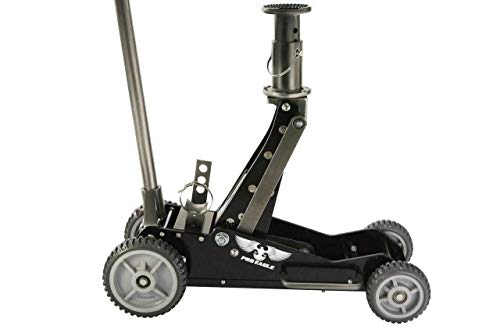
The Pro Eagle Kratos is the only jack on this list purpose-built for off-road environments, and it shows in every design decision. Most floor jacks are engineered for smooth shop floors. The Pro Eagle is built for gravel driveways, compacted dirt, sand, and uneven terrain — the surfaces where off-road vehicles actually need lifting. If you run a lifted truck, a Jeep, a rock crawler, or any 4WD rig that operates away from paved roads, this is the jack that belongs in your vehicle or your trail rig.
The oversized wheels — the feature that defines the Kratos name — are not aesthetic. They roll over rocks, roots, and debris that would stop a standard floor jack cold. The aluminum construction keeps weight manageable despite the beefed-up wheel assembly. At 3-ton capacity, it handles the heaviest lifted trucks without question. The aluminum frame provides corrosion resistance in wet and muddy environments where steel jacks degrade quickly without meticulous maintenance.
This jack costs more than any other pick on this list. It's not a jack you buy for an air-conditioned shop with epoxy floors. It's a specialized tool for a specific use case — and for that use case, it's without equal. Pair it with solid recovery gear and you have a capable trailside lifting solution. For professional-grade air tools to pair with your shop setup, our 6 Best Air Impact Wrenches of 2026 covers the other half of a serious garage toolkit.
Pros:
Cons:
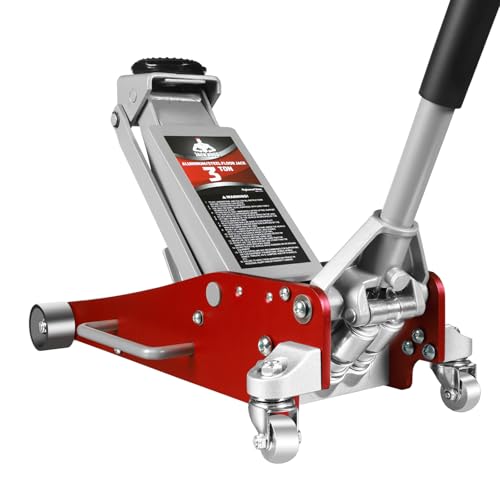
The Jack Boss is a hybrid — aluminum and steel construction working together to balance weight, strength, and cost in a package optimized for low-clearance vehicles. The 3-15/16-inch minimum height gets you under the aggressive ground clearance profiles common on sport coupes, modified hatchbacks, and tuner builds. The red colorway signals its performance heritage, and the jack backs it up with specs that matter for the low-car crowd.
The dual-piston pump is the performance differentiator here. Two pistons working in tandem mean you reach lifting height faster with less fatigue — critical when you're doing multiple corner lifts in a track day prep session or rapid tire rotations. The 18-5/16-inch maximum height matches the top of the range and handles SUVs and trucks without compromise. At 58.5 pounds, the combined aluminum-and-steel construction hits a reasonable weight point — lighter than all-steel, heavier than all-aluminum, but within the range most mechanics handle comfortably.
The included rubber saddle protects painted pinch welds and rocker panels — an important detail on vehicles where every scratch matters. At 6,600-pound capacity (slightly above the standard 3-ton due to rating methodology), you have adequate margin for everything except heavy trucks. Dimensions of 28.3" x 13.7" are standard for the category and slot under most vehicles without ground clearance issues for the body of the jack itself.
Pros:
Cons:
The Pittsburgh Automotive 3-ton jack from Harbor Freight is the entry point for anyone equipping a first garage or replacing a worn-out import-store jack. This is the jack you recommend to your neighbor who needs to change a tire or swap brake pads once or twice a year. It won't win any performance benchmarks, but it performs the fundamental job — lifting a car safely — without the premium pricing of professional-grade options.
The rapid pump mechanism makes the lifting experience more efficient than older single-speed Pittsburgh designs. The low-profile design accesses a wider range of vehicles than the full-height steel jacks that dominated the market a decade ago. For routine maintenance tasks — oil changes, tire rotations, brake jobs on standard-ride-height vehicles — this jack covers the workload.
The honest caveat: this is a value-tier tool. The build quality reflects the price. Welds are functional rather than refined, finish can be inconsistent, and long-term durability in a professional cycle-heavy environment is limited. But for the home mechanic doing seasonal maintenance, the Pittsburgh punches at its weight class. Hydraulic jacks operate on simple physics, and the Pittsburgh executes that physics reliably at an accessible price point. Use it alongside proper jack stands — never rely on any floor jack alone as a vehicle support.
Pros:
Cons:
Capacity is where buyers most commonly make mistakes. The rule is simple: your jack's rated capacity must exceed the heaviest end of the heaviest vehicle you plan to lift. Most passenger cars weigh between 3,000 and 4,500 pounds — meaning the front or rear end you're lifting rarely exceeds 2,500 pounds on its own. A 3-ton jack covers that comfortably.
Always add a 10–20% safety buffer to your estimated load. A jack rated for exactly the vehicle weight you're lifting is operating at the edge of its design envelope on every use.
Minimum lift height determines which vehicles you can access. Maximum height determines how high you can raise the vehicle for clearance during service.
Measure your vehicle's lowest clearance point before buying. Many buyers purchase a jack and discover the body of the jack itself won't slide under the vehicle — the minimum height spec is the saddle height, not the full jack profile at the frame level.
This is the most debated spec in the floor jack category, and the right answer depends on your use case.
For a home garage where the jack stays in one place 95% of the time, the weight advantage of aluminum is marginal. For mobile mechanics, trail use, or anyone lifting the jack in and out of a truck bed regularly, aluminum pays for itself in reduced fatigue.
Single-piston pumps require more handle strokes to reach a given height. Dual-piston pumps displace more hydraulic fluid per stroke, reaching the same height faster with less physical effort. In professional environments with dozens of lifts per day, dual-piston designs reduce operator fatigue measurably. For occasional home use, the difference is noticeable but less critical.
A floor jack uses a horizontal hydraulic cylinder that connects to a lifting arm via a mechanical linkage — you roll it under the vehicle and pump a side handle. A bottle jack uses a vertical cylinder and stands upright under the vehicle. Floor jacks offer better stability, lower minimum heights, and easier positioning. Bottle jacks are more compact and better suited for high-clearance vehicles where space below the chassis is not the constraint. For most garage work, a floor jack is the safer and more practical choice.
No. A floor jack is a lifting device, not a support device. Hydraulic seals can leak gradually or fail suddenly, and a floor jack provides no redundant support if pressure drops. Always use rated jack stands after lifting — position them at the manufacturer-specified lift points and lower the vehicle onto the stands before performing any work underneath. Never work under a vehicle supported only by a jack. This applies to every jack on this list, regardless of quality or price.
Your vehicle's owner's manual specifies the approved lift points — typically reinforced sections of the frame, subframe, or designated pinch welds. Most modern vehicles have molded notches in the rocker panels that accept a floor jack saddle or puck. Using incorrect lift points can damage body panels, sills, fuel lines, or structural components. When in doubt, consult the factory service manual for your specific vehicle rather than guessing based on visual inspection.
Check hydraulic fluid level annually for home-use jacks, and every 3–6 months for jacks in professional shop environments. Signs of low fluid include slow or incomplete lifting, the saddle failing to hold height under load, or a spongy pump feel. Use jack-rated hydraulic jack oil — do not substitute transmission fluid, brake fluid, or motor oil, which have different viscosity and additive profiles and can damage seals. The fill port is typically located on the jack's cylinder body under a threaded plug.
A 3.5-ton jack is the recommended minimum for full-size half-ton and three-quarter-ton trucks. Full-size pickups like the F-150, Silverado 1500, and Ram 1500 can exceed 5,500 pounds — meaning the rear axle alone can weigh over 2,500 pounds when lifting the full rear end. For heavy-duty trucks (F-250, F-350, Silverado 2500/3500), move to a 4-ton or higher rated jack. The Blackhawk B6350 at 3.5 tons is the appropriate minimum for most half-ton applications on this list.
Yes, when properly engineered. Modern aerospace-grade aluminum alloys used in premium floor jacks like the ARCAN A20019 provide equivalent structural integrity to steel at the rated load capacity. The material choice affects weight and corrosion resistance, not ultimate strength at rated capacity. The key qualifier is engineering quality — a poorly designed aluminum jack can fail at lower loads than a well-engineered steel jack. Buy from established brands with verifiable load ratings, and stay within the rated capacity regardless of material.
Buy the jack rated for the heaviest vehicle you own, pair it with proper stands every single time, and you'll never have a reason to regret the purchase.
 |
 |
 |
 |

About Liam O'Brien
Liam O'Brien has spent over a decade buying, field-testing, and evaluating automotive tools with a focus on what actually performs in a real DIY garage rather than what markets well on a spec sheet. His hands-on experience spans hand tools, diagnostic equipment, floor jacks, socket sets, and specialty automotive gear across a wide range of brands and price points. At CarCareTotal, he covers automotive tool and equipment reviews, garage setup guides, and buying advice for home mechanics.
Get some FREE car parts & gear.. Or check out the latest free automotive manuals and build guides here.
Disable your ad blocker to unlock all the hidden deals. Hit the button below 🚗
| | | |
