by Liam O'Brien
According to OSHA workplace safety data, vehicle crush injuries account for dozens of fatalities and hundreds of serious hospitalizations in the United States every year, and a significant share of those incidents trace back to improperly rated or poorly maintained jack stands used in home garages and small shops. That single statistic should reframe how you think about this purchase, because a set of jack stands is not an accessory — it is the last line of defense between you and several thousand pounds of steel. Whether you are swapping brake rotors on a Saturday morning or doing a full suspension overhaul, the stands holding your vehicle in place need to be as capable as the task demands, and in 2026 the market offers genuinely excellent options across every capacity range and price point.

The challenge is sorting through the noise, because the jack stand category is flooded with products that look nearly identical on a shelf but differ dramatically in steel quality, ratchet bar construction, and load-bearing integrity. You need to match the stand's rated capacity to your heaviest vehicle, account for the height range required by your typical workspace, and decide whether ratchet-style or pin-style adjustment better suits the way you actually work. Paired with the right 3-ton floor jack, a quality set of stands completes the foundation of a safe home garage — and once you understand the key differentiators, making the right call becomes straightforward.
This guide covers seven of the most capable and well-reviewed jack stands available in 2026, ranging from the budget-friendly Amazon Basics 3-ton pair all the way up to the Sunex 1410's jaw-dropping 10-ton-per-stand rating. We break down exactly who each product is built for, where each one earns its price, and what to watch for before you place your order. You will also find a thorough tools buying guide and a comprehensive FAQ section covering the questions most readers ask before committing to a set. Every recommendation here is grounded in specifications, real-world usability, and honest assessment of the trade-offs — no filler, no padding.
Contents









The BIG RED T43002A from Torin has earned its reputation as the go-to jack stand for home mechanics who want dependable capacity at a price that does not sting, and after spending time with this pair it is easy to understand why it consistently tops best-seller charts. The 3-ton (6,000 lb) capacity covers the overwhelming majority of passenger cars, crossovers, and light SUVs you will encounter in a typical driveway, and the height range of 11-1/4 inches to 16-3/4 inches accommodates most factory lift points without forcing you to stack adapters or perform awkward positioning maneuvers. The industrial-welded heavy-duty steel construction is immediately apparent when you handle these stands — there is a solidity to them that speaks to long-term durability rather than just meeting a minimum spec.
What genuinely separates the Torin from cheaper alternatives is the double-locking system, which combines the standard ratchet mechanism with a removable locking support pin that Torin claims increases safety by 200 percent over single-lock designs. That pin is not just a marketing feature — it eliminates the scenario where a damaged or worn ratchet tooth could allow the stand to creep downward under load, which is exactly the failure mode that contributes to those OSHA injury statistics mentioned in the introduction. The saddle diameter of 3.35 inches provides a broad contact patch with the vehicle's pinch welds or frame rails, distributing the load evenly and reducing the risk of deformation on modern unibody vehicles that have thinner sill sections than older body-on-frame platforms. If you want one pair of stands that handles 95 percent of home garage work without drama or compromise, the Torin T43002A is that product.
The only realistic limitation here is capacity — 3 tons per pair means each individual stand is rated at 1.5 tons, which is sufficient for a compact car but not appropriate for heavier trucks, full-size SUVs, or commercial vehicles. You also need to keep in mind that while the locking pin dramatically improves security, these stands are not intended for extended storage under a vehicle, and Torin is explicit about recommending them for most 3-ton autos rather than large pick-ups or oversized off-road SUVs.
Pros:
Cons:
Pro-Lift has built a solid reputation in the automotive tool space for delivering professional-grade materials at accessible price points, and the 3-ton jack stands from their current lineup demonstrate exactly why that reputation holds up under scrutiny. The stamped steel construction is notably robust for a product in this category, with the steel gauge being thick enough that you feel genuine confidence loading these stands rather than the faint unease that cheaper stamped-steel competitors can inspire. The standout component is the ratchet bar itself, which is fabricated from high-quality cast ductile iron — a material choice that prioritizes strength and fracture resistance over the brittle cast iron used in lower-tier products, and one that directly impacts long-term reliability under cyclic loading.
The height adjustment mechanism on the Pro-Lift stands is smooth and deliberate, with the release handles locking into position with an audible and tactile click that removes any guesswork about whether the stand is properly engaged at your selected height. That clarity matters enormously when you are positioning stands solo, because you need to be able to confirm engagement without bending down to visually inspect each stand every single time. The overall footprint of the base provides solid lateral stability, and these stands handle slight surface irregularities in concrete floors better than more narrowly based competitors, which is a practical advantage in older garages where the slab has settled unevenly over the years.
At 3-ton capacity, the Pro-Lift shares the same fundamental limitation as the Torin above — these are stands for passenger vehicles, light crossovers, and most standard pickup trucks, not for heavy-duty commercial applications. That said, for the buyer who wants cast ductile iron ratchet bar quality without stepping up to a premium price tier, the Pro-Lift stands deliver exceptional value and should be a first consideration for anyone building out a starter garage tool set.
Pros:
Cons:
The Sunex 1410 occupies a completely different tier from everything else on this list, and the numbers make that unmistakably clear: 10 tons of capacity per stand, for a combined pair capacity of 20,000 pounds, covering everything from commercial box trucks to heavy agricultural equipment and the largest full-size pickups on the market. If you work on commercial vehicles, RVs, semis, or any platform that laughs at a 3-ton stand, the Sunex 1410 is the product built for your specific application, and its pin-type support column design is precisely the right engineering choice at this capacity level. According to Wikipedia's overview of jack stand design, pin-type stands are generally favored for higher-capacity applications because the mechanical engagement is simpler and less prone to fatigue failure than ratchet-based systems — an observation that aligns directly with how Sunex has engineered these stands.
The height range of 28.1 inches to 46.5 inches, achievable across 10 height intervals in 2-inch increments, is another specification that immediately reveals the intended audience here — these are working-height stands designed to give a technician comfortable under-vehicle clearance rather than the minimal ground clearance needed for pavement-level brake work. If you regularly work on lifted trucks, high-clearance 4x4 vehicles, or commercial equipment, that height range is not a luxury but a necessity, and Sunex has calibrated the increment steps thoughtfully to cover practical working positions without excessive adjustment gaps. The pin-type column provides positive mechanical engagement at every height setting, and the heavy-gauge steel construction is visibly in a different class from lighter consumer-grade competitors.
The trade-offs are weight and size — these are substantial pieces of equipment that are not designed for casual portability, and the price point reflects both the capacity and the quality of materials involved. For the DIY mechanic who only works on passenger vehicles, the Sunex 1410 is far more stand than necessary, but for anyone running a small shop or working regularly on commercial or heavy-duty platforms, this is an investment that pays dividends in confidence and longevity. You will also want to pair them with a floor jack rated appropriately for the vehicles involved, and our air impact wrench guide covers complementary shop tools worth considering alongside these stands.
Pros:
Cons:
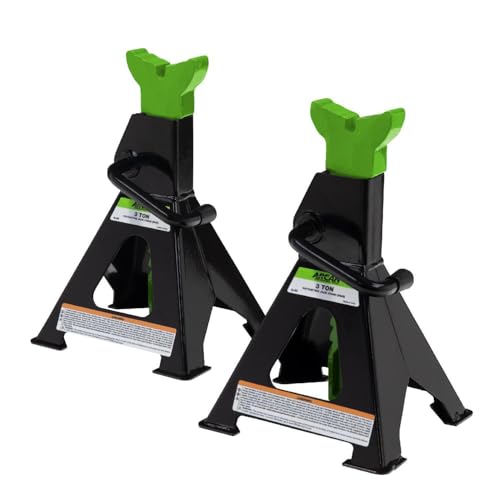
ARCAN builds tools for professional technicians and serious home mechanics who expect their equipment to behave with precision under real working conditions, and the ALJS3 ratcheting jack stands reflect that engineering philosophy throughout their construction and mechanical design. The counterweighted pawl locking mechanism is the defining feature of this product — rather than relying on a standard spring-loaded pawl that can lose tension over time, ARCAN's counterweighted design uses gravity to maintain positive engagement with the ratchet bar, which means the pawl locks more securely as load increases rather than just maintaining a static spring force. This approach produces stands that feel genuinely locked in place rather than held by spring tension, and it allows for tool-free height adjustments with a smooth, consistent action that does not vary based on stand orientation or temperature.
The height range of 11.62 inches to 17.5 inches is slightly more generous than the Torin at the upper end, which gives you meaningful additional working clearance when servicing vehicles with taller ride heights or lifted suspensions within the 3-ton class. The 3-ton (6,000 lb) combined capacity is consistent with the other passenger-vehicle-class stands in this review, and the ARCAN handles that load with appropriate rigidity and zero observable flex in the stand body or base. These are notably well-suited to the mechanic who rotates frequently between different vehicles at different heights, because the adjustment action is fast and the locking engagement is reliable enough that you do not feel compelled to double-check it repeatedly during a work session — a quality-of-life advantage that compounds over the course of a busy afternoon in the garage.
The price point sits above the Torin and Pro-Lift but below the premium commercial-grade options, and you are paying primarily for the counterweighted pawl mechanism and ARCAN's professional brand reliability. The trade-off is that the counterweighted design adds a small amount of mechanical complexity compared to a simple pin-and-ratchet system, meaning there are marginally more components that could theoretically wear over many years of use, though ARCAN's build quality makes this a theoretical rather than practical concern for most buyers.
Pros:
Cons:
GEARWRENCH occupies a respected position in the professional tool market, and the GWJS12T brings that professional pedigree to a capacity category that is genuinely underserved by ratcheting-style jack stands: 12 tons per pair, combining substantial load capability with the height-adjustment convenience that pin-type stands at this capacity level typically sacrifice. Most heavy-duty stands at 10 tons and above use pin-type columns precisely because ratchet mechanisms at extreme loads are difficult to engineer reliably, but GEARWRENCH has addressed this with a ductile iron ratcheting bar that is specifically chosen for its strength and resistance to the cyclic stress that ratchet stands experience during repeated use. The result is a stand that serves as a genuine bridge between the consumer 3-ton ratcheting category and the commercial-grade pin-type heavy-capacity market.
The double lock pin design is a significant safety differentiator in this class — the ratcheting engagement is reinforced by a secondary pin that prevents any downward movement even in the scenario where the ratchet bar is damaged or the pawl mechanism fails to engage properly. Welded feet with a large surface area distribute the load across a wider footprint than many competitors at this capacity level, which reduces the risk of stand sinkage or tipping on softer garage floor surfaces and provides meaningful stability when working at height. These stands are the right choice for the enthusiast who regularly services 3/4-ton and 1-ton pickup trucks, large SUVs, and work vans, where 3-ton stands are clearly inadequate but the Sunex 1410's dimensions and weight are impractical for a home garage setting.
The GEARWRENCH stands represent a premium investment that is justified when your typical work involves consistently heavy vehicles, and the combination of ratcheting convenience with high capacity and double-lock security is genuinely difficult to replicate at a lower price point. If you also use penetrating oil on stubborn fasteners during your service work — which at this vehicle weight class is nearly inevitable — our penetrating oil guide covers the best options for breaking loose corroded hardware on heavy-duty platforms without damaging threads.
Pros:
Cons:
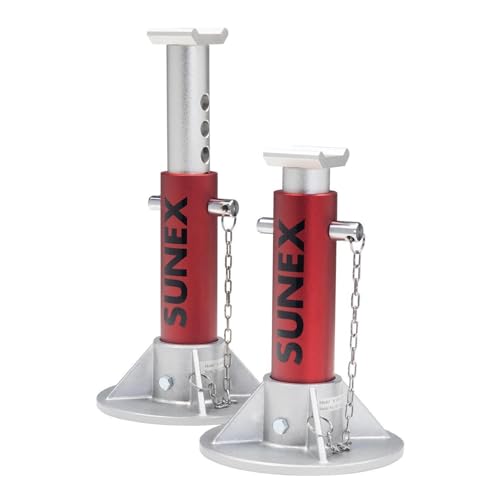
Weight is a real consideration when you are regularly transporting jack stands to track events, autocross days, or remote job sites, and the SUNEX 1003AJ addresses that constraint directly by using aluminum construction to achieve a total pair weight of under 10 pounds — a figure that is roughly half the weight of equivalent steel stands and makes a genuine practical difference when loading and unloading a service vehicle or track day kit repeatedly. The 3-ton capacity is identical to the steel competitors at this tier, and the heavy-duty flanged base is specifically engineered to maintain the structural integrity that aluminum construction can theoretically compromise if not designed correctly — Sunex has reinforced the base geometry to ensure that the load is distributed safely rather than concentrated at stress points that aluminum handles less gracefully than steel.
The six locking positions provide meaningful height adjustment flexibility for a pin-type mechanism, allowing you to accommodate a reasonable range of vehicle lift points and pinch weld heights without the infinite adjustment of a ratcheting system but with greater mechanical simplicity and lower maintenance requirements over years of use. The locking positions are positive and clear, with no ambiguity about whether the pin is fully seated — an important characteristic given that aluminum stands sometimes receive skepticism from mechanics accustomed to steel construction, and Sunex has clearly been deliberate about ensuring the locking mechanism builds rather than erodes confidence. These stands are the right choice when you need certified 3-ton capacity in a package that travels well and stores efficiently in tight spaces.
The limitation of six discrete height positions versus the continuous adjustment of a ratcheting stand is worth acknowledging, particularly if your vehicles have lift point heights that fall inconveniently between the available settings. Aluminum also carries a higher price premium over steel at equivalent capacity, meaning you pay for the weight savings — a trade-off that makes clear sense for mobile use cases but is less compelling for a fixed garage setup where weight is never a concern.
Pros:
Cons:
The Amazon Basics jack stands occupy the entry point of this category, and for buyers who perform infrequent DIY maintenance on a single passenger vehicle, these stands deliver 3-ton capacity with ASME PASE-2014 compliance at a price that is difficult to argue against. The ASME PASE-2014 standard is the relevant safety specification for portable automotive service equipment in the United States, and compliance with this standard means the Amazon Basics stands meet the minimum engineering and testing requirements for rated-capacity use — a baseline that gives you concrete assurance rather than just a manufacturer's marketing claim. The self-locking ratchet eliminates the need for a separate locking key, which simplifies the setup process and reduces the number of small components that can be lost during storage or transport.
The adjustable height mechanism functions exactly as you would expect for a straightforward consumer-grade ratcheting jack stand, with smooth upward movement and positive downward locking once the ratchet engages at your selected height. Amazon has kept the design clean and functional rather than adding complexity, which works in the product's favor for a first-time buyer who wants a reliable pair of stands without navigating counterweighted pawl mechanisms or pin-type columns. The black and red color scheme is a cosmetic choice, but the steel construction meets the practical demands of supporting 6,000 pounds across the pair for the duration of an oil change, brake service, or suspension inspection without any concerning flex or settlement.
Where the Amazon Basics stands trail the Torin and Pro-Lift is in the absence of a secondary locking mechanism — these are single-lock ratchet stands, and while ASME compliance means the ratchet is engineered to hold the rated load, you do not have the additional security of a locking pin or counterweighted pawl that reinforces the primary mechanism. For a mechanic doing occasional brake jobs on a single sedan, that trade-off is entirely reasonable given the price difference. For anyone working more frequently, on heavier vehicles, or in a professional context, the investment in a double-lock or counterweighted design like the Torin or ARCAN is genuinely worthwhile.
Pros:
Cons:

Choosing the right pair of jack stands requires you to think through four fundamental criteria: weight capacity matched to your heaviest vehicle, height range appropriate for your workspace and lift points, locking mechanism design suited to how frequently you work, and material construction that aligns with your portability needs and budget. Getting these four decisions right means you will use your stands with confidence every time — getting them wrong creates either a safety liability or a tool you quickly outgrow.
The most common mistake buyers make is purchasing jack stands rated for their smallest car while ignoring the heavier vehicles in their household. The general rule is that each individual jack stand should support at least half the weight of the heaviest end of your heaviest vehicle, with a meaningful safety margin on top of that calculation. A full-size pickup truck with a GVWR above 7,000 pounds requires stands that exceed the 3-ton pair rating — you need 3-ton minimum per stand, not per pair, when working under a loaded or stock heavy-duty platform. Always consult your vehicle's owner manual for gross vehicle weight and confirm that your selected stands are rated appropriately, noting whether the manufacturer's listed capacity is per stand or per pair, since product listings sometimes emphasize the combined figure in the headline.
The height range of the stands you choose must overlap with the actual lift point height of your vehicle once it is raised on a floor jack to a safe working position, and this is a specification that deserves more attention than most buyers give it. A stand with a maximum height of 16 inches may not reach the pinch weld of a lifted truck or a tall SUV that has been raised high enough to allow comfortable work underneath, while a stand with a minimum height of 28 inches is completely impractical for a lowered sedan sitting 14 inches off the floor. Ratcheting mechanisms offer continuous height adjustment within their range, which is convenient for vehicles with lift points that fall between the fixed positions of pin-type stands, but pin-type designs are generally more robust at higher capacities and require less maintenance over time. Choose the mechanism that aligns with both your vehicles' requirements and your working preferences.
The distinction between single-lock ratchet stands and double-lock designs with a secondary safety pin is not a marketing distinction — it is an engineering safety margin that matters when you are working underneath a vehicle for an extended period. Single-lock stands meet applicable safety standards and are appropriate for supervised, time-limited use on the appropriate vehicle class, but double-lock designs provide an additional layer of protection against the failure mode where ratchet teeth are worn, damaged, or improperly engaged. The ARCAN counterweighted pawl represents a third approach that uses mechanical advantage rather than a redundant pin, and it is equally valid as a secondary security mechanism. If you regularly perform work that keeps you under a vehicle for more than a few minutes, the investment in a double-lock or mechanically reinforced design is non-negotiable — your safety is not the place to optimize for the lowest price.
Steel remains the dominant material for jack stands because it combines high tensile strength with relatively low cost, and for fixed-garage use cases there is no practical advantage to paying the aluminum premium — steel stands at the same capacity rating are heavier, yes, but that weight is irrelevant when the stands live on a shelf between uses. Aluminum makes sense for track day mechanics, mobile technicians, or anyone who transports stands frequently in a vehicle, where the weight savings translate to real ergonomic benefit over repeated loading cycles. Regardless of material, the key quality indicators to inspect are the ratchet bar material (cast ductile iron is preferable to standard cast iron), the weld quality at the base and stand body joints, and the surface finish of the ratchet teeth, which should be uniform and sharp rather than rough or inconsistently machined. A stand that wobbles or flexes during the unloaded height adjustment process is providing an early warning of inadequate construction — trust that signal and choose a different product.
You need stands rated to support at least half the weight of the heaviest end of your heaviest vehicle, with a meaningful safety buffer above that. For most passenger cars and crossovers, a 3-ton pair (6,000 lb combined) is sufficient — but if you regularly work on full-size pickup trucks, large SUVs, or commercial vehicles, you need per-stand capacity of 3 tons or higher, and products like the GEARWRENCH 12-ton pair or Sunex 1410 become appropriate. Always check whether the listed capacity is per stand or per pair before purchasing.
Never use a single jack stand to support a vehicle for any service work. Jack stands are designed to be used in pairs to distribute the vehicle's weight across two contact points and maintain stable, balanced support. Using only one stand creates an inherently unstable configuration that can tip or shift when weight transfers during the work, which is a primary cause of jack stand-related injuries. Always use a minimum of two stands, placed at the manufacturer-specified lift points on the vehicle's frame or pinch welds.
Ratchet-type stands use a toothed bar that clicks into progressively higher positions as you raise the stand, with a pawl mechanism locking the bar in place — they offer continuous, stepless adjustment within their range and are the most common design for consumer and professional 3-ton stands. Pin-type stands use a cylindrical column with holes at fixed intervals, held in place by a cross-pin — they are simpler mechanically, require less maintenance, and are generally preferred at higher capacities like the Sunex 1410's 10-ton rating where ratchet mechanisms become more difficult to engineer reliably. For most home garage buyers, ratchet-type is the practical choice; for heavy-duty professional work, pin-type is the proven design.
Your vehicle's owner manual specifies the designated jack points along the frame, subframe, or reinforced pinch welds that are engineered to bear the vehicle's weight safely — use only these points, never place a stand under the oil pan, differential, exhaust, or plastic underbody panels. The saddle of the stand should make full, flat contact with the lift point, not a point contact on an edge or bolt head. Once placed, rock the vehicle gently from side to side with your hands before going under it — if the stands shift or the vehicle feels unstable, reposition before proceeding. This visual and physical check takes ten seconds and should be standard procedure every single time.
Yes — a properly engineered aluminum jack stand rated to 3 tons per pair carries the same load as a properly engineered steel stand with the same rating, and products like the Sunex 1003AJ are designed with reinforced flanged bases specifically to compensate for aluminum's lower inherent stiffness compared to steel. The rated capacity is the governing specification, not the material. That said, you should inspect aluminum stands more regularly for hairline cracks or surface damage than steel equivalents, because aluminum can fail more suddenly under fatigue loading than steel, which tends to deform visibly before fracturing. Any visible cracks, deformation, or deep gouges in an aluminum stand are immediate grounds for replacement.
Inspect your jack stands before every use for visible deformation of the stand body or base, worn or chipped ratchet teeth, corrosion at weld points, and any bending or cracking in the support column — a stand that shows any of these signs should be replaced immediately and not used in its compromised condition. There is no fixed calendar interval for replacement, but most manufacturers recommend retirement after any event where the stand was overloaded or dropped from height, and general practice in professional shops is to evaluate tools annually for wear and replace as needed. Do not repair damaged jack stands — the repair cost in materials and labor is not justified against the risk, and the integrity of the original engineered structure cannot be reliably restored through field repairs.
The right pair of jack stands is determined entirely by the vehicles you work on and how often you work on them — start by confirming the weight capacity you need, then match the height range to your floor jack and vehicle lift points, and you will find one of the seven options reviewed here lands squarely on the specification intersection you require. Take the time to get this decision right in 2026, because the stands you choose today will be under your vehicles for years to come, and the confidence that comes from knowing your equipment is genuinely rated for the job is worth every dollar of the investment.
 |
 |
 |
 |

About Liam O'Brien
Liam O'Brien has spent over a decade buying, field-testing, and evaluating automotive tools with a focus on what actually performs in a real DIY garage rather than what markets well on a spec sheet. His hands-on experience spans hand tools, diagnostic equipment, floor jacks, socket sets, and specialty automotive gear across a wide range of brands and price points. At CarCareTotal, he covers automotive tool and equipment reviews, garage setup guides, and buying advice for home mechanics.
Get some FREE car parts & gear.. Or check out the latest free automotive manuals and build guides here.
Disable your ad blocker to unlock all the hidden deals. Hit the button below 🚗
| | | |
