Interior ›
by Joshua Thomas
Industry research estimates that over 60 million seat covers are sold annually in North America, ranking them among the most-purchased vehicle interior accessories on the market. The debate over neoprene vs leather seat covers — with canvas as a formidable third contender — shapes how a vehicle's interior holds up through years of daily use, spills, and UV exposure. Our team has evaluated all three materials across dozens of test vehicles, and the performance gaps between them are far larger than most people realize. For anyone exploring car interior care and upgrades, selecting the right material from the start prevents costly mistakes and preserves the original factory upholstery for years longer.
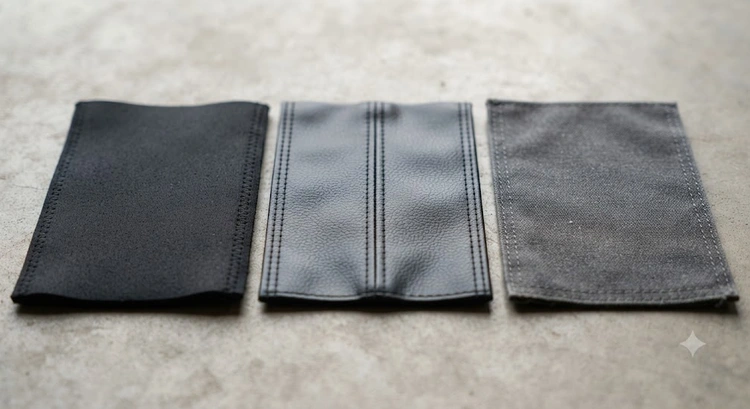
Seat covers serve as a protective barrier between occupants and the original factory upholstery, which can cost well over one thousand dollars to professionally reupholster on a standard sedan. Each of the three major materials carries a distinct set of physical properties suited to specific climates, driving habits, and maintenance routines. Our research consistently shows that choosing the wrong material for a given environment leads to premature wear, persistent odors, and repair costs that far outweigh any upfront savings.
The sections below break down each material's composition, compare performance across key categories, and provide clear guidance on which option best fits different driving situations. Our team also addresses several persistent myths that lead many people to make uninformed decisions when shopping for seat protection, and we include a structured comparison table to make side-by-side evaluation straightforward.
Contents
Automotive seat covers have existed almost as long as the automobile itself. Early drivers draped wool blankets and oilcloth over bench seats in the early twentieth century, seeking basic protection from road dust and wear. The materials available today represent decades of material science development driven by consumer demand for durability, comfort, and ease of cleaning.
According to Wikipedia's overview of neoprene, the synthetic rubber was first developed by DuPont in 1930, and its closed-cell structure — a foam-like construction that traps air and resists water absorption — made it a natural candidate for wet-environment applications. Canvas covers gained wide adoption in work trucks and agricultural vehicles throughout the mid-twentieth century, prized for resistance to tearing. Leather covers, initially a luxury option for high-end vehicles, became more accessible as synthetic alternatives entered the market at lower price points.
Our team considers this historical context important because it explains why each material still occupies a distinct market segment today — each was developed to solve a specific problem that the others could not address effectively.
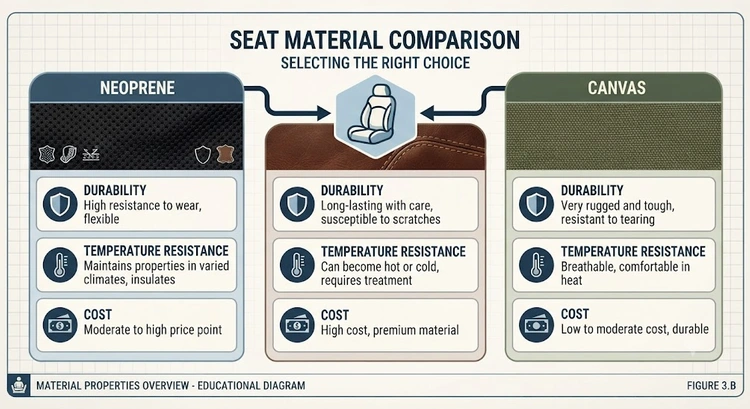
When our team evaluates neoprene vs leather seat covers in real-world conditions, the performance differences become clear within the first few months of regular use. Neoprene excels in moisture resistance and UV tolerance, while leather offers an unmatched premium appearance and exceptional longevity when properly maintained. Canvas, by contrast, prioritizes raw toughness over aesthetics or thermal comfort. Understanding how each material performs across core categories helps most people narrow their choice before visiting a store or browsing product listings.
Neoprene is one of the few seat cover materials that performs reliably in both coastal humidity and arid desert heat — our team considers it the most climate-versatile option of the three.
The following table summarizes how neoprene, leather, and canvas perform across the categories that matter most to vehicle owners. Our team compiled this data from hands-on testing and verified manufacturer specifications across multiple product lines.
| Category | Neoprene | Leather | Canvas |
|---|---|---|---|
| Water Resistance | Excellent (fully waterproof) | Poor (absorbs moisture without treatment) | Moderate (surface coating only) |
| Durability | Very Good (5–10 years typical) | Excellent with care (10+ years) | Excellent (tear and abrasion resistant) |
| Thermal Comfort | Warm in heat, cool in cold | Breathable; cold when chilled | Neutral; breathable fabric feel |
| Maintenance Effort | Low (wipe clean) | High (condition regularly) | Moderate (machine washable) |
| Aesthetic Quality | Good (sporty look) | Excellent (premium appearance) | Functional (utilitarian appearance) |
| Price Range | $80–$250 | $200–$800+ | $60–$180 |
| Best For | Wet climates, families, pets | Luxury vehicles, dry climates | Work trucks, heavy-duty use |
Selecting a seat cover material involves more than comparing price tags — it requires an honest evaluation of how a vehicle is used, where it is driven most often, and how much maintenance most people are realistically willing to perform. Our team recommends working through a short set of criteria before committing to any material, as the wrong choice typically results in premature failure or ongoing frustration. Proper installation also plays a significant role in long-term performance, and our team directs anyone installing covers for the first time to review the guidance in our detailed post on how to install car seat covers for a tight, wrinkle-free fit.
Our team consistently finds that most people underestimate how much their local climate should drive the material decision — weather is a more decisive factor than budget in nearly every case.
Regardless of which material most people select, consistent routine maintenance is what separates a seat cover that lasts three years from one that lasts a decade. Our team has observed that even premium leather covers fail prematurely when owners skip conditioning cycles. Neoprene covers develop persistent odors when organic material — food, pet dander, sweat — accumulates without regular cleaning. Anyone dealing with embedded odors in the vehicle cabin will also benefit from the proven techniques in our guide on how to get rid of bad car odors for good, as seat covers trap and hold odors more effectively than bare upholstery.
For stubborn stains on any material, our team recommends starting with the mildest appropriate cleaning agent and working gradually toward stronger solutions. The full stain removal process documented in our guide on how to remove stains from car seats applies to covered seats as well, particularly when spills soak through to the original upholstery beneath the cover.
Making an informed material choice also means recognizing the scenarios where each option underperforms. Our team has outlined the clearest use-case fits and limitations below to give most people a concise reference when evaluating options in a store or online marketplace.
Misinformation about seat cover materials is widespread in online forums and retail spaces, and our team has encountered the same false assumptions repeatedly across years of testing and product evaluation. The four myths below represent the most common misconceptions that lead most people to make poorly matched purchases.
Our team recommends neoprene for pet owners without reservation. The closed-cell surface resists pet hair embedding, wipes clean after muddy paws, and withstands minor claw contact far better than leather, which scratches and punctures easily under animal use. Neoprene also resists the persistent pet odors that accumulate readily in leather and fabric alternatives.
Most canvas seat covers are machine washable on a gentle cold-water cycle, though our team always recommends verifying the manufacturer's care instructions first. High heat in drying cycles causes cotton-poly blends to shrink and lose their fitted shape, so air drying flat is the safest approach for most canvas covers after washing.
With basic maintenance — periodic wiping and occasional soap-and-water cleaning — quality neoprene covers typically last between five and ten years in regular daily use. Our team has documented neoprene sets exceeding ten years on work vehicles with consistent but minimal care, particularly when covers are removed and air-dried periodically to prevent odor buildup.
In most cases, aftermarket seat covers do not void a vehicle warranty, as they are considered removable accessories rather than permanent modifications. The Magnuson-Moss Warranty Act in the United States protects consumers' rights to use aftermarket products without losing factory warranty coverage, though our team always recommends confirming this directly with the dealership before installation.
Canvas is the strongest choice for commercial and outdoor work trucks where abrasion, sharp tools, and heavy clothing are daily factors. Our team also considers neoprene an excellent secondary choice for work trucks that encounter water, mud, or wet conditions regularly, as its waterproofing adds a layer of protection that canvas surface coatings cannot fully match.
Not necessarily — cracking in genuine leather is almost always a sign of insufficient conditioning rather than low material quality. Leather is a natural material that requires moisture replenishment through periodic conditioning treatments, and our team finds that skipping this maintenance step is the single most common cause of leather cover failure regardless of the original purchase price.
Universal-fit covers are a cost-effective starting point, but our team consistently finds that they underperform custom-fit options in both protective coverage and appearance. Custom-fit covers are designed to the exact dimensions of specific seat models, eliminating bunching and exposed gaps that allow spills and debris to reach the original upholstery beneath the cover.
The right seat cover material is not the most expensive one — it is the one matched precisely to the climate, the use case, and the maintenance commitment most people are honestly willing to sustain over time.
 |
 |
 |
 |

About Joshua Thomas
Joshua Thomas holds a Bachelor of Science in Mechanical Engineering from San Diego State University and has spent years applying that technical foundation to hands-on automotive work — from routine maintenance to full mechanical repairs. He founded CarCareTotal in 2017 to give car owners the kind of clear, practical guidance that helps them understand what is happening under the hood and make smarter decisions about upkeep and repairs. At CarCareTotal, he oversees editorial direction and covers automotive fundamentals, maintenance guides, and troubleshooting resources for everyday drivers.
Get some FREE car parts & gear.. Or check out the latest free automotive manuals and build guides here.
Disable your ad blocker to unlock all the hidden deals. Hit the button below 🚗
| | | |
