by Marcus Chen
What's the better power upgrade — a turbocharger or a supercharger? It's one of the most debated questions in the performance world, and the honest answer is: it depends on what the build actually needs. Both are forced induction systems, both compress air into the engine to increase power output, and both have legitimate places in the performance landscape. But the turbocharger vs supercharger decision comes down to the specific goals of the build, the engine platform, and the budget in play.
Our team has spent years researching, testing, and working alongside performance builds across a wide range of platforms. In this guide, we break down exactly how these two technologies differ, where each one excels, and what realistic costs look like. Anyone shopping for their first forced induction upgrade — or just trying to settle a garage argument — will find a clear answer here.
Contents
Forced induction isn't a modern invention. Superchargers date back to the early 1900s, originally developed for aircraft engines to sustain power at high altitudes. Turbochargers followed shortly after, patented by Swiss engineer Alfred Büchi in 1905. Both technologies spent decades in motorsport and aviation before finding their way into mainstream passenger vehicles.
The core idea behind both is straightforward: a naturally aspirated engine is limited by the volume of air it can draw in on each intake stroke. Forced induction pushes more air into the combustion chamber — allowing more fuel to burn and releasing more energy per cycle. The critical difference is the energy source used to drive the compressor.
That single distinction creates a cascade of differences in power delivery, thermal efficiency, installation complexity, and long-term cost.
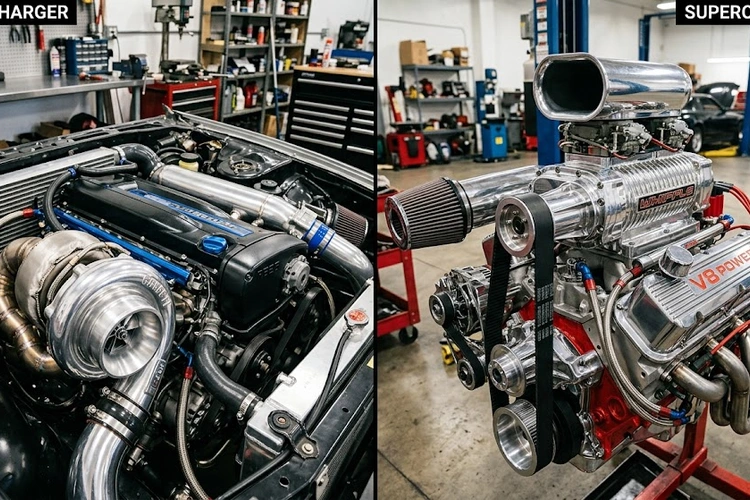
A turbocharger uses a turbine wheel spun by exhaust gases to simultaneously drive a compressor wheel on the intake side. The sequence runs like this:
The lag between throttle input and full boost — universally called "turbo lag" — occurs because exhaust pressure needs a moment to spool the turbine to operating speed. Modern twin-scroll and variable-geometry designs have dramatically reduced this characteristic on late-model applications.
A supercharger skips the exhaust entirely and runs off mechanical drive. The sequence is simpler:
The trade-off is parasitic drag — the supercharger consumes engine power to operate, typically absorbing 15–25% of the power it produces net. Anyone dealing with a car losing power when accelerating on a blower setup should inspect the drive belt and tensioner before chasing other causes.
A side-by-side comparison makes the key differences easier to evaluate quickly.
| Category | Turbocharger | Supercharger |
|---|---|---|
| Power source | Exhaust gases (recycled energy) | Crankshaft belt (parasitic draw) |
| Boost delivery | Builds with RPM, some lag | Instant, linear from idle |
| Thermal efficiency | Higher — recycles waste heat energy | Lower — engine drives compressor directly |
| Peak power potential | Very high (twin-turbo setups stack well) | High (limited by mechanical drive ratio) |
| Installation complexity | High — plumbing, intercooler, oil feed/return | Moderate — bolt-on kits widely available |
| Heat generated | High (positioned near exhaust manifold) | Moderate (roots-type runs hottest) |
| Tuning complexity | Higher — wastegate, boost controller, map | Lower — pulley swap adjusts boost level |
| Typical power gain over stock | 30–100%+ | 25–50% |
| Best use case | High-output builds, fuel efficiency focus | Daily drivers, street torque builds |
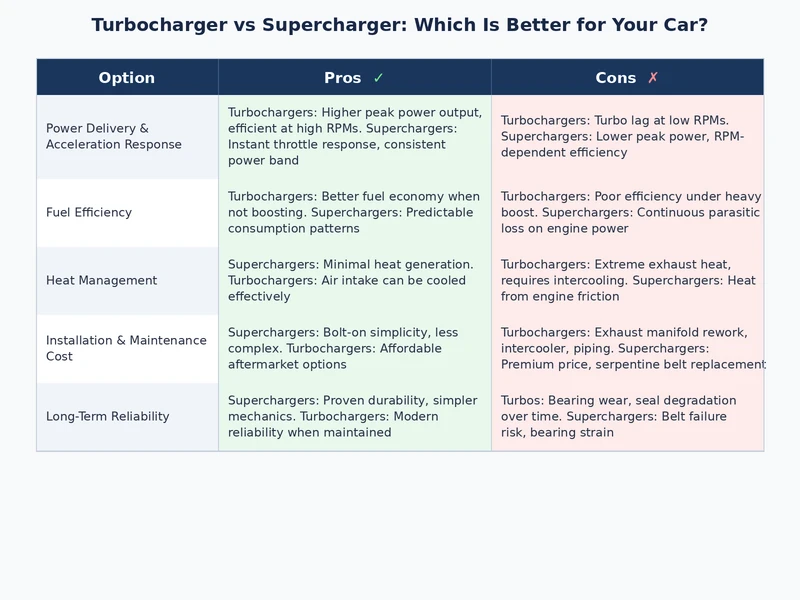
Strengths:
Weaknesses:
Strengths:
Weaknesses:
Our team consistently finds that the supercharger drive belt is the first component to inspect on high-mileage blower cars — a slipping or glazed belt under boost will kill power output before any internal component fails.
Production vehicles and well-known aftermarket builds tell the clearest story about where each technology fits.
Turbocharger applications:
Supercharger applications:
A clear pattern emerges: American muscle historically favors superchargers for their instant torque and linear feel, while import and efficiency-focused applications lean on turbos. Neither technology is universally superior — the application determines the fit.
Turbos operate in the harshest thermal environment on the engine. Our team recommends these non-negotiable practices:
Budget shapes the forced induction decision as much as any technical factor. Here's how the numbers realistically shake out for a street or light performance build:
Aftermarket turbocharger kit:
Aftermarket supercharger kit:
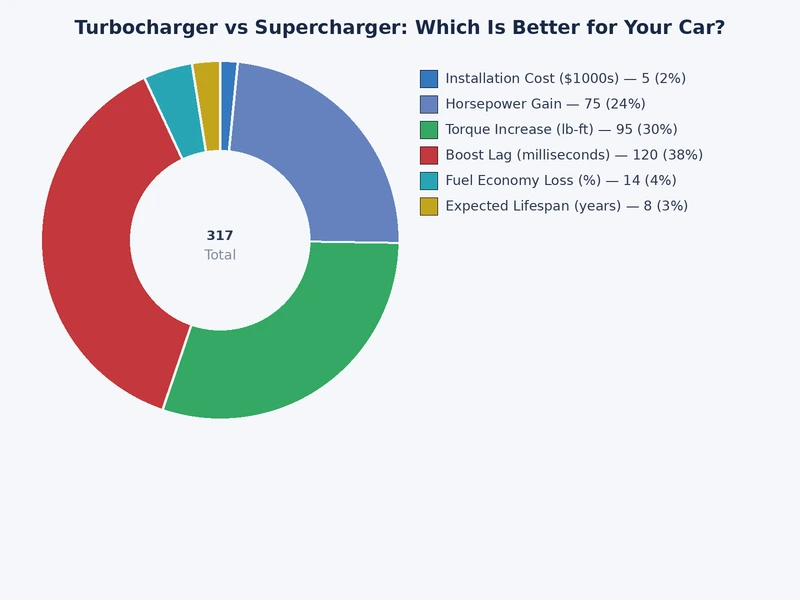
On a per-horsepower-gained basis, turbocharged setups consistently deliver more power per dollar at higher output levels. Supercharger kits win on simplicity and faster install time for moderate street builds. Both require a proper ECU tune — skipping the tune with either system is a reliable path to a flashing check engine light and potential engine damage.
Long-term maintenance costs differ as well. Turbos demand closer attention to oil quality and cooling, while superchargers require periodic belt replacement and internal fluid service. Neither carries dramatically higher ownership costs when properly maintained — but neglect is significantly more expensive on turbocharged setups due to the heat and oil dependency at the cartridge bearings.
For home builders tackling the install themselves, proper lift access is worth planning ahead — comparing a 2-post vs 4-post lift before committing to a full underhood build saves time and frustration. And anyone considering forced induction on a high-mileage engine should review low compression engine causes first — boost amplifies any existing cylinder sealing weakness and turns a manageable problem into an expensive rebuild.
For most daily drivers, a supercharger delivers more consistent low-RPM response and simpler overall maintenance. Modern turbocharged setups have improved dramatically through variable-geometry technology, but superchargers remain the more predictable and immediately responsive choice for stop-and-go city use.
Turbocharged setups carry a higher absolute power ceiling. Because they recycle exhaust energy rather than drawing mechanically from the crankshaft, larger or twin-turbo configurations can push significantly more boost than a belt-driven supercharger on the same engine displacement.
Both systems reliably exceed 100,000 miles with proper maintenance. Turbos are more sensitive to oil quality and heat management, while superchargers are more vulnerable to belt wear and internal rotor fluid neglect. Our team considers them roughly equal in real-world longevity when serviced correctly.
Yes — this is called a twin-charged setup. Volkswagen's 1.4 TSI used both systems in series from the factory for several years. The combination eliminates lag while maximizing peak output, but the complexity and cost are substantially higher than either system alone.
Supercharger bolt-on kits are generally simpler to install, particularly on popular platforms like LS-based engines or pushrod V8 Mustangs. Turbo builds require custom exhaust fabrication, intercooler plumbing, and oil feed and return lines, which adds significant labor time and fitment complexity.
A properly installed and tuned forced induction system adds stress but does not inherently shorten engine life. Problems arise from inadequate tuning, low-quality components, or skipped maintenance intervals. Many well-built turbocharged engines outlast their naturally aspirated counterparts in durability.
Both systems typically require higher-octane fuel than the stock naturally aspirated baseline. Most street builds running 6–8 psi of boost operate safely on 91–93 octane pump gasoline. Higher boost levels generally require premium fuel or ethanol blends like E85 to prevent detonation under load.
Modern production turbocharged engines have largely eliminated noticeable lag through twin-scroll housings, electric wastegates, and variable-geometry turbine technology. Factory turbocharged vehicles from mainstream manufacturers today deliver throttle response that matches or exceeds carbureted naturally aspirated engines from a generation prior.
The best forced induction system is the one matched to the build — not the one with the most hype on the forums.
 |
 |
 |
 |

About Marcus Chen
Marcus Chen is a performance and tuning specialist with 12+ years of hands-on experience modifying everything from daily drivers to track cars. He specializes in suspension setup, wheel-and-tire fitment, and squeezing every drop of performance from stock platforms without sacrificing reliability.
Get some FREE car parts & gear.. Or check out the latest free automotive manuals and build guides here.
Disable your ad blocker to unlock all the hidden deals. Hit the button below 🚗
| | | |
