by Sarah Whitfield
A driver merges onto the highway, presses the accelerator, and hears it — a rapid, rhythmic ticking from under the hood. At idle the car seemed fine. Under load, the sound returns every time. That scenario plays out in repair bays every day. A ticking noise in engine when accelerating is one of the most frequently reported symptoms in automotive diagnostics — and one of the most misread. The causes range from a simple oil level drop to a failing valve train. Identifying the correct cause early is the difference between a $15 fix and a $3,000 rebuild.
Drivers experiencing related vibration symptoms may want to review 8 Reasons Car Shakes When Idle & How to Fix in 4 Steps for context on overlapping issues. The CarCareTotal troubleshooting section also covers dozens of engine symptom guides organized by symptom type.

Contents
Ticking intensifies under acceleration because higher RPMs amplify small mechanical clearances. A loose component that holds together at idle will announce itself the moment the throttle opens. Below are the eight most documented causes.
Oil is the primary buffer between moving metal parts in the valve train. When levels drop — or when pressure falls below specification — components like rocker arms and camshaft lobes make contact without adequate lubrication. The result is a rapid, metallic tick that grows louder with acceleration.
Hydraulic valve lifters maintain valve clearance using oil pressure. When they wear out or collapse, the valve clearance opens up and creates a rhythmic tap that matches engine RPM.
A cracked exhaust manifold or failed gasket releases combustion gases before they reach the muffler. The escaping gas produces a sharp, metallic tick — particularly noticeable during cold starts and hard acceleration.
A spark plug that is loose, cross-threaded, or has a cracked ceramic insulator allows combustion pressure to escape the cylinder. This produces a ticking or hissing sound synchronized with the ignition cycle.

The timing chain synchronizes the crankshaft and camshaft. As it stretches over time, slack develops. Under acceleration, the chain slaps against its guide. The sound is a low, rattling tick originating from the front of the engine.
In overhead-valve (OHV) engines, pushrods transfer motion from the camshaft to the rocker arms. A bent or worn pushrod disrupts this motion and creates an irregular tapping noise.
When the clearance between a piston and cylinder wall increases due to wear, the piston rocks laterally during the power stroke. This is called piston slap. The sound is a hollow, repetitive knock that can resemble ticking at higher RPMs.
Fuel injectors operate at high frequency and do produce some sound during normal operation. A failing or partially clogged injector, however, can produce a louder, more erratic tick under load.
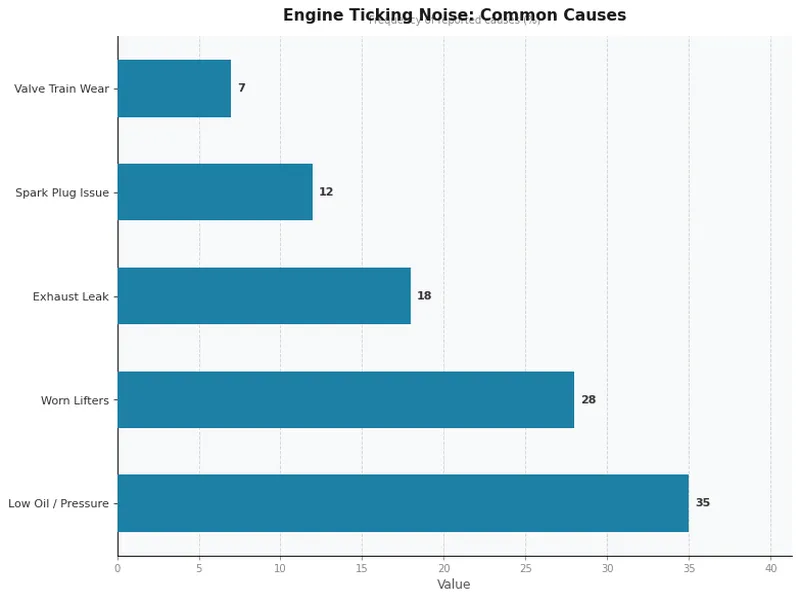
Narrowing down the cause before visiting a shop saves both time and diagnostic fees. The character of the sound and the conditions under which it appears are the primary diagnostic tools.
| Sound Character | When It Occurs | Most Likely Cause |
|---|---|---|
| Rapid metallic tick | Accelerating, RPM-dependent | Low oil, worn lifters |
| Sharp tick on cold start only | First 2–3 minutes of operation | Exhaust manifold leak |
| Low rattle from engine front | Cold start, acceleration | Timing chain wear |
| High-pitched, uniform tick | Any RPM, consistent | Fuel injector noise |
| Hollow knock or slap | Cold engine, under load | Piston slap |
| Single-cylinder tick with misfire | Idle and acceleration | Loose or damaged spark plug |
A systematic approach prevents misdiagnosis before parts are purchased.
Drivers who notice additional noise symptoms while driving may find Humming Noise While Driving: 8 Causes & How to Diagnose helpful for distinguishing tick from hum.
Not every tick requires a shop visit. Several of the most common causes have low-cost, accessible solutions that most drivers can perform themselves.
Using the wrong oil viscosity in a high-mileage engine accelerates valve train wear — always verify the manufacturer's specification before topping off.
Spark plug replacement is one of the most cost-effective maintenance tasks available — and one of the most commonly deferred.

Repair costs vary widely depending on the cause, the vehicle make and model, and regional labor rates. The table below represents average U.S. market estimates.
| Cause | DIY Parts Cost | Shop Labor | Total Estimate | Urgency Level |
|---|---|---|---|---|
| Low engine oil top-off | $8–$15 | N/A | $8–$15 | Immediate |
| Spark plug replacement | $20–$60 | $50–$150 | $70–$210 | Soon |
| Exhaust manifold gasket | $30–$80 | $200–$400 | $230–$480 | Within weeks |
| Fuel injector service | $50–$150 | $150–$400 | $200–$550 | Moderate |
| Valve lifter replacement | $100–$250 | $500–$1,200 | $600–$1,450 | High |
| Timing chain replacement | $150–$400 | $600–$1,500 | $750–$1,900 | Urgent |
| Piston/cylinder overhaul | N/A | $1,500–$4,500+ | $1,500–$4,500+ | Critical |
The majority of ticking noise cases fall into this category. Low oil, spark plugs, and exhaust manifold gaskets account for a substantial share of reported causes.
Valve train, timing chain, and internal engine repairs represent significant expenditures. Standard practice is to obtain a second quote before authorizing any repair exceeding $500.
Consistent preventive maintenance is the most reliable defense against engine ticking. Most causes trace back to deferred service or incorrect fluid specification.
Oil degradation is the single most common precursor to valve train noise. Sludge accumulation restricts oil flow to the upper valve train and starves lifters of pressure.
Drivers noticing unusual oil characteristics alongside ticking should review 7 Reasons Your Oil Smells Like Gas & How to Prevent — fuel contamination thins oil and accelerates valve train wear.
Structured inspection catches mechanical issues before they produce noise or damage.
It depends on the cause. Low engine oil is immediately dangerous and warrants stopping the engine before further diagnosis. Exhaust manifold leaks and injector noise are less urgent but should be addressed within a few weeks. Timing chain noise is urgent — it can escalate to engine failure without warning.
Short-distance driving is generally acceptable while diagnosing the cause, with one exception: if oil is confirmed low, driving should stop immediately. Continued operation with low oil or a confirmed timing chain rattle risks severe internal engine damage that may not be repairable.
Acceleration increases engine load and RPM, which amplifies small mechanical clearances. Loose spark plugs, sticky valve lifters, and exhaust leaks that hold together at idle will announce themselves the moment the throttle is pressed. Higher oil pump demand under load also exposes borderline oil pressure conditions.
Repair costs range from $8 for an oil top-off to over $4,500 for internal engine work. The most common causes — low oil, spark plugs, and exhaust manifold gaskets — fall under $500. The repair cost table in this article provides cause-by-cause estimates for budgeting purposes.
Yes. Oil lubricates rocker arms, camshaft lobes, and valve lifters. When the level drops, metal-to-metal contact in the valve train produces a rapid metallic tick. This is the first symptom to check regardless of other suspected causes — it takes under two minutes to verify with a dipstick.
Not necessarily. Many causes — low oil, loose spark plugs, exhaust manifold leaks — are fully repaired without lasting engine damage when addressed promptly. Ticking that is ignored for extended periods, however, allows secondary wear to accumulate. Early diagnosis is the factor that most determines whether the repair is minor or major.
A tick ignored today has a way of becoming an engine replaced tomorrow.
 |
 |
 |
 |

About Sarah Whitfield
Sarah Whitfield spent ten years as an ASE-certified automotive technician before transitioning to full-time automotive writing, giving her a diagnostic skillset that goes well beyond what most reviewers bring to the subject. She specializes in OBD-II code analysis, electrical system troubleshooting, and the intermittent failure modes that frustrate owners and confound general mechanics. At CarCareTotal, she covers car troubleshooting guides, diagnostic tools, and repair resources for drivers dealing with warning lights, strange symptoms, and hard-to-diagnose problems.
Get some FREE car parts & gear.. Or check out the latest free automotive manuals and build guides here.
Disable your ad blocker to unlock all the hidden deals. Hit the button below 🚗
| | | |
