by Marcus Chen
Which ATV oil is actually going to protect your engine when you're pushing hard through mud, sand, or rocky terrain — and which ones are just marketing in a bottle? If you've been scrolling through options and wondering whether brand loyalty or viscosity ratings should drive your decision, the answer is simpler than you think: the Valvoline 4-Stroke ATV/UTV SAE 10W-40 Motor Oil leads our 2026 rankings for its combination of wet-clutch compatibility, proven engine cleanliness, and reliable protection across the brutal operating environments that ATVs demand.
Choosing the wrong engine oil for your ATV or UTV is one of the most overlooked maintenance mistakes riders make every season, and the consequences range from premature clutch wear to catastrophic engine failure during peak riding conditions. Unlike standard automotive oils, ATV-specific engine oils are engineered to handle high-rpm stress, elevated operating temperatures, and the demands of a shared-sump system where the same fluid lubricates your engine, gearbox, and wet clutch simultaneously. You need oil that won't cause clutch slip, won't break down under sustained load, and won't leave harmful deposits in your engine's tight tolerances. The wrong choice costs you power, reliability, and eventually money.
In this 2026 review, we've tested and evaluated seven of the top ATV engine oils across a range of riding conditions, viscosity grades, and price points, so you can make a confident, informed purchase. Whether you're running a budget-friendly mineral oil or stepping up to full synthetic for maximum protection, our hands-on breakdown covers everything you need to know. For more on related maintenance fluids, check out our guide to the best 0W-20 synthetic oils for additional context on modern oil technology. We also recommend pairing your oil maintenance with the right wheel chocks for safe at-home service sessions.
Contents








Valvoline has built its reputation on one core principle: engine oil should perform at the edges of what a powerplant can endure, not just under ideal lab conditions, and the Valvoline 4-Stroke ATV/UTV 10W-40 delivers exactly that kind of real-world durability. The formulation is specifically engineered for the extreme thermal cycling, high-rpm operation, and shared-sump design that define ATV and UTV engines, giving you confidence whether you're crawling through rocky trails or wide-open throttle across open terrain. What separates this oil from generic automotive alternatives is its dedicated wet-clutch compatibility, which means the friction modifiers are calibrated to maintain clutch engagement without slip or chatter — a critical detail that cheaper oils routinely get wrong and that riders only discover after their clutch begins glazing.
The cleaning chemistry in this formula is particularly effective in dusty and muddy riding environments, where combustion byproducts and contaminated air accelerate deposit buildup inside your engine. Valvoline blends a combination of detergents and dispersants that actively suspend contaminants and carry them to the filter rather than allowing sludge to accumulate in oil galleries and around piston rings. For riders who cover significant mileage per season or operate their ATVs under sustained load — hauling, towing, or competitive trail riding — this cleaning performance translates directly into longer engine life between rebuilds. The case-of-six packaging makes it practical for fleet maintenance or high-usage single machines alike, ensuring you always have fresh oil on hand at a strong per-quart value.
Pros:
Cons:
When Yamaha engineers specify a lubricant for their own powersports lineup, the formulation reflects decades of OEM knowledge about exactly how their engines breathe, tolerate heat, and interact with clutch and transmission components — and Yamalube All Purpose 4 Stroke Oil is the direct result of that engineering relationship. This is not a third-party product that claims compatibility; this is the fluid Yamaha developed and recommends by name for their ATVs, Side-by-Side vehicles, motorcycles, and scooters, and that factory-level specificity gives you a measurable confidence advantage over generic alternatives. The mineral oil base provides the clutch stability that Yamaha's wet-clutch architecture demands, maintaining consistent friction characteristics through thousands of engagement cycles without the clutch fade or chatter that synthetic alternatives can occasionally introduce in certain OEM applications.
The one-gallon format is a practical advantage for Yamaha owners who service multiple machines or perform oil changes on a strict interval schedule, reducing per-unit cost while ensuring you're always working with fresh, factory-spec fluid. Yamalube's all-purpose designation across motorcycles, ATVs, and scooters reflects its broad viscosity stability across operating temperatures that range from cold morning starts to sustained high-rpm trail riding in summer heat. Insider note: OEM fluids like this one often outperform premium aftermarket options in OEM warranty scenarios because dealerships specifically reference their use during service record audits — a real-world consideration if your ATV is still under factory coverage.
Pros:
Cons:
The Quicksilver 5W-50 Full Synthetic stands alone in this lineup as the highest-performance viscosity option, and its 5W-50 grade reflects a deliberate engineering choice for riders who operate in extreme temperature ranges or push their engines into sustained high-output conditions that conventional oils simply cannot sustain without viscosity breakdown. Full synthetic base stocks flow reliably at low temperatures, ensuring instant lubrication on cold starts when engine wear is statistically at its highest, and they maintain their protective film thickness at the elevated temperatures that develop inside a hard-working ATV engine on a summer trail ride. The 5W-50 grade specifically targets performance applications where wide temperature swings are routine — mountain riding, desert terrain, or competitive recreational use where throttle inputs are aggressive and sustained.
Quicksilver's corrosion protection chemistry is formulated to guard against the moisture-related corrosion that develops in engines stored seasonally or operated in wet, muddy environments where contamination is a persistent risk. The deposit-minimizing additive package keeps combustion chambers, piston crowns, and valve stems clean across extended service intervals, reducing the frequency of internal cleaning interventions that high-mileage engines periodically require. This is the oil you choose when you want maximum performance headroom and you're willing to pay a modest premium over mineral or semi-synthetic alternatives for the assurance that your engine is protected at every point in its operating range, from a cold garage start to a sustained uphill pull in 95-degree heat.
Pros:
Cons:
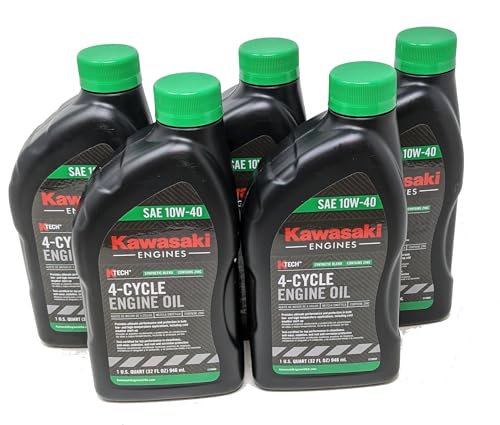
Kawasaki's K-Tech oil carries the weight of genuine OEM engineering behind its formulation, and the zinc additive package it contains is one of the most practically significant differentiators in this entire review, as zinc dialkyldithiophosphate (ZDDP) provides a sacrificial anti-wear layer that activates under metal-to-metal contact stress — exactly the condition that occurs inside a hard-working ATV engine when oil film temporarily breaks down under extreme load. Kawasaki machines are engineered with specific metallurgical tolerances and surface finishes that respond best to OEM lubricant chemistry, and the K-Tech formulation reflects that manufacturing knowledge in a way that aftermarket alternatives can approximate but rarely match precisely. The pack-of-five format means you're stocking your garage for multiple oil changes at a cost-per-quart that competes favorably with aftermarket options.
The K-Tech's viscosity stability at high temperatures is one of its defining performance characteristics, maintaining an adequate lubricating film even during sustained operation at elevated engine loads — trailer hauling, hill climbing, or long days of hard riding — where thermal degradation is the primary enemy of lubricant performance. Kawasaki's engineers specifically validate this oil against their own engine test cycles, which means the K-Tech's service interval recommendations are not conservative guesses but empirically verified performance benchmarks. For Kawasaki owners in particular, using this oil also preserves factory warranty compliance, eliminates the guesswork from fluid selection, and gives you a direct point of accountability if engine warranty claims arise during your ownership period.
Pros:
Cons:
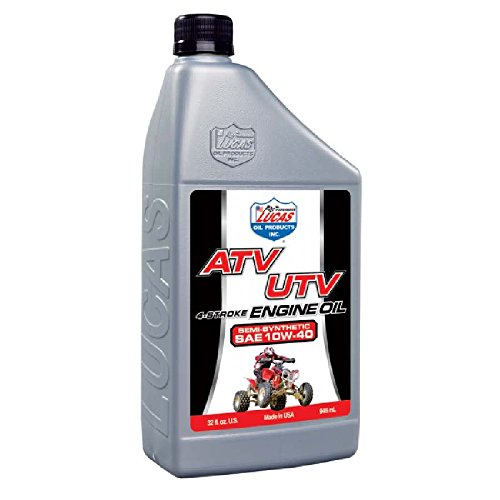
Lucas Oil has carved out a loyal following in the powersports community not through aggressive marketing but through consistent real-world results, and the Lucas 10720 Semi-Synthetic 10W-40 represents the brand's balanced approach to ATV lubrication — blending a synthetic base stock for enhanced thermal stability with a mineral component that provides the clutch-friendly friction characteristics that wet-clutch designs demand. Semi-synthetic formulations occupy a meaningful performance tier between conventional mineral oils and full synthetics, and for the majority of recreational ATV riders who operate in moderate climates and standard trail conditions, this middle-ground approach delivers genuine protection improvements over purely mineral options without the cost premium of going fully synthetic. The American-made manufacturing origin also gives domestic buyers an additional layer of quality assurance and supply chain confidence.
Lucas's reputation in the powersports market is built on the performance of their additive chemistry — particularly their anti-wear and film-strength additives that maintain a protective boundary layer even when engine temperatures spike unexpectedly during hard use. The 10W-40 viscosity grade positions this oil squarely in the mainstream ATV specification window, ensuring compatibility with the majority of four-stroke ATV engines currently in active use across Polaris, Can-Am, Yamaha, Honda, and Kawasaki platforms. Riders who alternate between demanding trail conditions and casual farm-use applications will find the semi-synthetic's broader performance envelope a practical advantage over strict mineral oils, and the single-quart packaging is convenient for precise oil additions between changes.
Pros:
Cons:
The ATV Premium 4T 10W-40 earns its place on this list by doing the fundamentals correctly at a price point that makes routine oil changes financially painless — and for the budget-conscious ATV owner who changes oil on schedule rather than stretching intervals, that accessibility is a meaningful performance advantage in itself, because fresh oil at the right interval beats premium oil changed too late every single time. Formulated specifically for ATV engines rather than adapted from automotive applications, this oil addresses the anti-wear demands of high-rpm four-stroke operation, corrosion resistance for engines stored in variable conditions, and rust protection for internal components exposed to moisture ingestion in wet riding environments. The targeted formulation reflects an understanding of the powersports use case that generic alternatives cannot replicate with automotive-spec chemistry.
The superior anti-wear protection at extreme temperatures and loads is the core performance claim that separates this oil from truly budget-grade alternatives that sacrifice additive quality to hit low price points, and riders who operate their ATVs in demanding conditions — sand dunes, rocky trails, sustained hill climbing — will find this protection level meaningful over a full riding season. Corrosion and rust prevention chemistry is particularly relevant for ATV owners in humid climates, coastal regions, or those who ride through water crossings regularly, as water contamination accelerates internal corrosion at a rate that inadequately formulated oils cannot counter. For riders who need a dependable, purpose-built ATV oil without a premium price tag, this is a straightforward and capable choice for the 2026 riding season.
Pros:
Cons:
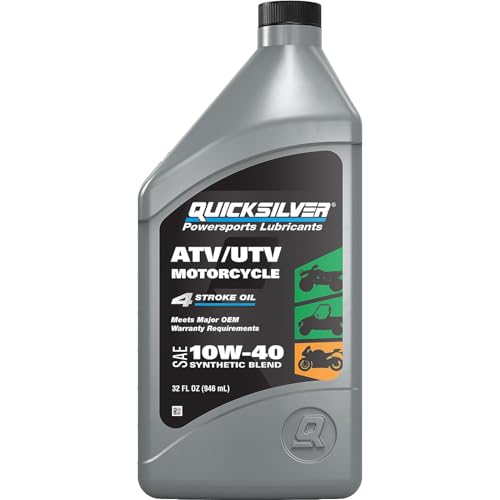
Quicksilver's 10W-40 Synthetic Blend rounds out the lineup with a formulation that specifically addresses one of the most technically demanding aspects of ATV lubrication: maintaining the precise friction balance required by wet-clutch systems that must engage cleanly under variable loads without slipping or dragging, which is a calibration challenge that general-purpose oils consistently fail to meet and that Quicksilver addresses with a dedicated wet-clutch compatible additive package. Wet clutch compatibility is not a simple checkbox — it requires friction modifiers that are absent from most automotive motor oils, because those automotive formulations contain friction-reducing additives that improve fuel economy but cause devastating clutch slip in powersports shared-sump applications. Quicksilver's synthetic blend base stock provides the thermal stability advantage of synthetic chemistry while the friction modifier calibration preserves exactly the clutch engagement characteristics your ATV's drivetrain requires.
The broad application range — covering ATVs, UTVs, and motorcycles — reflects the versatility of Quicksilver's formulation across powersports engine architectures, which makes this oil a practical choice for riders who maintain multiple machines across different platforms and want to simplify their fluid inventory to a single trusted product. Outstanding protection in harsh conditions is the operational promise that justifies the synthetic blend's modest premium over conventional alternatives, and that promise holds up across the range of environments that ATV and UTV riders routinely encounter: standing water, mud, extreme dust, sustained heat, and the mechanical stress of towing or hauling loads beyond what most riders consider normal use. If clutch performance is your primary concern and you want a proven, multi-application formula that won't compromise your drivetrain, this is your answer.
Pros:
Cons:
Selecting the right engine oil for your ATV or UTV in 2026 comes down to understanding a handful of technical factors that have a direct, measurable impact on engine longevity and ride performance. According to the motor oil overview on Wikipedia, viscosity grade, base stock type, and additive chemistry are the three pillars that determine whether an oil is appropriate for a given application — and all three matter significantly in the ATV context.
The viscosity grade on your ATV oil — expressed as a two-number rating like 10W-40 or 5W-50 — tells you everything about how the oil flows across the temperature range your engine encounters, and choosing the wrong grade is one of the most common and damaging maintenance mistakes you can make. The first number (the "W" rating) describes cold-weather flow: a 5W oil flows to critical engine components faster on a cold start than a 10W, which matters enormously in freezing temperatures where oil pump pickup can be delayed if viscosity is too high. The second number describes high-temperature viscosity: a 40-weight oil maintains a thicker protective film at operating temperature than a 30-weight, which is critical in high-rpm ATV engines that generate significant heat under load. Always match the grade to your climate range and your manufacturer's specification — never deviate from the minimum viscosity without understanding why.
Your choice of base stock determines your oil's fundamental performance ceiling, and understanding the tradeoffs between mineral, synthetic blend, and full synthetic formulations helps you invest appropriately for your specific use case rather than overpaying for capability you don't need or underpaying for protection that leaves your engine exposed. Mineral oils, like the Yamalube and Kawasaki K-Tech, provide reliable OEM-spec protection for riders operating in moderate conditions on standard service intervals, and their clutch-friendly friction characteristics make them particularly well-suited for wet-clutch ATV designs. Synthetic blends, like the Lucas Oil and Quicksilver 10W-40, extend that protection envelope into harsher operating conditions while maintaining clutch compatibility. Full synthetic options, like the Quicksilver 5W-50, deliver the maximum protection range for extreme performance applications where temperature swings are wide and engine loads are sustained — and if you're also researching other fluid upgrades for your vehicle, our review of the best brake fluids covers similar synthetic vs. conventional tradeoffs in another critical system.
The wet-clutch compatibility of your ATV oil is not a marketing differentiator — it is a mechanical requirement for any ATV or UTV with a shared-sump design where the engine oil lubricates the clutch pack directly, and using the wrong oil here destroys clutch performance within a single riding season in ways that are expensive to diagnose and repair. Standard automotive oils contain friction modifiers designed to reduce internal engine drag and improve fuel economy, but those same modifiers cause clutch slip in ATV wet-clutch systems by reducing the friction between clutch plates below the threshold needed for clean engagement. Every oil in this review is either explicitly certified wet-clutch compatible or OEM-formulated for ATV applications that use wet-clutch designs, which is why starting your ATV oil selection from this list is a safer baseline than browsing generic motor oil alternatives. Look for JASO MA or JASO MA2 certification as your verification standard when evaluating any oil not explicitly listed here.
The total cost of your ATV oil program is not the sticker price per quart — it is the cost per oil change multiplied by your annual change frequency, and optimizing this equation means matching your oil's service interval capability to your actual riding patterns rather than defaulting to the longest possible interval to save money at the expense of engine protection. Hard-riding applications — competitive trail riding, frequent towing, dusty or muddy environments — accelerate oil degradation and shorten the effective service interval regardless of the oil's rated capability, which means a premium full synthetic that theoretically lasts longer may actually need to be changed at the same interval as a conventional oil under your specific conditions. Budget-conscious riders who ride infrequently may find that a high-quality mineral oil changed on schedule is a better value than an expensive synthetic stretched beyond its practical service limit. If you also maintain a trailer for your ATV transport, our guide to the best trailer locks covers securing your equipment during seasonal transport.
You should not use regular automotive engine oil in an ATV with a wet-clutch system, because automotive oils contain friction modifiers that cause clutch slip and premature clutch wear in shared-sump four-stroke ATV engines. Always use an oil specifically rated for ATV, motorcycle, or powersports applications with wet-clutch compatibility — JASO MA or MA2 certified oils are the safest baseline specification to follow if your OEM manual does not specify a branded product.
The 10W-40 designation describes how the oil flows at two temperature extremes: the "10W" indicates the oil's cold-weather viscosity (the W stands for Winter), with a lower number meaning better flow at cold temperatures and faster cold-start protection, while the "40" describes the oil's viscosity at normal operating temperature, with a higher number indicating a thicker protective film under heat and load. Most ATV engines are factory-calibrated for 10W-40 in moderate climates, though you should always verify the correct grade in your owner's manual before selecting an oil.
Most ATV manufacturers recommend oil changes every 100 hours of operation or once per riding season, whichever comes first, but hard riding conditions — sustained high-load operation, dusty or muddy environments, water crossings, or towing — shorten that interval significantly and may require changes as frequently as every 50 hours. A quick visual inspection of your oil's color and consistency on the dipstick or sight glass is your best real-world indicator: fresh oil is amber and translucent, while oil due for a change is dark, murky, or carries a burnt smell that indicates thermal degradation has compromised its protective chemistry.
Full synthetic oil delivers measurable advantages over conventional mineral oil in extreme operating conditions — better cold-start protection, superior thermal stability under sustained high-load operation, and longer service life before viscosity breakdown — but for recreational riders operating in moderate climates on standard service intervals, a quality mineral or semi-synthetic ATV oil provides entirely adequate protection at a lower cost per change. The choice between synthetic and conventional should be driven by your actual operating environment and riding intensity rather than a general preference for the more expensive option.
JASO MA is a Japanese Automotive Standards Organization certification that verifies an engine oil meets specific friction performance requirements for four-stroke engines with wet-clutch systems, ensuring the oil will not cause clutch slip or chatter while still providing adequate lubrication for engine components operating in the same oil circuit. JASO MA2 is a stricter version of the standard with tighter friction specifications, and both certifications are accepted as wet-clutch compatible for ATV and motorcycle applications. When purchasing oil not explicitly branded for ATVs, JASO MA or MA2 certification is the critical verification to look for on the label before making your selection.
Mixing different ATV engine oils of the same viscosity grade — for example, two different brands of 10W-40 ATV oil — is generally acceptable in an emergency top-off situation and will not cause immediate engine damage, as modern API and JASO-certified oils share compatible additive chemistry at the base level. However, mixing oils of different viscosity grades, different base stock types (mineral with synthetic), or oils with significantly different additive packages can compromise the engineered performance characteristics of both products, and is not recommended as a routine practice. Always refill with your primary oil of choice at the earliest opportunity after any mixed top-off.
 |
 |
 |
 |

About Marcus Chen
Marcus Chen has over twelve years of hands-on experience modifying cars across a range of platforms — from commuter builds to track-focused setups — with deep expertise in suspension tuning, wheel and tire fitment, and performance upgrades that improve driving dynamics without sacrificing day-to-day reliability. He has worked with both bolt-on and engineered modifications and brings a methodical, results-focused approach to evaluating performance parts. At CarCareTotal, he covers performance upgrades, suspension and handling, and wheel, tire, and drivetrain modifications.
Get some FREE car parts & gear.. Or check out the latest free automotive manuals and build guides here.
Disable your ad blocker to unlock all the hidden deals. Hit the button below 🚗
| | | |
