Car Care ›
by Diego Ramirez
You're standing in the automotive aisle, staring at a dozen jugs of coolant in green, orange, red, and yellow — and wondering whether it matters which one you grab. It absolutely does. Using the wrong antifreeze can corrode aluminum components, eat through gaskets, and void your warranty before you even notice a problem. Finding the right formula for your specific vehicle in 2026 is simpler than it looks once you understand what separates each type.
Antifreeze serves two critical functions: it lowers the freezing point of your coolant so the fluid won't turn to ice in winter, and it raises the boiling point so your engine doesn't overheat in summer. Beyond temperature management, the inhibitor package inside each formula is what protects your radiator, water pump, and engine block from corrosion and scale buildup. The chemistry differs significantly between IAT, OAT, HOAT, and waterless systems, and your engine was engineered to work with one specific approach. Getting this wrong isn't just a minor inconvenience — it can mean expensive repairs down the road. If you're also keeping up with rust prevention elsewhere on your vehicle, you'll appreciate how much good coolant chemistry does the same job inside your cooling system.
We've reviewed seven of the top-rated antifreeze and coolant products available on Amazon in 2026, covering universal formulas, OEM-specific options, Asian vehicle coolants, and even a waterless alternative for high-performance applications. Whether you drive a daily commuter, a fleet vehicle, or a classic that sees the track on weekends, there's a product in this list that fits your needs. The ratings comparison below gives you a quick visual overview before we dive into the details.

Contents








If you want one bottle that works across every car, truck, or SUV you own without worrying about OEM specifications or fluid color compatibility, the Prestone AF2100 is the product most people reach for first — and for good reason. This is a 50/50 prediluted formula, meaning it's ready to pour straight into your overflow reservoir without any mixing, which eliminates the guesswork and the risk of accidentally diluting with tap water that carries minerals and contaminants. The AF2100 is engineered to be compatible with all ethylene glycol-based fluids regardless of color, and it supports OAT, POAT, HOAT, and IAT systems simultaneously, which is a genuinely impressive formulation feat.
Performance-wise, this coolant protects down to -34°F and guards against boilover up to 265°F in a properly maintained system. The inhibitor package is designed to protect aluminum, steel, copper, brass, and cast iron components all at once, which matters if you're driving a modern vehicle with a predominantly aluminum engine. Prestone packages this gallon with an ANF Brands sponge, which is a small bonus but reflects the brand's positioning as a complete car care product. The bottle itself is well-sealed with a screw cap that doesn't drip when pouring, which is a minor quality-of-life detail that frequent DIY mechanics actually notice. If you've been shopping around for engine maintenance supplies alongside a portable jump starter or other car care essentials, the AF2100 fits right into that toolkit as a worry-free maintenance product.
The universal claim holds up in real-world use across a wide range of vehicles, including older domestic trucks and newer imports, though some purists argue that using a formula specifically engineered for your OEM spec will offer marginally better long-term protection. That's a valid point worth considering if your vehicle is still under warranty or if you're working with a high-mileage engine that's already showing wear on cooling system components. For most drivers maintaining a mixed garage, however, the AF2100 strikes an excellent balance between versatility and protection.
Pros:
Cons:
If you own a General Motors vehicle manufactured after 1996, there's a strong probability that your cooling system was filled from the factory with Dex-Cool, GM's proprietary extended-life OAT coolant. Using a non-compatible formula in a Dex-Cool system without a complete flush can cause the two chemistries to react, forming a corrosive gel that clogs your heater core and radiator passages. The Prestone AF850 is formulated specifically to meet Dex-Cool performance requirements, making it the safe, straightforward choice for GM trucks, SUVs, and passenger cars that specify this type of coolant.
This is another 50/50 prediluted product, so you pour it directly into the system — a convenience that's especially welcome when you're topping off in a parking lot or making a quick emergency fill. The blend of premium long-lasting OAT inhibitors is engineered to go the distance in terms of service intervals, offering extended protection that aligns with GM's recommended change intervals for Dex-Cool systems. The formula is also particularly well-suited for vehicles with aluminum radiators, which are now standard on most modern light-duty trucks, since aluminum is especially vulnerable to the electrochemical corrosion that the wrong coolant chemistry can accelerate over time. Prestone's reputation in this space is built over decades, and the AF850 reflects that experience without overcomplicating the product.
The trade-off is specificity: this is not a universal product, and you shouldn't use it in vehicles that don't require Dex-Cool. If you're managing a mixed fleet or a garage with both domestic and foreign vehicles, you'll want the AF2100 or a HOAT-based formula alongside this one. But for dedicated GM owners, the AF850 is one of the most straightforward and reliable choices available in 2026, and it's competitively priced given its brand pedigree and extended-life inhibitor package.
Pros:
Cons:
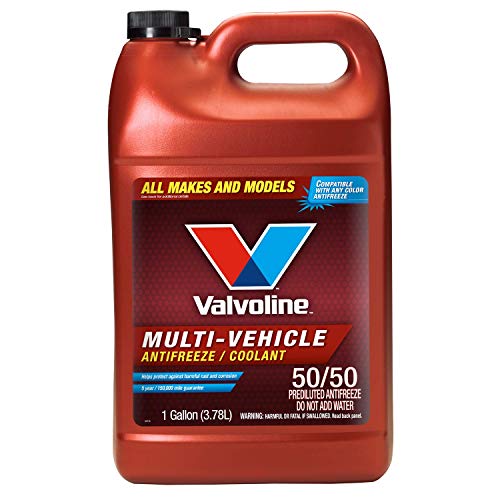
Valvoline has been a trusted name in automotive fluids for over 150 years, and the Multi-Vehicle 50/50 coolant carries that heritage into a modern, versatile formula designed for drivers who don't want to stock multiple jugs for different vehicles. The key ingredient here is Alugard Plus, Valvoline's proprietary additive package that creates compatibility with all ethylene glycol-based coolants in both automobiles and light-duty trucks. This means you can top off an older vehicle that still runs green IAT coolant or a newer model running an OAT formula without triggering the kind of chemical reactions that cause deposits and sludge inside your cooling system.
Beyond compatibility, the Valvoline formula delivers strong corrosion protection across all cooling system metals, including the aluminum components that dominate modern engine design. It guards against scaling and rust, which is particularly important if your tap water has high mineral content and you've had the system partially filled with water at some point. The high-quality additive package also claims to protect against leaks by conditioning gaskets and hoses rather than attacking them — a meaningful benefit since some lower-quality coolants can actually accelerate rubber degradation over time. The 50/50 prediluted concentration provides freeze protection down to -34°F and boilover protection up to 265°F, which covers the range that most drivers across North America encounter throughout the year.
Where the Valvoline Multi-Vehicle sits in a competitive field is somewhere between a true OEM-spec product and a budget universal formula. It's not the cheapest option on this list, but you're paying for Valvoline's research into cross-compatibility chemistry and a name that carries real credibility in the professional automotive service industry. If you run a small fleet, maintain multiple family vehicles, or simply want a single reliable coolant that you can use across the board, this is a strong contender that doesn't require you to think too hard about compatibility before pouring.
Pros:
Cons:
The Zerex G05 occupies a specific and important niche in the coolant market: it's the go-to HOAT (Hybrid Organic Acid Technology) formula for drivers of European vehicles, older Ford and Chrysler products, and heavy-duty trucks that require a phosphate-free coolant with silicate protection. Many Mercedes-Benz, Volkswagen, and Audi owners specifically seek out G05 because it meets MB 325.0, Ford WSS-M97B51-A1, and Chrysler MS-9769 specifications — the kind of detail that matters if your vehicle's manufacturer explicitly calls out these standards in the owner's manual. Using a formula that falls outside these specs on a European vehicle with a complex aluminum cooling system is the kind of mistake that surfaces slowly and expensively.
What makes HOAT chemistry appealing is that it blends the rapid protection of inorganic silicate inhibitors with the long-lasting durability of organic acid technology. You get fast-acting corrosion protection from the silicates in the early stage of the fluid's life, and the OAT inhibitors take over for the long haul, extending service intervals well beyond what traditional green IAT coolant offers. The G05 is phosphate-free by design, which is a requirement for European manufacturers who determined that phosphate chemistry can cause scaling on aluminum heat transfer surfaces under certain operating conditions. Zerex's freeze and boilover performance with this formula is competitive with the field — protection down to -34°F and solid anti-boil performance that outperforms the industry baseline according to Zerex's own testing data.
In practice, drivers who've switched to G05 from generic universal coolants frequently report that their heating and cooling systems perform more consistently, particularly in vehicles that had been running a mismatched formula for years. The 50/50 prediluted format makes it straightforward to use, and the yellow color means it's visually distinct from most other coolants in your garage, which helps prevent accidental mixing during top-offs. If your vehicle's service manual specifically calls for a HOAT or G05-type coolant, this is the product you want without significant reservation.
Pros:
Cons:
Toyota, Lexus, and Scion vehicles have a very specific coolant requirement that trips up a lot of well-intentioned owners: they need a red, silicate-free HOAT antifreeze that meets Toyota's LLC (Long Life Coolant) specification. Using a green IAT formula or even a standard HOAT in these vehicles can introduce silicates that the system wasn't designed to handle, potentially causing premature water pump seal degradation and deposits in the narrow passages of the aluminum radiator. The Zerex Asian Vehicle Red was developed precisely to replicate the chemistry of Toyota's factory fill and the OEM replacement fluid, making it the most direct aftermarket alternative for Toyota-platform vehicles.
The formula uses a silicate-free, borate-free phosphate Hybrid Organic Acid Technology that provides a 5-year or 150,000-mile service interval — matching the factory recommendation for Toyota's LLC coolant. That's a meaningful service life advantage over conventional green coolants, which typically need replacement every 2 years or 30,000 miles. The long-life inhibitor package protects all cooling system metals from rust and corrosion while the absence of silicates and borates means you're not introducing compounds that can react adversely with Toyota's specific elastomer seal materials. For Toyota and Lexus owners who take their vehicles' maintenance seriously, using the right coolant chemistry is as important as using the right motor oil viscosity — it's built into the engineering of the system.
It's worth noting that this formula is also compatible with many other Asian-market vehicles that specify a similar red silicate-free coolant, including some Honda and Mitsubishi applications that call for Honda Type 2 or equivalent. Always cross-reference your owner's manual before using any aftermarket coolant, but for Toyota, Lexus, and Scion owners, this product covers the most critical use case cleanly and reliably. The 50/50 prediluted concentration is ready to use as-is, and the distinctive red color helps you identify the fluid type at a glance during future service intervals.
Pros:
Cons:
EVANS Waterless Coolant is one of the most unconventional products in this category, and it challenges a fundamental assumption about how cooling systems work — that they need water to function properly. The reality is that water, while an excellent heat transfer medium, is also the primary source of corrosion, electrolysis, scaling, and boilover risk inside your engine's cooling system. EVANS eliminates water entirely, replacing it with a propylene glycol-based formula that has a boiling point of 375°F, which is dramatically higher than the 265°F ceiling you get with a conventional 50/50 water-based coolant even with a pressurized system.
The implications of that higher boiling point are significant for performance applications. Vapor pockets form inside a cooling system when localized hot spots cause the coolant to boil against the cylinder wall, and those pockets interrupt heat transfer at exactly the wrong moment. EVANS generates low vapor pressure by design, meaning the coolant stays in liquid contact with metal surfaces even under extreme heat loads, providing more consistent and effective cooling during hard driving. The complete absence of water also means there is no electrolytic activity, which eliminates the galvanic corrosion that gradually attacks aluminum, cast iron, and copper components in a conventional system over years of operation. For classic car restorers and track day enthusiasts, this represents a meaningful long-term maintenance advantage.
The conversion process does require a thorough system flush to remove all residual water before introducing EVANS, since even a small percentage of water contamination raises the boiling point enough to compromise the product's core benefit. EVANS sells a prep fluid specifically for this purpose. The upfront cost of EVANS is considerably higher than any water-based coolant on this list, and the product is not recommended for diesel engines or applications with coolant-to-fuel heat exchangers, where the chemistry may not perform as intended. But for gasoline-powered vehicles — from modern muscle cars to pre-war classics — it's a technically sophisticated solution for drivers who want to minimize long-term cooling system maintenance while protecting a prized build. Those doing comprehensive engine work alongside performance tuning might also find a timing light useful for dialing in ignition after cooling system service.
Pros:
Cons:

The Zerex Original Green is what most people picture when they think of antifreeze — the classic green formula that's been in use for decades on domestic vehicles built before the extended-life coolant era. This is an IAT (Inorganic Additive Technology) product built around a patented organic acid corrosion inhibitor package that Zerex has refined over many years, providing extended engine protection against rust and corrosion compared to basic green coolants. The low-silicate formulation is a specific design choice: silicates provide fast-acting corrosion protection but deplete relatively quickly, so Zerex keeps the concentration low and supplements it with organic acid inhibitors to stretch the service interval.
The core protection spec is freeze protection down to -34°F with this 50/50 ready-to-use concentration, which covers the needs of most North American climates without requiring any dilution work. The rust and corrosion inhibition works across the common cooling system metals you'll find in older domestic vehicles — cast iron engine blocks, steel water pumps, brass fittings, and copper radiator cores on pre-aluminum-radiator builds. If you're maintaining a vehicle from the 1980s or early 1990s that was engineered around traditional green IAT chemistry, introducing an OAT or HOAT formula without a proper flush can actually cause the different chemistries to interact poorly, making the Original Green the correct choice by specification rather than by personal preference.
The limitation here is the shorter service interval that comes with silicate-based IAT chemistry. Traditional green coolant typically needs to be replaced every 2 years or 30,000 miles, compared to the 5-year intervals of OAT and HOAT products. For owners of older vehicles who are already doing frequent maintenance checks and fluid changes, this isn't necessarily a drawback — it just means adding coolant to your regular service schedule. The Zerex Original Green is priced accessibly, widely available, and performs exactly as a traditional green IAT coolant should. It's the right tool for a specific set of vehicles, and there's real value in that specificity. If you enjoy keeping your vehicle in top shape overall, browsing our guide to car care products can help you build out a complete maintenance routine that keeps your cooling system and everything around it in peak condition.
Pros:
Cons:
The single most important factor in choosing an antifreeze is matching the chemistry to what your vehicle's manufacturer specified. IAT (Inorganic Additive Technology) is the traditional green formula designed for older domestic vehicles with cast iron and copper components, offering fast-acting protection that depletes relatively quickly and requires more frequent changes. OAT (Organic Acid Technology) is the longer-lasting chemistry used in modern vehicles, including GM's Dex-Cool and Toyota's red LLC, relying solely on organic corrosion inhibitors that protect aluminum effectively over a 5-year service window. HOAT (Hybrid Organic Acid Technology) blends both approaches — commonly found in European vehicles, Ford, and Chrysler applications — providing the immediate protection of silicates alongside the longevity of organic acids. Waterless coolants like EVANS occupy their own category, eliminating water to raise boiling points and eliminate electrochemical corrosion entirely. Mismatching chemistry without a full system flush is one of the most common and avoidable cooling system mistakes.
All seven products reviewed here are 50/50 prediluted formulas, which means they arrive at the correct water-to-glycol ratio and are ready to pour without any additional mixing. This is the right choice for topping off an existing system or for drivers who don't want to measure and mix. Concentrate formulas — sold as 100% ethylene glycol — allow you to customize the dilution ratio based on your climate, using a higher glycol percentage for extreme cold climates and a lower ratio for mild regions. The U.S. Environmental Protection Agency also has guidance on proper antifreeze disposal, since ethylene glycol is toxic to animals and should never be poured down a drain or into the ground regardless of whether you're using prediluted or concentrate. For most daily drivers using prediluted coolant, this isn't a concern during routine top-offs, but it matters when draining a full system during a flush.
Your owner's manual contains a specific coolant specification — it might reference a color, a standard number like MS-9769 or MB 325.0, or a brand name like Dex-Cool or Toyota LLC. That specification exists because your cooling system's metals, seals, and elastomers were engineered with a particular chemistry in mind, and using the wrong one can cause problems that don't show up immediately but compound over time. Universal coolants claim compatibility across all these specifications, and while modern universal formulas have become genuinely impressive in their cross-compatibility, OEM-spec products are still the safest choice for vehicles under warranty or for high-mileage engines where the cooling system is already under stress. When in doubt, use the product that most closely matches your manufacturer's specification rather than relying on a universal claim.
Not all coolants last the same amount of time, and understanding the service interval helps you plan your maintenance schedule correctly. Traditional IAT green coolants typically need replacement every 2 years or 30,000 miles, which is the most frequent change interval among the chemistry types. OAT and HOAT formulas typically offer 5 years or 150,000 miles of service life, significantly reducing the frequency of full system flushes. EVANS Waterless coolant claims an even longer service life once properly installed since the absence of water eliminates the primary cause of inhibitor depletion and corrosion. Regardless of chemistry, it's worth checking your coolant's freeze protection level with an inexpensive antifreeze tester annually, since the glycol concentration can shift over time if the system has taken on water during top-offs or from a slow leak that's been repaired.
You should avoid mixing coolants of different chemistry types even if the colors happen to match, because color alone does not determine compatibility. Green, orange, red, yellow, and blue coolants can represent entirely different inhibitor chemistries, and blending two incompatible types can cause gel formation, deposits, and accelerated corrosion inside your cooling system. If you're unsure what's already in your system, the safest approach is to perform a complete flush before adding new coolant, which removes all residual fluid and gives you a clean starting point for the new chemistry.
The correct change interval depends on your coolant chemistry. Traditional green IAT coolants should be replaced every 2 years or 30,000 miles. Modern OAT and HOAT formulas — including Dex-Cool, Toyota LLC equivalents, and G05-type products — are designed for 5-year or 150,000-mile intervals. Always check your specific coolant's documentation and your owner's manual, since some manufacturers specify different intervals based on operating conditions. If your vehicle has experienced overheating events or you notice the coolant has become dark, rusty, or has visible particulates, replace it promptly regardless of mileage.
Antifreeze is the concentrated ethylene glycol base product before dilution, while coolant refers to the ready-to-use mixture of antifreeze and water. In everyday usage the terms are used interchangeably, and most products sold today are labeled as "antifreeze/coolant" because they serve both temperature management functions. When you buy a prediluted 50/50 product, you're buying coolant that's already mixed. When you buy concentrate, you're buying antifreeze that needs to be diluted with distilled water before use.
Modern universal antifreeze formulas are engineered to be compatible with a wide range of coolant specifications, and reputable products like Prestone's AF2100 perform genuinely well across multiple chemistry types. That said, some manufacturers — particularly Toyota, certain European brands, and GM for Dex-Cool systems — specify proprietary coolant chemistries that an OEM-matched product will serve better than a universal alternative. If your vehicle is still under manufacturer warranty, check whether using a universal coolant affects your coverage before departing from the specified product. For older or out-of-warranty vehicles, a quality universal coolant is generally a safe and practical choice.
Adding water to a prediluted 50/50 coolant dilutes the glycol concentration and reduces both freeze and boilover protection, so it's not recommended as a regular practice. In an emergency top-off situation, distilled water is acceptable for getting you to a service facility, but you should check the concentration with an antifreeze tester and add the appropriate coolant to restore the correct ratio afterward. If you're frequently topping off with water, that's also a sign your system may have a slow leak worth investigating before it becomes a larger repair.
The consequences depend on how incompatible the chemistries are and how long they remain in contact. In mild cases, you might see accelerated depletion of inhibitors and a reduction in corrosion protection that only becomes apparent over several years. In more severe cases — particularly when an IAT green coolant is introduced into a Dex-Cool system or vice versa — the two chemistries can form a gel-like sludge that clogs your heater core, radiator, and coolant passages. Aluminum components are particularly vulnerable to the wrong inhibitor chemistry, and the damage can be expensive. If you're uncertain what's in your system, a full flush and refill with the correct product is always the safest and most cost-effective solution.
The right coolant isn't the most expensive one or the most universal one — it's the one your engine was actually designed to run on, and that detail alone is worth five minutes with your owner's manual before you open the cap.
 |
 |
 |
 |

About Diego Ramirez
Diego Ramirez has been wrenching on cars since his teenage years and has built a deep practical knowledge of automotive maintenance and paint protection through years of hands-on work. He specializes in fluid service intervals, preventive care routines, exterior protection products, and the consistent habits that extend a vehicle's lifespan well beyond average. At CarCareTotal, he covers car care guides, cleaning and detailing products, and exterior maintenance and protection reviews.
Get some FREE car parts & gear.. Or check out the latest free automotive manuals and build guides here.
Disable your ad blocker to unlock all the hidden deals. Hit the button below 🚗
| | | |
