by Marcus Chen
Finding the best ignition coil is something most drivers don't need to think about often — but when a coil starts to fail, you'll notice it immediately. An ignition coil is the component responsible for transforming your battery's 12 volts into the 20,000–45,000 volts needed to fire the spark plugs and ignite the fuel-air mixture in each cylinder.
The coil acts as a step-up transformer: it stores electrical energy in a magnetic field, then releases it in a sharp, high-voltage pulse that travels through the spark plug wire or coil boot directly to the plug. Without a healthy ignition coil, your engine will misfire, idle roughly, or fail to start at all.
Modern engines use either a distributor-based coil (one coil for all cylinders) or individual coil-on-plug (COP) units — one per cylinder. COP systems are more common on vehicles made after 2000 and deliver more precise spark timing. Replacing a failed coil restores lost performance, improves fuel economy, and reduces emissions.
This guide reviews the 6 best ignition coils of 2026, selected across the most common vehicle platforms, followed by a buying guide to help you choose the right coil for your car or truck. All products are available on Amazon with verified ratings and real customer reviews.
Contents







The Delphi GN10328 is the top choice for drivers who need a reliable OEM-quality ignition coil at a reasonable price. Delphi is a Tier-1 OEM supplier with decades of experience building ignition components for major automakers.
This coil delivers up to 45,000 volts of output energy, providing a powerful, consistent spark to fire your engine's fuel mixture. The precision-wound primary and secondary windings are encapsulated in high-quality epoxy for excellent resistance to heat, vibration, and moisture.
Delphi engineered this coil to meet or exceed the original equipment specifications — meaning it restores the engine's performance to factory standards. The connector orientation and mounting points are identical to the OEM part, making installation a straightforward plug-and-play replacement.
One minor limitation is that this coil is designed for specific vehicle applications, so always verify fitment before ordering. Delphi backs the GN10328 with a limited lifetime warranty, reflecting the brand's confidence in its quality.
Pros
Cons
The ENA Set of 8 Curved Boot Ignition Coils is a popular complete replacement kit for Ford, Lincoln, and Mercury trucks and SUVs powered by the 4.6L or 5.4L V8 engine. Replacing the full set at once eliminates the risk of remaining weak coils causing further misfires.
ENA manufactures these coils to exceed OEM specs — improved insulation materials and tighter winding tolerances result in better spark energy delivery compared to worn original equipment. The curved boot design is an exact match to the factory coil geometry for easy installation.
Each coil in the set undergoes rigorous quality testing including insulation resistance checks and high-voltage output testing. The set is particularly well-regarded by Ford F-150 and Expedition owners who want a complete, cost-effective solution rather than replacing coils one at a time.
The main trade-off with this aftermarket set is that it doesn't carry an official OEM part number, so some dealership technicians may prefer factory parts. ENA's lifetime warranty adds peace of mind for this value-priced kit.
Pros
Cons
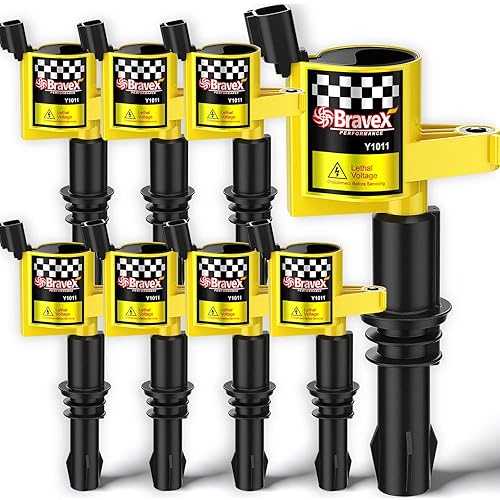
The Bravex Straight Boot Ignition Coil Pack stands out for delivering 15% more energy than the OEM specification — a genuine performance upgrade that results in more complete combustion, better throttle response, and improved fuel economy on Ford V8 and V10 platforms.
Bravex uses a high-grade silicon steel core and upgraded primary winding to achieve the increased energy output. The straight boot design fits the Ford DG457, DG472, and DG508 coil positions on the 4.6L, 5.4L Modular, and 6.8L V10 Triton engines found in F-150, F-250, F-350, Expedition, and Excursion vehicles.
These coils are a particularly good choice for high-mileage trucks where stock coils are beginning to weaken but haven't fully failed yet. Installing a full Bravex set often restores snap and performance that drivers didn't realize they had lost. The external housing is built from high-temperature-resistant thermoplastic for durability.
Bravex backs these coils with a 2-year warranty, which is solid coverage for an aftermarket part. The only limitation is the platform-specific fitment — these are built specifically for Ford V8/V10 applications.
Pros
Cons
The Bosch 0221504800 is a true OEM-quality ignition coil for BMW owners who want factory-grade reliability without paying dealer prices. Bosch is the original equipment supplier of ignition coils for many BMW models, making this coil an essentially direct factory replacement.
This pencil coil uses the same precision-wound core and high-grade insulation as the part installed at the BMW factory. It delivers the exact voltage output the engine management system expects, supporting optimal spark timing and combustion efficiency across the full RPM range.
Bosch manufactures these coils to exceed OE specifications for temperature tolerance, vibration resistance, and electrical insulation. BMW owners frequently report that Bosch coils solve misfires that cheaper aftermarket alternatives couldn't cure — particularly on the turbocharged N20 and N55 engines.
The trade-off is that this is a BMW-specific part and carries a correspondingly higher price compared to universal aftermarket coils. Bosch covers it with a 2-year/unlimited mileage warranty, consistent with the brand's premium positioning.
Pros
Cons
The ENA Set of 4 Ignition Coil Pack for Nissan is the go-to replacement for Altima, Versa, and Sentra owners dealing with misfires, rough idle, or poor fuel economy. Nissan's 2.0L and 2.5L four-cylinder engines are known to develop coil failures as they age, and replacing all 4 coils at once is the most effective fix.
ENA builds these coils to match the OEM voltage output characteristics, ensuring the engine management system receives the correct signal timing. The housing material is rated for high-temperature operation inside the tight Nissan engine bay, and the connector seals prevent moisture intrusion that commonly degrades ignition coils over time.
This set is especially popular among high-mileage Altima owners because it costs far less than the four individual OEM coils from a Nissan dealer while delivering comparable performance. Installation is straightforward — each coil removes and installs with a single bolt and a push-lock connector.
ENA covers these coils with a lifetime warranty, which is exceptional value for a full replacement set at this price point. The only limitation is the Nissan-specific fitment for the relevant 2007–2012 model years.
Pros
Cons
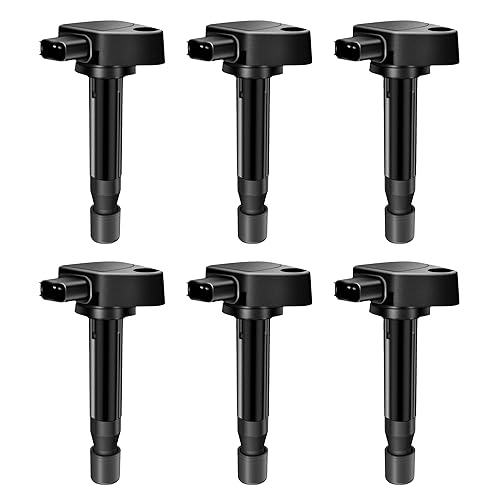
The MAS Set of 6 Ignition Coils is designed for Honda and Acura V6-powered vehicles — a common platform for the Honda Accord V6, Odyssey minivan, and Acura TL, RL, and CL. Replacing all 6 coils at once on these V6 engines is strongly recommended because when one coil fails, the others are typically at a similar age and condition.
MAS engineers these coils to the same voltage output specification as the Honda OEM parts. The construction uses high-temperature bobbin material and upgraded internal insulation compared to worn-out factory coils. Many users report that installing a full MAS set resolves rough idle and hesitation that a single coil replacement could not fully cure.
The connectors use the correct locking tab design for Honda/Acura applications, making installation a direct bolt-on swap. The coils are compatible with the 3.0L J30, 3.2L J32, and 3.5L J35 family of Honda V6 engines found across multiple model years.
MAS provides a 1-year warranty on this set — reasonable for the price. The main trade-off is the shorter warranty period compared to ENA or Delphi products, though real-world reliability has been solid based on buyer reviews.
Pros
Cons
With dozens of ignition coil options on the market — from OEM-matched replacements to performance-grade upgrades — choosing the right one takes a bit of knowledge. The four factors below cover everything you need to make a confident purchase. For a broader look at ignition system components, NGK's ignition coil resource page is an excellent technical reference.
The single most important factor when buying an ignition coil is whether it fits your specific vehicle. Ignition coils are not universal — they are engineered for specific engine families, and using the wrong coil can result in connector damage, incorrect voltage output, or misfires that are worse than the original failure.
Always check the coil's compatibility list before adding it to your cart. You'll need your vehicle's year, make, model, and engine displacement (e.g., 2012 Nissan Altima 2.5L). Most aftermarket coils also list the OEM part numbers they replace — cross-referencing those confirms fitment.
There are three main ignition coil types. Coil-on-plug (COP) units sit directly on top of each spark plug and are the most common design on vehicles built after 2000 — they deliver precise, high-energy sparks to each cylinder independently. Coil packs serve multiple cylinders and are common on older 4-cylinder and 6-cylinder engines. Distributor coils are found on older vehicles with a traditional distributor system.
Most replacement purchases today involve COP coils or COP pack sets. When one COP coil fails, the others on the same engine are usually at similar age and condition — replacing the full set at once prevents repeat misfires in the weeks following the first repair.
A healthy ignition coil delivers between 20,000 and 45,000 volts to the spark plug. Stock OEM coils are rated for a specific output; aftermarket performance coils can exceed OEM output by 10–15%, which improves ignition reliability at high RPM and under heavy load.
For most daily drivers, OEM-matching output is perfectly sufficient. For performance builds, turbocharged engines, or engines running E85 fuel, a higher-output coil can support more complete combustion and improve power delivery.
OEM-supplier brands like Delphi, Bosch, and Denso build ignition coils for the major automakers — buying their replacement parts means you're getting the same manufacturing standards that went into your vehicle at the factory. Premium aftermarket brands like ENA, Bravex, and MAS have built strong reputations through high sales volumes and consistently positive reviews on Amazon.
Warranty coverage varies from 1 year (MAS, some others) to lifetime coverage (ENA, Delphi). A longer warranty signals the manufacturer's confidence in their product's durability — prefer lifetime or 2-year coverage when all else is equal.
Delphi GN10328 Ignition Coil - Walmart Link
ENA Set of 8 Curved Boot Ignition Coil Pack Compatible with Ford Lincoln Mercury 4.6L 5.4L V8 - Walmart Link
Bravex Ignition Coil Pack Straight Boot 15% More Energy F-150 for Ford Lincoln Mercury V8 V10 4.6L 5.4L 6.8L - Walmart Link
Bosch 0221504800 Original Equipment Ignition Coil for Select BMW Vehicles - Walmart Link
ENA Set of 4 Ignition Coil Pack Compatible with Nissan Altima Versa Sentra 2007-2012 - Walmart Link
MAS Set of 6 Ignition Coils Pack Compatible with Honda Accord Odyssey Acura CL RL TL 3.0L 3.2L 3.5L V6 - Walmart Link
Delphi GN10328 Ignition Coil - eBay Link
ENA Set of 8 Curved Boot Ignition Coil Pack Compatible with Ford Lincoln Mercury 4.6L 5.4L V8 - eBay Link
Bravex Ignition Coil Pack Straight Boot 15% More Energy F-150 for Ford Lincoln Mercury V8 V10 4.6L 5.4L 6.8L - eBay Link
Bosch 0221504800 Original Equipment Ignition Coil for Select BMW Vehicles - eBay Link
ENA Set of 4 Ignition Coil Pack Compatible with Nissan Altima Versa Sentra 2007-2012 - eBay Link
MAS Set of 6 Ignition Coils Pack Compatible with Honda Accord Odyssey Acura CL RL TL 3.0L 3.2L 3.5L V6 - eBay Link
An ignition coil is an induction coil — essentially a compact electrical transformer — that converts the low voltage from your vehicle's battery into the high voltage required to produce a spark at the spark plug. In a conventional 12-volt automotive electrical system, the ignition coil steps voltage up by a factor of 1,000 or more, producing the tens of thousands of volts needed to jump the spark plug gap and ignite the compressed fuel-air mixture.
The coil consists of two sets of wire windings: a primary winding of relatively few, heavy turns of wire and a secondary winding with thousands of turns of finer wire. When current flows through the primary winding, it creates a magnetic field. When that current is suddenly interrupted by the ignition control module or ECU, the collapsing magnetic field induces a high-voltage pulse in the secondary winding — and that pulse fires the spark plug.
Modern coil-on-plug systems place a dedicated coil directly on each cylinder's spark plug, eliminating the distributor cap, rotor, and high-voltage plug wires found in older ignition systems. This design improves spark energy, reduces electrical losses, and gives the engine control module precise, independent timing control over each cylinder.
A weakening or failed ignition coil usually produces very clear symptoms. The most common is a engine misfire — a noticeable stumble or hesitation, particularly under acceleration or at idle. On modern OBD-II vehicles, a misfiring cylinder typically triggers a Check Engine light with a fault code such as P0300 (random/multiple misfire) or P0301–P0312 (specific cylinder misfire).
Additional signs include rough idling, reduced power and throttle response, noticeably worse fuel economy, and difficulty starting the engine — especially on cold mornings. In severe cases, the engine may idle so roughly that the vehicle shakes, or the engine may fail to start at all.
A simple diagnostic is to swap the suspect coil with one from an adjacent cylinder and see if the misfire code follows the coil to the new cylinder position. If it does, the coil is the problem. If the fault stays on the original cylinder, suspect the spark plug, injector, or a mechanical issue with that cylinder instead.
The best ignition coil for your vehicle depends on your platform, budget, and performance goals. For most drivers, an OEM-quality replacement from Delphi or Bosch is the safest choice — these Tier-1 suppliers build the same coils that went into your vehicle at the factory, and they back them with solid warranty coverage.
For Ford V8 owners, the ENA Set of 8 or the Bravex Straight Boot set offer complete, cost-effective replacements with the added benefit of improved energy output over worn factory coils. Nissan four-cylinder and Honda V6 owners will find the respective ENA and MAS complete sets to be the most economical way to restore full ignition performance.
Whichever product you choose, always verify fitment against your vehicle's year, make, model, and engine before purchasing — and consider replacing the full set of coils at once to avoid a return trip in a few weeks when the next coil fails. A healthy ignition system is one of the easiest ways to maintain peak fuel economy, clean emissions, and reliable engine performance in 2026.
Most ignition coils last between 80,000 and 100,000 miles under normal driving conditions. However, factors like engine heat, oil leaks onto the coils, and high-mileage use can shorten their lifespan. Some premium OEM-supplier coils have been known to last the life of the vehicle.
You can drive short distances with a single misfiring coil, but it is not recommended. A misfiring cylinder sends unburned fuel into the exhaust, which can damage the catalytic converter — an expensive repair. You should get the coil replaced as soon as possible.
When one coil fails, the others on the engine are usually at a similar age and wear level. Replacing the full set at once prevents repeat misfires in the weeks following the first repair and is generally more cost-effective than replacing coils one at a time.
A coil pack serves multiple cylinders through a shared housing and is common on older 4- and 6-cylinder engines. A coil-on-plug (COP) system places a dedicated coil directly on each spark plug and is the standard on most vehicles built after 2000. COP systems deliver more precise timing and higher energy to each cylinder.
Connect an OBD-II scanner and read the misfire fault codes — codes like P0301 through P0312 identify the specific misfiring cylinder. Then swap the suspect coil with an adjacent cylinder's coil and clear the code. If the misfire fault moves to the new cylinder, the coil is the cause.
Quality aftermarket coils from reputable brands like Delphi, ENA, Bravex, and Bosch perform comparably to OEM parts in real-world use. Some high-output aftermarket coils actually exceed OEM voltage specifications. The key is to buy from established brands with strong review histories, not the cheapest no-name option.
 |
 |
 |
 |

About Marcus Chen
Marcus Chen is a performance and tuning specialist with 12+ years of hands-on experience modifying everything from daily drivers to track cars. He specializes in suspension setup, wheel-and-tire fitment, and squeezing every drop of performance from stock platforms without sacrificing reliability.
Get some FREE car parts & gear.. Or check out the latest free automotive manuals and build guides here.
Disable your ad blocker to unlock all the hidden deals. Hit the button below 🚗
| | | |
