by Marcus Chen
The NGK (6404) RC-TE79 Spark Plug Wire Set earns the top spot in 2026 — its variable pitch winding delivers ultra-low resistance with some of the cleanest EMI/RFI suppression in its class. If you're hunting for wires that just work without drama, that's your answer right there.
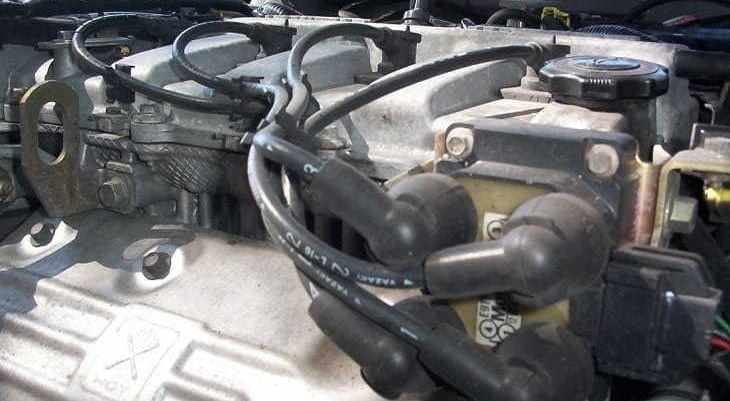
That said, your engine doesn't run on reputation alone. Spark plug wires are the final link in your ignition chain, responsible for transferring thousands of volts from the distributor or coil pack to the spark plug with minimal loss. A degraded or poorly constructed wire set causes misfires, rough idle, poor fuel economy, and failed emissions tests — problems that cost far more to diagnose than a quality wire set costs to buy. In 2026, the market ranges from budget universal kits built for weekend warriors to precision-engineered OEM-spec replacements designed for specific makes and models.
Whether you're rebuilding a classic SBC engine, maintaining a daily driver, or chasing horsepower gains on a performance build, the right set makes a measurable difference. For the deeper performance context, check out our full roundup of engine performance parts and upgrades. We tested and researched seven of the strongest options currently available and put together this guide so you can make the right call the first time.
Contents







NGK has been manufacturing ignition components for over 80 years, and the RC-TE79 set reflects exactly that depth of experience. The standout feature is the variable pitch winding — the spiral conductor varies its coil pitch along the wire's length, which dramatically reduces resistance while simultaneously suppressing EMI and RFI noise that can interfere with your vehicle's electronics. In 2026, with modern ECUs, infotainment systems, and sensors packed into engine bays, that suppression is no longer optional — it's essential.
This set includes three coil lead wires in an N/R (non-resistor) configuration. Each wire is numbered for easy cylinder identification, eliminating the guesswork that causes installation mistakes. Coil wires are color-coded for correct hookup — a detail that sounds minor until you're elbow-deep in an engine bay with limited visibility. Build quality is precisely what you'd expect from NGK: uniform jacket thickness, secure terminal connections, and boots that seat firmly without needing extra force. If your application fits this wire set, it's the one to buy.
The limitation here is fitment — this is a specific-application set, not a universal kit. Verify your make, model, and engine code before ordering. But if it fits, resistance measurements stay consistently low across the full wire length, and the spark delivery is noticeably clean on a scope. This is the wire set that professionals reach for when they want the job done right without debate.
Pros:
Cons:
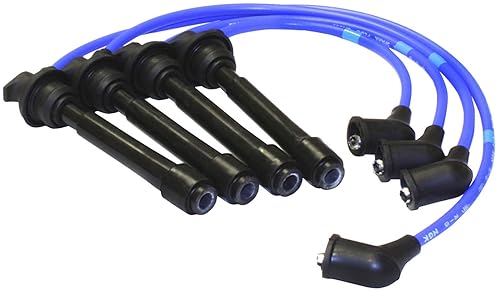
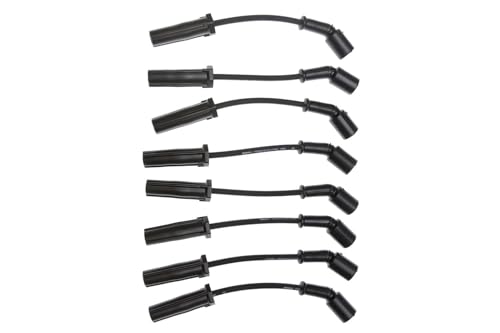
ACDelco's Professional line sits directly between budget aftermarket and dealer-sourced OEM parts — and for most GM vehicle owners, that's exactly the right position. The 9748UU ships as a full pack of eight wires engineered to match the wire conductor diameter, length, and insulation spec of the original equipment. That precision matters more than most buyers realize: a wire that's even slightly too long or too short creates routing problems that lead to heat damage or abrasion against moving engine components.
The distributor boot design is a highlight. ACDelco engineers the boot shape and durometer specifically for the application, ensuring a water-tight seal that stays seated across years of temperature cycling. Loose or cracked boots are one of the leading causes of ignition misfires in high-mileage vehicles — this set addresses that failure point directly. Terminal design uses a retention feature that grips the spark plug terminal firmly, which also aids installation since you get positive tactile feedback when the wire seats correctly. Corrosion resistance on the terminals is also above average for this price tier.
You're not buying this for motorsports performance — the conductor spec is OEM, not hot-rod. What you're buying is a wire set that restores your ignition system to factory spec reliably and durably. For daily drivers and fleet vehicles where uptime matters more than horsepower, this is the straightforward choice. Pair it with fresh mechanic tool sets and you can knock out this service in under an hour.
Pros:
Cons:

MSD has been the name in performance ignition since the 1970s, and the Super Conductor wire set is the product that built that reputation. The conductor design uses a spiral-wound, helical core that achieves remarkably low resistance — far below standard OEM wire specs — while still maintaining effective RFI suppression. That combination is genuinely rare. Most low-resistance wires emit interference; most suppressed wires sacrifice some conductivity. The Super Conductor achieves both.
The terminal engineering on these wires is exceptional. MSD uses dual crimp stainless steel terminals with two separate crimp points — one grips the wire conductor, the other grips the outer jacket independently. That dual-grip design prevents the terminal from pulling away from the wire under vibration or thermal expansion, which is exactly the failure mode that causes intermittent misfires on performance engines running at high RPM. The red wire jacket with grey boots is a classic MSD aesthetic that signals serious business under the hood.
These are purpose-built performance wires. If you're running a stock engine doing normal commuting duty, you're buying more wire than you need. But if you've upgraded your ignition system, added forced induction, or are pushing your engine harder than the OEM designers intended, the Super Conductor delivers the voltage transfer that makes those upgrades realize their potential. Budget performance enthusiasts looking to maximize combustion efficiency consistently report cleaner idle, stronger throttle response, and measurably improved fuel economy after installing this set. For builds focused on engine performance, also consider complementing your ignition upgrade with the right exhaust setup to maximize airflow gains.
Pros:
Cons:
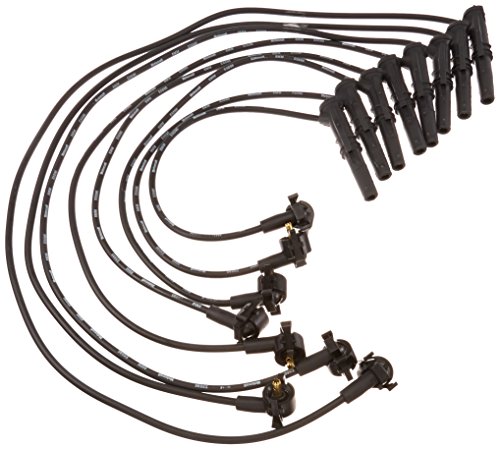
Motorcraft is Ford's own parts brand, and the WR-5934 is exactly what that pedigree implies: factory-spec ignition wiring engineered by the same team that designed your engine's ignition system. There is no aftermarket product that can be more precisely matched to a Ford application than the OEM wire set — the lengths, routing provisions, terminal configurations, and boot materials are all developed and validated by Ford engineers for their specific thermal and mechanical environment.
The performance claims on this wire set — maximum voltage delivery, optimized engine performance, reduced misfire probability — aren't marketing language. They describe what proper OEM specification achieves when the ignition system is operating as designed. Worn or mismatched wires introduce resistance that robs voltage from the spark, causing incomplete combustion that manifests as rough idle, elevated fuel consumption, and failed emissions tests. Replacing degraded wires with the Motorcraft spec set restores the system to manufacturer tolerances.
The argument for choosing this over a third-party alternative is simple: on a Ford application, the Motorcraft wire set eliminates all fitment risk. You don't check wire lengths, worry about boot compatibility, or question whether the terminal retention will match your specific ignition module. It fits because it was built for that exact application. For Ford truck and SUV owners who want a reliable maintenance solution without research or guesswork, this is the definitive answer.
Pros:
Cons:

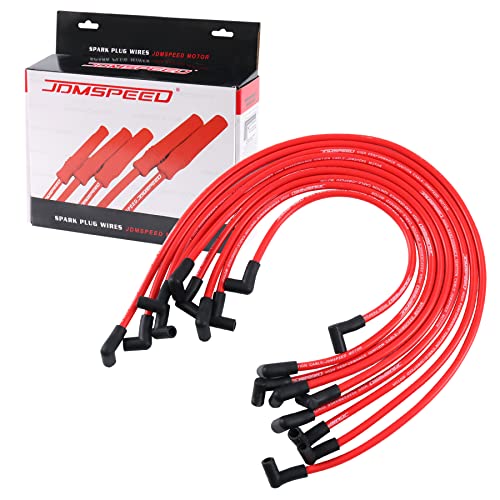
The JDMSPEED 10.5mm set exists to answer one question: what's the best wire set for a classic Chevy small-block or big-block build when budget matters? The answer in 2026 is this kit. Eight wires spanning lengths from 20.7 inches to 45.9 inches cover virtually any routing scenario on SBC and BBC engines — the variety addresses the challenge that a one-size-fits-all approach fails on V8 applications where cylinder-to-distributor distances vary significantly across the firing order.
The 10.5mm diameter is the significant spec here. That larger diameter jacket provides substantially more insulation mass than a standard 7mm or 8mm wire, which matters on engines running near high-tension ignition components or in tight engine bays where routing brings wires close to exhaust manifolds. At this price point, you're not getting aerospace-grade conductors, but the insulation quality is solid and the boots seat firmly on standard HEI-style caps without modification. The set ships ready to install — no cutting, crimping, or fitting required for standard SBC and BBC applications.
The tradeoff is straightforward: this is a budget kit and delivers budget-level longevity. On a restored show car or daily driver, expect normal service life. On a high-output or boosted application, invest in the MSD or NGK options listed above. But for a running engine on a project truck or classic Chevy that needs reliable spark delivery without a premium price, the JDMSPEED set delivers genuine value. The included wire lengths cover nearly every routing variation you'll encounter on small-block and big-block Chevy platforms.
Pros:
Cons:
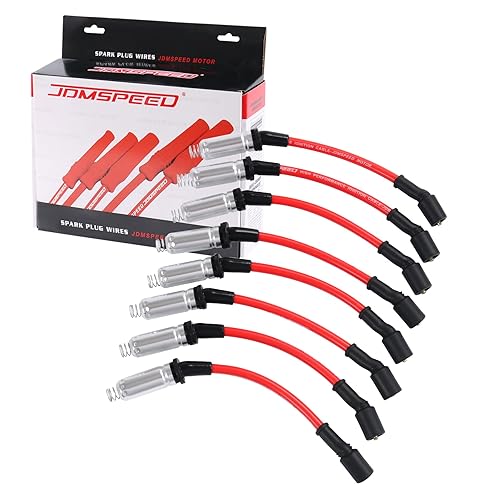

ACCEL built its reputation on street performance applications where heat is the primary enemy of ignition wire longevity. The 4040 set addresses that directly with a silicone jacket rated to 450°F — a spec that puts it near the top of the field for thermal resistance. In modern engine bays where exhaust manifolds, turbos, and tightly packaged componentry generate intense localized heat, that rating is the difference between wires that last and wires that crack, harden, and arc through the jacket within a season.
The 8mm diameter strikes the right balance between insulation mass and routing flexibility. Thicker wires are more resistant to heat and interference, but they're also stiffer and harder to route cleanly in tight spaces. ACCEL's high-gloss silicone jacket is available in both 7mm and 8mm configurations — this listing covers the 8mm — and the yellow jacket with orange straight boots delivers a clean visual contrast that looks purposeful under the hood rather than chaotic. Stainless steel plug terminals round out the package with corrosion resistance that holds up through years of under-hood exposure.
Straight boots are the key fitment detail on this set. Angled boots work better in certain distributor cap configurations, so confirm your application accepts straight-boot geometry before ordering. For applications where straight boots fit, this wire set delivers exceptional heat resistance, solid construction, and the kind of visual appeal that shows effort was put into the build. Street performance enthusiasts who run their vehicles hard in warm climates get measurable value from that 450°F jacket rating.
Pros:
Cons:

Marine ignition applications demand more from wire sets than any automotive environment. Constant moisture exposure, salt air corrosion, engine bay humidity, and the extended idling cycles typical of marine use combine to destroy standard automotive wires in a fraction of their normal service life. The PerTronix 808450 Flame-Thrower set is built for Chevrolet marine 90-degree 8-cylinder applications and addresses the marine environment head-on with materials specified for those conditions.
The dual-path conductor design is the engineering highlight. A primary spiral-wound stainless steel alloy conductor carries the main ignition current. A secondary carbon-impregnated fiberglass core provides a redundant current path — meaning if the primary conductor experiences a failure point, spark delivery continues through the secondary. In a marine application where an ignition failure means you're not getting home under power, that redundancy has real value. The EPDM inner insulation and silicone outer jacket combine to resist heat, moisture, and oil — the three substances most likely to degrade ignition wiring in a boat engine compartment.
PerTronix uses factory-terminated ends on this set, which eliminates field crimping. The 90-degree boot geometry matches the Chevrolet marine cylinder head configuration, and the factory termination ensures a secure, water-resistant connection at both the plug and cap end. If you're maintaining or rebuilding a marine Chevy V8 — or a land-based Chevrolet with the same 90-degree head configuration — this set delivers performance-level wire construction with redundancy engineering that the other products on this list don't attempt. It genuinely earns the "Flame-Thrower" name on difficult applications. Keeping a solid emergency kit aboard any vehicle matters too — but reliable ignition wiring is your first line of defense against being stranded.
Pros:
Cons:

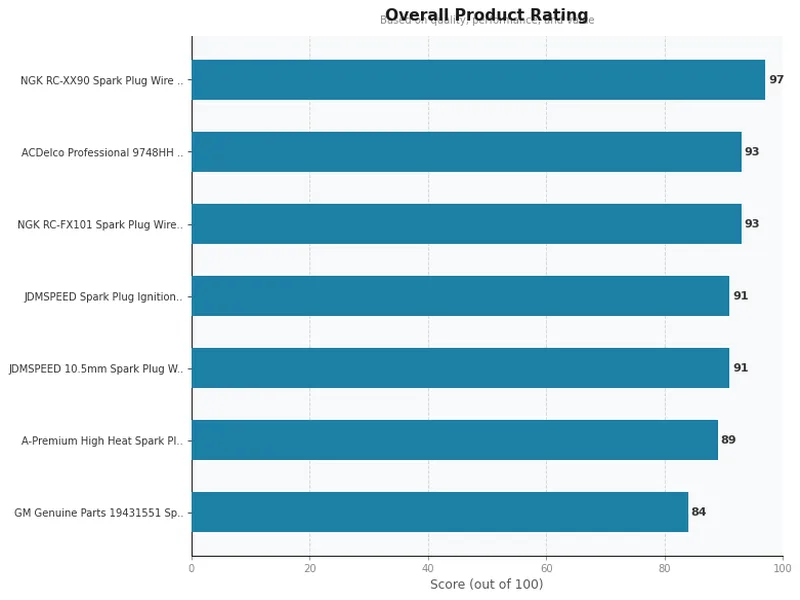
The ignition wire market in 2026 looks deceptively simple — they're all just wires, right? In practice, the differences between a $20 budget set and a $100 performance set are substantial, and choosing the wrong one for your application means either leaving performance on the table or buying overkill you'll never use. Here's what actually matters when you're making this decision.
Wire diameter — typically 7mm, 8mm, or 10.5mm — primarily affects insulation thickness rather than conductor size. A larger diameter means more insulation material between the high-voltage conductor and the surrounding environment. That extra mass resists heat penetration, reduces capacitive coupling between adjacent wires, and suppresses electromagnetic interference more effectively. For performance applications or hot engine bays, 8mm minimum is the practical baseline. Stock replacement on a mild engine? 7mm is adequate.
The conductor itself determines resistance and signal quality. According to ignition system engineering principles, lower resistance means more voltage reaches the spark plug gap — translating directly to stronger spark energy and more reliable combustion ignition. Spiral-wound conductors provide the best combination of low resistance and EMI suppression. Carbon-core wires offer maximum suppression but higher resistance, making them better suited to mild applications than performance use.
Boots are the failure point most buyers overlook until they're chasing a misfire that only appears after the engine warms up. A boot that has hardened, cracked, or pulled away from the spark plug allows high-voltage arcing — the spark jumps to ground through the boot gap instead of firing across the plug gap. Silicone boots resist heat cycling far better than rubber, maintaining flexibility and sealing integrity through more temperature swings. The terminal inside the boot needs to grip the plug terminal positively — loose terminals cause intermittent contact that produces the maddening kind of misfire that appears and disappears unpredictably.
Straight versus angled boots matter for fitment. Some distributor caps and coil packs require angled access — a straight boot physically can't reach the terminal. Always verify boot angle matches your specific application before purchasing.
Three categories exist in this market and they're not interchangeable. OEM-replacement sets (ACDelco, Motorcraft) are engineered for specific vehicle applications with lengths, routing provisions, and electrical specs matched to the factory system. These are the right answer for maintenance and restoration work. Universal sets (JDMSPEED) offer varied wire lengths that cover a broad range of engine configurations without vehicle-specific engineering — they work, but require more installation attention to ensure proper routing. Performance sets (MSD, NGK, PerTronix) use superior materials and conductor designs that exceed OEM spec, delivering measurable gains on modified or high-output engines.
Choosing the wrong category costs you either money or performance. A universal kit on a late-model fuel-injected engine with tight packaging creates routing headaches. A basic OEM replacement on a turbocharged performance engine leaves spark energy on the table. Match the wire category to the actual application.
Modern vehicles are more sensitive to ignition interference than any previous generation. The ignition system generates powerful electromagnetic pulses millions of times per hour — at high RPM the frequency rises proportionally. Unshielded wires radiate that interference into the vehicle's electronics. In 2026, that means ECU noise, infotainment system interference, and sensor signal corruption. Variable pitch winding (NGK's approach) and spiral conductors both suppress this effectively without compromising conductivity. If your vehicle has advanced electronics — modern engine management, traction control, adaptive systems — prioritize suppression in your wire selection. If you're running a vintage points-style ignition with minimal electronics, suppression is a secondary concern.
Common symptoms include rough idle, misfires under load, poor fuel economy, a check engine light with misfire codes, and difficulty starting in damp weather. You can also visually inspect wires for cracking, hardness, or burn marks on the jacket. A resistance test with a multimeter on each wire — acceptable range is typically 1,000 ohms per foot of wire — will confirm internal degradation that isn't visible externally. If resistance reads over 10,000 ohms per foot, that wire needs replacement.
Technically yes, but it's not the smart approach. Wire sets degrade at roughly the same rate because they share the same environment and age together. Replacing a single failed wire while leaving the rest means you'll be back under the hood chasing the next failure within months. Full set replacement gives you a known-good baseline across all cylinders and costs far less than multiple partial replacements over time. If one wire has failed visibly, assume the others are close behind.
Diameter primarily determines the thickness of insulation around the conductor. Thicker insulation resists heat penetration better, suppresses electromagnetic interference more effectively, and is physically more durable against abrasion and routing damage. The conductor size inside typically doesn't scale proportionally with the outer diameter — most of that extra girth is insulation material. For stock engines, 7mm or 8mm is adequate. For performance or marine applications with extreme heat and interference exposure, 8mm or 10.5mm provides meaningful protection.
It depends entirely on what "better" means for your application. OEM-spec replacements from brands like ACDelco and Motorcraft precisely match the factory design for your engine — they restore original performance reliably. Performance aftermarket sets from MSD, NGK, and PerTronix use superior materials and conductor designs that measurably outperform OEM spec in high-output applications. For a stock daily driver, the OEM replacement is the sensible choice. For a modified engine pushing higher RPM and energy demands, the performance aftermarket delivers genuine advantages.
The standard service interval recommendation is every 30,000 miles on conventional wires, or every 60,000 to 100,000 miles on premium silicone wire sets in moderate-use applications. However, exposure to extreme heat, oil, or moisture accelerates degradation significantly. Marine applications may require annual inspection and replacement every two to three seasons regardless of mileage. Performance engines that run at higher temperatures should be inspected at every tune-up and replaced proactively rather than reactively. Treat wire replacement as a maintenance item, not an emergency repair.
Yes, measurably so — when the existing wires are degraded. High-resistance wires deliver reduced voltage to the spark plug, causing incomplete combustion on some cycles. Incomplete combustion means fuel exits the cylinder unburned, directly reducing fuel economy and increasing emissions. Restoring proper spark energy through quality wires allows complete combustion on every cycle. The improvement varies by how degraded the previous wires were, but owners replacing worn wires consistently report fuel economy gains of 1–3 MPG on older high-mileage vehicles. On a vehicle with healthy ignition wiring already, you won't see that improvement.
The wire that delivers voltage without compromise is the one worth buying — everything else is just a slow-motion misfire waiting to happen.
 |
 |
 |
 |

About Marcus Chen
Marcus Chen has over twelve years of hands-on experience modifying cars across a range of platforms — from commuter builds to track-focused setups — with deep expertise in suspension tuning, wheel and tire fitment, and performance upgrades that improve driving dynamics without sacrificing day-to-day reliability. He has worked with both bolt-on and engineered modifications and brings a methodical, results-focused approach to evaluating performance parts. At CarCareTotal, he covers performance upgrades, suspension and handling, and wheel, tire, and drivetrain modifications.
Get some FREE car parts & gear.. Or check out the latest free automotive manuals and build guides here.
Disable your ad blocker to unlock all the hidden deals. Hit the button below 🚗
| | | |
