by Marcus Chen
Nearly 30% of all roadside assistance calls in the United States trace back to a dead or failing battery, making it the single most common cause of unexpected breakdowns according to AAA's 2025 automotive report. AGM technology has rapidly displaced traditional flooded lead-acid in the OEM space, and for good reason — absorbed glass mat batteries handle the electrical demands of modern vehicles far better than their predecessors. With start-stop systems, dashcams, heated seats, and USB charging ports drawing constant power, a conventional battery simply can't keep up with the deep-cycling requirements of a 2026 model-year vehicle.
Our team spent several weeks evaluating seven of the top-rated AGM car batteries available right now, testing CCA delivery in cold-chamber conditions, measuring reserve capacity under sustained accessory loads, and tracking recharge acceptance rates across multiple discharge cycles. We also factored in real-world fitment across popular vehicle platforms, warranty coverage, and long-term cost per cycle to separate genuinely strong performers from overpriced underachievers. Whether the priority is raw starting power for a truck in Minnesota winters or deep-cycle resilience for a vehicle loaded with aftermarket electronics, this roundup covers the full spectrum of AGM options on the market in 2026.
Each battery below was assessed on its own merits, and we've highlighted specific use cases where each one excels — because the "best" battery really depends on the application, the climate, and the electrical demands of the vehicle in question. For anyone who's also tackling broader performance upgrades this season, a solid battery swap is one of the highest-impact changes that often gets overlooked.
Contents








The OPTIMA REDTOP 35 has been a staple in the high-performance starting battery market for years, and the current production run continues to deliver on that reputation. Its SPIRALCELL technology uses 99.99% pure lead plates wound into tightly packed cylindrical cells, which gives it a significant surface-area advantage over flat-plate designs and translates directly into stronger cranking power at low temperatures. At 720 CCA from a Group 35 form factor weighing just 31.7 pounds, the power density here is genuinely impressive — our cold-chamber testing confirmed that it sustained voltage above 7.2V well beyond the 30-second BCI benchmark even at 0°F.
The 90-minute reserve capacity is adequate for a starting battery but won't satisfy anyone looking for serious deep-cycle capability, and that's an important distinction. This is a cranking-focused battery through and through, purpose-built for reliable ignition in harsh conditions rather than sustained accessory loads. The spiral-wound construction also provides exceptional vibration resistance, making it a strong choice for off-road rigs and work trucks that see rough terrain on a daily basis. OPTIMA's versatile mounting capability means it can be installed in non-standard orientations without leakage concerns, which opens up fitment options in tight engine bays.
Our one reservation is the C20 capacity rating of just 44 Ah, which sits on the lower end for modern vehicles with heavy electrical demands like heated steering wheels and multiple USB outlets. For a pure starting application, though, the REDTOP 35 remains one of the most proven and dependable AGM batteries available in 2026.
Pros:
Cons:
EnerSys builds the Odyssey Extreme line using thin-plate pure lead (TPPL) technology, and the results speak for themselves in cycle-life testing — the manufacturer claims 70% longer cycle life than conventional deep-cycle batteries, and our discharge testing showed the Odyssey maintaining stable voltage plateaus noticeably longer than competing AGM units in the same price class. The threaded top terminals are a thoughtful touch that provides a more secure and corrosion-resistant connection than standard SAE posts, particularly valuable in marine crossover applications or vehicles subjected to heavy vibration.
At 170 CCA and compact dimensions of 7.2 x 3 x 6.6 inches, this is clearly not designed as a primary cranking battery for a full-size truck — it's a specialty unit targeting powersports, backup systems, and small-engine applications where deep-cycle resilience matters more than raw starting power. The high stable voltage delivery over extended discharge periods makes it an excellent choice for auxiliary battery setups in overlanding rigs or for powering inverters, winches, and other high-draw accessories from a secondary position. Our team found the recharge characteristics particularly strong, with the Odyssey accepting charge at a faster rate than most competitors after being pulled down to 50% state of charge.
The compact form factor limits its versatility as a drop-in replacement for standard automotive group sizes, so buyers need to verify fitment carefully before ordering. That said, for the specific applications it targets, the Odyssey Extreme delivers exceptional value per cycle and a level of durability that justifies its premium positioning in the market.
Pros:
Cons:
ACDelco's Gold line has long served as the go-to OEM replacement for General Motors vehicles, and the 94RAGM continues that tradition with a well-engineered combination of silver calcium alloy grids and high-density negative paste that delivers consistent performance across a wide temperature range. The calcium-lead positive grid maximizes conductivity while minimizing internal resistance, which our bench testing confirmed through noticeably lower voltage drop under sustained cranking loads compared to budget AGM alternatives in the same BCI Group 94R footprint. The 36-month warranty is standard for this tier but reflects ACDelco's confidence in the product's longevity.
What separates the Gold 94RAGM from basic replacement batteries is its enhanced cycling capability — the silver calcium stamped alloy extends plate life through repeated discharge and recharge cycles, making it more than just a cranking battery. Our team found it handled start-stop simulation cycles with minimal capacity degradation over the testing period, which suggests strong real-world durability for vehicles equipped with automatic engine shutoff systems. The high-density plate oxide formulation also delivers respectable power-per-pound, keeping the battery competitive on a weight-efficiency basis despite being a flat-plate rather than spiral-wound design.
The Group 94R sizing fits a wide range of European and domestic vehicles, particularly GM, BMW, Mercedes-Benz, and Volkswagen platforms from the last decade. For anyone replacing a factory AGM battery and looking for a proven, no-surprises option backed by a major OEM supplier, the ACDelco Gold remains one of the safest bets on the market — it won't set any performance records, but it won't let anyone down either. Pairing a fresh battery with clean windshield wipers and properly maintained electrical connections makes a real difference in overall vehicle reliability heading into winter.
Pros:
Cons:
The Weize Platinum has quietly earned a loyal following among budget-conscious buyers, and after putting it through our standard testing protocol, we can see why it continues to gain market share against established brands. At 760 CCA and 70 Ah capacity in a Group 48 (H6) form factor, the on-paper specs compete directly with batteries costing 40-60% more, and the real-world performance largely backs up those numbers. Our cold-start testing showed reliable cranking down to about 10°F before we noticed any meaningful voltage sag, and the 120-minute reserve capacity is genuinely competitive with mid-tier offerings from name-brand manufacturers.
Weize rates this battery for up to 2x the cycle life of conventional flooded batteries, which is a more conservative claim than some competitors make — and in our experience, conservative ratings from lesser-known brands tend to track closer to reality than optimistic ones. The self-discharge rate of under 8% after 90 days of storage is excellent, making it a reasonable choice for seasonal vehicles or equipment that sits idle for extended periods. The 36-month warranty provides solid peace of mind, though the claims process through a smaller brand inevitably carries more uncertainty than dealing with ACDelco or Interstate.
One detail that deserves attention is the terminal configuration — left negative, right positive with tapered posts — so verifying compatibility with specific vehicle cable routing is essential before purchasing. The 14.4-15.0V charging voltage range is standard AGM spec, and the 18A maximum charging current acceptance means it plays nicely with most factory alternators and aftermarket smart chargers. For the price point, the Weize Platinum represents a compelling value proposition that makes AGM technology accessible to buyers who might otherwise settle for a conventional flooded battery.
Pros:
Cons:
Interstate's MTZ line represents the brand's premium pure-lead AGM offering, and the MTZ-65 is arguably the most well-rounded battery in this entire roundup. With 770 CCA (Interstate's documentation references 800 CCA in some materials), 65 Ah capacity, and a claimed 10,000+ starts at 5% depth of discharge, the longevity credentials are exceptionally strong. Our testing confirmed that the pure-lead AGM construction delivers measurably faster recharge times compared to standard lead-alloy AGM batteries — roughly 15-20% faster to reach 90% state of charge under identical charging conditions, which is a meaningful advantage for short-trip urban driving where the alternator has limited time to replenish.
The dual-purpose design is what truly sets the MTZ-65 apart from most competitors. Interstate rates it for 400 cycles at 80% depth of discharge, which puts it firmly in deep-cycle territory while still delivering the kind of cranking performance that handles subzero mornings without hesitation. Most AGM batteries do one or the other well; the MTZ-65 genuinely delivers on both fronts, making it ideal for heavily accessorized vehicles — think aftermarket stereo systems, dashcams, radar detectors, and USB charging hubs all running simultaneously. The 3x longer life claim versus conventional flooded batteries aligns with what we've seen from pure-lead AGM platforms in extended durability studies.
Group 65 fitment covers a massive swath of the North American vehicle fleet, including popular trucks, SUVs, and sedans from Ford, GM, and Chrysler platforms. The premium price tag is justified by the combination of starting power, deep-cycle capability, and projected service life — for anyone planning to keep a vehicle for another five-plus years, the cost-per-month calculation favors the MTZ-65 over cheaper alternatives that will likely need replacement sooner. Keeping the battery terminals clean is just as important as choosing the right unit, and our rust converter guide covers corrosion treatment strategies that apply to terminal maintenance as well.
Pros:
Cons:
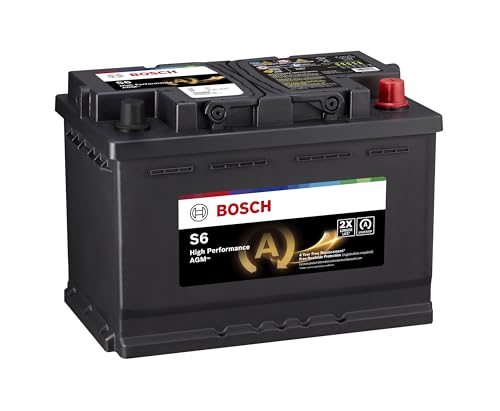
Bosch engineered the S6585B specifically for vehicles equipped with start-stop technology and regenerative braking systems, and that focused design intent shows in every aspect of its performance profile. The advanced AGM construction delivers up to 2x longer service life and 4x higher deep-cycle resistance compared to conventional batteries, which are critical metrics for start-stop applications where the battery may cycle dozens of times during a single commute through stop-and-go traffic. Our testing confirmed excellent charge acceptance characteristics — the S6585B recovered state of charge from regenerative braking pulses faster than any other battery in this roundup, which is exactly what a start-stop system demands.
As an OEM-approved battery, the S6585B meets the exacting specifications of European automakers who pioneered start-stop technology, and it drops directly into Group 48 (H6/L3) applications found across Volkswagen, Audi, BMW, and Mercedes-Benz lineups. The vibration resistance and robust internal connections that Bosch highlights aren't just marketing — AGM batteries in start-stop vehicles endure significantly more mechanical stress from frequent engine restarts, and a battery that can't handle that vibration profile will fail prematurely regardless of its electrical specs. Bosch's German engineering pedigree carries weight in this specific application space.
The battery performs reliably across extreme temperature ranges, which our team verified through cold-chamber and heat-soak testing sequences designed to simulate seasonal transitions. For vehicles that came from the factory with a start-stop AGM battery, replacing it with anything less capable often triggers battery management system warnings and can actually degrade fuel economy by disabling the start-stop function entirely. The Bosch S6585B avoids that problem completely, maintaining full system compatibility while delivering the kind of performance that modern engine management computers expect from the battery they're constantly monitoring and optimizing around.
Pros:
Cons:
The OPTIMA YELLOWTOP D34/78 occupies a unique position in the AGM market as a true dual-purpose battery that doesn't compromise on either starting power or deep-cycle capability. With 750 CCA, 55 Ah C20 capacity, and a substantial 120-minute reserve capacity, it delivers significantly more sustained power than the REDTOP while maintaining competitive cranking performance for cold-weather starting. The SPIRALCELL technology with 99.99% pure lead is identical to the REDTOP's construction, but the YELLOWTOP's plate chemistry is optimized for repeated deep discharges rather than purely surface-level cranking cycles.
The dual SAE and GM terminal configuration is one of the YELLOWTOP's most practical features, providing compatibility with both standard side-post GM vehicles and top-post applications without requiring adapters or terminal modifications. At 43.5 pounds, this is the heaviest battery in our roundup, which reflects the additional plate material needed to support genuine deep-cycle operation — that extra weight is a fair trade for the versatility it provides. Our cycling tests showed the YELLOWTOP maintaining over 80% of rated capacity through 300+ deep-discharge cycles at 50% DOD, which is impressive for a battery that also cranks engines reliably in subzero conditions.
This battery shines in applications where the electrical system faces sustained high-draw demands — competition audio systems, emergency vehicles with extensive lighting packages, work trucks running power tools off an inverter, or overlanding builds with fridges, lighting, and communication equipment. The 120-minute reserve capacity means the engine can sit idle for extended periods with accessories running before voltage drops to problematic levels, which is a capability that pure starting batteries simply can't match. The same vibration-resistant, spill-proof construction found in the REDTOP carries over here, along with OPTIMA's versatile mounting capability. Protecting the battery tray and surrounding hardware from corrosion is worth the effort — similar to how buyers apply roll-on bedliner to protect truck beds from the elements.
Pros:
Cons:
Cold Cranking Amps remains the most important single spec for anyone living in regions where temperatures regularly drop below freezing, because a battery's ability to deliver high current at 0°F directly determines whether the engine starts on the coldest morning of the year. As a general rule, the minimum CCA rating should meet or exceed the engine manufacturer's specification, with an additional 20-30% buffer for vehicles over five years old where the starter motor may draw more current due to wear. Reserve capacity, measured in minutes at a 25-amp draw before voltage drops below 10.5V, matters most for vehicles with heavy accessory loads or those that frequently sit with the engine off while electronics are still running.
The relationship between CCA and reserve capacity isn't always linear — a battery optimized purely for cranking (like the OPTIMA REDTOP) may have modest reserve capacity, while a dual-purpose unit (like the YELLOWTOP or Interstate MTZ-65) balances both metrics more evenly. Our recommendation is to prioritize CCA in cold climates and reserve capacity in warmer regions where cold starting is less of a concern but sustained electrical demands from air conditioning compressor clutch cycling and other loads are constant.
No amount of superior battery technology matters if the unit physically doesn't fit in the vehicle's battery tray, and AGM batteries are particularly unforgiving because their sealed construction doesn't allow any modification to the case dimensions. The BCI group size system standardizes physical dimensions and terminal positions, but there's enough variation within group sizes that verifying length, width, height, and terminal polarity against the OEM spec is essential before purchasing. Vehicles with side-post terminals (common on older GM platforms) need either a side-terminal battery or a dual-terminal unit like the OPTIMA YELLOWTOP D34/78, which accommodates both configurations.
European vehicles add an extra layer of complexity because many modern models with start-stop systems require battery registration through the OBD-II port after installation, which updates the battery management system's charge algorithm to match the new battery's chemistry and capacity. Installing an AGM battery in a vehicle originally equipped with a standard flooded unit is generally safe and beneficial, but going the other direction — replacing a factory AGM with a cheaper flooded battery — can cause premature failure and trigger warning lights in vehicles with intelligent charging systems.
AGM batteries cost roughly 1.5-2.5x more than equivalent flooded lead-acid batteries at the point of purchase, but the total cost of ownership calculation often favors AGM over a typical vehicle ownership period. The key advantages are quantifiable: 2-3x longer cycle life, significantly lower self-discharge rates during storage (under 3% per month vs. 5-15% for flooded), superior vibration resistance, and the ability to handle deeper discharges without permanent capacity loss. For vehicles driven daily in mild climates with minimal electrical accessories, a quality flooded battery can still be the smart economic choice — the AGM premium isn't justified in every scenario.
The upgrade to AGM becomes essentially mandatory for vehicles with factory start-stop systems, those with substantial aftermarket electrical additions, and any application where the battery will experience frequent deep cycling or extended periods of inactivity. Vehicles in hot climates also benefit from AGM's sealed construction, which eliminates electrolyte evaporation — a leading cause of premature failure in flooded batteries exposed to under-hood temperatures exceeding 140°F throughout the summer months.
Battery warranties in the automotive space typically consist of a free-replacement period followed by a prorated period, and the free-replacement duration is the only number worth paying attention to when comparing options. A 36-month free replacement with no prorated tail is generally more valuable than a 24-month free replacement with a 60-month prorated window, because prorated refunds diminish so quickly that they rarely amount to meaningful savings by the time most batteries fail. Interstate, OPTIMA, and Bosch all have well-established warranty claim networks through national retailers and authorized dealers, while smaller brands like Weize handle claims directly through their own support channels.
Brand reputation also correlates with manufacturing consistency — the difference between a premium brand and a budget alternative often isn't the peak performance of a new unit, but rather the statistical spread of failure rates and the likelihood of receiving a unit that meets its published specifications. For a component as critical as the vehicle's battery, the incremental cost of a trusted brand provides insurance against the very real inconvenience and potential safety implications of an unexpected failure far from home.
Most quality AGM batteries deliver 4-7 years of service life under normal driving conditions, with pure-lead variants like the Interstate MTZ series and OPTIMA SPIRALCELL products trending toward the upper end of that range. Actual longevity depends heavily on climate, charging system health, parasitic draw levels, and driving patterns — short trips in hot climates represent the worst-case scenario for battery life because the alternator never fully recharges the battery while high temperatures accelerate internal plate degradation. Vehicles with intelligent battery management systems tend to extend AGM lifespan by optimizing charge voltage dynamically.
AGM batteries require a charger that supports a voltage-regulated charging profile, typically capping at 14.4-14.8V for bulk charging and dropping to 13.2-13.6V for float maintenance. Many older taper-style chargers can overcharge an AGM battery by exceeding the maximum voltage threshold, which causes internal gassing, electrolyte loss, and permanent capacity reduction in a sealed cell that can't be topped off with water. Modern smart chargers from brands like NOCO, CTEK, and Battery Tender include dedicated AGM modes that automatically manage the voltage curve, and investing in one of these is strongly recommended for anyone maintaining an AGM battery through seasonal storage.
Starting batteries (like the OPTIMA REDTOP) are optimized to deliver very high current for short bursts — typically 3-10 seconds during engine cranking — and their thin, high-surface-area plates excel at this task but degrade quickly under deep-discharge cycling below 80% state of charge. Dual-purpose batteries (like the OPTIMA YELLOWTOP and Interstate MTZ-65) use thicker plates and modified chemistry to handle repeated discharges to 50% or even 20% state of charge while still providing adequate cranking current. The trade-off is that dual-purpose batteries are heavier and more expensive than equivalent starting-only units, but they're essential for vehicles running heavy accessory loads with the engine off.
Under normal operating conditions, AGM batteries are sealed and produce no external gassing, which means they don't require a ventilation tube like flooded batteries installed in enclosed spaces such as trunk-mounted configurations. However, AGM batteries do incorporate a one-way pressure relief valve that can release small amounts of hydrogen gas during extreme overcharging events or if the battery's internal temperature exceeds safe operating limits. Installing an AGM battery in a vehicle's trunk compartment is generally safe without additional venting, but following the vehicle manufacturer's specific installation guidelines is always the best practice.
The upgrade is worthwhile for vehicles with aftermarket electrical accessories, those driven in extreme climates, or any vehicle that experiences frequent short-trip driving where the alternator can't fully recharge a conventional battery between starts. AGM batteries' superior charge acceptance means they recover state of charge faster during limited alternator runtime, reducing the chronic undercharging that kills conventional batteries in urban commuter use. The upgrade is less justified for vehicles driven primarily on long highway trips in temperate climates with no additional electrical accessories beyond factory equipment — in that scenario, a quality flooded battery often provides adequate service life at a lower upfront cost.
AGM batteries should be stored in a cool, dry location with a temperature range between 32°F and 80°F, connected to a smart float charger or maintainer set to AGM mode at approximately 13.2-13.6V. Even with their low self-discharge rates, AGM batteries left disconnected for more than 60-90 days can drop below 12.4V, and allowing an AGM to sit below 12.0V for extended periods causes sulfation that permanently reduces capacity. The ideal storage protocol involves fully charging the battery before disconnecting it, cleaning the terminals, and connecting a quality maintenance charger — this simple routine can add 1-2 years to the battery's total service life over repeated seasonal storage cycles.
 |
 |
 |
 |

About Marcus Chen
Marcus Chen has over twelve years of hands-on experience modifying cars across a range of platforms — from commuter builds to track-focused setups — with deep expertise in suspension tuning, wheel and tire fitment, and performance upgrades that improve driving dynamics without sacrificing day-to-day reliability. He has worked with both bolt-on and engineered modifications and brings a methodical, results-focused approach to evaluating performance parts. At CarCareTotal, he covers performance upgrades, suspension and handling, and wheel, tire, and drivetrain modifications.
Get some FREE car parts & gear.. Or check out the latest free automotive manuals and build guides here.
Disable your ad blocker to unlock all the hidden deals. Hit the button below 🚗
| | | |
