by Joshua Thomas
According to AAA, dead or weak batteries account for the single largest category of roadside assistance calls in the United States — topping 7.7 million service calls in a recent year alone. That number tells you something important: no matter how well you maintain your vehicle, a failing battery is one of the most common automotive problems you will face in your lifetime, and having a reliable set of jumper cables within arm's reach can be the difference between a five-minute fix and a two-hour wait on the shoulder. In 2026, the market for jumper cables has expanded considerably, giving you options ranging from lightweight, budget-friendly 6-gauge sets designed for compact cars all the way to beefy 0-gauge, 1000-amp behemoths built to resurrect the deadest diesel truck engine on a January morning.
Choosing the right set is not as simple as grabbing whatever is cheapest at your local auto parts store. Gauge, cable length, clamp quality, insulation flexibility in cold weather, and whether the product carries a legitimate UL listing all determine whether your cables will perform when you genuinely need them. A thinner gauge cable may work fine for a small sedan in mild temperatures, but ask it to jump-start a loaded pickup truck in sub-zero conditions and you will be standing in the cold waiting for a tow truck regardless. The buying guide section below breaks down every spec you should evaluate before pulling the trigger. You can also browse our full collection of automotive tools and accessories at our tools and gear hub for related recommendations across every category.

To build this 2026 guide, we evaluated seven of the most popular and highly rated jumper cable sets available on Amazon, comparing them across gauge, length, clamp construction, insulation quality, included accessories, and real-world usability for everything from motorcycle batteries to 24-volt diesel rigs. Whether you are shopping for a compact set to stow under a seat or a professional-grade kit for your garage or roadside emergency bag, there is a right answer here for your exact situation, and we have ranked them accordingly below.
Contents
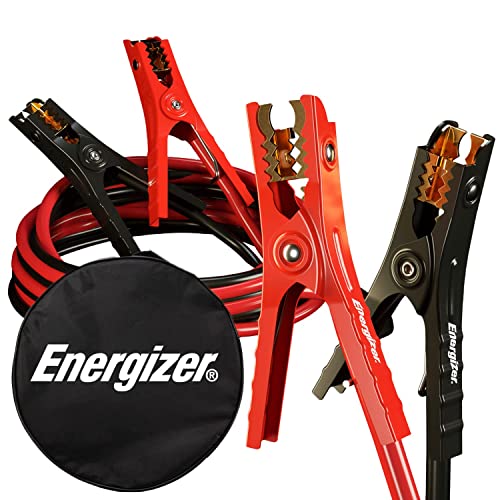







If you drive a compact car, mid-size sedan, or small SUV and you want a dependable set of jumper cables without spending more than the situation warrants, the Energizer 16-foot 6-gauge set is the most logical starting point in 2026. Energizer is a name you already trust for battery products, and this set delivers the same reliability you expect from that brand in a package that is genuinely compact enough to live in a carry bag in your trunk without taking up meaningful space. The 6-gauge wire is appropriate for most passenger vehicles and lighter trucks, providing enough amperage capacity to handle the vast majority of dead-battery scenarios you are likely to encounter in day-to-day driving.
The cables themselves are coated in a thick vinyl jacket that resists rust, corrosion, and the kind of general abuse that comes from being thrown around a trunk over years of use. The clamps feature strong springs and comfortable handles that make it easy to position them on battery terminals with one hand, which matters more than people realize when you are crouched behind an open hood in the dark or rain. The included carrying bag is legitimately high-grade — not the flimsy drawstring sacks many competitors include — and keeps the set neatly coiled and ready to deploy. If you need something heavier for a full-size truck or a diesel engine, step up in gauge, but for the average passenger vehicle owner, this Energizer set punches well above its price point.
Pros:
Cons:
Goodyear is one of the most recognized names in the automotive world, and this 2-gauge, 20-foot booster cable set earns that name's reputation for durability and field reliability. The 2-gauge wire construction is a significant step up from the 4 and 6-gauge sets that dominate the budget end of the market, offering substantially better energy transfer efficiency and far greater amperage capacity across a wide range of vehicle types, including full-size trucks, larger SUVs, and high-displacement gas engines that demand serious current to turn over a dead battery in cold conditions.
The 20-foot cable length is one of the most practical features of this set, because it eliminates the frustration of trying to maneuver two vehicles close enough together to connect a shorter cable. Whether you pull up nose-to-tail or side-by-side, 20 feet gives you the flexibility to make the connection without a second attempt at positioning. The PVC insulation remains pliable in extreme temperatures, which is not something you can say about every set at this gauge level — cheaply insulated cables stiffen in the cold and become awkward to handle precisely when you need them most. If you keep a dedicated car emergency kit in your vehicle, this Goodyear set belongs in it alongside a set of OBD2 diagnostic tools and other roadside essentials.
Pros:
Cons:
When you drive a diesel truck, a freight hauler, or any large commercial vehicle, the word "heavy duty" on a set of jumper cables needs to actually mean something — and the TOPDC 0-gauge, 1000-amp set delivers on that promise with a specification sheet that leaves no ambiguity. The 2/0 gauge conductor is among the thickest wire you will find in a consumer-grade jumper cable set in 2026, and that thickness directly translates into the instantaneous current capacity needed to turn over high-compression diesel engines that draw enormous amperage during cold starts. This set is rated for both 12-volt and 24-volt systems, which means it is genuinely appropriate for freight vehicles and heavier commercial applications where lesser cables would simply overheat.
The conductors are built with high-density copper-clad aluminum, which strikes the right balance between conductivity, weight, and cost — pure copper at this gauge would be significantly heavier and more expensive. The four alligator clamps feature sharp, jagged serrated teeth and heavy-duty springs that bite firmly onto battery terminals without slipping, even on corroded or irregularly shaped posts. The outer insulation is fabricated from premium PVC that TOPDC rates for operation between -40°F and 140°F, and the UL listing on these clamps is legitimate third-party certification rather than a self-declared marketing claim. The 20-foot cable length is appropriate for most scenarios, and the included kit with case and gloves makes this a genuinely complete package for professional use.
The copper-clad aluminum construction does mean you are not working with solid copper conductors, which some professionals prefer, but in practical terms the performance difference in jump-starting applications is negligible given the gauge. The weight savings are real, and at 0-gauge this matters when you are coiling and uncoiling cables repeatedly during a workday.
Pros:
Cons:
Forney is a brand built on professional-grade welding and electrical equipment, and this Number 2 jumper cable set reflects that industrial heritage in the most important component of any booster cable: the clamps. The 500-amp clamps on this Forney set are super heavy-duty forgings that apply consistent, high-force pressure to battery terminals, delivering the kind of contact reliability that matters most when you are trying to push maximum current through a barely-alive battery. The premium copper welding cable used for the conductors is not an accident — welding cable is specifically engineered for high-current applications and retains flexibility under load in ways that standard PVC-coated hookup wire simply does not.
At 16 feet in length and Number 2 gauge, this set is ideally suited for professional shops, service vehicles, and serious DIY mechanics who work on a range of vehicle types and need a cable that will not degrade after repeated cycles of heavy use. The copper welding cable construction is genuinely superior to the copper-clad aluminum you find in many competing products at similar price points, and that matters for conductivity and longevity when you are using these cables regularly rather than stowing them for years between rare emergency uses. If you work in an automotive shop or you run a fleet of service vehicles, this Forney set is the most durable option under 20 feet in this comparison. If you want to pair your shop tools with a professional-grade battery monitoring solution, take a look at our roundup of the best trickle chargers of 2026 for maintaining batteries between uses.
Pros:
Cons:
The EXTRESPO 0-gauge, 25-foot jumper cable set takes the same fundamental specification as the TOPDC above — heavy gauge, high amperage, UL-listed — and extends it by five additional feet of cable length, which is a more meaningful upgrade than it sounds. In real-world emergency scenarios, the difference between 20 and 25 feet can determine whether you need to maneuver a second vehicle at all, because 25 feet gives you enough slack to connect nose-to-tail, side-by-side, or even in a diagonal configuration across a median or curb without repositioning. For anyone who regularly drives or works in environments where vehicle positioning is constrained — parking garages, service bays, tight job sites, or roadside scenarios with active traffic — that extra five feet is genuine practical value.
The conductors use high-density copper-clad aluminum for excellent electrical conductivity, and the patented clip design with solid serrated teeth and robust spring tension outperforms the generic alligator clamps found on cheaper sets. The thick vinyl coating carries a legitimate UL listing, and the -40°F to 140°F operating range certification means these cables remain genuinely pliable and functional in the brutal cold of northern winters, where cheap insulation compounds stiffen and crack. The included carry bag, gloves, and brushes make this a comprehensive roadside emergency package rather than just a pair of cables. At 0-gauge with 1000-amp instantaneous current capacity, this set is rated for trucks, SUVs, mini vans, and large diesel vehicles on both 12V and 24V systems — a genuinely versatile specification for anyone who works across multiple vehicle classes.
Pros:
Cons:
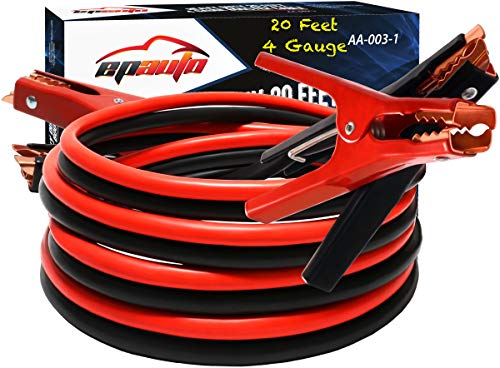
EPAuto has built a strong reputation over several years for producing automotive tools that hit the sweet spot between professional-grade performance and consumer-friendly pricing, and these 4-gauge, 20-foot booster cables are a textbook example of that approach. The 4 AWG wire sits in the productive middle ground between the lightweight 6-gauge budget sets and the heavy-duty 2-gauge and 0-gauge options above, making it genuinely appropriate for full-size passenger cars, most crossovers, light trucks, and the majority of non-diesel SUVs you are likely to encounter in everyday driving scenarios. The copper-plated clamps deliver solid conductivity and corrosion resistance without the cost premium of pure copper, and the no-tangle cable design addresses one of the most frustrating real-world aspects of carrying jumper cables — unrolling a snarled mess of cable under pressure.
The 20-foot length strikes the ideal balance between reach and portability at this gauge level, giving you enough cable to make connections in most parking configurations without the weight and storage footprint that comes with heavier-gauge 25-foot sets. The included travel bag keeps things organized and the pair of safety working gloves is a practical inclusion that competitors at this price point frequently skip. If you own a standard passenger vehicle and you want a no-nonsense set that will work reliably for the next decade without requiring you to think too hard about it, the EPAuto 4-gauge is one of the most straightforward recommendations in this guide. It is also worth noting that maintaining your vehicle's battery with a quality trickle charger during storage periods extends battery life substantially and reduces how often you reach for these cables.
Pros:
Cons:
The ABN 2-gauge, 25-foot, 600-amp set is the cable you buy when you need commercial-grade reliability at 2-gauge rather than stepping all the way up to 0-gauge. Designed explicitly for RVs, tractors, buses, semis, motorcycles, and ATVs in addition to standard passenger vehicles, this ABN set covers an unusually broad application range for a single cable specification. The 25-foot reach makes it the longest 2-gauge option in this comparison, and that extra length proves particularly valuable when you are working around large commercial vehicles where battery terminals may be located in unusual positions relative to the front or rear of the vehicle.
The solid copper clamps are a standout feature here — where most competitors use copper-plated or copper-clad alternatives, ABN uses solid copper construction for maximum conductivity and contact quality at the terminal junction. The serrated-jaw high-tension parrot clamps provide an extremely firm grip, and the non-slip rubber coating on the handles makes positioning comfortable and secure even with gloves on. Color identification between red positive and black negative cables prevents accidental reverse polarity connections, which is a safety detail that matters more under stress when you are rushing to get a jump done in traffic or poor lighting. The tangle-free cable design keeps deployment quick and clean. According to the standard jump-starting procedure, proper cable color identification and connection sequence are the two most important safety factors in any jump-start operation, and ABN addresses both definitively. If you also keep a compression tester in your shop kit, this ABN cable set rounds out a capable mechanical toolkit for serious diagnostic and maintenance work.
Pros:
Cons:

In the American Wire Gauge (AWG) system, lower numbers mean thicker wire — and thicker wire carries more current with less resistance and less heat buildup. This is counterintuitive for first-time buyers who assume a higher number means a better product, so get this straight before you shop: a 0-gauge cable is massively thicker and more capable than a 6-gauge cable, not the other way around. For compact cars, sedans, and smaller crossovers, a 4-gauge or 6-gauge cable is entirely adequate for the vast majority of real-world jump-starting scenarios. For full-size trucks, larger SUVs, high-displacement gas engines, and anything with a diesel powerplant, you need at minimum a 2-gauge cable, and for heavy commercial vehicles or 24-volt diesel systems, 0-gauge is the correct specification. Buying undersized gauge to save money is a false economy — a cable that cannot transfer sufficient current will overheat, potentially damaging the cable, your clamps, and in worst-case scenarios, the battery or electrical system of either vehicle involved.
The standard recommendation from automotive professionals for general use is a minimum of 20 feet, and that recommendation is well-founded in real-world experience. At 16 feet, you will occasionally find yourself unable to make a clean connection without repositioning one or both vehicles, which adds time and frustration to an already stressful situation. At 20 feet, you have enough slack to connect vehicles parked nose-to-tail or in most side-by-side configurations without a second approach. At 25 feet, you gain the flexibility to handle commercial vehicle scenarios and unusual parking situations where battery terminals are not in standard locations. The trade-off is weight and storage volume — 25 feet of 0-gauge cable is genuinely heavy and takes up meaningful trunk space. Match your length to your typical use scenario: 20 feet for general passenger vehicle use, 25 feet if you work with large or commercial vehicles regularly.
The clamp is where the electrical connection actually happens, and clamp quality has an outsized effect on how reliably your cables perform in the field. Look for clamps with sharp, serrated or jagged teeth that bite firmly into battery terminals even when they are corroded or coated in residue — smooth-jaw clamps slip off under vibration or light pressure and create intermittent connections that prevent the jump-start from completing. Spring tension is equally important: high-tension springs maintain consistent clamping force throughout the jump-start sequence, while weak springs allow the clamp to work loose from the terminal under the vibration of a running engine. For insulation, the key properties you care about are rated temperature range and flexibility at low temperatures. A cable insulated for -40°F to 140°F will stay pliable and manageable in the coldest winter conditions; a cable with no cold-weather rating will stiffen like a garden hose in January and become genuinely difficult to work with when you need it most.

UL listing is the most meaningful third-party certification to look for on jumper cables in 2026, because it involves actual independent testing of the clamps and insulation under defined standards rather than a self-declared marketing claim from the manufacturer. Products that specify "UL Listed" on the clamps — as both the TOPDC and EXTRESPO sets in this guide do — have been tested by Underwriters Laboratories and confirmed to meet safety standards for electrical insulation and construction quality. The amperage rating you see on packaging (600A, 1000A, etc.) typically refers to instantaneous peak current rather than sustained load capacity, so treat these numbers as relative comparisons between products in the same gauge tier rather than absolute performance guarantees. For a broader set of automotive tools worth keeping in your shop, explore our coverage on the best compression testers and diagnostic gear that pairs well with a solid set of jumper cables for complete roadside preparedness.
For most passenger cars, sedans, and smaller crossovers, a 4-gauge or 6-gauge cable provides sufficient current capacity for reliable jump-starting in normal conditions. If you drive a full-size truck, large SUV, or any high-displacement engine, move up to 2-gauge. For diesel engines and commercial vehicles operating on 12V or 24V systems, 0-gauge cables with 1000-amp capacity are the correct specification. Buying thicker gauge than you need does no harm; buying thinner gauge than your vehicle requires risks overheating the cable and failing to complete the jump-start.
A minimum of 20 feet is the professional standard recommendation for general passenger vehicle use in 2026. This length gives you enough slack to connect vehicles positioned nose-to-tail or side-by-side without repositioning. If you regularly work with commercial vehicles, RVs, or trucks where battery terminals may be in non-standard locations, 25 feet provides meaningful additional flexibility. Cables shorter than 16 feet create frequent positioning problems in real-world scenarios.
For jump-starting applications specifically, the practical performance difference between copper-clad aluminum and solid copper conductors is negligible at the same gauge rating. Solid copper offers marginally better conductivity per unit of cross-section, but the far thicker wire in 0-gauge and 2-gauge copper-clad aluminum sets compensates for this completely in real-world use. Solid copper clamps — as found on the ABN set in this guide — do offer a meaningful advantage at the contact point, where conductivity and corrosion resistance directly affect the quality of the electrical connection.
Yes, but only if the cable insulation is rated for the temperatures you are working in. Look for products that specify a cold-weather rating of -40°F or equivalent, which ensures the insulating jacket stays pliable and manageable rather than stiffening into a rigid, difficult-to-handle cable. Cables with no cold-weather rating or cheap PVC insulation can become extremely stiff in sub-zero temperatures, making them awkward to connect and creating potential cracking risks in the jacket over time. The TOPDC and EXTRESPO sets in this guide both carry -40°F ratings and are reliable choices for cold-climate use.
UL listed means the product has been independently tested and certified by Underwriters Laboratories, a recognized safety certification organization, to meet defined standards for electrical insulation quality and construction. On jumper cables specifically, UL listing typically applies to the clamps and insulating jacket, confirming they meet standards for current capacity, temperature resistance, and material safety. This is a meaningful third-party verification rather than a manufacturer self-certification, and it is one of the most reliable quality indicators you can use when comparing competing products.
The correct sequence for connecting jumper cables is: red (positive) clamp to the dead battery's positive terminal first, then red clamp to the working battery's positive terminal, then black (negative) clamp to the working battery's negative terminal, and finally the black clamp to an unpainted metal ground point on the dead vehicle away from the battery — not the dead battery's negative terminal itself. This sequence minimizes the risk of sparking near the battery, which can emit hydrogen gas during charging. Reverse the order exactly when disconnecting: ground clamp off first, then working battery negative, then working battery positive, then dead battery positive.
Every vehicle on the road in 2026 will eventually need a jump-start — the only question is whether you are prepared when that moment arrives. Pick the right gauge for your vehicle, choose a length of at least 20 feet, verify that the clamps are UL-listed, and make sure your insulation is rated for the coldest weather you are likely to face, and you will have a set of jumper cables that performs reliably for a decade or more without a second thought.
 |
 |
 |
 |

About Joshua Thomas
Joshua Thomas holds a Bachelor of Science in Mechanical Engineering from San Diego State University and has spent years applying that technical foundation to hands-on automotive work — from routine maintenance to full mechanical repairs. He founded CarCareTotal in 2017 to give car owners the kind of clear, practical guidance that helps them understand what is happening under the hood and make smarter decisions about upkeep and repairs. At CarCareTotal, he oversees editorial direction and covers automotive fundamentals, maintenance guides, and troubleshooting resources for everyday drivers.
Get some FREE car parts & gear.. Or check out the latest free automotive manuals and build guides here.
Disable your ad blocker to unlock all the hidden deals. Hit the button below 🚗
| | | |
