by Liam O'Brien
Nearly 40% of all roadside breakdowns in the United States are caused by dead or degraded batteries — a staggering number when you consider that most of those failures are entirely preventable with the right maintenance charger. A trickle charger keeps your battery conditioned during long storage periods, slow-charges depleted cells without heat damage, and extends overall battery life well beyond what you'd get from seasonal neglect. Whether you park a daily driver for winter, store a motorcycle from October through April, or keep a vintage car sleeping in the garage year-round, a quality trickle charger is one of the smartest investments you'll make in 2026.
The market has evolved considerably over the past few years. Today's smart chargers do far more than drip electricity into a battery overnight. They monitor charge state in real time, adjust amperage based on ambient temperature, detect sulfation and attempt recovery, and switch automatically to float mode the moment a full charge is reached. That means you can connect a charger and walk away for weeks without risking overcharge damage. If you've been using a basic trickle charger from a decade ago, upgrading to one of the modern units on this list will feel like a completely different experience. Pairing your charger with a reliable OBD2 Bluetooth adapter gives you a full picture of your vehicle's electrical health, letting you catch problems before they strand you.
To build this guide, we evaluated dozens of chargers across several battery chemistries — lead-acid flooded, AGM, Gel, VRLA, and LiFePO4 — testing charge accuracy, temperature compensation, recovery capability on deeply discharged batteries, and long-term float mode stability. The seven picks below represent the best trickle chargers you can buy in 2026 at every price point, from budget-friendly maintainers to professional-grade multi-stage units. If you want a complementary tool for emergency situations, check out our guide to the best portable jump starters of 2026 as well.
Contents








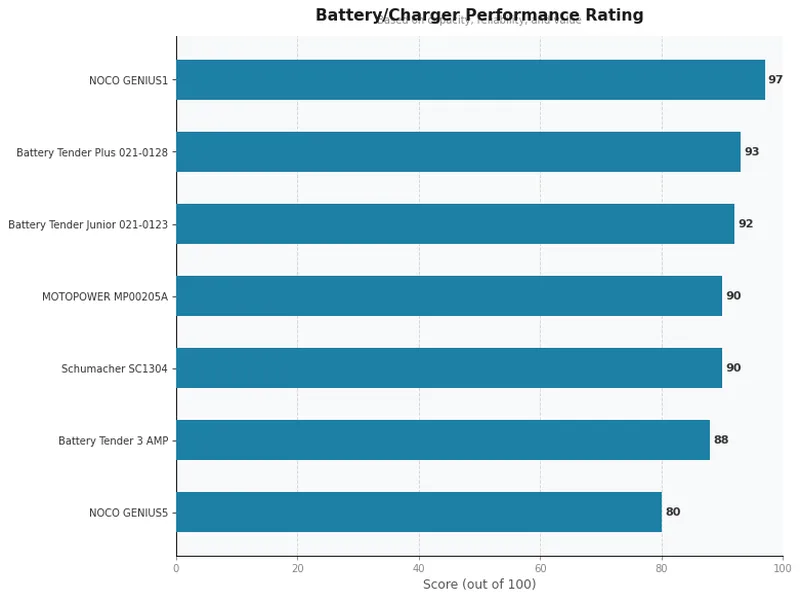
The NOCO GENIUS1 is the kind of charger that makes you wonder why anyone would settle for a dumb trickle unit ever again. At just 1 amp of output current, it sounds modest — and it is — but that restraint is exactly what makes it the ideal all-day, all-season maintainer for vehicles that spend more time sitting than running. The GENIUS1 handles 6-volt and 12-volt batteries across every lead-acid chemistry, including AGM, Gel, SLA, and VRLA, as well as lithium-ion LiFePO4 batteries, making it genuinely versatile across your entire garage fleet.
The integrated thermal sensor is one of the most underappreciated features on this unit. It reads ambient temperature continuously and adjusts the charge output accordingly, so cold winter garage temperatures don't cause undercharging, and summer heat doesn't push the battery into overcharge territory. NOCO claims the GENIUS1 is 35% smaller than its predecessor while delivering over 35% more power, and the physical unit backs that up — it's compact enough to tuck behind a tire or hang from a hook without taking up valuable workbench space. The desulfation mode addresses one of the most common causes of premature battery failure, actively breaking down sulfate crystal buildup that accumulates on lead plates during long periods of discharge.
For a single-car household maintaining one battery through winter storage, the GENIUS1 is all you need. It's not the right tool if your battery is deeply discharged to the point of complete voltage collapse — that's where the GENIUS2's Force Mode comes into play — but for healthy batteries in regular maintenance situations, the precision, reliability, and compact footprint make this the top pick on our list in 2026.
Pros:
Cons:
Step up your battery care game with the NOCO GENIUS5 — a 5-amp smart charger that handles everything the GENIUS1 does, but with the output capacity to service larger batteries in a fraction of the time. NOCO positions this as the successor to their G3500 model, and the numbers bear that out: 34% smaller body with over 65% more power output. That's a meaningful leap, especially when you're working with full-size truck batteries, marine deep-cycle units, or larger RV batteries that a 1-amp unit would take days to charge from a low state.
Like its smaller sibling, the GENIUS5 handles 6V and 12V lead-acid chemistries across the full spectrum — flooded, AGM, Gel, SLA, VRLA — as well as LiFePO4 lithium batteries. The same precision thermal sensor adjusts charge output based on temperature, and the multi-stage charging algorithm optimizes every phase from initial bulk charge through absorption and float. NOCO's desulfation mode is present here too, and at 5 amps it works more aggressively on heavier sulfation buildup, giving older batteries a genuine second chance at useful service life.
The GENIUS5 is the sweet spot for users who need one charger to handle multiple vehicles with different battery sizes. You can safely leave it connected to a compact car battery overnight without worry, then switch it to a marine battery for a full weekend charge before the season opens. The build quality is robust, the cable connectors are well-made, and the LED indicator system is clear enough to read across a dim garage. If you only buy one charger this year, the GENIUS5 offers the most capability per dollar in the NOCO lineup.
Pros:
Cons:
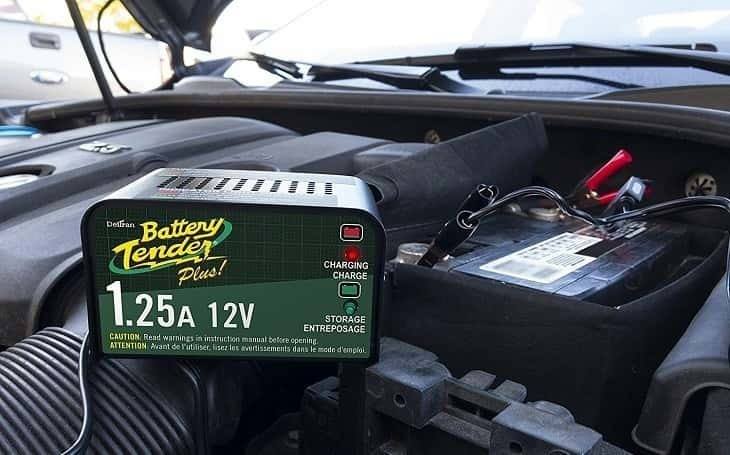
Battery Tender built its reputation on one thing: keeping batteries alive through months of storage without any oversight required. The Battery Tender Plus is the product that cemented that reputation, and after two decades on the market it remains one of the most trusted names in motorcycle and automotive battery maintenance. The 4-step charging program — initialization, bulk charge, absorption, and float — is a clinically efficient sequence that fills the battery without stressing it, then transitions to a safe float voltage that keeps cells topped off indefinitely.
At 1.25 amps, the Battery Tender Plus is purpose-built for long-term maintenance rather than fast charging. That's not a flaw — it's intentional design. The adaptive charging logic reads your battery's actual state and adjusts its approach accordingly, which means a severely depleted battery gets a gentler recovery cycle before the system pushes into bulk charge mode. This adaptive behavior is what distinguishes it from a basic trickle charger, which simply outputs a constant current regardless of what the battery needs. The 10-year manufacturer warranty and lifetime customer support package are genuine differentiators that add real value for buyers who want a set-it-and-forget-it solution.
The Battery Tender Plus ships with both alligator clips and a fused ring terminal harness, so connecting to batteries in tight engine bays or under-seat motorcycle compartments is straightforward. The ring terminal approach is especially convenient for seasonal vehicles: install the harness once, then plug and unplug the charger each season without opening the battery compartment again. If you use your garage for more than just storage and want help keeping that space organized while your vehicles charge, our best garage floor coatings guide pairs nicely with a long-term storage setup like this one.
Pros:
Cons:
Swedish engineering applied to battery maintenance — that's the CTEK MXS 5.0 in a phrase. CTEK is the brand you'll find in professional workshops and OEM service centers across Europe, and the MXS 5.0 is their flagship consumer charger, featuring a fully automatic 8-step charging process that goes well beyond what most competitors offer. The eight stages include desulfation, soft start, bulk charge, absorption, analysis, reconditioning, float, and pulse maintenance — a comprehensive sequence that diagnoses battery condition, recovers what it can, and maintains what's left with surgical precision.
At 4.3 amps output for 12V lead-acid and AGM batteries, the MXS 5.0 positions itself as a capable all-weather charger, specifically highlighted by CTEK for cold weather performance. The reconditioning function is the standout feature: it applies a controlled overcharge cycle to batteries that have lost significant capacity, forcing electrolyte mixing and sulfate dissolution in a way that can genuinely restore a healthy percentage of lost capacity to underperforming batteries. Not every battery responds — severely damaged cells won't recover — but CTEK's reconditioning stage has saved users the cost of premature battery replacement on countless occasions.
The MXS 5.0 handles car, bike, marine, RV, and tractor batteries with equal competence. According to battery charger science, multi-stage charging is demonstrably superior to constant-current approaches for both charge efficiency and battery longevity, and the CTEK's 8-stage implementation is the most thorough on this list. The build quality reflects the professional market this unit was designed for — the connectors are solid, the casing is durable, and the unit is rated for long continuous duty cycles. This is the charger you buy when you want the absolute best and are willing to pay for it.
Pros:
Cons:
If you own a motorcycle, ATV, personal watercraft, or any other powersport vehicle that hibernates through winter, the Battery Tender Junior is the most cost-effective way to guarantee a ready-to-ride battery when the season opens back up. At 750 milliamps, the Junior delivers a gentle, constant trickle that's perfectly sized for smaller powersport batteries without any risk of overcharge or plate damage during extended storage. The 4-step charging program — initialization, bulk charge, absorption, and float — mirrors the bigger Battery Tender Plus in structure, just calibrated for the lower capacity and more delicate chemistry of small-format batteries.
The 12-foot output cord is a thoughtful inclusion that gives you real flexibility in routing from an outlet to a battery tucked inside a motorcycle frame or under an ATV seat. The fused ring terminal harness makes seasonal connection and disconnection a five-second operation rather than a fumbling ordeal with pliers and terminal covers, and the included alligator clips handle situations where the ring terminal approach isn't practical. Battery Tender backs the Junior with a 5-year warranty and lifetime customer support — generous coverage for a unit in this price bracket.
The 750mA output makes the Junior a pure maintenance charger rather than a recovery charger. If your powersport battery has discharged below a workable threshold, you may need to bulk charge it with a higher-amp unit before handing it off to the Junior for maintenance duty. Within those limits, though, this is an incredibly dependable long-term solution that's earned a loyal following among riders who understand that preventative battery care costs a fraction of what a replacement costs in an emergency.
Pros:
Cons:
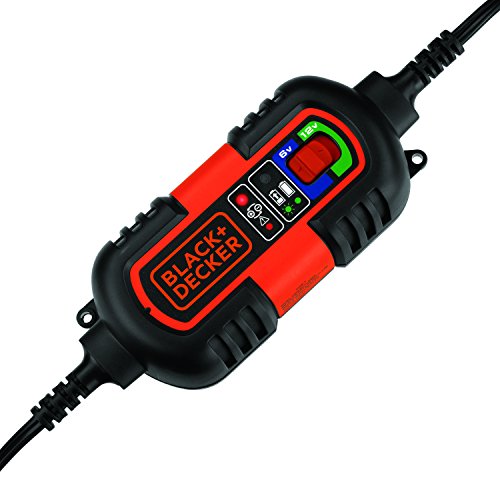
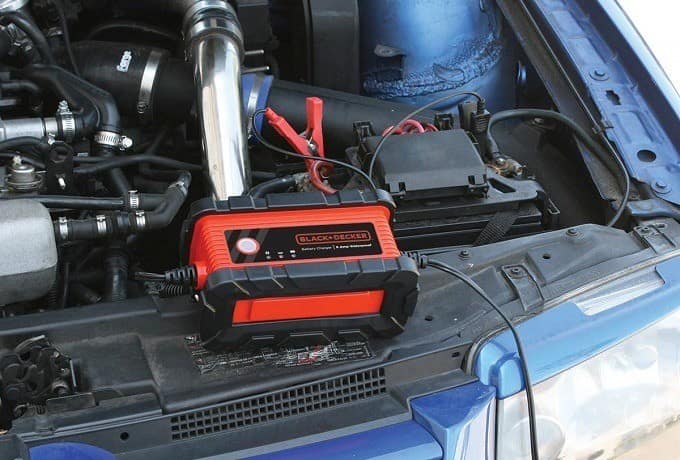
The BLACK+DECKER BM3B occupies an important niche on this list: it's the most accessible dual-voltage option for someone who has a mix of 6V and 12V batteries to maintain, doesn't want to spend a premium, and simply needs a reliable automatic maintainer that shuts off when the job is done. The fully automatic charging circuit monitors battery voltage continuously and stops applying current the moment the battery reaches full charge, then switches to float mode monitoring to keep the battery topped off without overcharge risk.
At 1.5 amps, the BM3B handles AGM, Gel, and wet lead-acid batteries in both 6V and 12V configurations — useful if you have an older vehicle with a 6V electrical system alongside your standard modern car. The dual-voltage flexibility is genuinely rare at this price point, and BLACK+DECKER executes it cleanly without complicating the user interface. Connection is simple: either the included battery clips for direct post attachment, or the O-ring terminals for a semi-permanent connection that makes seasonal reconnection instant.
You should calibrate your expectations appropriately with the BM3B. It's not a multi-stage smart charger with desulfation modes and temperature compensation. It's a straightforward automatic maintainer that does its core job reliably without any frills. For someone who needs to maintain a fleet of lawn equipment batteries, vintage vehicle batteries, or a mix of 6V and 12V applications on a tight budget, the BM3B delivers honest, dependable value. Just make sure any batteries you connect aren't so deeply discharged that they need a recovery protocol first.
Pros:
Cons:
The NOCO GENIUS2 sits between the GENIUS1 and GENIUS5 in output capacity, but it holds a unique position on this list for one reason that has nothing to do with amperage: Force Mode. Most smart chargers — including the GENIUS1 and GENIUS5 — rely on an internal battery sensing circuit to verify that a valid battery is connected before beginning the charge cycle. That's a sensible safety feature, but it creates a problem when a battery has discharged completely to zero volts, because the sensing circuit detects nothing and refuses to engage. Force Mode bypasses that sensing protocol and manually initiates charging on a dead battery, giving deeply discharged cells a path back to life that most competitors simply cannot provide.
Beyond Force Mode, the GENIUS2 delivers all the features that make NOCO's lineup exceptional in 2026 — dual 6V/12V voltage support, lead-acid and LiFePO4 lithium battery compatibility, thermal sensor-based temperature compensation, and active desulfation. The 2-amp output is genuinely useful for automotive batteries that the 1-amp GENIUS1 charges too slowly, without the overkill of the 5-amp GENIUS5 for smaller batteries where slower charging is actually healthier. It's a thoughtful middle ground that earns its place in the lineup rather than just splitting the difference arbitrarily.
If you've ever returned to a vehicle after an extended trip only to find a battery that won't respond to a conventional charger, the GENIUS2 is the tool that could have saved you. It's the right pick for anyone who maintains multiple vehicles with varying age and condition, stores seasonal equipment for months at a time, or simply wants the extra assurance that dead-battery recovery capability provides. Pair it with our recommended tools and accessories to round out a complete preventive maintenance kit for your garage in 2026.
Pros:
Cons:
Before you evaluate charging amperage or price, you need to confirm that any charger you're considering is compatible with your specific battery chemistry. Lead-acid batteries come in several varieties — flooded wet cell, AGM, Gel, SLA, and VRLA — and while most smart chargers handle all of them, the charging algorithms differ slightly between chemistries. AGM and Gel batteries, in particular, require tighter voltage control during absorption to avoid electrolyte damage. If you've upgraded any of your vehicles to a lithium LiFePO4 battery for its weight and capacity advantages, you need a charger that explicitly supports lithium chemistry with a dedicated mode — the NOCO GENIUS series is the only lineup on this list with that capability. Running a lead-acid charger on a lithium battery risks overcharging it past safe voltage limits, which is dangerous and will void your battery warranty immediately.
The rule of thumb for safe charging is that your charger's output amperage should not exceed 10% of your battery's amp-hour (Ah) capacity during bulk charging. For a 50Ah motorcycle battery, that means a 5A maximum; for a 100Ah automotive battery, up to 10A is acceptable. Trickle chargers and maintainers operate well below those maximums by design, which is exactly why they're safe for long-term unattended use. When you're choosing between 1A, 2A, and 5A chargers, consider both the battery size you're maintaining and how often you need to actually charge versus simply maintain. A 1A charger on a 100Ah automotive battery is perfectly fine for maintenance but will take four days to charge from empty — the 5A option handles the same job in roughly 20 hours.
The difference between a basic trickle charger and a smart multi-stage maintainer is the difference between slowly filling a bathtub and carefully monitoring the water level, temperature, and chemistry in real time. A basic charger pushes constant current until you disconnect it, which risks overcharging and gassing. A smart charger progresses through defined stages — typically desulfation, bulk, absorption, and float — adapting its output to the battery's actual state at each point. The desulfation stage is particularly valuable for batteries that have been left in a discharged state, because sulfate crystal formation on lead plates is the leading cause of capacity loss in healthy batteries that have simply been neglected. If you're maintaining older batteries or vehicles that sit unused for months at a time, prioritize chargers with active desulfation modes.
Batteries are temperature-sensitive devices — cold reduces their effective capacity and acceptance of charge current, while heat accelerates chemical reactions and risks overcharging at voltages that would be safe in moderate temperatures. A charger with a thermal sensor continuously reads ambient temperature and adjusts its charge voltage accordingly, delivering more precise charge curves across the full range of environments your vehicles occupy. This feature matters most if you live in a climate with significant seasonal temperature variation or if your vehicles are stored in unheated spaces. Beyond temperature compensation, look for overcharge protection, reverse polarity protection, and short-circuit protection as baseline safety features — every charger on this list includes them, but not every charger at every price point does.
A traditional trickle charger outputs a constant low current regardless of the battery's state, which means it can overcharge and damage a battery if left connected too long. A modern battery maintainer — which is what most products marketed as trickle chargers actually are in 2026 — uses a smart charging algorithm that monitors battery voltage continuously and switches to a safe float mode once full charge is reached. You can leave a quality battery maintainer connected indefinitely without risk of overcharge damage.
Yes, but you need to confirm that the charger explicitly supports AGM chemistry. AGM batteries require a lower absorption voltage ceiling than flooded batteries — typically 14.4V to 14.7V rather than 14.8V or higher. A charger without an AGM-specific mode may charge to voltages that damage AGM cell construction over time. All seven chargers on this list support AGM batteries with appropriate voltage control built in.
Charging time depends on the charger's amperage and the battery's amp-hour capacity. A 1-amp charger on a completely discharged 50Ah battery requires roughly 50 hours to reach full charge. A 5-amp charger handles the same battery in about 10 hours. In practice, smart chargers don't deliver rated amperage throughout the full cycle — absorption and float phases reduce current progressively, so real-world times are typically 15-25% longer than simple math suggests. If you have a battery that needs regular fast recovery, prioritize a 5-amp model like the NOCO GENIUS5.
With a smart maintainer that features automatic float mode switching and overcharge protection — which includes all seven units on this list — yes, it's safe to leave the charger connected for weeks or even months. These units monitor battery voltage continuously and only reapply charge current when voltage drops below the float threshold, typically cycling on and off to maintain the battery in its fully charged state without overcharging. Never leave a basic constant-current trickle charger connected unattended for extended periods — that's a different product category with real overcharge risk.
Most smart chargers detect a battery's voltage before initiating a charge cycle and will refuse to engage if the voltage has dropped below their minimum detection threshold, typically around 2-3 volts. The NOCO GENIUS2's Force Mode is specifically designed to bypass this limitation and manually initiate charging on zero-volt batteries. For a battery that's simply been sitting discharged for months but has no cell damage, recovery is usually successful. Batteries with shorted cells, cracked cases, or severe physical damage cannot be recovered regardless of the charger used.
Yes. Lithium LiFePO4 batteries use a fundamentally different charging profile than lead-acid batteries, with different voltage thresholds at every stage of the charge cycle. Using a lead-acid charger on a lithium battery can overcharge it beyond safe limits, which causes permanent capacity loss and creates a fire risk in severe cases. The NOCO GENIUS1, GENIUS2, and GENIUS5 all include dedicated lithium battery modes that apply the correct voltage and current profiles for LiFePO4 chemistry. If you have or plan to upgrade to a lithium battery, these three are the only options on this list that apply.
Buy the charger that matches your battery chemistry and worst-case scenario — because the one time you actually need it to recover a dead battery, you'll be glad you didn't cut corners.
 |
 |
 |
 |

About Liam O'Brien
Liam O'Brien has spent over a decade buying, field-testing, and evaluating automotive tools with a focus on what actually performs in a real DIY garage rather than what markets well on a spec sheet. His hands-on experience spans hand tools, diagnostic equipment, floor jacks, socket sets, and specialty automotive gear across a wide range of brands and price points. At CarCareTotal, he covers automotive tool and equipment reviews, garage setup guides, and buying advice for home mechanics.
Get some FREE car parts & gear.. Or check out the latest free automotive manuals and build guides here.
Disable your ad blocker to unlock all the hidden deals. Hit the button below 🚗
| | | |
