by Joshua Thomas
Picture this: you pull into the driveway after a weekend camping trip, open the garage, and your daily driver cranks over just fine — not because you remembered to run it every few days, but because a small solar panel on the dashboard quietly did all the work while you were gone. That is exactly the kind of hands-off reliability a good solar battery charger delivers, and in 2026 the technology has matured to the point where even budget-friendly panels offer smart MPPT controllers and multi-stage charging that rivals dedicated wall units.
Solar battery chargers for cars sit in a sweet spot between convenience and practicality. They draw zero energy from the grid, require no manual intervention once connected, and extend battery life by preventing the slow discharge that kills batteries sitting in storage for weeks at a time. Whether you are maintaining a seasonal RV, keeping a collector car ready, or simply ensuring your daily driver holds a charge through a long airport parking stint, the right solar charger pays for itself in a single prevented service call. For more automotive tools and accessories, explore our full tools section.
We evaluated seven of the top-performing solar battery chargers available in 2026, assessing wattage output, controller technology, connection versatility, weather resistance, and overall value. Below you will find everything you need to make a confident purchase decision, from a quick-reference picks list to a deep-dive buying guide and answers to the questions we see most often.
Contents







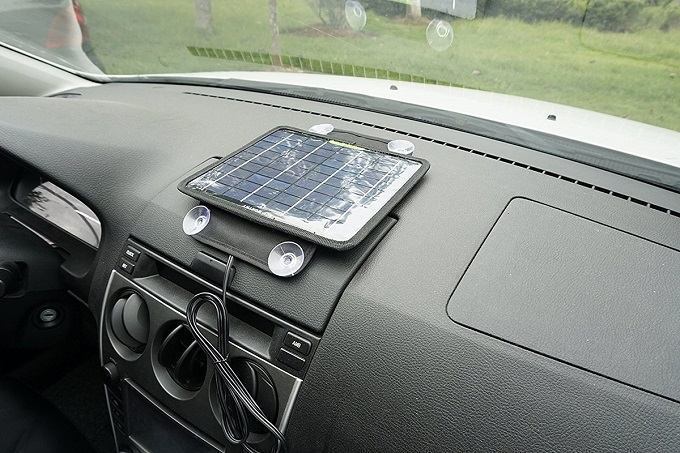
Battery Tender has been a trusted name in battery maintenance for decades, and the 021-1171 solar panel carries that legacy forward with a design that prioritizes installation simplicity above all else. The panel mounts directly to your windshield glass using four robust suction cups and plugs into your vehicle's cigarette lighter outlet — meaning you need zero tools and zero mechanical knowledge to get it running in under five minutes. The IP67 weatherproof rating ensures the unit handles rain, dust, and temperature swings without complaint, making it equally at home on a car sitting in an outdoor lot or a boat parked beside a dock.
The 5-watt output is intentionally conservative, and that is precisely the point. This is a trickle charger designed to offset parasitic draw and self-discharge rather than recover a deeply depleted battery, and within that role it excels. The intelligent charge controller reads battery voltage continuously, delivering full current while the battery absorbs it and then stepping down to float mode to hold the charge at optimal levels without ever overcharging. The included 8-foot output cord plus alligator clip and ring terminal combo cable gives you flexibility in how you connect, and the five-year warranty underscores Battery Tender's confidence in the build quality.
One trade-off worth noting: the windshield mounting position limits sun exposure compared to a roof or hood installation, particularly in northern latitudes during winter months. If your vehicle is stored in a garage with indirect light, you will see reduced output. For drivers who park outdoors with southern exposure, though, this charger represents one of the cleanest and most foolproof maintenance solutions on the market in 2026.
Pros:
Cons:
When you need genuine charging capability rather than simple maintenance, the SUNER POWER 20W PRO is the unit that steps up. Its proprietary UltraSmart MPPT technology delivers a tracking efficiency of up to 99 percent and a peak conversion efficiency of 98 percent, which translates to roughly 20 to 30 percent more usable energy compared to conventional PWM controllers operating in the same light conditions. That edge matters in practice: on a partially cloudy afternoon, an MPPT charger will continue extracting meaningful current while a PWM unit barely registers output, which is exactly the scenario most car owners face during shoulder seasons.
The built-in three-stage charging algorithm — Bulk, Absorption, and Float — manages the battery through its complete recharge cycle intelligently. During the Bulk phase the charger pushes full current to replenish depleted capacity quickly, the Absorption phase tapers current as the battery approaches full charge to prevent gassing, and the Float phase maintains voltage at a safe holding level indefinitely. This is the same charging profile used by professional-grade bench chargers, and its presence in a 20-watt solar unit is genuinely impressive for the price point. The panel is fully waterproof and built for permanent outdoor mounting on RVs, marine vessels, trailers, and automotive applications.
You get the most value from this unit when your application involves a vehicle that sits for extended periods — a seasonal RV, a stored classic car, or a work trailer that only moves once a month. At 20 watts it can handle moderate recovery duties as well as pure maintenance, giving it more real-world versatility than any 5-watt or 10-watt competitor in this list. If you are also shopping for complementary vehicle accessories, our guide to the best electric trailer jacks of 2026 pairs well with an RV or trailer setup.
Pros:
Cons:
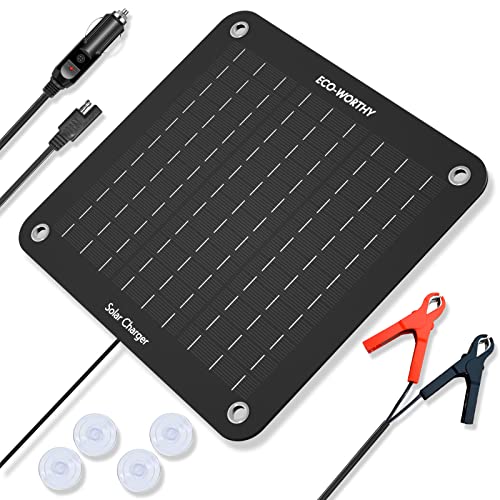
ECO-WORTHY's 10W solar maintainer has earned its place as one of the most-reviewed solar chargers in its category, and the reason is straightforward: it delivers reliable trickle maintenance at a price point that makes it accessible for virtually any vehicle owner. The monocrystalline solar panel construction provides better cell efficiency per square inch compared to polycrystalline panels, and the frosted surface finish eliminates the need for a separate UV protective film while reducing glare. A built-in blocking diode prevents reverse current flow at night, protecting your battery from drain during dark hours without requiring any additional components.
The PCB upgrade that ECO-WORTHY incorporated into this version adds both reverse charge protection and overcharge protection at the circuit level, making it meaningfully safer than the original design. The indicator light on the rear panel provides a quick visual confirmation of charging status — a small feature that saves you the hassle of pulling out a multimeter every time you want to verify the system is functioning. The panel performs adequately on overcast days, though output naturally drops with cloud cover as it would with any photovoltaic system operating under reduced irradiance.
At 10 watts this unit sits firmly in the maintenance lane — it keeps a healthy battery topped up and offsets parasitic drain from clocks, alarm systems, and ECUs during storage, but it will not recover a battery that has dropped below 11 volts. For seasonal vehicle storage, weekend toys, lawn mowers, ATVs, and boats left at a marina, it performs exactly as advertised. If your budget is tight and your goal is simply preventing battery death during storage, this is your pick without question.
Pros:
Cons:
The upgraded OBDII variant from ECO-WORTHY takes the solid foundation of the standard 10W maintainer and adds two features that make it stand out in 2026: a genuine OBD-II plug for battery connection and a redesigned mounting system that dramatically improves the installation experience. The OBD-II cable connects directly to your car's diagnostic port and routes power straight to the battery even when the vehicle is switched off, which eliminates the common problem of a discharged cigarette lighter socket cutting power to a solar charger connected through that path. For modern vehicles where the cigarette socket is ignition-dependent, this is not just a convenience upgrade — it is the difference between a charger that actually works and one that does not.
The hardware improvements are equally practical. The old push-pull suction cup design that plagued earlier versions is replaced by a screw-on mount that twists securely into position without the frustration of cups that pop free in temperature extremes. The four PVC suction cups adhere with a single press, and the integrated bracket adjusts freely for optimal sun angle whether you are mounting on a windshield, roof panel, trunk lid, or hood. You still get the same waterproof construction, rear indicator light, and dual connection options — alligator clips for direct battery access and the new OBD-II cable for clean interior routing.
This is the charger we recommend for modern passenger cars and trucks where you want to leave the system connected indefinitely without touching the engine bay. The OBD-II port on most vehicles built after 1996 is always powered when the ignition is off, which makes it the most reliable low-profile connection point for a solar maintenance system. If you already own a motorcycle that needs similar attention, check out our review of the best motorcycle batteries of 2026 for compatible storage charging guidance.
Pros:
Cons:
Renogy built its reputation in the off-grid solar space, and the brand's engineering discipline shows clearly in this compact 10-watt trickle charger. The panel uses high-efficiency monocrystalline solar cells assembled with multi-layered sheet lamination technology that serves two functions simultaneously: it enhances cell-level conversion efficiency and creates a rigid, durable structure that resists delamination and moisture intrusion over years of outdoor exposure. Where many budget solar panels begin degrading within two to three seasons, the Renogy lamination process is designed to maintain output performance over a significantly longer service life.
The connection versatility here is genuinely unmatched in this wattage class. The quick SAE connection system offers three terminal options in one unit: ring terminals for permanent battery connection, alligator clips for temporary direct attachment, and a cigarette lighter adapter for vehicles where dashboard access is preferred. This means the same charger works across your entire fleet — car, boat, RV, electric fence controller, and accessory battery — without buying separate adapters or cables. Battery chemistry compatibility covers Gel, AGM, Flooded, and Lithium variants, which is the full spectrum of batteries you are likely to encounter across modern vehicles and marine applications.
Renogy's brand backing provides an additional layer of confidence in terms of after-sale support and warranty servicing that smaller brands cannot match. For a 10-watt portable maintainer that you want to move between multiple vehicles and applications without technical fussing, the Renogy delivers a professional experience at a competitive price. It pairs naturally with other towing and hauling equipment — our guide to the best ratchet straps of 2026 covers another category of essential gear for those transporting vehicles or trailers.
Pros:
Cons:
The POWOXI 15W occupies a genuinely useful middle ground between the modest 10-watt maintainers and the full-sized 20-watt SUNER POWER unit, delivering MPPT controller technology at a price point that makes it accessible without sacrificing the efficiency advantages that separate MPPT from conventional PWM designs. The POWOXI-MPPT algorithm optimizes energy extraction by dynamically adjusting its operating point to match the panel's maximum power output as light intensity fluctuates throughout the day, with conversion efficiency reaching up to 99 percent under optimal conditions. That dynamic adjustment is what gives MPPT chargers their cloudy-day advantage — when irradiance drops, the controller continuously hunts for the new maximum power point rather than accepting a fixed, suboptimal operating voltage.
The 15-watt rating gives this unit enough output to handle light recovery duties on a battery sitting between 11.5 and 12 volts, not just pure float maintenance, which makes it useful for vehicles that see occasional use rather than strict long-term storage. The battery protection suite is comprehensive: the float and maintenance stage in the MPPT controller prevents overcharging by design, and the unit is compatible with the full range of 12V battery chemistries — Gel, AGM, SLA, VRLA, and lithium-ion — so you can confidently deploy it on modern vehicles without worrying about compatibility issues with absorbed glass mat or lithium starter batteries.
For marine applications, RV owners, and anyone maintaining multiple vehicles including motorcycles, this sits at a price and performance level that justifies buying one for each stored vehicle rather than moving a single unit around. The built-in MPPT controller means you do not need to purchase a separate charge controller to protect your batteries, which is a hidden cost savings compared to bare-panel products in this category.
Pros:
Cons:
OptiMate built its name in European motorcycle and automotive circles by engineering chargers that do not merely maintain batteries but actively diagnose, recover, and preserve them across extended storage periods. The Solar Duo TM522-D2 brings that same engineering philosophy to solar charging with a 20-watt panel designed from the outset for permanent exterior mounting rather than windshield suction-cup convenience. The system ships as a complete kit — 20W panel, DUO charge controller, and two battery connection cables — which means you can connect it to two separate battery banks simultaneously, a genuinely useful feature for dual-battery RVs, boats with house banks, or anyone storing multiple vehicles under one roof.
The six-step charging program is where OptiMate's expertise becomes visible. Standard solar maintainers offer two modes at best: charge and float. The OptiMate Solar Duo steps through desulfation, soft-start, bulk charge, absorption, analysis, and maintenance stages in sequence, each one addressing a specific aspect of battery health and longevity. The desulfation step in particular recovers batteries that basic chargers would write off by applying controlled high-frequency pulses to break down the lead sulfate crystal buildup that causes capacity loss in older flooded batteries. For a stored vehicle that has been sitting for six months or more, this recovery capability can be the difference between a battery that returns to service and one that goes to recycling.
The weatherproof construction is rated for permanent outdoor exposure, and the mounting hardware accommodates roof, shed wall, and carport installations with a clean, semi-professional appearance. This is the premium choice for a dedicated storage solution, particularly for boats, classic cars, and seasonal vehicles where you want a set-and-forget system that actively protects a valuable battery investment across multiple years of storage cycles.
Pros:
Cons:
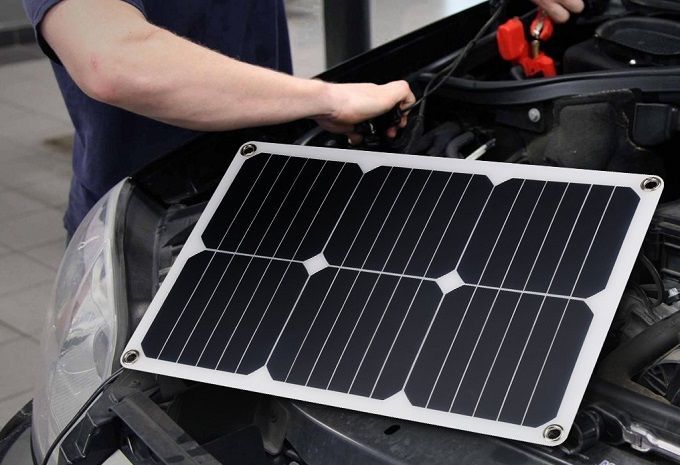
The most common mistake buyers make in 2026 is purchasing a charger based on price without considering whether the wattage matches their use case. A 5-watt panel generates roughly 15 to 25 watt-hours per day under average sun exposure, which is enough to offset the 1 to 5 milliamp parasitic drain of a modern vehicle's electronics and keep the battery at full charge during storage. A 10-watt panel doubles that buffer and handles vehicles with slightly higher parasitic loads — aftermarket alarms, GPS trackers, and infotainment systems that draw power when the vehicle is off. Step up to 15 or 20 watts and you gain genuine light recovery capability: a panel in this range can bring a battery from 75 percent charge back to full over one to two days of direct sun, which is practical for vehicles that see irregular use rather than strict long-term storage. The rule is simple — if your vehicle is in pure storage, 5 to 10 watts is adequate; if it sees occasional use and runs the risk of partial discharge between trips, 15 to 20 watts provides meaningful recovery capability.
The charge controller is the intelligence layer between the solar panel and your battery, and the technology used determines both efficiency and battery protection. PWM (Pulse Width Modulation) controllers are the older, simpler design — they regulate charge by rapidly switching current on and off, which is effective but wastes a portion of the panel's potential output when battery voltage drops below panel voltage. MPPT (Maximum Power Point Tracking) controllers are more sophisticated, continuously adjusting their operating point to extract the absolute maximum power the panel is capable of producing at any given light intensity; in practical terms this delivers 20 to 30 percent more usable energy than PWM in real-world variable light conditions. Some budget panels ship with no controller at all, relying on the battery's own chemistry and a simple blocking diode to prevent overcharge — these are acceptable for very low wattage trickle applications but introduce risk if the panel can potentially deliver more current than the battery can safely absorb. For anything above 5 watts in a permanent installation, look for an integrated controller, and at 15 watts or above the MPPT premium is justified by the efficiency gains.
A solar charger that requires you to bring it inside when it rains defeats much of its convenience value, so weather resistance is a non-negotiable specification for any outdoor installation. Look for an IP65 rating or higher — IP65 means the unit is dust-tight and protected against direct water jets from any angle, while IP67 (as found on the Battery Tender unit in our list) adds protection against temporary submersion. Beyond the rating itself, examine the quality of the connector seals, cable entry points, and the lamination layer covering the solar cells, as these are the failure points that weather eventually finds on lower-quality panels. Mounting flexibility deserves equal attention: windshield suction cups are convenient for temporary installations but limit sun angle and exposure area; dedicated panel mounts, adjustable brackets, and roof or hood installation options allow you to optimize panel angle for your location and season. If you store your vehicle in a garage, look for a unit with a long enough output cable to route through a window or door gap to a panel positioned outside.
Your solar charger is only as useful as its ability to connect cleanly to your specific vehicle. The three standard connection methods — direct battery via alligator clips, ring terminals bolted to battery posts, and cigarette lighter or OBD-II plug — each serve different situations. Alligator clips are the fastest for temporary connections but require engine bay access every time you connect. Ring terminals provide the cleanest permanent connection but require a one-time installation. Cigarette lighter connections are the most convenient but depend on that socket being powered when the ignition is off, which is not the case on all vehicles. The OBD-II connection found on the ECO-WORTHY upgraded unit solves this elegantly for modern cars, routing power through a port that is always active. On the battery chemistry side, verify that the charger supports your battery type — AGM batteries in particular require a slightly different voltage profile than flooded lead-acid, and using a non-compatible charger on an AGM battery can shorten its lifespan significantly.
A solar trickle charger alone cannot reliably recover a completely dead battery — one that has dropped below 10.5 volts — because most small solar units lack sufficient current output to overcome the battery's internal resistance in a deeply discharged state. For a fully dead battery, use a dedicated wall-powered battery charger first to bring the battery back above 11.5 volts, then connect the solar charger to maintain the charge going forward. Higher-wattage units like the 20W SUNER POWER or the OptiMate Solar Duo with its desulfation step can recover moderately discharged batteries over several days of good sun exposure, but that is the practical upper limit of solar trickle technology.
Yes, any solar charger equipped with an automatic float mode or a three-stage MPPT controller is designed specifically for permanent connection without risk of overcharging. The controller monitors battery voltage continuously and reduces current to a safe maintenance level once the battery reaches full charge, then resumes active charging when voltage drops due to parasitic drain. Units without an integrated controller — bare panels with only a blocking diode — should be used more cautiously and monitored periodically, as they rely entirely on the blocking diode to prevent reverse current at night but do not actively limit charge current during the day.
Solar panels generate electricity from light, not direct sunlight, so they continue producing output on overcast days — typically at 10 to 25 percent of their rated wattage depending on cloud density and light diffusion. A 20-watt panel on a heavily overcast day might deliver 3 to 5 watts, which is still sufficient to offset most vehicle parasitic loads and maintain the battery at its current charge level. MPPT controllers provide a measurable advantage in these conditions because they continuously hunt for the maximum available power point as irradiance fluctuates, extracting meaningfully more energy from partial cloud cover than PWM controllers operating at a fixed voltage ratio.
For an RV or boat with a single house battery bank that is not powering any loads during storage, a 20-watt solar charger is the practical minimum recommendation, as these larger battery banks have higher capacity and correspondingly higher self-discharge rates than typical automotive starter batteries. If your RV or marine installation includes a dual battery bank — one for starting, one for accessories — the OptiMate Solar Duo with its dual-output controller is the most elegant single-panel solution on this list. For RVs or boats with solar panels already integrated into the roof system, a small dedicated maintenance charger on the starting battery specifically is still worthwhile, as house bank systems often do not route charge to the starting battery without additional isolator hardware.
Absolutely — most 12V solar trickle chargers work equally well on motorcycle batteries, and motorcycle storage is one of the most common and practical applications for these devices. The smaller battery capacity of a typical motorcycle battery (typically 10 to 20Ah compared to 50 to 70Ah for a car battery) means even a 5-watt solar panel is sufficient for maintenance purposes during winter storage. Make sure the charger supports your battery's chemistry — many modern motorcycles use AGM or lithium iron phosphate batteries that require compatible charge profiles — and position the panel where it receives adequate sun exposure through a garage window or skylight.
In everyday usage the terms are often interchangeable, but there is a technical distinction worth understanding. A trickle charger delivers a small but continuous current regardless of the battery's state of charge, which can eventually overcharge a battery if left connected indefinitely without a controller. A solar maintainer — the more accurate term for the smart devices in this review — uses a charge controller to monitor battery voltage and adjust or stop current flow accordingly, making it safe for permanent connection. All seven products in this list function as maintainers in the strict sense, not bare trickle chargers, because they include either integrated controllers or blocking diodes that prevent unsafe overcharge conditions.
The right solar battery charger for your situation comes down to three questions: how long does your vehicle sit, how much sun does your parking spot see, and how much hands-on installation work you are willing to do. Start with the product that matches your honest answer to those three questions, check the current prices on Amazon using the links above, and invest in one of these units before your next storage season costs you a battery replacement. A quality solar maintainer pays for itself the first time it saves you a roadside jump-start or an unplanned battery purchase.
 |
 |
 |
 |

About Joshua Thomas
Joshua Thomas holds a Bachelor of Science in Mechanical Engineering from San Diego State University and has spent years applying that technical foundation to hands-on automotive work — from routine maintenance to full mechanical repairs. He founded CarCareTotal in 2017 to give car owners the kind of clear, practical guidance that helps them understand what is happening under the hood and make smarter decisions about upkeep and repairs. At CarCareTotal, he oversees editorial direction and covers automotive fundamentals, maintenance guides, and troubleshooting resources for everyday drivers.
Get some FREE car parts & gear.. Or check out the latest free automotive manuals and build guides here.
Disable your ad blocker to unlock all the hidden deals. Hit the button below 🚗
| | | |
