by Liam O'Brien
The Rhino USA 86-Piece Tire Repair Kit is the best tire repair kit you can buy in 2026 — it gives you 60 plug strings, a full suite of professional steel tools, and the confidence to handle virtually any tubeless puncture without calling a tow truck. A flat tire is one of those frustrations that feels catastrophic when it happens miles from the nearest service station, yet it's almost always fixable in under ten minutes if you have the right kit in your vehicle. A quality tire plug kit lets you thread a vulcanizing rubber cord directly into the puncture, seal it from the outside, and drive away without ever removing the wheel — no jack stand gymnastics, no waiting by the side of the road, no $150 roadside assistance bill.

According to the National Highway Traffic Safety Administration, tire failures are a significant contributor to highway accidents every year, and a surprising number of those incidents begin with a slow leak that could have been addressed with a simple plug repair. The majority of punctures — nails, screws, road debris — land in the tread area and are completely repairable with a plug kit, meaning you don't need to destroy the tire or even visit a shop. If you're also thinking about which tires are best suited to your specific driving conditions, our guide to the best tires for Florida heat and rain covers some of the most durable all-season and summer options on the market today. The right tire paired with the right repair kit makes you genuinely road-ready for almost any situation.
We evaluated seven of the most well-reviewed tire repair kits available in 2026, looking at tool construction, plug string quality, kit completeness, ease of use in roadside conditions, and overall value. The lineup covers everything from fully loaded 86-piece professional sets to ultra-compact 14-piece EDC kits that slip into a glove box or motorcycle bag. You'll find an option here whether you drive a sedan, truck, RV, ATV, or motorcycle. Browse the automotive tools category for more guides that keep you prepared on the road.
Contents








The Rhino USA 86-Piece kit is the most comprehensively equipped tire repair kit in our 2026 lineup, and it earns that distinction through sheer depth of preparation rather than marketing fluff. You get 60 plug strings in the box, which means you can theoretically handle up to 60 separate puncture repairs before you ever need to resupply — a figure that puts every other kit in this roundup to shame. The steel tools are heavy-gauge and solidly constructed, including a spiral probe/reamer tool for opening and cleaning the puncture channel, a handle insert tool for threading the plug, needle-nose pliers, a utility knife, and enough lubricant to keep the process smooth even in cold weather when rubber gets stiff and stubborn.
Rhino USA is an American-owned, family-operated business with a father-and-son operation at its core, and they back their products with US-based live phone support — not a chatbot, not an email form, but an actual person you can call. That level of service is increasingly rare in the budget-to-midrange tool market, and it adds real reassurance when you're depending on a kit for roadside emergencies. The kit includes stickers and accessories beyond the core repair tools, and the carry case keeps everything organized so you're not rummaging in the dark when you have a flat at 10 PM on a rural highway. At the price point Rhino USA commands, this kit delivers professional-level capability at a fraction of what a tire shop would charge you per repair.
The only genuine limitation here is physical size — 86 pieces means a larger carry case, and while it's compact enough for a truck bed or SUV cargo area, it won't slide into a glove box or motorcycle bag. If you need something truly pocket-sized, the compact Rhino USA 14-piece we review later solves that problem. But for your primary vehicle, the 86-piece kit is the one to buy.
Pros:
Cons:
The Boulder Tools tire repair kit is one of the most popular kits on the market in 2026, and its success comes down to a smart combination of completeness, packaging, and price. This is not a stripped-down kit that ships with a couple of plugs and expects you to figure out the rest — it includes a pressure gauge, needle-nose pliers, a knife, lubricant, T-handle insertion and reamer tools, repair strips, and valve core components, all stored in a compact and well-organized carry case. That case design matters more than you might think when you're crouched at the side of a highway with a nail in your rear passenger tire, because fumbling for the right tool in an unmarked bag is how mistakes happen.
The plug strings deliver a consistent seal under pressure, and multiple independent users have reported repairs that held through months of highway driving without any pressure loss. Boulder Tools positions this kit as a one-purchase solution for cars, trucks, SUVs, tractors, and trailers, and based on what's in the box, that claim is legitimate. The T-handle insertion tool gives you excellent leverage when threading the plug into a resistant puncture, which is particularly useful on thicker truck or SUV tires where a flimsy handle would slip or bend before the plug seats properly.
Where the Boulder Tools kit falls slightly short of the Rhino USA 86-piece is in total plug string count — you're working with fewer repairs before resupply, and the tools, while very functional, don't quite match the steel weight of Rhino's hardware. But for the vast majority of drivers who want a dependable, complete kit at a competitive price, Boulder Tools delivers an exceptional package that covers every scenario you're likely to encounter.
Pros:
Cons:
Safety Seal is a professional-grade brand that has been supplying tire repair tools to fleet operators and commercial service technicians for decades, and the Deluxe Case Kit is their flagship offering for truck, off-road, and commercial vehicle applications. The critical differentiator here is plug string length — Safety Seal ships 8-inch plug strings designed specifically for the thicker tread blocks found on truck, commercial, and heavy off-road tires, where a standard 4-inch or 6-inch string simply doesn't reach far enough into the tire body to create a reliable seal. If you're running heavy-duty all-terrain or commercial tires on your truck, this is not a detail you can afford to overlook.
The deluxe kit covers up to 30 repairs and arrives in a rigid plastic case that protects the tools and plugs from the kind of punishment a truck bed delivers on a daily basis. The insertion tool and 7-inch probe tool are both built to handle the greater resistance you encounter when working through thick tread rubber, and the overall construction quality reflects Safety Seal's commercial heritage. This is a kit that professional mechanics and fleet managers trust, which tells you something meaningful about its durability and performance in real-world conditions.
The 30-repair capacity is modest compared to the Rhino USA 86-piece, and Safety Seal isn't trying to compete on total plug count — this kit is built for reliability per repair rather than volume. If you drive a full-size truck, a commercial van, or a vehicle with aggressive off-road tires, the Safety Seal Deluxe Case is the kit that will actually work when you need it, because the plug strings are sized correctly for your tires.
Pros:
Cons:
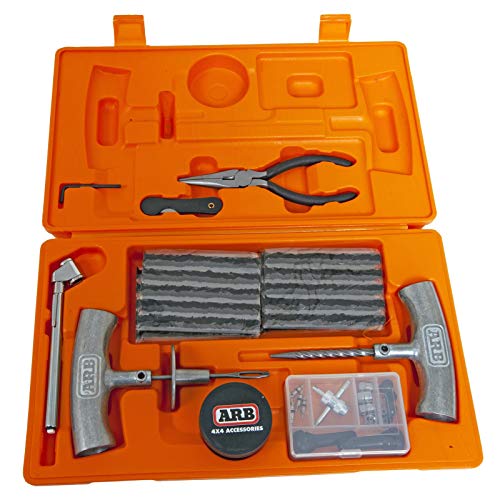
ARB is one of the most respected names in 4x4 and overland accessory manufacturing, and the Speedy Seal 2 reflects that pedigree in every detail of its construction. The kit is built around a premium spring steel insertion needle with a cast handle — not stamped sheet metal, but properly machined spring steel that flexes without snapping under the torque required to drive a plug into an off-road tire. The hardened steel reamer tool provides the same level of durability, which matters enormously when you're working on aggressive mud-terrain tires with reinforced sidewalls and deep tread that resist the reaming process far more than a standard highway tire.
What sets the ARB kit apart from most competitors is the accessory depth — in addition to the insertion and reamer tools, you also get a pencil-type dual-chuck tire gauge, needle-nose pliers, a blade, lubricant, spare valve cores, and spare valve caps, all in a single compact package. The inclusion of valve cores and caps is a detail that most kit manufacturers overlook entirely, yet a damaged or missing valve core is one of the most common secondary causes of a slow leak after a plug repair. ARB's kit addresses that scenario proactively. Replacement 50-string plug packs are also available separately from ARB, which means you're investing in a platform with long-term resupply support rather than a disposable kit.
The Speedy Seal 2 carries a higher price point than the Boulder Tools or AUTOWN kits, and that premium is entirely justified by the tool quality and the off-road-specific engineering. If you're heading into the backcountry, overlanding, or running a Jeep, Land Cruiser, or similar platform where a flat tire could happen miles from cell service, this is the kit you want secured to your gear. It's also an excellent companion to tools like the ones reviewed in our best air ratchets guide, which covers the pneumatic tools that keep your rig running during more involved trailside repairs.
Pros:
Cons:
The Dynaplug Ultralite is a fundamentally different kind of tire repair kit from everything else on this list, and that difference is intentional. Where every other kit in this roundup relies on the traditional ream-and-plug method using separate reamer and insertion tools, the Dynaplug uses a single insertion tube machined from billet 6061 aircraft-grade aluminum to push a self-sealing repair plug directly into the puncture in a single motion — no reaming required, no glue, no wait time. You remove the object from the puncture, insert the repair plug through the insertion tube, push and pull, and you're done. The entire process takes under a minute on a cooperative puncture.
This kit is made in the USA, carries a limited lifetime warranty, and is machined to the tolerances you'd expect from aerospace aluminum rather than stamped from cheap sheet metal. Each repair plug seals punctures up to 3/16 inch in diameter, and you can stack additional plugs side-by-side for larger punctures. The Ultralite version comes with four repair plugs and one insertion tube, which keeps the kit extraordinarily compact — small enough to fit in a jersey pocket if you're cycling, a motorcycle jacket pocket, or tucked alongside a spare air cartridge in a fanny pack for trail running.
The trade-off is price-per-repair and total capacity. Four repair plugs mean four repairs before you need replacement plugs, and the per-plug cost is noticeably higher than a bag of standard vulcanizing strings. This is not the kit you buy as your primary roadside emergency tool for a fleet of vehicles — it's the kit you carry when weight and size are the primary constraints, such as on a bicycle, motorcycle, or ultralight overlanding setup. For motorcycle riders specifically, the Dynaplug pairs perfectly with a CO2 inflator and represents a complete flat repair solution that weighs almost nothing.
Pros:
Cons:
The AUTOWN 68-Piece kit stakes its claim in the budget-to-midrange segment by delivering professional-level material quality at a price that makes it easy to justify keeping one kit in every vehicle you own. AUTOWN builds these kits using refined high-quality steel for the insertion and reamer tools, and they've put genuine attention into the plug strip material — the vulcanizing cords deliver strong adhesion and flexibility, resist aging, and maintain their sealing properties across a wide temperature range, which matters if you're repairing a tire in winter or in the summer heat of the Southwest. The 68-piece count gives you substantial repair capacity that covers the vast majority of personal use scenarios without the larger footprint of an 86-piece kit.
AUTOWN explicitly designs this kit for universal application across cars, motorcycles, ATVs, tractors, lawn mowers, RVs, Jeeps, and trucks, and the plug strings are sized to work across that full range of tire constructions. The tool quality exceeds what you typically find at this price point, with steel tools that have real weight and rigidity rather than the stamped-metal tools that flex and slip when you're trying to drive a plug into a resistant truck tire. The kit arrives in a compact carry case that organizes everything cleanly, and the overall size strikes a balance that works for both glove box storage and truck bed tool boxes.
Compared to the Rhino USA 86-piece, the AUTOWN gives up a meaningful plug count advantage and the US-based support infrastructure, but it matches up favorably on tool quality and delivers a noticeably lower price tag. If you're equipping a second vehicle, a trailer, or a family member's car with a reliable repair kit on a budget, the AUTOWN 68-piece is the kit to buy. You're not making a significant quality compromise here — you're simply choosing efficient value over maximum capacity.
Pros:
Cons:
The Rhino USA Compact 14-Piece kit is the same American-owned, family-operated quality as the 86-piece flagship but packed into a form factor small enough to slide into a glove box, motorcycle saddlebag, or emergency kit pouch without a second thought. It's the kit you add to your everyday carry rotation because it's simply never in the way. The 14 essential items include 9 plug strings, a handle insert tool, a spiral probe tool, lubricant, a tire gauge, and a utility cutter — everything you need to execute a complete plug repair on a tubeless tire from start to finish, sized to handle the most common puncture scenarios you'll encounter.
Nine plug strings means nine repairs before you need to resupply, which is genuinely sufficient for the vast majority of drivers who will encounter one or two flats per year at most. The compact format does not compromise on the tools themselves — Rhino USA uses the same durable, high-quality steel construction here that they deploy in the full-size kit, and the spiral probe tool provides proper leverage for cleaning and opening the puncture channel even in a smaller handle form. The included tire gauge removes the need to hunt for a separate pressure checker after you've completed your repair, which is a thoughtful inclusion in a kit this compact.
The most honest use case for the Rhino USA 14-piece is as a complement to the 86-piece kit rather than a replacement for it — keep the big kit in your truck or SUV for heavy-duty situations, and slip the compact kit into your motorcycle bag, your spouse's car glove box, or your bicycle tool kit. Motorcycle riders dealing with tire issues should also check out our guide to the best motorcycle tire changers for tools that handle more involved tire work, but for a simple puncture on the road, this compact Rhino USA kit is all you need. If you're also thinking about winter safety accessories, our roundup of the best tire chains of 2026 covers traction devices that complement a solid repair kit for cold-weather driving.
Pros:
Cons:
The first number you should look at when comparing tire repair kits is plug string count, because it directly determines how many repairs you can execute before buying a resupply. For a single personal vehicle that sees one or two punctures per year, a 9-plug compact kit is entirely adequate. For a truck, RV, or fleet operator who covers high annual mileage across varied road conditions, a 60-plug kit like the Rhino USA 86-piece is the investment that pays off over time. Don't just focus on the total piece count advertised on the packaging — count the plug strings specifically, because the rest of the piece count includes tools, accessories, and packaging components that don't contribute to your repair capacity. A kit that advertises "68 pieces" with only 20 plug strings gives you far less repair capability than a "30-piece" kit with 25 strings.
The two most critical tools in any tire repair kit are the reamer (also called a spiral probe or rasp tool) and the insertion tool, because these are the instruments doing the actual physical work against a punctured tire under tension. Cheap stamped-metal tools bend under load, slip when you're applying torque, and can strip the T-handle connection after just a few uses — which is exactly the moment you don't want your equipment failing on you. Look for kits that specify heavy-gauge or high-quality steel for these tools, and pay attention to the handle design. A solid T-handle with a non-slip grip gives you the leverage to seat a plug cleanly on the first attempt, while a flimsy handle forces multiple insertion attempts that can enlarge the puncture and compromise the repair.
Standard plug strings run between 4 and 6 inches, and that's perfectly adequate for passenger car, compact SUV, and motorcycle tires with tread depths in the standard range. If you're repairing truck tires, commercial tires, or aggressive all-terrain rubber with deep tread blocks, you need 8-inch strings to reach through the full tread depth and create a seal at the proper depth in the tire body. A standard 4-inch string inserted into a deep-tread truck tire simply doesn't seat far enough into the tire structure, and the repair will fail under highway speed. The Safety Seal Truck kit is the specific solution for this scenario, and it's worth the premium if your daily driver has aggressive tires. Always match the plug string length to your tire's actual tread depth rather than assuming the strings in a universal kit will cover every application.
Where you plan to store your tire repair kit should influence which format you choose, and it's worth thinking through this practically rather than just buying the biggest kit available. A rigid plastic carry case like the Safety Seal Deluxe is ideal for truck beds and organized tool storage because it protects the tools and plugs from moisture and physical impact. A soft carry pouch works well for glove boxes and smaller storage compartments but offers less protection against the elements. Ultra-compact kits like the Dynaplug or the Rhino USA 14-piece are specifically designed for space-constrained storage — motorcycle bags, bicycle saddle bags, and jacket pockets — and their small footprint is the primary feature rather than a compromise. For RV owners, keeping two kits makes sense: a compact kit accessible from the driver's seat for quick roadside repairs, and a full-size kit in your exterior storage compartment for extended trips where multiple punctures are more likely.
A tire plug repair is considered a permanent fix in many situations, particularly for punctures in the center tread area that are smaller than 1/4 inch in diameter. The vulcanizing rubber cords bond with the tire's inner liner as heat and pressure are applied during driving, creating a seal that can hold for the remaining life of the tire. However, sidewall punctures and punctures larger than 1/4 inch are not candidates for plug repair — those require professional patching from the inside or tire replacement entirely. Always have a plugged tire inspected by a professional if you have any doubt about the repair quality.
Most tire plug kits are designed to handle punctures up to approximately 1/4 inch (6mm) in diameter, which covers the vast majority of roadside punctures caused by nails, screws, and small road debris. The Dynaplug Ultralite specifically seals punctures up to 3/16 inch per plug, with the option to stack multiple plugs for larger holes. Punctures larger than 1/4 inch, irregular tears, or sidewall damage are outside the safe operating range of any plug kit and require a full tire replacement or professional inside-out patch repair.
No — that's one of the primary advantages of a plug repair kit over a traditional patch repair. You ream and plug the tire from the outside while it remains mounted on the wheel, and the wheel stays on the vehicle throughout the entire process. This is what makes plug kits viable as a roadside emergency solution. You remove the object causing the puncture, ream the hole to open and clean the channel, insert the plug string with the insertion tool, trim the excess, and reinflate. The entire process typically takes five to ten minutes with a little practice.
A properly executed plug repair using quality vulcanizing strings in a tread-area puncture of appropriate size can last for tens of thousands of miles — often for the remaining life of the tire. The vulcanizing compound bonds chemically with the tire rubber under heat and pressure, forming a seal that is not significantly weaker than the surrounding tire material. That said, plug repairs should be inspected periodically, especially before long trips or if the tire shows any signs of slow leakage. Improper insertion depth, overly large punctures, or poor-quality plug strings are the most common causes of plug repair failure.
Yes, most universal tire plug kits work on tubeless motorcycle tires, and the standard plug string length (4-6 inches) is appropriate for motorcycle tire tread depths. The Dynaplug Ultralite is particularly popular among motorcyclists because of its minimal size and weight. Tube-type tires — still found on some older motorcycles and dirt bikes — cannot be plug-repaired from the outside and require tube replacement. Always verify that your motorcycle's tires are tubeless before purchasing a plug kit as your repair solution, and check the tire manufacturer's guidelines on acceptable repair methods for your specific tire model.
A tire plug is inserted from the outside of the tire without removing it from the wheel, using a vulcanizing rubber cord threaded through the puncture channel. It's fast, convenient, and effective for tread-area punctures within size limits. A patch is applied from the inside of the tire after the tire is dismounted from the wheel, and it provides a more comprehensive seal that covers the inner liner around the puncture. Many professional tire technicians recommend a combination plug-patch repair as the most secure permanent solution. For roadside emergency use, a plug repair is the practical standard — follow up with a professional inspection and potential plug-patch combination repair if you want maximum long-term confidence in the repair.
 |
 |
 |
 |

About Liam O'Brien
Liam O'Brien has spent over a decade buying, field-testing, and evaluating automotive tools with a focus on what actually performs in a real DIY garage rather than what markets well on a spec sheet. His hands-on experience spans hand tools, diagnostic equipment, floor jacks, socket sets, and specialty automotive gear across a wide range of brands and price points. At CarCareTotal, he covers automotive tool and equipment reviews, garage setup guides, and buying advice for home mechanics.
Get some FREE car parts & gear.. Or check out the latest free automotive manuals and build guides here.
Disable your ad blocker to unlock all the hidden deals. Hit the button below 🚗
| | | |
