by Liam O'Brien
Picture this: you've just bought a second vehicle, your driveway is getting crowded, and every oil change means lying on cold concrete wrestling with a floor jack that slips at the worst moment. You've watched enough YouTube walkthroughs to know a car lift would change everything about how you work on your vehicles, but the sheer variety of models, weight ratings, and post configurations has you second-guessing every click. That's exactly where this guide steps in — seven of the best car lifts of 2026, reviewed with the specs and trade-offs you actually need to make a confident decision.
Car lifts have moved well beyond the professional shop floor. Compact two-post models and portable column lifts now fit standard residential garages, while commercial-grade four-post units give serious enthusiasts the same capabilities found in dealership service bays. Choosing correctly comes down to your ceiling height, floor footprint, the weight of the heaviest vehicle you plan to lift, and whether you need drive-through storage or full undercarriage access. We've covered all seven lifts below with honest pros and cons, so you can match the right unit to your garage before you buy. If you're also putting together a full garage setup, our roundup of the 6 Best Mechanic Tool Sets of 2026 pairs well with any of these picks.
Every lift on this list meets or exceeds the Automotive Lift Institute (ALI) safety standards that govern load ratings and structural integrity across North America. That certification matters because an under-rated or poorly welded lift under a 6,000-pound truck is not a risk worth taking for the sake of saving a few hundred dollars. Whether you're doing routine maintenance, storing a classic, or swapping suspension components, the right lift makes the job safer, faster, and far more enjoyable in 2026.
Contents



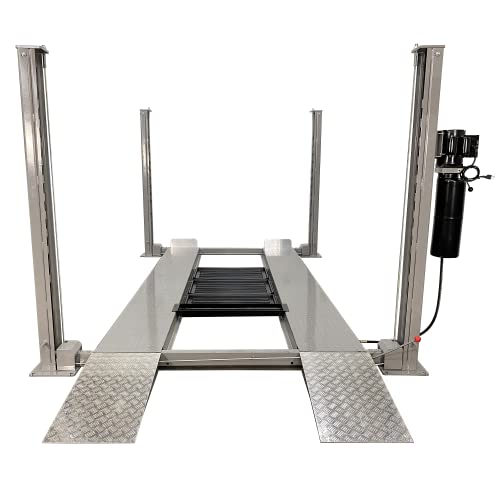







The BendPak HD-9XL is the benchmark against which serious garage owners measure every four-post lift on the market, and it earns that reputation by combining a 9,000-pound capacity with extended-length runway platforms that accommodate full-size trucks and long-wheelbase SUVs without compromise. The dual-hub cable sheave system distributes load symmetrically across all four columns, which means the platform stays level even when your vehicle weight isn't perfectly centered — a real-world situation that cheaper lifts handle poorly. BendPak engineers the HD-9XL for 220V operation, which is standard in any properly wired garage, and the motor is quiet enough that you won't feel the need to shout across the bay during a lift cycle.
The extended-length runway is a genuine differentiator: where standard four-post lifts top out around 161 inches, the HD-9XL stretches to accommodate longer vehicles without requiring you to position the front bumper at the very edge. The heavy-duty aircraft cable — the same specification used in commercial shop lifts — shows no signs of stretch or fray under repeated heavy loads, giving you confidence that the safety rating isn't just a marketing number. Delivery requires a forklift because of the unit's weight, so coordinate your receiving logistics before the truck arrives, and make sure your floor is rated for the concentrated column loads this lift places on it.
Installation takes a full day for two experienced people, but BendPak's manual and hardware kit are complete and clearly labeled, which sets this brand apart from competitors who ship partially documented assemblies. Once it's in and leveled, the HD-9XL delivers the kind of rigid, rattle-free operation that makes you forget you're working in a home garage rather than a professional service center. If you're investing in a four-post lift for the long term, this is the unit that will still feel solid a decade from now.
Pros:
Cons:
The TRIUMPH NSS-8 solves the single biggest headache of small garage ownership: where to put the second car while you're working on the first. With an 8,000-pound capacity and drive-through dimensions that allow genuine service work — not just parking — this four-post lift occupies a practical sweet spot between pure storage platforms and full-service commercial units. The 84-inch overall height fits under a standard 9-foot garage ceiling with enough clearance to work comfortably once the vehicle is raised, and the 175-inch overall length accommodates most production sedans, crossovers, and light trucks without overhang issues.
The 93-inch drive-through width is one of the NSS-8's strongest selling points, because it means you're not threading the needle every time you pull a vehicle onto the runways — even a full-size pickup with running boards rolls on with room to spare. The structural design uses heavy-gauge steel columns and cross-bracing that eliminate the lateral flex you sometimes feel on lighter-duty storage lifts when a vehicle shifts weight during a brake or suspension job. You get genuine service versatility here, not just a parking solution with pretensions.
Triumph backs the NSS-8 with solid parts availability and a straightforward assembly process that most mechanically confident owners complete in a single weekend with two people. For anyone who wants to maximize usable garage space while keeping a service-ready platform on hand, the NSS-8 delivers exceptional value at its price point. It also pairs naturally with the kind of comprehensive tooling described in our 6 Best Car Wheel Dollies of 2026 guide, since the raised platform creates room to roll dollies and service equipment underneath freely.
Pros:
Cons:
The Maxjax M7K answers the question every renter and frequent mover asks: what if you want a real two-post lift but can't bolt anything permanently into the concrete? With a 7,000-pound capacity and a stow-away setup time of just 15 minutes, the M7K genuinely delivers on the promise of portability without sacrificing the lifting capability you need for modern vehicles. The Ultimate Package includes an oil drain, a full set of adapters, and a creeper seat, which means you're buying a complete service station rather than just a lift mechanism — that's a meaningful distinction when you're pricing out what a full setup actually costs.
The adjustable lifting arms and stackable adapters accommodate the wide variety of pinch-weld configurations you'll encounter across sedans, crossovers, light trucks, and performance vehicles, so you're not hunting for adapter kits after purchase. The M7K uses a freestanding base design with integrated anchoring logic that distributes the load through the floor without permanent fasteners, which is why it can be used on standard residential garage slabs rated for typical vehicle traffic. The hydraulic system operates smoothly through the full lift range, and the safety locks engage at multiple height positions so you're not working with anything suspended solely on hydraulic pressure.
If your situation involves a shared garage, a rental property, or frequent travel to different job sites, the M7K is the only lift in this category that genuinely solves the portability problem without stepping down to a floor jack and jack stand combination. Competitors in the portable segment typically cap out at 6,000 pounds or require significantly more setup time, which makes the M7K's combination of capacity, speed, and completeness stand alone in 2026. This is also an excellent complement to the kind of detailed suspension work that benefits from the stability of a comprehensive mechanic tool set.
Pros:
Cons:
The BendPak HD-7PXW takes the four-post concept in a direction most home-shop owners never consider: straight up. Its super-tall rise delivers 12 full feet of lifting height, which means you can store one vehicle at ceiling level while working on another at floor level, or display a collector car at eye level in a showroom environment with full undercarriage visibility. Dealerships and high-end private collections gravitate toward this model specifically because the elevated display position lets customers and owners examine the vehicle from angles that would require a pit on any conventional setup.
The 7,000-pound capacity covers virtually every passenger car and light crossover on the road today, and BendPak's multi-position safety locks in each column engage mechanically at each height increment, providing a redundant safety system that operates independently of the hydraulic circuit. The wider platform design accommodates vehicles up to the maximum allowable track width for the class, and the platform surface itself uses a slip-resistant texture that keeps tires stable during repositioning. Like the HD-9XL, this unit requires a forklift for delivery and 220V power, so plan your site preparation accordingly before the shipping truck arrives.
For serious collectors, dealership principals, or anyone building a dedicated display space for high-value vehicles, the HD-7PXW delivers a capability that no standard four-post lift can match. The 12-foot rise isn't just a marketing statistic — it fundamentally changes what's possible in a given floor footprint by stacking vehicles vertically rather than spreading them horizontally, which translates directly to more usable space in shops where real estate is expensive. BendPak's build quality on this unit matches the standard established by the rest of their commercial lineup, and parts support is excellent through their dealer network.
Pros:
Cons:
The KATOOL 11000lbs two-post lift occupies a position that few competitors at this price bracket can challenge: heavy-duty rated capacity with a clear-floor design that gives you unobstructed undercarriage access across the full length of the vehicle. The 11,000-pound rating exceeds what most heavy-duty pickup trucks, larger commercial vans, and even some light-duty commercial vehicles actually weigh at the curb, which gives you a genuine safety margin rather than the paper-thin buffer you'd have on a lift rated exactly at your vehicle's weight. The 220V electric motor powers the hydraulic circuit through the full lift range without laboring, and the lifting speed is quick enough that it doesn't become a time cost on a busy work day.
The sturdy steel frame uses heavy-wall rectangular tubing in the columns and overhead beam, with a hydraulic system that KATOOL has reinforced for sustained commercial-duty cycling rather than occasional home-shop use. The manual safety release operates independently from both sides of the lift, which is a critical design feature that ensures you can lower the vehicle safely even if one side's mechanism develops an issue. The pedestrian handle for maneuvering the unit during installation is a thoughtful addition that acknowledges the practical reality of setting up heavy equipment in a single-person garage environment.
If your primary concern is maximum lifting capacity at the lowest possible price point without sacrificing the clear-floor access that makes two-post lifts valuable for service work, the KATOOL 11000lbs delivers a compelling combination. The build quality is competitive with units priced 20 to 30 percent higher, and the 11,000-pound rating future-proofs your investment as you add heavier vehicles to your fleet. For reference on the kinds of detailed mechanical work this lift enables, our guide to the 6 Best Oil Filter Wrenches of 2026 walks through the tools that pair most effectively with clear-floor undercarriage access.
Pros:
Cons:
The TRIUMPH NTO-10A delivers 10,000 pounds of two-post clear-floor lifting capacity in a package that professional shops and serious home mechanics have trusted for years, with dimensions calibrated to fit the standard service bay width without crowding adjacent work areas. At 145 inches overall height and 133 inches overall width, this unit requires a ceiling clearance of at least 12 feet for full use, but in return it provides the kind of reach and stability that makes exhaust work, transmission drops, and full suspension rebuilds genuinely comfortable tasks rather than awkward contortions. The overhead beam clear-floor design means no floor-level obstruction between the two columns — your transmission jack, exhaust stands, and rolling tool cart move freely under the vehicle without negotiating around base-mounted components.
TRIUMPH built the NTO-10A with a hydraulic system designed for commercial cycling, which means the equalizing cable and pulley system maintain synchronized arm height throughout the lift cycle even under asymmetric loading conditions. The arm reach on this model covers a wide range of vehicle track widths, and the adjustable arm tips accommodate the pinch-weld and frame contact variations you'll encounter across domestic, European, and Asian vehicle platforms. Safety locks engage automatically at preset height intervals, and the manual release mechanism is accessible from a standing position without requiring you to reach overhead or into the column.
At 10,000 pounds, the NTO-10A handles every passenger vehicle, light truck, and SUV produced for the North American market in 2026 with significant capacity to spare, which means you're not making conservative choices about which vehicles you'll lift. Triumph's parts network is well-established in North America, and replacement cables, arm pads, and hydraulic components are available without long lead times — a practical consideration that matters when a commercial shop's revenue depends on lift uptime. This is the lift you buy when clear-floor access and proven reliability at a reasonable price are both non-negotiable requirements.
Pros:
Cons:
The Atlas Platinum PVL12 is an ALI-certified 12,000-pound two-post lift designed to handle everything from long-wheelbase passenger trucks to box trucks and tall vans — a combination that makes it the most versatile unit on this list for shops that service a genuinely diverse vehicle mix. The adjustable height options of 165 or 177 inches let you configure the lift for your specific ceiling height without being locked into a single setup dimension, and the extra-wide column spacing accommodates vehicles that would challenge a standard-width two-post unit. If your shop regularly sees dual-rear-wheel pickups, extended-length cargo vans, or taller SUVs alongside standard passenger cars, the PVL12's dimensional flexibility prevents the "that vehicle doesn't fit" conversation entirely.
Atlas equipped the PVL12 with automatic arm restraints that lock the arms in the raised position without requiring manual engagement — a feature that removes a step from the workflow and eliminates the scenario where a technician forgets to set the locks before crawling under the vehicle. The thick rubber door guards protect both the vehicle's paintwork and the columns from contact damage during the positioning process, which matters in a production shop where vehicles cycle through quickly. The padded shut-off bar provides a physical safety cutout that stops the lift if it contacts an obstacle during the raising cycle, adding a layer of protection for vehicles with low-hanging components or unusual undercarriage profiles.
At 12,000 pounds of ALI-certified capacity, the PVL12 gives you the highest weight rating on this list in a two-post clear-floor format, which translates to the most comprehensive coverage of the vehicle types currently on North American roads in 2026. The Atlas Platinum line uses heavier steel specifications than the entry-level Atlas models, and the certification process requires independent verification of the load rating rather than self-reported manufacturer numbers — that distinction is meaningful when you're making a capital investment that will carry vehicles over employees and customers for years. Browse more automotive tools and equipment on our tools and reviews page to round out your garage setup.
Pros:
Cons:
The most fundamental decision you'll make is whether you need a two-post or four-post lift, and it comes down to how you plan to use it. Two-post lifts — both clear-floor overhead-beam designs like the Triumph NTO-10A and symmetric models — give you unrestricted undercarriage access across the full length of the vehicle, which makes them the professional's choice for brake work, exhaust replacement, transmission service, and suspension rebuilds. Four-post lifts require drive-on runways that obstruct some undercarriage access points, but they offer superior stability for storage applications and eliminate the need to precisely locate arm contact points each time you use the lift. If your primary use is parking a second vehicle or storing a collector car, a four-post unit is more practical. If your primary use is hands-on mechanical work, the two-post format is almost always more productive.
Every lift manufacturer publishes a rated capacity, and your first instinct might be to match that number exactly to your vehicle's curb weight. That approach is wrong and potentially dangerous. You want a lift rated to at least 125 percent of your heaviest vehicle's gross vehicle weight rating (GVWR), not just its curb weight — because a loaded pickup truck with a toolbox, cargo, and a full fuel tank can easily exceed its published curb weight by 1,000 pounds or more. ALI certification, which the Atlas Platinum PVL12 carries, provides independent verification that the published capacity is accurate, as opposed to unverified manufacturer claims that may not account for real-world fatigue cycling and load distribution scenarios.
Before you finalize any lift purchase, measure your ceiling height from the floor to the lowest obstruction — not from the floor to the peak of the ceiling — and compare it to the lift's total collapsed and extended height specifications. The TRIUMPH NTO-10A requires 12 feet of clearance, while the BendPak HD-7PXW needs significantly more for its 12-foot-rise capability. Equally important is the floor footprint: four-post lifts typically require 20 to 22 feet of runway length, while two-post clear-floor lifts need only vertical column space but demand adequate width between columns for your widest vehicle. Measure your garage before you order — a return shipment on a 1,500-pound freight item is an expensive lesson in pre-purchase planning.
Every electric-powered lift on this list runs on 220V single-phase power, which is standard in properly equipped garages but absent in many residential spaces that haven't been updated for automotive work. Budget for an electrician's visit if your garage currently only has 120V circuits, because running a 220V line and proper disconnect panel is not a DIY shortcut worth taking around heavy-current equipment. Installation complexity varies meaningfully across lift types: the Maxjax M7K's portable design requires no floor anchoring, while permanent two-post and four-post units require anchor bolts set into concrete of adequate thickness and strength — typically a minimum of 4 inches for residential lifts, with some commercial units specifying 6 inches or more. Read the installation manual before purchase, not after delivery.
Most residential two-post and four-post lifts specify a minimum concrete thickness of 4 inches at the anchor point locations, with a compressive strength of at least 3,000 PSI. Commercial-grade lifts like the Atlas Platinum PVL12 often specify 6 inches for full-rated capacity use. Always verify the specific requirement in your lift's installation manual before committing to installation, because using undersized or compromised concrete is one of the leading causes of lift-related incidents.
Permit requirements vary by municipality, but many jurisdictions require a permit for permanent lift installations because they involve bolting into the structural slab and adding 220V electrical circuits. Contact your local building department before installation to determine what permits are required. Skipping permits can create liability issues if an incident occurs and can complicate insurance claims, so the administrative effort is genuinely worth it for a permanent installation.
ALI (Automotive Lift Institute) certification means an independent third-party laboratory has physically tested the lift to verify that it meets its published specifications for capacity, structural integrity, and safety system performance. Non-certified lifts rely solely on manufacturer-reported numbers, which may not account for real-world fatigue cycling or manufacturing variation. For lifts that will support vehicles over people, independent certification is a meaningful safety distinction rather than just a marketing credential.
Yes, but you need to measure carefully. A two-post clear-floor lift like the TRIUMPH NTO-10A has an overall width of 133 inches between column centers, which means you need a garage interior width of at least 14 feet to position a standard sedan safely between the columns with room to open doors. The lift's height requirement is equally critical — most two-post lifts need a minimum ceiling height of 11 to 12 feet. Single-car garages built in recent decades often meet these requirements, but older and smaller detached garages frequently do not.
Professional shop guidelines and manufacturer recommendations typically call for a full safety inspection every six months or every 200 operating cycles, whichever comes first. For home-shop use where the lift cycles far less frequently, an annual inspection that covers cable condition, hydraulic fluid level and quality, anchor bolt torque, and safety lock function is appropriate. Replacing cable and hydraulic seals on a preventive schedule — typically every five to seven years depending on use — is far less expensive than dealing with a component failure under load.
A portable lift eliminates the need for floor anchoring, 220V wiring to a fixed location, and the permanent commitment to a specific garage layout. For renters, for owners who anticipate moving, and for mechanics who work at multiple locations, portability is a genuine functional advantage rather than a compromise. The trade-off is that portable lifts require setup time for each use and typically have somewhat lower maximum weight ratings than the heaviest permanent commercial units, though the Maxjax M7K's 7,000-pound capacity covers the vast majority of passenger vehicles and light trucks on the road today.
 |
 |
 |
 |

About Liam O'Brien
Liam O'Brien has spent over a decade buying, field-testing, and evaluating automotive tools with a focus on what actually performs in a real DIY garage rather than what markets well on a spec sheet. His hands-on experience spans hand tools, diagnostic equipment, floor jacks, socket sets, and specialty automotive gear across a wide range of brands and price points. At CarCareTotal, he covers automotive tool and equipment reviews, garage setup guides, and buying advice for home mechanics.
Get some FREE car parts & gear.. Or check out the latest free automotive manuals and build guides here.
Disable your ad blocker to unlock all the hidden deals. Hit the button below 🚗
| | | |
