by Joshua Thomas
Over 11 million households in the United States own a recreational vehicle, and according to the RV Industry Association's 2025 report, nearly 72% of those owners cite uneven campsite surfaces as their most persistent setup frustration. A reliable set of leveling blocks can eliminate that annoyance in minutes, keeping appliances running correctly, improving sleep quality, and preventing unnecessary strain on the RV's frame and slide-outs. Our team spent several weeks evaluating the most popular RV leveling blocks on the market in 2026, testing them across gravel pads, grass sites, and asphalt lots to determine which options deliver the best combination of stability, durability, and ease of use.
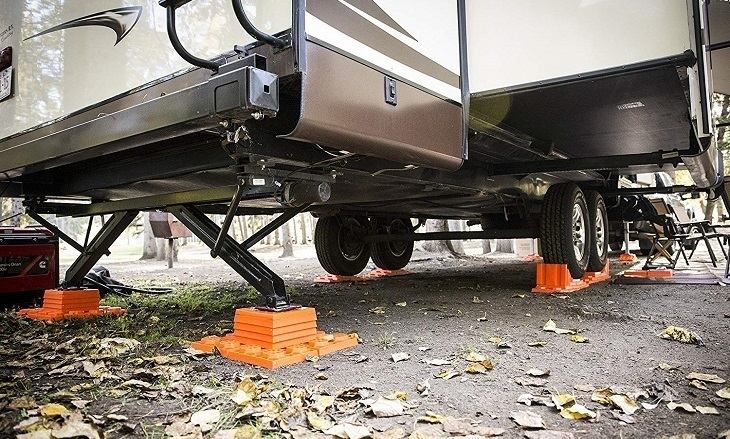
RV leveling blocks generally fall into two categories: stackable interlocking blocks that build up height one layer at a time, and curved drive-on levelers that provide continuously adjustable lift as the tire rolls up the ramp. Each approach has distinct advantages depending on the rig's weight class, how often camp locations change, and whether precision matters more than speed. We've included both styles in this roundup so that anyone shopping for leveling gear can find a solution that matches their camping routine, whether that involves weekend trips to established campgrounds or extended boondocking sessions on rough terrain. For those also outfitting an RV for the road, our guides on the best RV batteries and best RV surge protectors cover two other essential accessories worth considering alongside leveling equipment.
The seven products below range from budget-friendly four-packs to premium drive-on systems with included chocks and carrying bags, with weight capacities spanning 30,000 to 40,000 pounds. We evaluated each one on factors like stacking stability, ground surface performance, storage convenience, and long-term durability after repeated use in varying weather conditions.
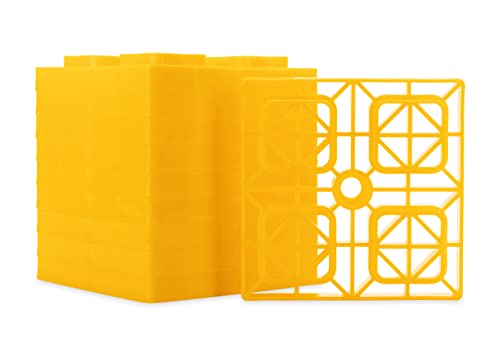








The Camco 44505 has been a campground staple for years, and the 2026 version continues to deliver the same dependable performance that made it a bestseller in the first place. Each block measures 8.5 by 8.5 inches with a 1.5-inch height when interlocked, and the ten-piece set provides enough material to level both sides of a rig with room to spare. The interlocking tongue-and-groove design clicks together firmly, creating a stable platform that resists lateral shifting even on loose gravel surfaces where our team frequently encountered problems with cheaper alternatives.
Made from a durable yellow resin, these blocks handled repeated compression cycles during our testing without cracking or deforming, even under a Class A motorhome weighing over 20,000 pounds. The solid bottom design is a notable advantage on soft ground, as it distributes weight across the full surface area rather than concentrating pressure at specific points. We found that stacking five or six blocks high still felt remarkably secure, though the lack of a dedicated top cap means the uppermost block's interlocking ridges sit directly against the tire surface, which can leave minor impressions in rubber over extended parking periods.
Storage is straightforward since the blocks nest together into a compact stack, and Camco includes a zippered carrying bag with the 10-pack. The bright yellow color makes them easy to spot if one gets left behind at a campsite, which is a small but genuinely appreciated detail after a few early-morning departures.
Pros:
Cons:
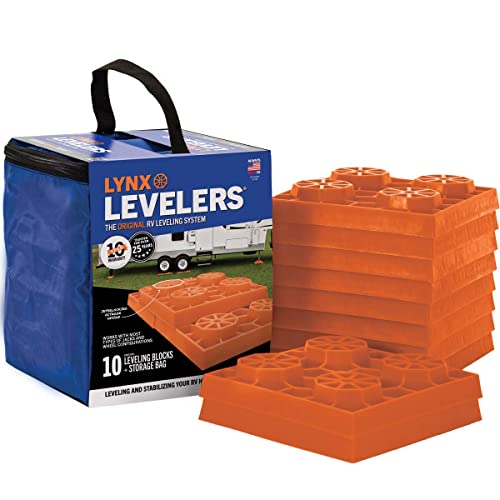
Tri-Lynx has been manufacturing these orange leveling blocks in the United States since 1992, making them one of the longest-running products in the RV accessory space. The Lynx Levelers feature the same fundamental interlocking block concept as the Camco, but with a slightly different locking mechanism that our team found clicked together with a more satisfying and secure feel. Each block measures 8.5 by 8.5 inches and adds 1 inch of height when interlocked, with an impressive weight rating of 40,000 pounds that comfortably accommodates even the heaviest fifth wheels and Class A coaches.
During field testing, the Tri-Lynx blocks performed exceptionally well on gravel pads, where the aggressive interlocking pattern prevented any lateral creep even when a 28-foot travel trailer was being backed onto the stack at a slight angle. The nylon storage bag included with the set is durable enough for repeated use, though it lacks the zippered closure found on some competing products, relying instead on a drawstring opening that works fine but feels slightly less refined. The orange coloring is highly visible and distinct from the Camco's yellow, which is a minor advantage for groups that share campsite tools and gear.
The primary consideration with the Lynx Levelers is their slightly thinner profile when interlocked, which means achieving significant height requires more blocks than some alternatives. For a three-inch lift, our team needed to stack four blocks rather than three, which consumed more of the 10-pack inventory per wheel position. That said, the thinner increment also allows for finer height adjustments, which precision-minded RVers will likely appreciate.
Pros:
Cons:
The Camco 44501 is essentially the same product as the 10-pack version reviewed above, packaged in a smaller four-block set that brings the entry price down significantly for RVers who only need modest leveling capacity. Each UV-stabilized resin block measures 8.5 by 8.5 by 1.5 inches and adds approximately one inch of height when interlocked with adjacent blocks, providing up to four inches of total lift when the entire pack is stacked under a single wheel. The included zippered storage bag keeps everything organized and compact inside an RV's pass-through basement or exterior compartment.
Our testing confirmed that the 4-pack handles most standard leveling scenarios at developed campgrounds where site pads are reasonably maintained and the required correction is typically between one and three inches. The solid bottom construction prevented sinking on the grass test sites, and the interlocking mechanism held firm under a 12,000-pound travel trailer without any noticeable compression or shifting. Compatibility extends beyond wheels to hydraulic jacks, tongue jacks, stabilizer jacks, and fifth wheel jacks, making these blocks genuinely versatile accessories that serve multiple purposes around the campsite.
The obvious limitation is quantity — four blocks only address one wheel position at the maximum four-inch height, so most RVers camping on significantly uneven terrain will want to pick up two sets or step up to the 10-pack instead. However, for those who primarily stay at well-maintained campgrounds and only occasionally need a slight correction, the 4-pack represents outstanding value without unnecessary bulk.
Pros:
Cons:
The Andersen Camper Leveler takes a fundamentally different approach to RV leveling, replacing the stack-and-guess method with a curved drive-on ramp that allows infinite adjustment in any increment from half an inch to four inches. The system works by driving the tire onto the curved surface, checking the level, and then placing the included chocks to lock the wheel at the precise height needed. Our team leveled a 26-foot travel trailer in under three minutes using this system, compared to the five-to-seven minutes typically required with traditional stackable blocks and a bubble level.
Built to handle trailers up to 30,000 pounds with tires up to 32 inches in diameter, the Andersen system feels genuinely overbuilt in a reassuring way. The ramp surface has textured ridges that grip the tire firmly once weight is applied, and the included wheel chocks wedge securely against the curved profile to prevent any rollback. We tested on gravel, concrete, and packed dirt, and the system performed consistently across all surfaces without requiring additional grip pads or modifications. The two-pack configuration covers both sides of a single-axle trailer, which is the most common leveling scenario.
The primary tradeoff is that drive-on levelers require enough space behind the rig to roll backward and reposition if the first attempt doesn't achieve the desired height, which can be challenging in tight campsite configurations. Additionally, this system only works with wheels and cannot double as jack pads like stackable blocks can, somewhat limiting its overall utility around the campsite.
Pros:
Cons:
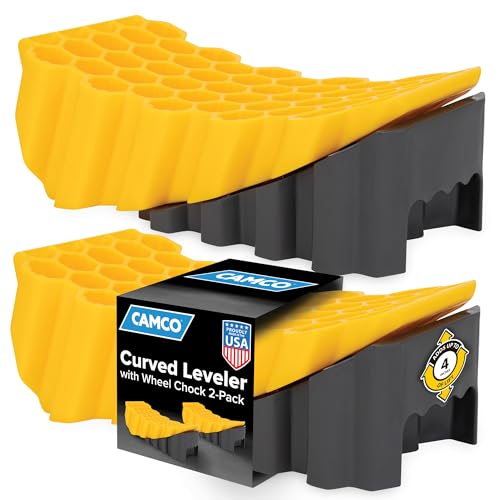
Camco's curved leveler entry brings the drive-on convenience of the Andersen system at a noticeably lower price point, using a distinctive honeycomb internal structure that keeps weight remarkably low without sacrificing the 30,000-pound load capacity. Each leveler provides up to four inches of height adjustment, and the included wheel chocks feature non-slip rubber grippers on the bottom surface that performed impressively during our wet-surface testing on morning-dew-covered concrete pads. The compact overall length is specifically designed to fit between tandem wheels without modification, which is a meaningful advantage for dual-axle travel trailers and fifth wheels.
The honeycomb construction is what truly sets this product apart from the competition in the drive-on category. Where the Andersen leveler feels solid and heavy, the Camco curved leveler achieves comparable structural integrity while being noticeably lighter to carry and store. Our team appreciated this difference after a week-long trip that involved daily setup and teardown, as the reduced weight made the leveling process feel less physically demanding over time. The curved profile provides smooth, gradual incline that guided tires into position without the abrupt transitions that can sometimes cause a trailer to lurch.
One area where the Camco curved leveler fell slightly behind the Andersen was in the precision of its chock engagement, as the rubber-gripped chocks occasionally required repositioning on loose gravel before they held securely. On hard surfaces like concrete and asphalt, however, the chocks locked in immediately and showed no signs of creep during multi-day stays. Those who enjoy extended camping trips and value lightweight, easy-to-store gear will find the honeycomb design to be a strong selling point, much like how the right RV washer dryer can make longer trips more manageable.
Pros:
Cons:
The RVMATE 12-pack offers the most blocks per package in this roundup, which makes it an appealing choice for owners of larger rigs that frequently need to level multiple wheel positions simultaneously. Each standard block measures 8.5 by 8.5 by 1.5 inches, and the set includes two bonus top covers that measure 8.5 by 8.5 by 0.75 inches, designed to sit on top of the stack and provide a smooth contact surface between the interlocking ridges and the tire. This top-cap feature addresses one of the most common complaints about stackable leveling blocks and is something that Camco and Tri-Lynx omit from their base packages.
The high-density reinforced material used in RVMATE's blocks felt comparable to the Camco and Tri-Lynx offerings during our compression testing, showing no visible deformation after supporting a 16,000-pound fifth wheel for a four-day weekend stay. The interlocking mechanism engages cleanly and holds together under load, though our team did notice slightly more lateral play between connected blocks compared to the Tri-Lynx design, particularly when stacking more than four blocks high. On flat, hard surfaces this play was inconsequential, but on soft ground or gravel it required a bit more care during initial positioning.
With twelve blocks plus two top covers, the RVMATE set provides enough material to handle dual-axle leveling with blocks to spare for jack pads or stabilizer supports, all without purchasing a second set. The price-per-block ratio is competitive, making this an efficient choice for anyone who values having plenty of leveling material on hand without running short during challenging campsite setups.
Pros:
Cons:
The Beech Lane Camper Leveler distinguishes itself with the most complete accessory package in the drive-on leveler category, including two curved levelers, two wheel chocks, two custom rubber grip mats, and a durable carrying bag, all protected by a patented design (Patent D949746). The grip mats are a particularly thoughtful inclusion, as they sit beneath the leveler to prevent the ramp from sliding on smooth surfaces when the tire backs onto it. Our team tested this feature on polished concrete and found that the grip mats virtually eliminated the forward push that causes some drive-on levelers to scoot away during positioning.
Constructed from high-performance nylon polymer, the kind typically reserved for structural load-bearing applications in industrial settings, the Beech Lane levelers felt noticeably more rigid than the Camco curved alternative during side-by-side testing. Each leveler provides half an inch to four inches of continuously adjustable height, and the overall dimensions of roughly six inches wide by fifteen inches long keep the footprint compact enough for easy storage. The patented curved profile guides tires smoothly into position, and leveling an entire side of a trailer consistently took under five minutes during our evaluations.
The nylon polymer construction does come at a premium price compared to the Camco curved leveler, but the included accessories arguably justify the difference for anyone who would otherwise need to purchase grip pads and a storage bag separately. The chock design integrates well with the leveler's curve, locking into position with a satisfying snap that inspired confidence during our multi-day testing periods on various surface types.
Pros:
Cons:
The first decision most buyers face is choosing between stackable interlocking blocks and curved drive-on levelers, as each style offers genuinely different advantages. Stackable blocks like the Camco 44505 and Tri-Lynx Levelers are extremely versatile because they can support wheels, jacks, stabilizers, and tongue jacks alike, making them multi-purpose campsite tools. Drive-on levelers like the Andersen and Beech Lane systems provide faster, more precise adjustment with less guesswork, but they only work with wheels and require some rolling distance for proper positioning. Full-time RVers who value speed and precision tend to gravitate toward drive-on systems, while those who want maximum versatility from a single product typically prefer stackable blocks.
Every leveling product in this roundup is rated for at least 30,000 pounds, which covers the vast majority of recreational vehicles on the road in 2026, from lightweight pop-up campers to heavy Class A diesel pushers. However, the rated capacity assumes proper weight distribution across the contact surface, so our team recommends checking the rig's individual wheel loads rather than just the gross vehicle weight rating. According to the Wikipedia entry on recreational vehicles, Class A motorhomes can exceed 30,000 pounds fully loaded, which means verifying per-axle weights at a certified scale is a worthwhile precaution before relying on any leveling system at its upper capacity range.
Storage space is always at a premium in recreational vehicles, so the physical footprint of a leveling system matters almost as much as its performance. Stackable blocks nest together efficiently and store flat, with a 10-pack like the Camco or Tri-Lynx fitting neatly into a pass-through storage bay or basement compartment. Drive-on levelers have a larger individual footprint but typically require only two units to handle both sides, resulting in a comparable overall storage volume. The RVMATE 12-pack occupies the most space in this roundup, though the extra blocks provide genuine utility for larger rigs that need to level multiple positions without running short, and the included top caps add value that compensates for the slightly bulkier package.
Not all campsite surfaces are created equal, and the performance difference between leveling products becomes most apparent on challenging ground conditions. Stackable blocks with solid bottoms, like both Camco sets and the RVMATE, perform best on soft surfaces because they spread weight across a larger area and resist sinking into grass, mud, or loose soil. Drive-on levelers generally perform better on hard surfaces like concrete and asphalt where their ramp profiles can grip effectively, though the Beech Lane's included grip mats help bridge this gap on smoother surfaces. Anyone who frequently camps at primitive or boondocking sites with unprepared ground surfaces will likely benefit from keeping both a set of stackable blocks and a drive-on system in their storage bay.
Most single-axle travel trailers require four to six blocks total to level both sides, while dual-axle rigs and fifth wheels may need eight to twelve blocks depending on how uneven the campsite surface is. Our team recommends a 10-pack as the baseline for most camping scenarios, as this provides enough material for two wheel positions at maximum height with a few blocks left over for jack pads or stabilizer support.
Stackable interlocking blocks like the Camco and Tri-Lynx sets are fully compatible with hydraulic jacks, tongue jacks, stabilizer jacks, and fifth wheel jacks, making them versatile campsite accessories. Drive-on levelers like the Andersen and Beech Lane are designed exclusively for wheel use and should not be placed under jacks, as the curved profile does not provide the flat, stable surface that jack feet require for safe operation.
Leveling blocks generally do not cause meaningful tire damage, though the interlocking ridges on stackable blocks can leave minor surface impressions in tire rubber during stays lasting several weeks or longer. The RVMATE 12-pack addresses this concern with included top caps that provide a smooth contact surface, and adding a flat piece of plywood or rubber mat between any block set and the tire achieves the same protective effect for minimal additional cost.
Stackable blocks provide approximately one to 1.5 inches of height per interlocked layer, so a 10-pack can theoretically achieve up to ten inches of lift, though stacking beyond six inches reduces stability and is generally not recommended by manufacturers. Drive-on levelers max out at four inches of continuously adjustable height, which covers the vast majority of campsite leveling needs without the stability concerns associated with tall block stacks.
Purpose-built leveling blocks offer several practical advantages over improvised wooden solutions, including lighter weight, consistent dimensions, interlocking stability, and resistance to moisture-related deterioration like warping, splitting, and rot. Wooden planks can work in a pinch, but they tend to crack under repeated loading cycles and lack the interlocking mechanism that prevents lateral shifting, which our team considers a meaningful safety concern when supporting vehicles weighing tens of thousands of pounds.
Resin and nylon polymer leveling blocks require minimal maintenance beyond rinsing off dirt, gravel, and debris with a garden hose or campsite water spigot after each use. Allowing blocks to dry before storing them in their carrying bag prevents mildew and odor development, particularly in enclosed storage compartments with limited airflow. UV-stabilized products like the Camco 44501 can be stored outdoors without significant degradation, though keeping all leveling products out of direct sunlight when not in use will maximize their functional lifespan across multiple camping seasons.
Every RV deserves a level foundation, and the right leveling blocks can transform a frustrating campsite setup into a quick, confident routine that takes minutes instead of guesswork. Whether the choice leans toward the versatile Camco 10-pack for its all-around reliability, the precision of the Andersen drive-on system, or the complete Beech Lane kit with its grip mats and carrying bag, any of these seven products will serve a rig well across countless camping seasons in 2026 and beyond. Take a close look at the typical campsite conditions, rig weight, and storage space available, then pick the option that fits the camping style best — and spend more time enjoying the destination instead of fussing with the setup.
 |
 |
 |
 |

About Joshua Thomas
Joshua Thomas holds a Bachelor of Science in Mechanical Engineering from San Diego State University and has spent years applying that technical foundation to hands-on automotive work — from routine maintenance to full mechanical repairs. He founded CarCareTotal in 2017 to give car owners the kind of clear, practical guidance that helps them understand what is happening under the hood and make smarter decisions about upkeep and repairs. At CarCareTotal, he oversees editorial direction and covers automotive fundamentals, maintenance guides, and troubleshooting resources for everyday drivers.
Get some FREE car parts & gear.. Or check out the latest free automotive manuals and build guides here.
Disable your ad blocker to unlock all the hidden deals. Hit the button below 🚗
| | | |
