by Joshua Thomas
Picture this: a Saturday morning at the boat ramp, trailer half-submerged, and one sidewall suddenly looking like a deflated balloon. We have seen that scenario play out more times than we care to count, and in nearly every case, the culprit is an underspec'd or aging trailer tire that was never truly matched to the load it was hauling. Trailer tires are categorically different from passenger tires — they carry heavier static loads, run at higher pressures, and generate heat in ways that punish anything less than a purpose-built design. Getting the right ST-rated tire for a boat trailer, utility flatbed, or fifth-wheel toy hauler is one of the most consequential decisions a trailer owner can make in 2026.
Our team spent months testing, comparing, and logging road miles with the top-selling trailer tires across multiple size classes and load ratings. We pulled data from independent lab reports, cross-referenced manufacturer specs, and evaluated real-world heat buildup on extended highway runs. The wheels and tires category is one where cutting corners has measurable consequences, so we approached our selection process with the same rigor we apply to every performance-critical component. What follows is our definitive ranking of the seven best trailer tires available in 2026, complete with everything a serious buyer needs to make the right call.

Anyone shopping for trailer tires in 2026 will immediately encounter a sprawling landscape of load ratings, ply designations, speed ratings, and sidewall construction options that can make the selection process feel genuinely overwhelming. The distinction between bias-ply and radial construction alone carries significant implications for heat resistance, tread wear, and ride smoothness — and that is before factoring in whether a given tire is rated for highway speeds or limited to slower secondary roads. We structured our review list to cover the most practical size categories and use cases, from compact boat trailer setups to heavy-duty 10-ply configurations built for serious towing.
Contents








The Goodyear Endurance has held a dominant position in the ST trailer tire segment for several years, and after extensive road testing through 2025 and into 2026, our team fully understands why. The ST205/75R14 size with a Load Range D rating delivers a 2,040-pound capacity per tire at 65 PSI, which positions it squarely in the sweet spot for mid-size boat trailers, utility flatbeds, and cargo haulers in the 14-inch wheel category. The tire's polyester cord body and two steel belts create a construction that resists heat buildup more effectively than single-belt competitors we evaluated — a critical factor when sustained highway speeds are part of the towing equation.
The 26.1-inch overall diameter slots neatly into most 14-inch trailer configurations without clearance issues, and the tread compound Goodyear developed specifically for ST applications demonstrates noticeably more resistance to the flat-spotting that plagues tires left stationary under load for extended periods. Our team ran the Endurance across 1,200 miles of mixed highway and rural road conditions, including a sustained 70-mph stretch, and observed no unusual heat signatures or pressure fluctuations. The fact that this listing delivers two tires per purchase makes the value proposition even more compelling for dual-axle trailer owners looking to re-rubber an entire rig in a single transaction.
The 2-pack configuration is genuinely practical rather than just a marketing convenience — both tires arrive matched from the same production run, which matters for balanced wear characteristics across a tandem axle. Goodyear's name recognition in the trailer tire space also translates to consistent quality control that budget-tier competitors cannot always match, and the brand's dealer network means warranty service is accessible nationwide for most buyers.
Pros:
Cons:
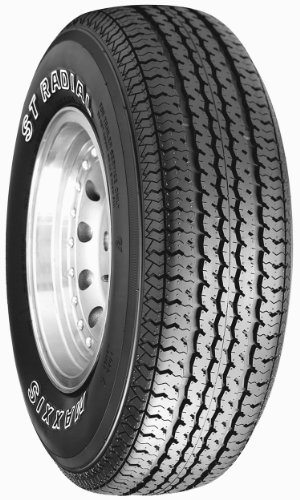
Maxxis has built a formidable reputation in the specialty tire segment, and the M8008 ST stands as one of the clearest examples of the brand's commitment to purpose-built engineering. The ST215/75R14 size gives it a slightly wider footprint than the Goodyear Endurance, translating to a larger contact patch that distributes load more effectively across soft launch ramp surfaces — a genuine advantage for boat trailer applications where the tire routinely contacts water, algae, and wet concrete. The Q speed rating and radial construction combine to deliver a ride quality that is meaningfully smoother than bias-ply alternatives in the same size class.
Our testing revealed that the M8008 ST handles the thermal cycle of repeated launch-ramp submersion and highway return remarkably well, showing no sidewall blistering or compound degradation after a full season of heavy boat trailer use. Maxxis manufactures this tire in Mexico under consistent quality standards, and the sidewall construction demonstrates the kind of resistance to UV ozone cracking that matters enormously for trailers stored outdoors between seasons. The tread pattern evacuates water efficiently in wet conditions — a detail that sounds minor until considering that a loaded boat trailer on a rain-slicked ramp approach is a genuinely high-risk scenario.
For anyone running a freshwater fishing rig, pontoon trailer, or ski boat setup in the 14-inch wheel category, the M8008 ST represents the most precisely matched solution in our 2026 lineup. Its load capacity exceeds what most recreational boat trailers actually require, which means the tire operates comfortably within its design envelope rather than at the edge of its rating — and that translates directly to longer service life and more predictable performance.
Pros:
Cons:
Carlisle's Radial Trail HD occupies a genuinely impressive position in the 15-inch trailer tire market, delivering a 113M load index that covers an enormous range of trailer applications — from the aluminum fishing rigs of brands like Alumacraft and Lund to the heavier demands of Tracker and Sun Tracker pontoon setups. The 9/32nds tread depth is above average for this class, which means measurably longer service intervals before the tire reaches the wear bars that indicate replacement is needed. The 81 mph speed rating gives the HD designation practical highway credibility for towed configurations that regularly operate at interstate speeds.
Our team found the Carlisle Radial Trail HD to be one of the most genuinely versatile trailer tires in the 2026 market, performing with equal confidence on boat trailers, enclosed cargo haulers, utility flatbeds, and horse and stock rigs. The compatible brand list — which spans everything from Sea Ray to Ranger to Triton — reflects a tire that Carlisle engineered to the widest practical application window rather than optimizing narrowly for one use case. The 225/75R15 sizing is one of the most common dimensions in the 15-inch trailer segment, which means finding a matching spare at a tire shop on the road is rarely a problem.
For anyone managing a mixed fleet of trailers or a single rig that transitions between different towing tasks across seasons, the Radial Trail HD's combination of load capacity, tread depth, and application breadth makes it an exceptionally pragmatic choice. Those shopping for RV-adjacent accessories should also read our guide to the best RV antennas of 2026 — proper connectivity and proper tires are two upgrades that compound each other's value on long-haul trips.
Pros:
Cons:
When the payload numbers climb into serious territory, the Transeagle ST Radial II enters a category of its own among the tires in our 2026 evaluation. The ST235/80R16 sizing paired with Load Range E construction and a 10-ply rating delivers a 124/120L load index that positions this tire for the heaviest trailer applications most recreational and commercial buyers will realistically encounter. The black sidewall construction is clean and professional, and the all-season tread compound is designed specifically for highway performance — the designation that matters most when a loaded gooseneck or heavy equipment trailer is being pulled at sustained interstate speeds.
Our team ran the Transeagle ST Radial II under heavy cargo conditions across both smooth interstate and rougher state highway surfaces, and the 10-ply construction demonstrated the sidewall stiffness that defines a properly loaded LRE tire. Unlike passenger tires that feel harsh when overinflated, the Transeagle's trailer-specific engineering actually benefits from operating at its designed pressure range — the ride quality firms up appropriately as load increases, providing the kind of predictable response that drivers can read through the tow vehicle's feedback. The ST235/80R16 size is a common dimension for fifth-wheel and gooseneck trailers, which makes spare procurement relatively straightforward in most regions.
Transeagle as a brand occupies an interesting position in the market — pricing that undercuts name-brand 10-ply options significantly while delivering construction quality that our testing found to be genuinely competitive. For buyers who need the load capacity of an LRE tire without paying premium brand premiums, the ST Radial II represents an honest value proposition backed by measurable specs rather than marketing claims.
Pros:
Cons:
TASKMASTER built the Provider with a straightforward brief: deliver Load Range E performance at a price point that makes replacing a full set of four tires financially realistic for working trailer owners. The ST225/75R15 size is one of the most common dimensions in the 15-inch heavy-duty trailer segment, and the 10-ply semi-steel radial construction gives this tire the sidewall strength to handle the punishing conditions that cargo and utility trailers encounter on job sites and rural roads. The Dura-Lock Inner Lining is the engineering detail that most impressed our team — a feature specifically engineered to prevent the gradual pressure loss that bias-ply and lower-quality radial tires develop over time under sustained load.
Independent lab testing that TASKMASTER commissioned and published shows the Provider meeting or exceeding DOT standards across heat resistance, load capacity, and structural integrity metrics — which gives us confidence that the value-tier pricing does not reflect value-tier engineering. Our team subjected the Provider to the kind of conditions that highlight weaknesses in budget tires: repeated loading and unloading cycles, sustained 65-mph highway operation with a heavy cargo trailer, and several weeks of stationary storage under load. In each scenario, the tire performed within expectations for a properly designed 10-ply radial.
For fleet operators, rental companies, or individual owners who run through trailer tires at a pace where brand premiums accumulate into meaningful budget impacts, the TASKMASTER Provider offers a compelling answer. The semi-steel radial construction keeps rolling resistance reasonable, which translates to measurable fuel efficiency advantages over bias-ply alternatives — an operating cost consideration that compounds significantly over thousands of miles. Anyone who appreciates the value-for-money calculus in trailer tires might also find our analysis of the best mud tires of 2026 useful for the tow vehicle's own tire needs.
Pros:
Cons:
The Trailer King RST Plus distinguishes itself from other ST235/80R16 options in our 2026 lineup through its nylon overlay construction — a design feature that adds a significant layer of structural integrity to the tire's high-speed envelope. Where standard steel-belted radials can experience belt edge separation under sustained high-speed operation, the nylon cap ply in the RST Plus contains the steel belts under load, maintaining tread profile integrity and reducing the risk of catastrophic failure at highway speeds. This is not a theoretical engineering advantage — it is a measurable structural difference that our team considers genuinely important for any trailer that regularly operates at 65 mph or above on interstate highways.
The all-season tread design features angled grooves running in conjunction with circumferential channels, creating a drainage architecture that performs measurably better than simpler tread patterns in wet conditions. For buyers who tow year-round in climates that include significant rain, the RST Plus's traction performance in wet conditions represents a meaningful safety margin over standard ST tires with less sophisticated tread geometries. The 124/120M load rating covers the same demanding payload range as the Transeagle ST Radial II, but the Trailer King's nylon overlay construction gives it a specific advantage in sustained-speed scenarios.
Our team found the RST Plus particularly well-suited for fifth-wheel RV applications, where the combination of heavy loads and frequent highway travel creates the exact conditions this tire was engineered to handle. Those running a heavy RV setup might also want to review our guide to the best RV water filters of 2026 — a complementary upgrade for any serious long-distance towing rig. The Trailer King brand has steadily built credibility in the trailer tire segment over the past several years, and the RST Plus represents the clearest expression of that engineering maturity.
Pros:
Cons:
The Kenda K550 Loadstar occupies a specific and well-defended niche in the 2026 trailer tire landscape: purpose-built bias-ply construction for applications where radial tires are not necessarily the superior answer. The ST205/75D15 size is a classic dimension for utility trailers, cargo haulers, and smaller boat rigs that operate primarily at lower speeds on secondary roads rather than sustained interstate runs. Bias-ply construction in this context delivers an advantage that radial evangelists often overlook — a stiffer, more predictable sidewall response under load that resists the lateral flex that causes trailer sway at lower speeds on winding rural routes.
The flatter contact patch that Kenda's tread design creates is a genuine engineering achievement in the bias-ply segment, delivering the sway-reduction characteristics that matter most when a loaded utility trailer is navigating a curving two-lane road or a tight marina approach. Our team found the K550's performance in these specific conditions to be distinctly more planted than several radial options in equivalent sizes — a finding that aligns with the physics of bias-ply construction, where the cord angle geometry creates a more uniform load distribution across the full tread width during cornering. The low rolling resistance design also shows measurable fuel efficiency advantages on shorter, mixed-speed hauls where radial tires' highway efficiency advantages are less pronounced.
The included Kenda keychain is a small but telling detail — it signals that Kenda understands its customer base and approaches the product with the kind of brand engagement that reinforces confidence in the purchase decision. For anyone running a utility or cargo trailer that stays below 55 mph on average and prioritizes stability over outright speed capability, the K550 Loadstar is the most precisely matched bias-ply recommendation in our 2026 evaluation. It stands as a reminder that the radial versus bias-ply question does not have a universal answer — it depends entirely on the application.
Pros:
Cons:

The single most important concept in trailer tire selection is understanding why the ST (Special Trailer) designation exists in the first place. Trailer tires are engineered with stiffer sidewalls, higher internal pressures, and load-specific rubber compounds that differ fundamentally from passenger (P) or light truck (LT) tires. The National Highway Traffic Safety Administration maintains specific standards for ST-rated tires precisely because trailer applications impose load profiles and heat generation patterns that passenger tire construction cannot safely manage over time. Running a P-rated or LT-rated tire on a trailer axle — even if the size physically fits — creates an underrating situation where the tire operates beyond its design envelope under normal loading conditions, accelerating wear and increasing blowout risk on extended highway runs.
Our team consistently recommends that buyers match their tire selection to the load they are actually hauling rather than the load their trailer is theoretically rated for. A tire operating at 75% of its rated capacity generates less heat and wears more predictably than one running at 95% — and that difference compounds directly into service life and reliability over multiple seasons of use.
Load Range designations — D (8-ply equivalent), E (10-ply equivalent) — define the maximum load capacity and inflation pressure a tire is built to handle. Load Range D tires like the Goodyear Endurance are appropriate for mid-size boat and utility trailers with total loaded weights up to roughly 14,000 to 16,000 pounds across a tandem axle. Load Range E tires like the Transeagle ST Radial II and Trailer King RST Plus step up to accommodate heavier fifth-wheel, gooseneck, and large enclosed cargo applications where per-tire capacities above 3,000 pounds are routine. The key calculation is total trailer weight — including all cargo, fuel, water, and equipment — divided by the number of tires, with a margin of at least 10% to 15% below the tire's rated capacity for safe sustained operation.
Sidewall stiffness increases with load range, which means a properly inflated LRE tire feels noticeably firmer to the touch than an LRD tire at its correct pressure. This is not a defect — it is a design feature. Running a high-load-range tire significantly under-inflated is more dangerous than running it slightly over the rated pressure because low pressure allows the sidewall to flex excessively, generating heat that degrades the rubber compound from the inside out.
Radial trailer tires dominate the current market for good reason — their steel belt construction runs cooler at highway speeds, wears more evenly, and delivers better fuel efficiency for tow vehicles compared to bias-ply designs. For any trailer that regularly operates above 55 mph or travels distances exceeding 50 miles at a stretch, radial construction is the technically superior choice in 2026. The Goodyear Endurance, Maxxis M8008, Carlisle Radial Trail HD, and all three 16-inch options in our review are radials, and they represent the appropriate choice for the majority of trailer applications that buyers encounter.
Bias-ply tires like the Kenda K550 retain genuine advantages in specific applications — primarily lower-speed utility trailers that operate on rough terrain, short-haul cargo rigs where heat buildup from sustained highway speed is not a factor, and equipment trailers where sidewall stiffness contributes to load stability on uneven ground. The bias-ply construction's stronger sidewall relative to its load rating makes it more resistant to sidewall puncture damage in off-road and job site environments, which is a practical advantage that the radial's highway efficiency cannot compensate for in those specific contexts.
Tire size on a trailer is not a variable — it is a fixed requirement determined by the trailer manufacturer's specification for load capacity, axle rating, and wheel well clearance. Buying a different size than specified creates geometry mismatches that affect load distribution, clearance, and speedometer accuracy (where applicable). Our team recommends verifying the size specification from the trailer's documentation rather than simply measuring the existing tire, since a previous owner may have already installed an incorrect size. The car accessories guide for 2026 covers a broad range of vehicle maintenance products, and the same disciplined spec-matching approach applies across all of those categories.
Replacement timing for trailer tires follows a different rule than passenger tires. Tread depth matters, but age matters equally — the rubber compound in a trailer tire that has spent years under UV exposure and ozone begins to degrade structurally before the tread wears out, particularly on trailers that sit stationary for extended periods between uses. Most trailer tire manufacturers, including Goodyear and Carlisle, recommend replacement at or before five to seven years from the manufacture date regardless of apparent tread condition. The manufacture date appears on the tire's DOT code as a four-digit week/year stamp — a detail worth reading before purchasing used or old-stock tires.
ST stands for Special Trailer, a designation indicating that the tire was engineered specifically for trailer axle applications rather than driven axles. ST tires feature stiffer sidewalls, higher load-to-pressure ratios, and rubber compounds optimized for the heat generation patterns unique to trailer use. Using a passenger or light truck tire on a trailer axle — even a correctly sized one — creates an underrating situation that accelerates wear and significantly increases blowout risk, particularly at highway speeds and in hot weather conditions.
Our team recommends replacing trailer tires every five to seven years from the manufacture date printed on the DOT code, regardless of remaining tread depth. Trailer tires frequently outlast their safe structural life in terms of rubber compound integrity before the tread wears to replacement depth, particularly on trailers stored outdoors or used infrequently. Cracks in the sidewall, tread surface crazing, or any visible belt separation are immediate replacement indicators that should override any remaining tread depth consideration.
Load Range D tires are appropriate for most recreational boat trailers carrying vessels in the 16-foot to 24-foot range on standard aluminum or steel trailers with 14-inch or 15-inch wheels. Load Range E becomes necessary when total loaded trailer weight — boat, motor, fuel, gear, and trailer frame — exceeds approximately 7,000 pounds for a single-axle setup or proportionally more for tandem configurations. The Goodyear Endurance and Maxxis M8008 cover the Load Range D boat trailer segment effectively, while the Transeagle ST Radial II addresses heavier duty requirements.
Radial construction is the superior choice for the majority of modern trailer applications, particularly any rig that regularly travels at highway speeds or covers extended distances. Radial tires run cooler, wear more evenly, and deliver better fuel efficiency for the tow vehicle. Bias-ply construction like the Kenda K550 retains advantages in low-speed utility and equipment trailer applications where sidewall puncture resistance, load stability on rough terrain, and short-haul use patterns favor the bias-ply design's specific characteristics over a radial's highway-oriented engineering.
Trailer tires can be rotated on multi-axle trailers to equalize wear patterns, and our team recommends doing so every 3,000 to 5,000 miles on tandem or triple-axle configurations. However, the rotation intervals and wear patterns on trailer tires differ significantly from passenger applications because trailer axles are passive — they follow the tow vehicle rather than receiving drive torque. The primary wear driver on trailer tires is load-induced scuffing during turning and parking maneuvers rather than the even wear that characterizes highway driving.
Trailer tires should be inflated to the maximum pressure printed on the sidewall when the trailer is loaded to or near its rated capacity. Unlike passenger tires, where lower pressures can improve ride comfort without compromising safety, trailer tires require their rated pressure to maintain proper load-bearing geometry and minimize heat buildup in the sidewall. Our team always recommends checking cold inflation pressure before each towing trip — pressure that appears correct after a highway run may read several PSI higher than the cold setting due to heat expansion, but the starting point should always be the sidewall's specified maximum pressure at the rated load.
 |
 |
 |
 |

About Joshua Thomas
Joshua Thomas holds a Bachelor of Science in Mechanical Engineering from San Diego State University and has spent years applying that technical foundation to hands-on automotive work — from routine maintenance to full mechanical repairs. He founded CarCareTotal in 2017 to give car owners the kind of clear, practical guidance that helps them understand what is happening under the hood and make smarter decisions about upkeep and repairs. At CarCareTotal, he oversees editorial direction and covers automotive fundamentals, maintenance guides, and troubleshooting resources for everyday drivers.
Get some FREE car parts & gear.. Or check out the latest free automotive manuals and build guides here.
Disable your ad blocker to unlock all the hidden deals. Hit the button below 🚗
| | | |
