by Liam O'Brien
Over 11 million households in the United States own an RV, yet a staggering number of them are missing dozens of free over-the-air HD channels simply because they're running outdated or mismatched antennas. A quality RV antenna is one of the most underrated upgrades you can make to your rig — it determines whether you're watching crystal-clear local news in camp or staring at a pixelated mess. Whether you're full-timing, weekend camping, or tailgating across the country, the right antenna keeps you connected without paying monthly satellite fees.
In 2026, the RV antenna market has matured significantly. You've got omnidirectional antennas that pick up signals in every direction simultaneously, directional antennas that lock onto distant towers with precision, and fully automatic dome antennas that do all the work for you. Then there's the satellite side: portable DISH-compatible dishes that deliver premium programming wherever you park. The tricky part is knowing which type fits your travel style, your rig, and your budget.
This guide cuts through the noise. We tested and researched seven of the best RV antennas available right now, covering everything from budget-friendly OTA options to premium automatic systems. You'll find detailed reviews, a clear buying guide, and honest pros and cons for every pick. If you're also upgrading other RV essentials, check out our guide to the best RV water filters of 2026 — clean water and clear TV are both non-negotiable on the road. And if you need other automotive tools and accessories, browse our full tools directory for more expert picks.
Contents






The Winegard RZ-8500 Rayzar is the antenna you buy when you want to press a button and forget about signal hunting forever. It automatically rotates a full 360 degrees, scanning for every available channel in your area and locking onto the strongest signal without any input from you. That's a genuine game-changer if you're moving campsites frequently — no more climbing on the roof, no more manual aiming, no more guesswork.
The dual-band VHF/UHF setup covers the full broadcast spectrum, and Winegard's built-in amplifier does real work here. It extends your range meaningfully while actively reducing pixelation and dropout — two of the most frustrating problems with cheap RV antennas. The sleek dome housing isn't just cosmetic either. Every internal component is sealed against moisture, UV, and road debris, so it holds up through seasons of use. Installation is clean and straightforward, fitting the same footprint as most standard RV roof antennas for a no-fuss swap.
Performance in fringe signal areas is where this antenna truly separates itself from the competition. While omnidirectional antennas are picking up whatever they can, the Rayzar is actively hunting and optimizing. You get more channels, better signal quality, and fewer interruptions. If budget isn't your primary concern and you want the most hands-off antenna experience possible, this is your pick.
Pros:
Cons:
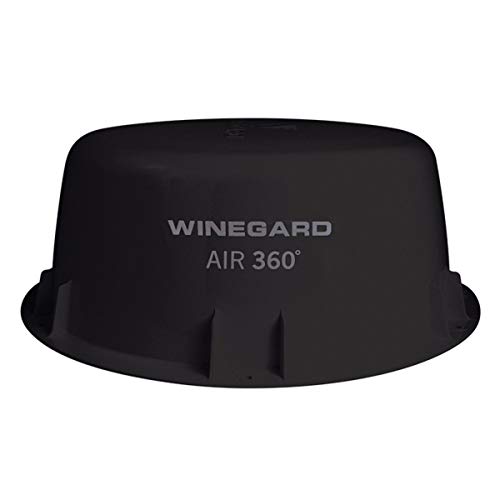
The Winegard Air 360 takes a fundamentally different approach than directional antennas: it receives signals from every direction simultaneously. You mount it, you connect it, and it works — no pointing, no rotating, no adjustments needed as you drive to a new campsite. For RVers who move frequently and don't want to think about antenna aiming, that's a powerful value proposition.
The 360-degree reception pattern means you're never in the wrong orientation for a broadcast tower. In suburban and semi-rural camping areas with towers spread in multiple directions, you'll often pull in more channels than a directional antenna that's pointed at just one cluster. The build is solid and compact — the unit weighs just under 2.5 kilograms and has a relatively tight footprint on your roof, which matters for aerodynamics at highway speeds.
Signal strength in deep rural or mountainous terrain is the one tradeoff you make with omnidirectional design — you sacrifice some raw gain compared to a directional antenna pointed precisely at a distant tower. But for most RV travelers spending time in developed campgrounds within 50 miles of a city, the Air 360 delivers consistent, reliable HD reception without any fuss.
Pros:
Cons:
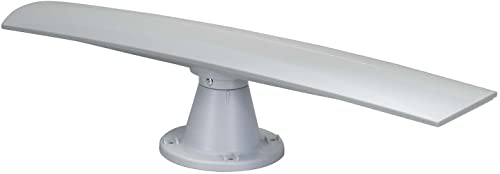
If your RV already has a batwing-style antenna — which describes the majority of factory-installed units built in the last two decades — the King OA8301 Jack is the single smartest upgrade you can make. It's a direct replacement head designed to bolt onto your existing King Batwing mount, and the installation takes about five minutes. No new wiring, no new mounting hardware, no roof penetrations. You simply swap the head and immediately gain modern digital HD signal acquisition.
The engineering improvement over the original batwing design is substantial. The OA8301 features upgraded UHF reception technology that dramatically outperforms older analog-era batwing antennas at picking up today's digital broadcast signals. It still handles VHF channels too, so you won't lose access to those remaining VHF broadcasts in your area. Long-range signal acquisition is where you'll feel the difference most — channels that were previously borderline or nonexistent start coming in clean and stable.
This is the best value upgrade path for RV owners who already have the King mounting system. Rather than buying an entirely new antenna and dealing with installation complexity, you spend a fraction of the cost and get dramatically better performance. It's a practical, no-nonsense solution. For anyone troubleshooting their existing RV electrical systems, you might also find our guide to the best OBD2 scanners of 2026 useful for diagnosing other onboard issues.

Pros:
Cons:
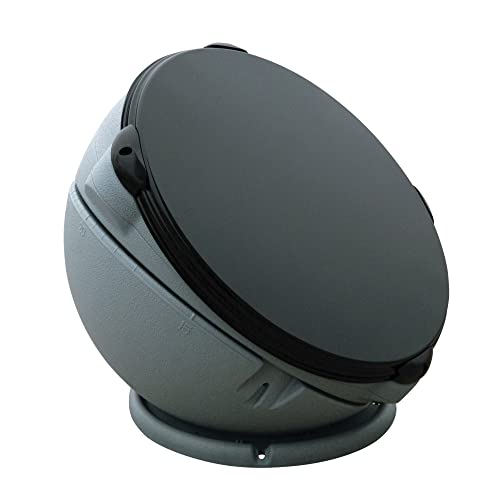
The Winegard Dish Pathway X2 is built specifically for DISH Network subscribers who want to take their programming on the road. It's a portable satellite dish that automatically acquires the DISH Eastern or Western arc satellites, giving you access to your complete DISH channel package without any manual pointing or alignment. That automatic satellite acquisition is the key feature here — the dish does the heavy lifting, so you just set it down, power it up, and wait for it to lock on.
Compatibility with the full DISH satellite fleet means you're not limited to a subset of channels. Whatever programming package you have at home, you get on the road. The antenna is powered through the DISH ViP 211 series receiver, which means you need that specific receiver to run it — this isn't a universal plug-and-play dish. If you're already a DISH subscriber with a ViP 211, though, this setup is seamless and highly capable.
Portability is a real strength. The Pathway X2 packs up and travels without requiring permanent roof mounting, which means you can set it up at the campsite and point it wherever you have the clearest view of the sky. It's an excellent choice for seasonal RVers who want satellite TV quality without the complexity of a roof-mounted automatic system.
Pros:
Cons:
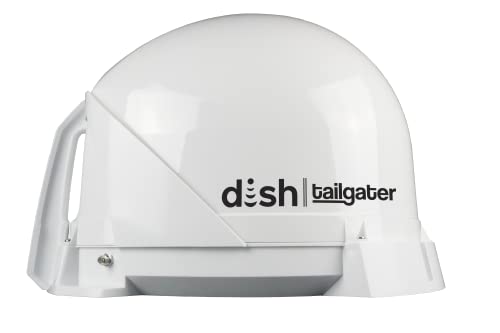
The KING DT4400 DISH Tailgater is the satellite antenna for RVers who don't want to be locked into a monthly contract. DISH's Pay As You Go HD programming model lets you activate service only for the months you're actually traveling — a huge financial win if you're an occasional RVer. You call DISH before your trip, they enable your portable dish, and you get the full network wherever you are within the contiguous US. No annual commitment, no paying for months you're sitting in your driveway.
The engineering on this unit is built for life on the road. It's lightweight enough to carry easily but engineered to handle whatever weather you encounter — rain, wind, heat. You can use it portably on the ground at your campsite or permanently mount it on your roof if you prefer a cleaner setup. The DISH Wally receiver (sold separately) handles the subscription management and gives you access to your programming anywhere in the lower 48 states.
This is a genuinely premium satellite antenna. KING builds quality products, and the Tailgater reflects that with solid construction, reliable satellite acquisition, and the flexibility of dual use — portable and mountable. If you're adding this to your setup, it pairs well with other RV upgrades. Check out our roundup of the best trickle chargers of 2026 to keep your RV's battery topped up during longer stays at camp.
Pros:
Cons:
The KING OA1501 OmniGo is the antenna you want when you need free HD TV without any installation commitment. It's completely portable — no tools, no mounting hardware, no permanent fixture required. You set it up wherever you're parked, and the omnidirectional design means you don't have to point it at anything. Just power it on and it starts pulling in VHF, UHF, and even FM radio signals from every direction simultaneously.
The frequency coverage here is genuinely comprehensive: VHF from 54–216 MHz, UHF from 470–698 MHz, and FM from 87.9–107.9 MHz. That FM capability is a nice bonus that most roof-mounted RV antennas don't offer. You're getting free broadcast TV and free radio in a single portable package. The compact size means it packs easily with your camping gear and doesn't take up meaningful space in your RV.
Performance is solid within about 30-40 miles of broadcast towers. In denser suburban camping areas, you'll typically pull in 20+ clear HD channels without any fuss. Out in genuinely remote locations, you'll feel the limitations of the omnidirectional design — you're trading raw directional gain for convenience. But for the casual camper who wants free TV without the complexity of a roof antenna, the OmniGo is exactly right.
Pros:
Cons:
The RV Omni Directional Amplified Antenna stands out from every other option on this list because it does something none of the others do: it receives TV and AM/FM radio simultaneously through a single antenna unit with a built-in distribution plate. If you want one antenna solution that handles your complete entertainment needs — broadcast TV and radio — this is the pick. The distribution plate simplifies your wiring setup considerably, consolidating what would otherwise be two separate antennas into one clean installation.
The integrated 4G LTE filter is a smart engineering choice that matters more in 2026 than it did even a few years ago. As cellular networks have expanded, interference from LTE signals has become an increasingly common source of pixelation and signal quality problems for RV antennas. This unit actively filters out that interference, which means cleaner, more stable reception without the artifacts that plague unfiltered antennas in areas with heavy cellular coverage.
Installation is streamlined by pre-assembled connectors: a Female Motorola connector for AM/FM and a Female F-connector for TV. The included wall plate completes the package, giving you a professional-looking interior connection point. This is a great option for RV owners doing a full entertainment system upgrade who want to simplify their antenna setup while gaining multi-band capability.
Pros:
Cons:
The first decision you need to make is whether you want over-the-air (OTA) or satellite. These are fundamentally different technologies with different cost structures and content libraries.
According to the FCC's consumer antenna guidance, OTA digital broadcasts are available to the vast majority of the US population within range of a quality antenna — making OTA an excellent starting point for most RV setups.
Once you've chosen OTA, you need to decide between directional and omnidirectional reception patterns. This is the spec that most directly affects your day-to-day experience.
Amplification is not always better. Here's how to think about it:
Think about how your camping style matches your antenna setup requirements before you buy.
An OTA (over-the-air) antenna receives free broadcast signals from local TV towers — no subscription required. A satellite dish connects to a paid service like DISH or DirecTV and delivers hundreds of channels including cable-style programming. OTA is free forever but limited to local channels; satellite costs monthly but works anywhere in the coverage area regardless of tower proximity.
It depends on where you camp. If you frequently park in rural or remote areas more than 40 miles from broadcast towers, amplification helps pull in weak signals. If you camp primarily in suburban or developed campground areas within 30-40 miles of a city, a passive antenna often works just as well without the added electrical draw. In 2026, prioritize antennas with LTE filtering regardless of amplification to avoid cellular interference.
Technically yes, but it's not recommended. Indoor antennas are designed for fixed structures with stable electrical environments. In an RV, they struggle with movement, vibration, and the metal construction of most rigs that interferes with signal reception. An antenna built specifically for RV use — whether portable or roof-mounted — will deliver dramatically better results and is built to survive travel conditions.
An omnidirectional antenna receives broadcast signals from all directions simultaneously, so you never have to aim or adjust it based on where broadcast towers are located. You need one if you move campsites frequently, don't want to manually aim your antenna, or camp in areas where towers are spread in multiple directions around you. If you camp primarily in one region and don't mind occasional manual aiming, a directional antenna may deliver better range for the same price.
A quality amplified directional antenna can receive signals from 50–70 miles under ideal conditions — flat terrain, no obstructions, clear weather. Omnidirectional antennas typically max out around 30–50 miles. Mountains, dense forests, and urban building clutter all reduce effective range. Automatic antennas like the Winegard Rayzar compensate by continuously optimizing their position, which maximizes practical range in real-world conditions.
Yes, for the right type of RVer. DISH Pay As You Go lets you activate satellite service only during the months you're traveling and cancel when you're not. There are no annual contracts and no cancellation fees. If you travel 4-6 months per year, you pay only for those months. Combined with the KING DT4400 Tailgater antenna, it's a cost-effective way to get premium satellite programming without the year-round subscription cost of a traditional satellite package.
 |
 |
 |
 |

About Liam O'Brien
Liam O'Brien has spent over a decade buying, field-testing, and evaluating automotive tools with a focus on what actually performs in a real DIY garage rather than what markets well on a spec sheet. His hands-on experience spans hand tools, diagnostic equipment, floor jacks, socket sets, and specialty automotive gear across a wide range of brands and price points. At CarCareTotal, he covers automotive tool and equipment reviews, garage setup guides, and buying advice for home mechanics.
Get some FREE car parts & gear.. Or check out the latest free automotive manuals and build guides here.
Disable your ad blocker to unlock all the hidden deals. Hit the button below 🚗
| | | |
