by Joshua Thomas
Our top pick for 2026 is the Clearsource Ultra RV Water Filter System with VirusGuard — no other RV filter on the market matches its three-stage protection against viruses, bacteria, and cysts. Clean water is one of the most overlooked aspects of RV ownership, yet it directly affects the health and comfort of everyone on board. Whether pulling into a full-hookup campground or filling up at a rural well, the quality of incoming water varies wildly — and unfiltered water from municipal or private sources can carry chlorine, sediment, lead, VOCs, and biological contaminants that no serious traveler should ignore.
In 2026, the RV water filter market has matured considerably. Multi-stage systems, NSF-certified cartridges, and inline filters with brass fittings have largely replaced the basic carbon hose filters of a decade ago. Our team evaluated seven of the top-rated units based on filtration stages, certification standards, flow rate, ease of installation, and long-term value. The results span a wide price range — from disposable two-packs under $30 to premium three-stage systems built for full-time travelers. For anyone building out a reliable RV tool kit, proper water filtration belongs in the same conversation as choosing the right OBD2 scanner or stocking quality jumper cables — it's core infrastructure, not an optional accessory.

The EPA's drinking water standards set the floor for what's considered safe, but campground hookups and RV park spigots don't always meet those benchmarks consistently. Our review process factored in independent certification (NSF/ANSI 42, 53, and 372), real-world flow performance, and the total cost of ownership over a typical camping season. Browse the full breakdown below — including a detailed buying guide and FAQ — or head to our automotive tools section for more gear reviews.
Contents
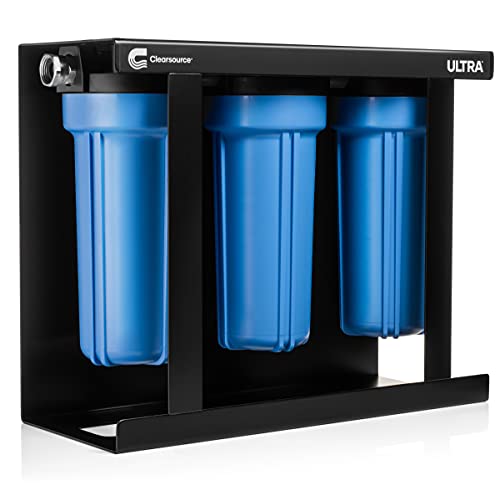







The Clearsource Ultra sits at the top of our 2026 rankings for a single, decisive reason: it's the only RV water filter system tested that eliminates viruses — not just bacteria and cysts. Most competing systems rely on a 0.2-micron filter and market it as comprehensive protection, but Clearsource points out a critical flaw in that approach — unless a filter is rated "absolute," only some pores reach the stated size, leaving gaps in performance. The Ultra's proprietary VirusGuard technology uses an electrically charged coating developed from NASA research to trap even the smallest viral particles, making it uniquely suited for international travel, private well hookups, and any campsite where water source quality is genuinely uncertain.
The filtration architecture runs three stages in sequence. Stage one uses a 5-micron filter to strip rust and coarse sediment before it can degrade downstream components. Stage two deploys a 0.5-micron coconut shell carbon block that targets chlorine, VOCs, and taste-and-odor compounds. Stage three is the VirusGuard cartridge, which handles bacteria like E. coli, cysts like Giardia, and all virus types — a combination no single-stage or even dual-stage RV filter can replicate. Build quality reflects the premium price point: the housing is solid, connections are leak-resistant, and the system is designed for straightforward cartridge replacement rather than full unit disposal.
Our team considers this the correct choice for full-time RVers, anyone camping internationally, or travelers who regularly connect to private or unknown water sources. The cost per gallon is higher than a disposable inline filter, but the level of pathogen coverage justifies the investment for those who treat water safety as a non-negotiable priority.
Pros:
Cons:
The iSpring CW31 is a three-stage system engineered for whole-rig filtration — meaning filtered water reaches not just the drinking tap but the shower, water heater, and every other outlet in the camper. That full-coverage architecture is rare at this price tier and makes the CW31 one of the most compelling mid-range options tested in 2026. The dual CTO (chlorine, taste, odor) filtration stages work in tandem to deliver consistently clean water throughout the rig, a feature especially valuable for larger Class A motorhomes where water usage across multiple fixtures is high.
Construction quality stands out. The 3/4-inch GHT brass fittings are lead-free and rated for zero-leakage performance — a meaningful spec distinction over systems that use plastic quick-connect fittings prone to cracking under temperature swings. NSF-certified filter media and BPA-free materials across the entire system confirm that the CW31 meets independent safety standards, not just manufacturer claims. Flow rate stays strong enough that most buyers report no perceptible pressure drop at the tap, which is a common complaint with under-spec'd multi-stage systems.
The tankless design keeps the installation footprint compact and eliminates stagnant water accumulation that can occur in tank-based systems. For families spending extended time on the road in 2026 — whether cross-country road trips or seasonal full-time living — the CW31 delivers a clean-water solution across the entire rig at a price point well below whole-house alternatives.
Pros:
Cons:
The Camco Tastepure has maintained its position as one of the best-selling RV inline filters year after year, and the 2026 2-pack offering explains why: it delivers certified performance at a price that makes no-excuse water filtration accessible to every RV owner regardless of budget. The six-step Hex-Flow Technology filtration process is independently tested and listed to NSF/ANSI 42 and NSF/ANSI 53 standards — the same benchmarks used for residential drinking water filters. It's CSA lead-free content certified to NSF/ANSI 372 and compliant with all federal and state lead-free laws.
The filtration mechanism combines GAC (granular activated carbon) with KDF media. GAC handles chlorine, sediment, and taste-and-odor compounds. KDF provides bacteriostatic control — it inhibits bacteria and mold growth within the filter itself during periods of non-use, which is a practical advantage for seasonal campers who store their rigs for months at a time. Made in the USA, the Tastepure connects directly to any standard RV water inlet hose and requires no tools for installation. The 2-pack format gives most buyers two to three full camping seasons of protection depending on usage frequency.
The tradeoff is filtration depth. The Tastepure handles chemical contaminants and sediment effectively, but it does not remove cysts, lead, or viral threats. For campgrounds with treated municipal water supplies — which describes the majority of RV parks in North America — that filtration level is entirely adequate. For remote or international use, stepping up to a multi-stage system is the right call.
Pros:
Cons:
The Camco EVO X2 occupies an important middle tier in the 2026 RV water filter market — it delivers significantly more filtration depth than a basic inline hose filter without reaching the price or complexity of a full three-stage system. The dual-stage design is purpose-built for campers who want protection against lead, cysts, and VOCs but don't need virus-level filtration. Stage one is a 5-micron sediment pre-filter loaded with KDF and GAC media that clears heavy particulate, chlorine, and odor while extending the life of the downstream cartridge. Stage two is a 0.5-micron carbon block that handles lead, VOCs, cysts, and Giardia — contaminants that a standard inline filter cannot touch.
The replaceable cartridge model is a practical long-term design decision. Rather than discarding the entire system at end of filter life, buyers swap Camco item 40637 for stage one and 40638 for stage two — a straightforward process that keeps ongoing costs reasonable. Build quality is consistent with Camco's established reputation in RV accessories: durable housings, secure fittings, and a compact form factor that stores easily when not in use.
Our team rates the EVO X2 as the strongest choice for weekend-to-two-week campers who use established campgrounds but want meaningful protection beyond chlorine reduction. It handles the most common municipal water contaminants with a 0.5-micron second stage that few budget filters can replicate. Just as a quality garage heater changes the comfort level of a workspace, the EVO X2 genuinely changes the quality of water across an entire camping trip.
Pros:
Cons:
Culligan's name carries weight in water filtration circles built over decades of residential and commercial filter manufacturing, and the RV-800 applies that credibility to a straightforward pre-tank inline application. Designed specifically as an exterior pre-tank filter, it connects directly to the campground spigot and filters incoming water before it ever reaches the RV's holding tank — a sensible approach for anyone concerned about contaminants accumulating in the tank itself rather than just at the tap.
The RV-800 targets chlorine taste and odor, sediment, and aesthetic chlorine — the primary complaints at municipal campground hookups. A bacteriostatic agent limits the passage and growth of bacteria that may exist in the incoming water supply, adding a meaningful layer of protection that pure carbon-only filters lack. The high flow rate is designed to keep fill times reasonable even when used with large fresh water tanks, and the system connects easily to campers, trailers, motor homes, and boats without adapters or special tools.
Where the Culligan RV-800 earns its spot on our 2026 list is simplicity and brand reliability at an accessible price. It won't remove cysts, lead, or VOCs, so it's not the right choice for areas with known water quality issues. But for campground-to-campground travel across established North American RV destinations, it handles the most common complaints — bad taste, chlorine smell, and visible sediment — with minimal fuss and proven brand backing.
Pros:
Cons:
The RVGUARD Inline filter punches above its weight class in 2026 by combining IAPMO R&T certification against NSF/ANSI 42 with dual KDF and GAC filtration technology — specs that used to be reserved for more expensive units. IAPMO certification is independently administered and carries genuine credibility; it confirms that the RVGUARD meets material safety and aesthetic chlorine reduction standards, not just manufacturer claims. The combination of KDF and granular activated carbon delivers cleaner, better-tasting water than GAC-only inline filters at a comparable price point.
The 2-pack format is the practical differentiator here. Most buyers running an inline filter through a full camping season benefit from having a fresh filter on hand when the first unit reaches capacity. First-time users should note the manufacturer's advisement: carbon fines are normal on initial use and clear quickly after a short flush — this is standard behavior for GAC filters, not a defect. The RVGUARD handles that flush cleanly in our testing, and water quality after the initial purge is noticeably improved over unfiltered campground water.
For buyers who want certified filtration at a budget price, the RVGUARD 2-pack represents one of the strongest per-dollar values in the 2026 RV water filter category. The certification distinguishes it meaningfully from uncertified competitors at similar price points, and the KDF addition improves bacteriostatic performance beyond what basic GAC filters offer.
Pros:
Cons:
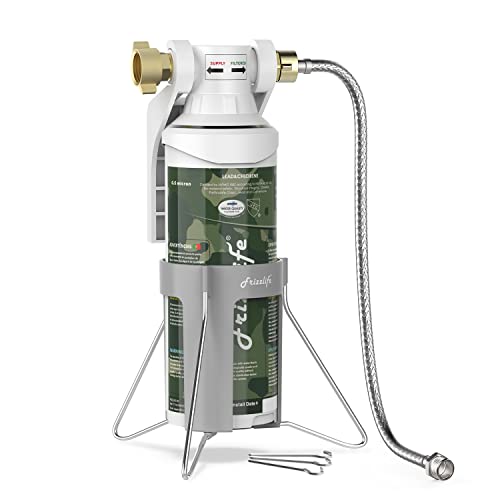
The FRIZZLIFE MV99 closes our 2026 list with a combination of features that make it stand out in the inline filter segment: dual NSF/ANSI 42 and 53 certification, a 0.5-micron composite activated carbon block, and solid brass fittings — all in an inline hose form factor. NSF/ANSI 53 certification is significant because it covers health-effects contaminant reduction, including lead and heavy metals — a standard that most basic RV inline filters do not achieve. The 0.5-micron filtration accuracy removes chlorine, sediment, lead, heavy metals, bad taste, and odors while retaining beneficial minerals.
The brass fittings are a standout construction detail at this price tier. Plastic quick-connects are the failure point on most inline filters, especially in climates with significant temperature variation between summer travel and shoulder-season storage. The MV99's lead-free brass connections are compatible with any standard 3/4-inch garden hose and eliminate the cracking and leakage risk that plastic parts introduce. Frizzlife also notes that the MV99 is sized larger than traditional RV hose filters — which translates to 2-4 times the service life of comparable units. Replacement is handled by the Frizzlife FZ-2 cartridge.
Flow rate is strong, and the filter supports multiple applications: potable water, cooking, dish washing, and even boat use. For RV owners who camp in areas where aging infrastructure means elevated lead risk, the MV99's NSF/ANSI 53 certification delivers genuine peace of mind that other inline filters simply cannot match.
Pros:
Cons:
The number of filtration stages directly determines what a system can and cannot remove. Single-stage inline filters using GAC media handle chlorine, taste, and odor — the most common complaints at established campgrounds with treated municipal water. Two-stage systems add a finer carbon block that captures lead, cysts, and VOCs. Three-stage systems like the Clearsource Ultra layer biological protection on top of chemical and particulate filtration. Buyers should assess the water sources they most commonly encounter: municipal campground hookups call for different protection than remote rural wells or international travel destinations where viral contamination is a documented risk.
NSF certification is the clearest shortcut through marketing noise. NSF/ANSI 42 covers aesthetic contaminant reduction (chlorine, taste, odor, particulate). NSF/ANSI 53 covers health-effects reduction (lead, cysts, VOCs). A filter carrying both certifications — like the FRIZZLIFE MV99 — has had those specific claims independently verified, not just stated on the box. Our team recommends requiring at least NSF/ANSI 42 certification as a minimum baseline for any RV water filter purchase in 2026.
Multi-stage systems improve filtration depth but introduce potential pressure drop — the reduction in water pressure that occurs as water passes through progressively finer filter media. In practical terms, a poorly designed three-stage system can turn a campground spigot with 60 PSI of pressure into a frustratingly slow trickle at the RV tap. Our testing favored systems that specify flow rate data and use properly sized housings to minimize restriction. The iSpring CW31 scored well here despite its three-stage design, with consistently strong flow reported across its user base. Buyers adding an RV water filter to a rig that already runs a pressure regulator should account for the combined pressure reduction.
Inline hose filters offer the simplest installation path — they connect directly between the campground water supply hose and the RV inlet, require no tools, and add no hardware to the rig's interior. They're the right choice for occasional campers, weekend travelers, and anyone who prioritizes simplicity over filtration depth. Multi-stage canister systems mount more permanently (often at the water inlet or under the sink) and require more initial setup, but they deliver meaningfully better contaminant removal and lower cost-per-gallon over time through replaceable cartridges rather than full-system disposal.
The decision between inline and canister frequently comes down to usage pattern. Seasonal campers using established RV parks are well served by a quality inline filter like the Camco Tastepure or RVGUARD 2-pack. Full-time RVers or those who camp in remote locations benefit from the additional protection and cost efficiency of a canister system like the Camco EVO X2 or Clearsource Ultra.
Advertised filter lifespan is stated in gallons processed, but real-world longevity depends heavily on incoming water quality. Water with high sediment loads degrades a filter far faster than clean municipal supply. The practical advice: buy a 2-pack when inline filters are available in that format (as with the Camco Tastepure and RVGUARD), and factor replacement cartridge costs into the budget for canister-style systems. The FRIZZLIFE MV99's 2-4x extended service life claim translates to a meaningfully lower cost per gallon than standard inline alternatives. For the most comprehensive systems like the Clearsource Ultra, the three-cartridge replacement cycle is an ongoing operating cost that serious buyers should calculate before purchase rather than after.
Most RV water filters do not remove viruses. Standard GAC, KDF, and even 0.5-micron carbon block filters are not rated for viral removal. The Clearsource Ultra with VirusGuard is currently the only RV water filter system in our 2026 review that specifically targets and removes viruses using electrically charged filter media. Travelers to regions with known viral water contamination risks should consider the Clearsource Ultra or pair a standard filter with chemical treatment (iodine or chlorine dioxide tablets).
NSF/ANSI 42 certification covers aesthetic contaminant reduction — specifically chlorine taste and odor, and particulate. It confirms that the filter performs as claimed in those categories based on independent laboratory testing. NSF/ANSI 53 certification covers health-effects contaminant reduction, including lead, cysts, and volatile organic compounds. A filter certified to both standards — like the FRIZZLIFE MV99 — has independently verified claims across both aesthetic and health-related contaminant categories. Certification to NSF/ANSI 42 alone is insufficient for lead or cyst removal claims.
Replacement frequency depends on the filter type and actual water volume processed. Most inline hose filters are rated for 1,000 to 2,000 gallons or approximately one camping season under typical usage. Canister-style systems with replaceable cartridges specify replacement intervals per stage — usually every 500 to 1,500 gallons depending on cartridge type. Water with high sediment or heavy chlorine loads depletes filters faster than clean municipal supply. Our recommendation: replace inline filters at the start of each camping season regardless of stated capacity, and inspect canister cartridges mid-season for any signs of reduced flow or taste change.
Yes, and the two accessories are often used together. A pressure regulator protects the RV's plumbing from campground water supplies that exceed safe pressure limits (typically above 60 PSI). An RV water filter addresses contaminant removal. The standard installation sequence places the pressure regulator before the filter — regulator at the spigot, filter between regulator and RV inlet. This order protects both the filter housing and the RV's internal plumbing. Running a filter without a pressure regulator on a high-pressure supply can damage the filter housing or fittings over time.
No. GAC (granular activated carbon) is the most common RV filter media. It works through adsorption to capture chlorine, organic compounds, and taste-and-odor contributors. KDF (Kinetic Degradation Fluxion) is a copper-zinc alloy media that uses redox reactions to reduce chlorine, heavy metals, and to inhibit bacterial growth within the filter itself. The bacteriostatic property of KDF is particularly valuable for RV filters that sit unused for extended periods during storage. Most mid-range and premium filters in our 2026 review combine both media for broader contaminant coverage than either type achieves alone.
Yes. All activated carbon filters — GAC or carbon block — release carbon fines on initial use. These are harmless but produce visibly gray or cloudy water from the tap. Running the filter for a short period (typically 2-5 minutes of continuous flow) clears the fines and establishes normal water clarity. The RVGUARD documentation specifically flags this for first-time users to avoid confusion. Skipping the initial flush and drinking the first output is not a health risk, but it produces water with an unpleasant appearance. Our standard protocol: flush every new filter thoroughly before consuming output water.
Clean water is a non-negotiable on any RV trip, and the 2026 market offers a well-matched option for every type of traveler — from the weekend camper who needs a certified inline filter to the full-timer demanding three-stage virus protection from a Clearsource Ultra. Our team's consistent advice: match the filter's certification level to the actual water sources encountered, factor in total cost of ownership beyond the sticker price, and never skip the initial flush on a new filter before use.
 |
 |
 |
 |

About Joshua Thomas
Joshua Thomas holds a Bachelor of Science in Mechanical Engineering from San Diego State University and has spent years applying that technical foundation to hands-on automotive work — from routine maintenance to full mechanical repairs. He founded CarCareTotal in 2017 to give car owners the kind of clear, practical guidance that helps them understand what is happening under the hood and make smarter decisions about upkeep and repairs. At CarCareTotal, he oversees editorial direction and covers automotive fundamentals, maintenance guides, and troubleshooting resources for everyday drivers.
Get some FREE car parts & gear.. Or check out the latest free automotive manuals and build guides here.
Disable your ad blocker to unlock all the hidden deals. Hit the button below 🚗
| | | |
