by Liam O'Brien
Nearly 30% of RV owners have experienced some form of electrical damage at a campground — and most of those incidents could've been prevented with a $100-$300 surge protector. That's a small price to pay when you consider that replacing a fried air conditioner, refrigerator, or converter can easily run $2,000 or more. Campground power pedestals are notoriously unreliable, and you never know when a brownout, voltage spike, or miswired outlet is going to hit your rig.
An RV surge protector sits between the campground pedestal and your RV's power cord, constantly monitoring the incoming electricity. If it detects a problem — whether that's a dangerous voltage spike, reversed polarity, or an open ground — it cuts the connection before your electronics take the hit. Think of it as a bouncer for your RV's electrical system. Some models are portable (they plug inline at the pedestal), while others are hardwired permanently inside your RV's electrical compartment. Both styles work well, but each has trade-offs we'll cover below.
We tested and compared seven of the top-rated RV surge protectors available in 2026. Whether you've got a 30-amp travel trailer or a 50-amp fifth wheel, this guide will help you pick the right protector for your setup. If you're also outfitting your rig for the season, check out our guides to the best RV water hoses and best RV toilets to keep the rest of your system in top shape.
Contents






The Progressive Industries EMS-PT30X is the gold standard for 30-amp RV surge protection, and it's earned that reputation for good reason. This isn't just a surge protector — it's a full electrical management system (EMS) that continuously monitors your power supply and reacts in real time. With 1,790 joules of surge absorption, it handles the vast majority of power spikes you'll encounter at campgrounds across the country.
What sets the PT30X apart from basic surge protectors is its comprehensive fault detection. It guards against overvoltage, undervoltage, open ground, open neutral, reversed polarity, miswired pedestals, accidental 240V connections, and even AC frequency anomalies. That's an impressive list. The digital display shows real-time voltage, amperage, and error codes, so you always know exactly what's happening with your power. If something goes wrong, the unit automatically disconnects your RV and displays the fault code so you know why.
Build quality is solid. The housing is weather-resistant, and the locking mechanism keeps it securely attached to the pedestal — a nice theft deterrent. It's rated for 30 amps at 120V with a 3,600-watt capacity, which covers everything from a small pop-up camper to a mid-size travel trailer. If you own a 30-amp rig, this is the one to buy. Period.
Pros:
Cons:
The EMS-PT50X is the big brother of our top 30-amp pick, and it delivers the same excellent protection scaled up for 50-amp RV systems. Rated for 50 amps at 120/240V with a whopping 12,000-watt capacity, this unit handles everything a large motorhome or fifth wheel can throw at it. The surge absorption jumps to 3,580 joules — double the 30-amp model — because 50-amp rigs have more expensive electronics at stake.
You get the same advanced fault detection here: overvoltage, undervoltage, reverse polarity, and surge failure protection all come standard. The portable design means you plug it inline between the pedestal and your power cord, no tools or installation required. Just plug it in, wait for the 136-second boot delay (it tests the power before connecting your RV), and you're protected. That boot delay can feel long when you're eager to get set up, but it's actually a feature — the unit is running diagnostics to make sure the power is safe before letting it through.
If you're running a 50-amp rig with dual AC units, a residential fridge, and a washer/dryer combo (speaking of which, here's our best RV washer dryer roundup), this is the protector that'll keep all of it safe. The PT50X has been the go-to choice for serious RVers for years, and the 2026 version continues that tradition.
Pros:
Cons:
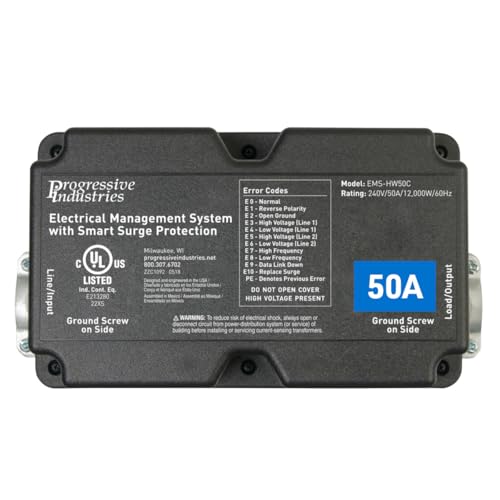
If you're tired of hauling a portable protector in and out of your storage bay every time you set up camp, the EMS-HW50C is the answer. This hardwired unit installs permanently inside your RV's electrical compartment, so it's always protecting your rig — even when you forget. Once it's wired in, you never think about it again. That convenience alone makes it worth considering, especially for full-timers.
The specs match the portable PT50X: 50-amp capacity, 120/240V operation, 12,000 watts, and 3,580 joules of surge absorption. But you also get the full fault detection suite that Progressive Industries is known for — overvoltage, undervoltage, open ground, open neutral, reversed polarity, miswired pedestal, accidental 240V, surge failure, and AC frequency monitoring. That's nine distinct fault types this unit watches for. The included remote display panel mounts inside your RV so you can check your power status without going outside.
Installation does require some electrical knowledge. You'll need to wire it into your RV's power distribution panel, which means working with 50-amp wiring. If you're handy, it's a straightforward afternoon project. If not, any RV tech can install it in about an hour. The extra cost of installation is worth it for the "set it and forget it" peace of mind. This is our top pick for anyone who camps frequently or lives in their RV full-time.
Pros:
Cons:

Southwire is one of the biggest names in electrical products (they've been making wire and cable since 1950), and their Surge Guard line brings that expertise to the RV world. This 50-amp hardwired model is a solid alternative to the Progressive Industries HW50C, especially if you find it at a lower price point. It installs inside your RV's electrical compartment and provides continuous protection without any daily setup required.
The Surge Guard uses Southwire's 3-mode protection technology, which addresses normal mode, common mode, and differential mode surges. In plain English: it protects against power spikes regardless of which path they take through your wiring. You also get automatic shutdown for overvoltage and undervoltage conditions, plus indicators for reverse polarity and other wiring faults. The connected remote display lets you monitor power conditions from inside the coach.
Where the Southwire falls slightly behind Progressive Industries is in the breadth of its fault detection. It covers the essentials well, but Progressive's nine-fault system is more comprehensive. For most RVers, though, the Southwire catches everything you're likely to encounter at a standard campground. It's a reliable, well-built unit from a trusted electrical brand.
Pros:
Cons:
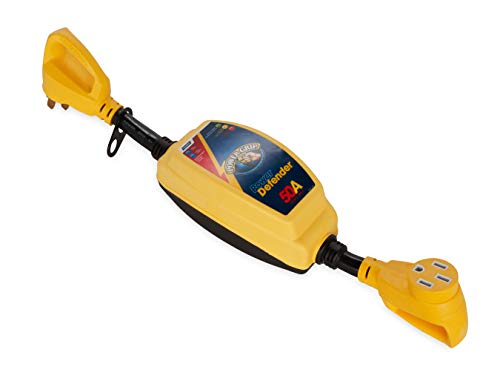
Camco is a household name in the RV world, and their Power Grip surge protector delivers respectable protection at a price that won't make your wallet cry. With 4,200 joules of surge absorption, it actually outperforms the Progressive Industries PT50X on raw joule rating alone. That's a surprising stat for a budget-friendly option. The unit plugs inline at the pedestal, so setup is as simple as connecting two plugs.
The Power Grip monitors for high voltage (above 132 VAC) and low voltage (below 102 VAC), automatically disconnecting your RV when conditions are unsafe. When power returns to normal, it reconnects automatically — no need to go outside and reset anything. Diagnostic LEDs on the unit indicate wiring faults including reverse polarity, open neutral, and other common campground wiring issues. You'll know immediately if the pedestal is miswired before you plug in your RV.
The trade-off for the lower price is a simpler feature set compared to Progressive Industries. You don't get a full digital display showing real-time voltage and amperage — just LED indicators. And the fault detection covers fewer scenarios. But if you're on a budget and need solid surge protection for a 50-amp rig, the Camco Power Grip punches well above its price class. It's a smart pick for weekend warriors who want protection without the premium cost. Much like choosing the right RV roof coating, getting reliable surge protection is about matching the product to how you actually use your rig.
Pros:
Cons:
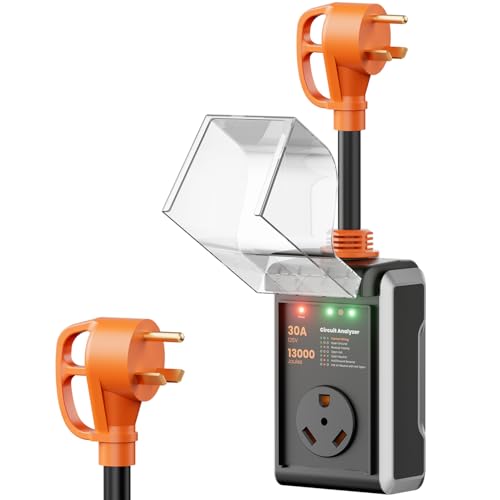
The CRTBETLIF 30-amp surge protector is the new kid on the block, and it comes out swinging with a jaw-dropping 13,000-joule surge rating. That's over seven times the joule rating of the Progressive Industries PT30X. Now, joules aren't the only thing that matters (fault detection and build longevity count too), but there's no denying that's an impressive number for the price. This 2026 upgraded model continuously monitors your power connection status and acts as a circuit analyzer before you even connect your RV.
The unit doubles as a circuit analyzer, meaning it tests the quality of the campground power before your RV draws from it. You'll see indicator lights showing whether the wiring is correct, if there's an open ground or neutral, and if voltage is within safe range. The weatherproof housing and included cover mean you can leave it plugged in through rain, dew, and whatever else Mother Nature throws at your campsite.
The catch? CRTBETLIF doesn't have the decades-long track record of Progressive Industries or Camco. Newer brands can be hit or miss on long-term reliability and customer support. But if you're budget-conscious and want the most joules per dollar on a 30-amp system, this is tough to beat in 2026.
Pros:
Cons:
CRTBETLIF's 50-amp model takes the same budget-friendly approach as their 30-amp unit and scales it up for larger RV systems. With 16,000 joules of surge protection, this is the highest joule rating on our entire list — by a wide margin. It continuously monitors your power connection and provides real-time alerts for wiring faults including open neutral, open ground, overvoltage, undervoltage, reversed polarity, and no-power conditions.
The built-in circuit analyzer is a standout feature at this price. Before your RV draws a single watt, the unit checks that the campground pedestal is wired correctly and delivering safe voltage. You get visual indicators for each fault type, so even if you don't know much about electrical wiring, you can quickly tell if something's wrong. The waterproof cover and rugged housing are built for outdoor use in all conditions.
Like its 30-amp sibling, the main question mark is long-term durability. CRTBETLIF is still proving itself in the market. But the specs are impressive, the price is right, and if the 16,000-joule rating holds up as advertised, you're getting more raw surge protection per dollar than any other option on this list. For budget-minded RVers with 50-amp rigs, it's absolutely worth a look.
Pros:
Cons:
This is the most important decision, and it's non-negotiable — you must match the surge protector to your RV's amp rating. Check your RV's power cord plug:
Using a 30-amp protector on a 50-amp system won't work physically (the plugs are different shapes). Using a 50-amp protector with a 30-amp adapter is possible but not ideal — get the right one for your rig.
Portable units plug inline at the power pedestal. They're easy to install, require no tools, and can move between RVs. The downside? You have to remember to use them every time, and they're exposed to theft and weather at the pedestal. Hardwired units install permanently inside your RV's electrical compartment. They're always working, can't be stolen, and stay dry. But they cost more, require installation, and can't easily transfer to a new RV. Our recommendation: go hardwired if you camp frequently or full-time, portable if you're a weekend warrior or want flexibility.
Joules measure how much surge energy the protector can absorb over its lifetime. Higher is generally better, but it's not the whole story. A 13,000-joule unit isn't necessarily seven times better than a 1,790-joule one — the quality of the internal components, response time (how fast it reacts to a surge), and clamping voltage (the level at which it activates) all matter. That said, for most RVers, anything above 1,500 joules provides solid protection against common campground surges. Units in the 3,500+ joule range offer excellent protection for high-value rigs.
Beyond surge protection, the best units also monitor for wiring faults in the campground pedestal. Here are the key faults to watch for:
Progressive Industries covers all of these. Budget models typically cover three to five. If you camp at well-maintained RV parks, basic fault detection is probably fine. If you boondock or stay at older campgrounds with questionable electrical infrastructure, invest in comprehensive detection. It's the same logic as choosing the right tools for any maintenance job — match the tool to the conditions you'll actually face.
Yes, absolutely. Campground power pedestals are one of the most unpredictable electrical sources you'll ever plug into. Voltage spikes, brownouts, miswired outlets, and lightning-induced surges can all fry your RV's electronics. Replacing an air conditioner, converter, or refrigerator board costs $500 to $2,000+. A surge protector costs $50 to $350. The math is simple — it pays for itself the first time it saves you from a single electrical event.
A basic surge protector only guards against power spikes — sudden jolts of high voltage. An EMS does that plus continuously monitors for sustained problems like low voltage, high voltage, wiring faults, and frequency issues. Think of a surge protector as a safety net for sudden events, while an EMS is a full-time watchdog for all electrical conditions. The Progressive Industries models on our list are full EMS units, while the Camco and CRTBETLIF models are closer to enhanced surge protectors.
No. RV surge protectors draw power from the campground pedestal (shore power), not from your RV's battery system. They only work when you're plugged into shore power. When you're running off your battery or generator, the surge protector isn't in the circuit. There's no impact on your 12V system whatsoever.
Most quality RV surge protectors last 3 to 10 years under normal use. However, their surge protection capacity (measured in joules) degrades with each surge they absorb. A protector that's taken several big hits may still power up but offer reduced protection. Progressive Industries models include a "protection status" indicator that tells you when the surge components are depleted and need replacement. Budget models typically don't have this feature, so plan to replace them every 3 to 5 years as a precaution.
It depends on your camping style. Hardwired units are better for full-timers and frequent campers because they're always active and can't be forgotten or stolen. Portable units are better for occasional campers, people who own multiple RVs, or anyone who doesn't want to deal with installation. Performance-wise, the same manufacturer's portable and hardwired models typically offer identical protection — the difference is convenience and security.
Most portable RV surge protectors can be used with a generator, but there's a caveat. Cheap or poorly maintained generators can produce "dirty" power with voltage fluctuations and frequency irregularities that may cause the surge protector to repeatedly disconnect your RV. Higher-end inverter generators produce clean, stable power that works well with surge protectors. If your surge protector keeps tripping on your generator, the issue is likely the generator's power quality, not the protector.
 |
 |
 |
 |

About Liam O'Brien
Liam O'Brien has spent over a decade buying, field-testing, and evaluating automotive tools with a focus on what actually performs in a real DIY garage rather than what markets well on a spec sheet. His hands-on experience spans hand tools, diagnostic equipment, floor jacks, socket sets, and specialty automotive gear across a wide range of brands and price points. At CarCareTotal, he covers automotive tool and equipment reviews, garage setup guides, and buying advice for home mechanics.
Get some FREE car parts & gear.. Or check out the latest free automotive manuals and build guides here.
Disable your ad blocker to unlock all the hidden deals. Hit the button below 🚗
| | | |
