by Joshua Thomas
Whether you are reflashing a stock ECU or tuning a standalone engine management system, a wideband gauge is one of the most important instruments you can install in a performance build. It reads the oxygen content in your exhaust stream and translates that into real-time air-fuel ratio data, giving you the precise feedback needed to dial in fueling for maximum power, efficiency, and engine safety.
Unlike narrowband O2 sensors that only report rich or lean near stoichiometric, a wideband gauge reads across the entire useful AFR range — typically from a rich 8:1 to a lean 20:1 — allowing you to tune naturally aspirated engines, turbo builds, and flex-fuel setups with equal precision. The quality of the sensor and the controller circuit determines how accurate and how fast those readings are.
This guide reviews the 7 best wideband gauges available in 2026, covering everything from professional-grade AEM and Innovate units to budget-friendly options that still use the trusted Bosch LSU 4.9 sensor. Read on to find the right wideband for your build and budget.
Contents







The AEM 30-0300 X-Series is the top choice for serious performance tuners who demand the most accurate, fastest-responding wideband gauge available. Built around AEM's patented X-Digital technology and the industry-leading Bosch LSU 4.9 sensor, it delivers precision that competing gauges simply cannot match.
The gauge reads an AFR range of 8.0 to 20.0 and displays values to the hundredths place. The X-Digital controller processes sensor data faster than traditional analog circuits, which translates directly to tighter closed-loop feedback control during tuning sessions on a dyno or on the street.
A 7-segment center display that is 87% larger than previous AEM units makes readings easy to see at a glance, even in bright sunlight. The gauge ships with both 0–5V and RS232 serial outputs for data logging with popular software such as EFILive, HPTuners, and AEM's own logging suite. An AEMnet CANbus output adds compatibility with the broader AEM ecosystem. Auto-dimming and an included weld-in stainless-steel bung round out the package.
The main limitation is price — the X-Series commands a premium over budget alternatives. A boost pressure gauge is not included and must be purchased separately if needed. Overall, for professional-grade tuning, this is the benchmark wideband gauge in 2026.
Pros
Cons
The AEM 30-4110 is the value pick for tuners who want AEM's proven accuracy without paying for the full X-Series feature set. It uses the same Bosch LSU 4.9 wideband oxygen sensor found in the X-Series, meaning the core measurement quality is essentially identical.
The gauge displays AFR on a sweeping LED bar graph with a simultaneous digital readout, making it fast and easy to interpret. Both a weld-in stainless-steel bung and the wiring harness are included in the kit, so you have everything needed for a clean installation from the start.
Interchangeable black and white faceplates let you match the gauge to your interior or instrument cluster style. Compatibility with vehicle electrical systems up to 16V makes it a universal fit for nearly any street or track application.
The 30-4110 lacks the CANbus output and the extra-large display of the X-Series. Its AFR range is slightly narrower than the 30-0300. However, for the vast majority of naturally aspirated and mildly boosted builds, these differences are inconsequential, and the lower price makes this one of the best-value widebands on the market.
Pros
Cons
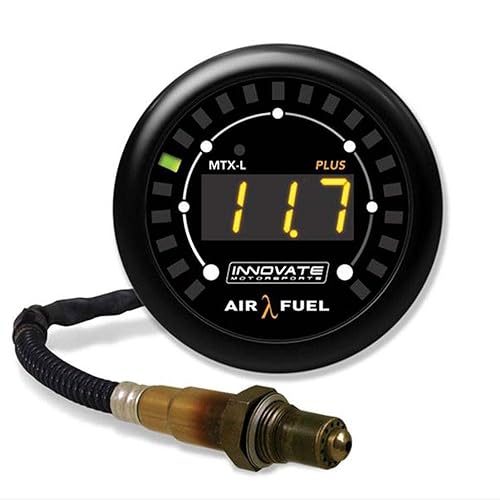
Innovate Motorsports has been in the wideband game longer than almost any other brand, and the MTX-L Plus represents their latest refinement of the classic MTX-L design. The wide 6.0 to 20.0 lambda AFR range makes this gauge usable on gasoline, diesel, E85, and methanol applications.
The white OLED display provides sharp, high-contrast readings that are very easy to read day or night. The MTX-L Plus uses a faster sensor frequency than the original MTX-L, resulting in quicker response times for more accurate closed-loop tuning feedback.
Setup is straightforward, with the gauge accepting power, ground, and the included Bosch LSU 4.9 sensor cable. A 0–5V analog output allows integration with standalone ECUs and data loggers. The black and white faceplate option lets you customize the look to suit your cockpit.
The MTX-L Plus is a well-regarded unit, but it costs slightly more than the comparable AEM 30-4110 for a similar feature set. Some users have reported that the OLED display can be harder to see at certain angles in direct sunlight compared to a backlit LED display. Innovate provides strong support and an active community for calibration troubleshooting.
Pros
Cons
The AEM 30-0334 is the OBDII-enabled version of the X-Series line, designed for enthusiasts and tuners who work with OBDII-capable tuning platforms. Its most distinctive feature is OBDII output compatibility, which allows it to be read directly by EFILive, HPTuners, and DashDaq without needing an additional wideband input channel.
Like the 30-0300, it uses the same Bosch LSU 4.9 sensor and X-Digital controller, delivering the same class-leading accuracy and response time. The AEMnet CANbus output provides integration with other AEM devices in multi-gauge setups.
The large 7-segment center display is identical to the 30-0300, making readings crisp and clear. The weld-in bung and wiring harness are included. Auto-dimming keeps the display readable in all lighting conditions.
The OBDII functionality adds cost over the standard 30-0300, making it the most expensive gauge in this lineup. If you are not actively using EFILive, HPTuners, or DashDaq, the premium may not be justified. For GM, Ford, and Dodge tuners on those platforms, however, the 30-0334 is arguably the most convenient wideband solution available.
Pros
Cons
The GlowShift Tinted 7 Color Series Wideband Gauge is the best choice for drivers who want accurate AFR monitoring paired with a visually customizable display. Seven solid color modes and two color cycle modes allow you to perfectly match the gauge illumination to your car's interior theme.
The gauge supports both gasoline and E85 FlexFuel applications, with an AFR range of 9.0 to 19.99. Auto-dimming activates when the headlights are turned on, reducing glare in night driving. The tinted face gives it a sleek, professional look that stands out from plain-black alternatives.
Installation is clean and straightforward. GlowShift includes the oxygen sensor, weld-in bung, and all necessary wiring in the kit. The 52mm housing fits standard gauge pods found in virtually every aftermarket A-pillar or gauge panel.
The GlowShift is a consumer-grade gauge aimed more at style-conscious enthusiasts than professional dyno tuners. It lacks data logging outputs and a CANbus interface. Accuracy is adequate for most street tuning needs but falls short of AEM's X-Digital precision. It is, however, one of the most affordable name-brand options with a complete kit.
Pros
Cons
The CNRAQR Universal Wideband is a relatively new entrant that punches well above its price class by including the full Bosch LSU 4.9 sensor in the kit — the same sensor found in gauges costing twice as much. This makes it an excellent choice for budget-minded builders who refuse to compromise on sensor quality.
The gauge features one of the widest AFR reading ranges in this roundup, spanning 7.35 to 22.39 lambda, which provides more headroom on both the rich and lean ends. The digital color LED display is bright and readable, showing values clearly during high-RPM tuning passes.
The 52mm standard housing ensures it fits virtually any gauge pod, A-pillar mount, or dash cutout. Compatibility up to 16V means it works with stock and upgraded electrical systems alike. All wiring, a weld-in bung, and instructions are included for a straightforward installation.
As a newer brand, CNRAQR does not yet have the long-term track record of AEM or Innovate. Long-term durability in high-heat environments is less established. However, early user reviews are strongly positive, and the Bosch LSU 4.9 sensor ensures the measurement core is solid regardless of the gauge brand.
Pros
Cons
The Innovate LM-2 is the data-logging specialist of this group, designed for advanced tuners who need to capture and analyze AFR data over full driving sessions rather than just watching a live display. Its internal memory can store complete logging sessions that are then downloaded and analyzed using Innovate's LogWorks software.
The LM-2 supports two independently configurable channels, allowing it to display AFR alongside a second data input such as boost pressure, RPM, or EGT when connected to the appropriate auxiliary sensor. This makes it an extremely versatile diagnostic tool beyond simple wideband monitoring.
Included in the kit are the Bosch LSU 4.2 sensor, weld-in bung, programming cable, and sensor cable — everything required for a full installation. The complete kit nature of the product is one of its strongest selling points for first-time wideband installers.
The LM-2 is primarily a standalone controller and meter, not a traditional cockpit-mounted gauge. It requires the separate purchase of a display pod for permanent dash mounting. The Bosch LSU 4.2 sensor is older technology compared to the 4.9 sensor found in newer units, though it remains accurate and widely used.
Pros
Cons
Choosing the right wideband gauge comes down to four key factors: the sensor type, AFR range and accuracy, display and output features, and the type of tuning work you plan to do. Here is what to look for in each area.
The oxygen sensor is the heart of any wideband gauge, and the Bosch LSU 4.9 is the current gold standard. It offers faster response, longer service life, and better resistance to fuel contamination compared to the older LSU 4.2 design. When evaluating any wideband gauge, confirm which sensor is included — a name-brand gauge with a cheap third-party sensor is rarely worth the savings. Every top product in this guide uses either the Bosch LSU 4.9 or LSU 4.2, both of which are reliable and well-supported.
Sensor lifespan is also worth considering. Wideband sensors wear out over time, especially in high-heat applications. The best brands — AEM and Innovate — sell replacement sensors directly, so you are never stranded if a sensor fails after a few years of use. Budget brands may require you to source compatible replacements from aftermarket suppliers.
A wider AFR reading range gives you more flexibility across different fuel types and tuning scenarios. Gasoline applications typically need coverage from about 9:1 (very rich, high-boost) to 18:1 (very lean, idle or decel). If you plan to run E85, methanol, or diesel, you will want a gauge that explicitly supports those fuels, as the stoichiometric ratios differ significantly from gasoline.
Accuracy is driven by both the sensor quality and the controller circuit. AEM's X-Digital technology sets the benchmark by sampling the sensor faster and with more precision than conventional analog circuits. If you are tuning on a dyno or doing closed-loop feedback tuning with a standalone ECU, faster and more accurate readings translate directly into safer and more effective tune sessions.
For cockpit use, the display must be legible at a glance in both bright sunlight and dark conditions. Digital displays with auto-dimming are the most user-friendly. Some gauges offer multiple color modes, which is a nice touch for matching interior aesthetics. Bar-graph plus numeric displays give the fastest intuitive read of where the AFR is trending, while pure numeric displays are most precise for static readings.
For tuners who log data, analog 0-5V outputs and RS232 serial outputs are essential. These allow the gauge to feed AFR data into a laptop or standalone ECU for real-time monitoring and post-session analysis. High-end units like the AEM X-Series and 30-0334 also offer AEMnet CANbus output for seamless integration with AEM ECUs and multi-gauge setups. If you are using EFILive or HPTuners, the AEM 30-0334 with OBDII output is the most convenient solution available.
Most wideband gauges use a standard 52mm (2-1/16 inch) housing that fits the vast majority of aftermarket gauge pods, A-pillar mounts, and dash cutouts. Confirm the diameter before purchasing if you are fitting to a specialized panel. Electrical compatibility is rarely an issue — virtually all modern widebands accept 12-16V, covering stock and upgraded charging systems.
Installation always requires welding or threading a bung into the exhaust system to mount the sensor. Most kits include a weld-in stainless-steel bung. If you are not comfortable welding, a fabricator or exhaust shop can install the bung in under an hour. Plan to position the sensor 18 to 24 inches downstream of the exhaust manifold for the most accurate readings in a naturally aspirated build, and further downstream on boosted applications.
AEM 30-0300 X-Series Wideband UEGO AFR Sensor Controller Gauge - Walmart Link
AEM (30-4110) UEGO Air/Fuel Ratio Gauge - Walmart Link
Innovate Motorsports 3918 MTX Series MTX-L Plus Wideband Gauge, Black/White, 52mm - Walmart Link
AEM 30-0334 X-Series OBDII Wideband UEGO AFR Sensor Controller Gauge - Walmart Link
GlowShift Tinted 7 Color Series Digital Wideband Air/Fuel Ratio Gauge Kit - Walmart Link
CNRAQR Universal Digital Wideband Air/Fuel Ratio AFR Gauge Kit, 52mm (2-1/16"), Wideband O2 with Bosch LSU 4.9 Sensor - Walmart Link
Innovate Motorsports 3795 LM-2 Digital Air/Fuel Ratio Meter with Bosch LSU 4.2 Sensor - Walmart Link
AEM 30-0300 X-Series Wideband UEGO AFR Sensor Controller Gauge - eBay Link
AEM (30-4110) UEGO Air/Fuel Ratio Gauge - eBay Link
Innovate Motorsports 3918 MTX Series MTX-L Plus Wideband Gauge, Black/White, 52mm - eBay Link
AEM 30-0334 X-Series OBDII Wideband UEGO AFR Sensor Controller Gauge - eBay Link
GlowShift Tinted 7 Color Series Digital Wideband Air/Fuel Ratio Gauge Kit - eBay Link
CNRAQR Universal Digital Wideband Air/Fuel Ratio AFR Gauge Kit, 52mm (2-1/16"), Wideband O2 with Bosch LSU 4.9 Sensor - eBay Link
Innovate Motorsports 3795 LM-2 Digital Air/Fuel Ratio Meter with Bosch LSU 4.2 Sensor - eBay Link
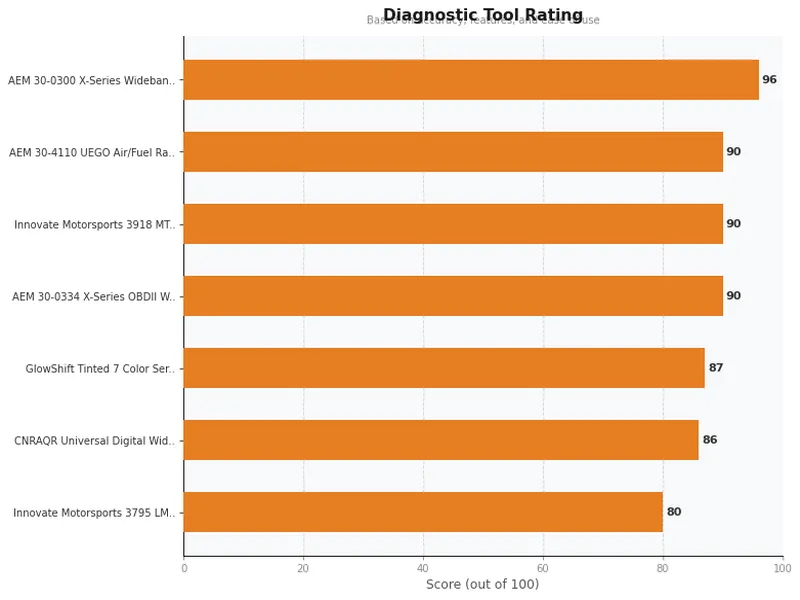
A wideband gauge is one of the most impactful upgrades you can make to a performance vehicle. Real-time AFR data gives you the visibility to tune confidently, avoid lean conditions that damage engines, and extract maximum power from your fuel system. The 7 gauges reviewed here represent the best options available in 2026 across a range of price points and use cases.
For most builders, the AEM 30-0300 X-Series is the best overall choice. Its X-Digital technology, Bosch LSU 4.9 sensor, and comprehensive outputs make it the most capable gauge in the group for dyno tuning and data logging. For a more affordable alternative that uses the same sensor, the AEM 30-4110 delivers excellent value without sacrificing measurement quality.
If you are on a tight budget but still want a Bosch LSU 4.9 sensor, the CNRAQR Universal gauge is the best current option. And if data logging is your priority, the Innovate LM-2 is the most capable dedicated meter for capturing full session data. Whatever your build and budget, one of these seven gauges will give you the accurate AFR data you need to tune your engine right.
A wideband gauge measures the oxygen content in your exhaust gas and converts it to an air-fuel ratio (AFR) reading. Inside the sensor, a zirconia element measures the differential oxygen concentration between the exhaust stream and a reference cell, generating a signal that the controller translates into an AFR value displayed on the gauge.
For a turbo build, the AEM 30-0300 X-Series or AEM 30-4110 are the top recommendations due to their fast response time and Bosch LSU 4.9 accuracy. Fast response is especially important on boosted engines where AFR can shift rapidly under transient boost conditions. Ensure the sensor is positioned far enough downstream of the turbine to avoid heat damage.
Most kits include a weld-in stainless-steel bung that needs to be welded into the exhaust pipe. If you are not equipped to weld, any local exhaust shop or fabricator can install the bung quickly and inexpensively. Thread-in bungs with compression fittings are available as alternatives but are generally less reliable under high heat and vibration.
For a naturally aspirated gasoline engine at wide open throttle, a target AFR of around 12.5:1 to 13.2:1 is typical for peak power. At cruise, 14.7:1 (stoichiometric) is the efficiency target. Lean misfire typically begins above 16:1 under load. Your specific engine and cam profile will shift these targets, which is exactly why a wideband is essential for proper tuning.
Bosch LSU 4.9 sensors typically last 50,000 to 100,000 miles in street-driven applications with stock fuel. Heavy track use, high exhaust temperatures, or water injection can shorten sensor life. Sensors used primarily on the dyno may last for years of intermittent use. Replacement sensors are readily available from AEM, Innovate, and Bosch directly.
 |
 |
 |
 |

About Joshua Thomas
Joshua Thomas just simply loves cars and willing to work on them whenever there's chance... sometimes for free.
He started CarCareTotal back in 2017 from the advices of total strangers who witnessed his amazing skills in car repairs here and there.
His goal with this creation is to help car owners better learn how to maintain and repair their cars; as such, the site would cover alot of areas: troubleshooting, product recommendations, tips & tricks.
Joshua received Bachelor of Science in Mechanical Engineering at San Diego State University.


Get some FREE car parts & gear.. Or check out the latest free automotive manuals and build guides here.
Disable your ad blocker to unlock all the hidden deals. Hit the button below 🚗
| | | |
