Interior ›
by Rachel Park
You parked your car overnight in an unfamiliar neighborhood and woke up wondering whether it would still be there in the morning. That familiar anxiety is exactly why steering wheel locks remain one of the most popular and cost-effective vehicle security tools available in 2026. A visible physical deterrent on your steering wheel signals to would-be thieves that your car is not an easy target, and in most cases, that visual warning alone is enough to send them looking elsewhere.
According to the National Highway Traffic Safety Administration, vehicle theft remains a persistent problem across the United States, with hundreds of thousands of vehicles stolen annually. Steering wheel locks work on a straightforward principle: they physically prevent the wheel from turning a full revolution, making the vehicle nearly undrivable even if a thief manages to bypass your ignition. Combined with other security measures, they form a reliable first line of defense that costs far less than comprehensive insurance deductibles or the hassle of a stolen-vehicle claim.
This guide covers the seven best steering wheel locks of 2026, selected based on build quality, security features, compatibility, and real-world usability. Whether you drive a compact sedan, a full-size SUV, or a heavy-duty truck, there is a lock on this list designed specifically for your situation. If you are also concerned about theft at the wheel level, check out our companion roundup of the 7 Best Wheel Locks of 2026 for lug-nut security that complements a steering wheel lock perfectly. These two layers of protection together present a formidable barrier to any opportunistic thief.
Contents






The Club 1000 is the lock that defined the category, and after decades on the market it remains one of the most recognizable anti-theft devices in North America. Its bright red finish is deliberately conspicuous, communicating clearly to any passing thief that this vehicle presents a significant obstacle. The patented self-locking mechanism engages with a single pull, eliminating the need to fumble with keys during the locking process, and the solid steel hook design resists the kind of lateral force that typically accompanies a pry attack.
Constructed from cro-moly steel, the Club 1000 is engineered to resist the full spectrum of common theft attacks, including sawing, prying, hammering, and freon-spray techniques that criminals use to shatter locks quickly. The laser-cut keys provide a meaningful level of duplication resistance, and the lock cylinder itself is hardened against picking and drilling. For daily commuters who want a trusted, no-frills deterrent backed by decades of proven performance, the Club 1000 delivers exactly what it promises without unnecessary complexity.
Installation takes under ten seconds once you are familiar with the mechanism, which makes it practical for everyday use rather than just occasional parking. The lock fits a wide range of standard passenger vehicle steering wheels, though Winner International recommends measuring your wheel diameter before purchasing to confirm compatibility. At its price point, the Club 1000 represents one of the strongest value propositions in the entire interior security accessories category, and it belongs in the glove box of virtually every car owner who prioritizes theft deterrence without a large investment.
Pros:
Cons:
The Disklok operates on an entirely different security philosophy than conventional hook-style locks, and that distinction places it in a category of its own. Rather than clamping onto the steering wheel rim with one or two hooks, the Disklok encases the entire steering wheel in a solid steel disc, covering the wheel from hub to rim and eliminating any grip point for a thief attempting to steer the vehicle. This full-cover design also protects the airbag from tampering, which is a meaningful benefit given that airbag theft has become an increasingly common secondary crime.
The Disklok's most innovative security feature is its spinning outer shell. If an attacker attempts to grab the lock and force the wheel, the outer surface rotates freely, denying any torque transfer and making it physically impossible to steer around the lock's resistance. Thatcham approval, the UK's gold standard for automotive security certification, confirms that the Disklok meets rigorous independent testing criteria, giving insurance-conscious owners an additional reason to consider this unit. The small size (13.7 to 15.3 inches) fits the majority of compact and mid-size passenger cars with steering wheels in that diameter range.
Installation requires the driver to slide the disc over the wheel and engage the locking mechanism at the hub, which takes slightly longer than a hook-style lock but becomes intuitive after a few repetitions. The silver polished-steel finish is highly visible and communicates premium security credentials at a glance. If you are serious about deterring professional thieves rather than merely casual opportunists, the Disklok's engineering superiority and independent certification make it the most defensible purchase at the premium end of the market in 2026.
Pros:
Cons:
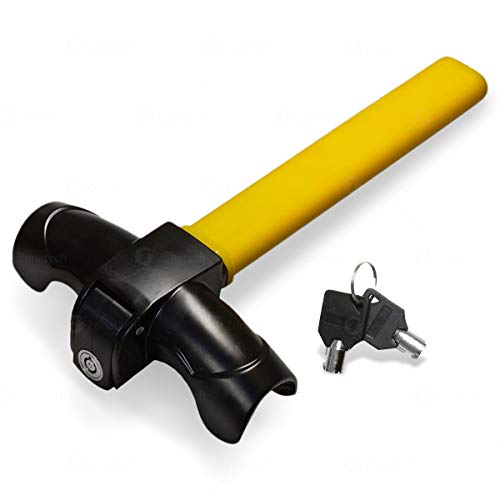
The Tevlaphee lock distinguishes itself from single-hook competitors by deploying four locking hooks combined with twin parallel bars, creating a grip on the steering wheel that is significantly more stable under lateral stress. This double-protection design means that a thief attempting to pry or cut the lock faces substantially more material and more anchor points than a traditional single-hook unit presents. The bright yellow color is a deliberate visual deterrent choice, and research consistently shows that high-visibility locks reduce the likelihood of a vehicle being targeted in the first place.
Tevlaphee uses top-grade steel for the primary locking beam, and the lock core is solid copper rather than the cheaper zinc alloys that appear in many budget security products. The double-spring crescent encoding system for the keys is specifically designed to reduce mutual-open rates, meaning the chance that another key in the same series opens your lock is statistically very low. The entire body is finished with a plastic dipping process that cushions contact points and protects your steering wheel from scratches during installation and removal, which is a thoughtful design detail that separates this unit from rougher competitors.
With three keys included, the Tevlaphee gives you redundancy that many competing products at this price tier omit. The adjustable design accommodates a broad range of steering wheel diameters, and the locking and unlocking process is straightforward enough to complete in seconds once you develop a routine. For budget-conscious buyers who want genuine heavy-duty construction rather than a lightweight deterrent dressed up in thick plastic, the Tevlaphee delivers material quality and security engineering that punches well above its price class.
Pros:
Cons:
Winner International designed the Club 3000 as a direct evolution of the original Club, adding a second hook to address the primary structural weakness of its predecessor. The twin-hook configuration doubles the number of anchor points gripping the steering wheel rim, which makes prying the lock free substantially more difficult and time-consuming for a thief working under time pressure. The lock retains the original Club's patented self-locking feature, engaging with a single pull so that daily installation never feels like a chore, and keyless locking means you secure the device before walking away without needing to retrieve your keys.
The improved lock housing on the Club 3000 is reinforced compared to earlier generations, providing added resistance at the cylinder point where many attacks concentrate. High-visibility yellow coloring ensures that the deterrent signal is clear from a distance, and the universal fit design covers cars, vans, and SUVs without requiring vehicle-specific adapters or adjustments. Winner International has refined this product over multiple product cycles, and the 2026 version reflects meaningful engineering improvements that keep it competitive against newer entrants to the market.
The Club 3000 occupies a compelling middle position in the lineup, offering meaningfully better security than the single-hook Club 1000 without the premium pricing of specialized full-cover solutions. For drivers who want the proven Club brand heritage combined with enhanced twin-hook resistance, this is the natural upgrade choice. Pairing this lock with proper lug-nut security — as covered in our guide to the best wheel locks of 2026 — creates a multi-layer deterrent system that most thieves find not worth the effort.
Pros:
Cons:
Truck and SUV steering wheels typically measure several inches larger in diameter than compact car wheels, and most standard steering wheel locks simply do not span that distance effectively. Winner International engineered the Club 2100 specifically to address this gap, building it on a longer shaft than the standard Club series to reach across the larger wheel diameters common in pickup trucks and full-size SUVs. The result is a lock that fits securely without improvised adjustments, providing the same patented self-locking convenience that Club users have relied on for years, now scaled correctly for larger vehicles.
Security credentials on the Club 2100 are strong for its class. The high-security lock cylinder uses laser-encrypted keys that cannot be duplicated at a standard key-cutting counter, which closes a common vulnerability in cheaper locks where a thief can simply obtain a working duplicate key from a hardware store. The cro-moly steel construction carries the same resistance profile as the rest of the Club family, handling saw, pry, and impact attacks effectively during standard security testing scenarios.
Truck and SUV owners represent some of the most theft-targeted vehicle demographics in the United States, partly because of the high resale value of parts and partly because larger vehicles are often parked in commercial or open-lot environments overnight. The Club 2100 addresses this specific vulnerability with a purpose-built solution rather than a stretched compromise, and its bright red coloring maintains the visual deterrent effectiveness that the Club brand is known for. If you drive a full-size truck or three-row SUV, this is the Club model designed for your vehicle.
Pros:
Cons:
MONOJOY takes a practical approach to the steering wheel lock category by bundling an emergency safety hammer into the product's rear housing, effectively combining two essential safety tools into a single purchase. The safety hammer allows the driver to break a car window in emergency situations such as flooding or entrapment, which gives the MONOJOY a dual-purpose functionality that pure security products cannot match. For drivers who value preparedness across both theft prevention and emergency egress scenarios, this combination is a genuinely compelling value proposition rather than a gimmick.
The security hardware is based on a real B+ lock cylinder, which represents a meaningful step above the basic lock cores found in many budget competitors. MONOJOY's adjustable design spans from 6.6 to 12.8 inches (approximately 16.8 to 32 centimeters), giving it one of the broadest compatibility ranges on this list and making it suitable for nearly any passenger car, light truck, or SUV without requiring separate sizing. The zinc alloy handle is covered in foam padding to protect your steering wheel's surface finish during installation and removal, which reflects the same thoughtful detail approach seen in premium competitors.
The lock cylinder is hardened against sawing, prying, hammering, and freon-spray attacks, meeting the same resistance criteria that established brands advertise at higher price points. Black coloring makes the MONOJOY slightly less visually arresting than red or yellow alternatives, which some buyers prefer for interior aesthetics while still maintaining the general deterrent silhouette that thieves recognize. Keeping your vehicle secure also means keeping its exterior maintained, and pairing security upgrades with regular detailing using products from our guide to the best waterless car washes of 2026 keeps your investment in top condition from every angle.
Pros:
Cons:
The ZONETECH T-Shape lock takes a geometric approach to steering security that differs from the hook-and-bar designs dominating most of this list. The T-shaped body braces across the steering wheel spokes rather than clamping the rim, creating a rigid obstruction that prevents wheel rotation regardless of the force applied to the outer rim. This bracing method distributes stress across a wider surface area and reduces the single-point failure risk that exists in designs that rely entirely on the strength of one or two hook connections under sustained attack.
ZONETECH builds the lock body from solidified steel with a computer-coded crescent cylinder as the locking mechanism, providing meaningful resistance to both physical attacks and key-duplication attempts. The manufacturer specifically notes that the design stops keyless entry robbery, a claim supported by the cylinder's resistance to the electronic amplification attacks that have made relay theft a significant concern for modern vehicles with passive entry systems. Two keys are included, providing basic redundancy, and the overall construction feels dense and substantial rather than hollow or thin-walled.
Weatherability is another stated design priority for the ZONETECH, with the steel body engineered to resist the environmental degradation that makes cheaper locks seize or corrode over time. For car owners who park outdoors year-round in varying climates, long-term durability is a practical security consideration: a corroded or seized lock that you cannot remove quickly undermines the daily convenience that makes steering wheel locks a sustainable habit. The ZONETECH's combination of durable construction, keyless-entry resistance claims, and T-shape geometry makes it a distinct option for buyers who want something structurally different from the conventional hook-style market leaders.
Pros:
Cons:
The quality of the lock cylinder is the single most consequential factor in determining how resistant your steering wheel lock is to professional attack. Basic pin-tumbler locks, which appear in many budget models, can be picked by experienced thieves in under a minute using readily available tools. Crescent-style encoding systems, double-spring mechanisms, and computer-coded cylinders all raise the difficulty level significantly, adding critical seconds or minutes to the time a thief needs to spend at your vehicle. At the high end, Thatcham-certified products such as the Disklok have undergone independent laboratory testing and passed standardized attack protocols that no amount of marketing language can replicate. If your vehicle is a frequent theft target based on make, model, or parking environment, investing in a certified lock cylinder is a defensible priority.
The physical architecture of how a steering wheel lock grips the wheel determines how well it resists brute-force attacks. Single-hook designs concentrate all lateral stress on one anchor point, which is the path of least resistance for a determined attacker using a pry bar. Twin-hook designs double the anchor points and the material that must be defeated, while full-cover designs like the Disklok eliminate anchor points entirely by encasing the wheel in a solid disc. Cro-moly and high-grade steel are the construction materials you want to see specified, as they resist sawing significantly better than standard mild steel. Verify that the product specifies resistance to freon attacks, where thieves spray the lock with compressed refrigerant to make the metal brittle and then shatter it with a single hammer blow.
Steering wheel diameters vary meaningfully across vehicle categories. Most compact and mid-size passenger cars use wheels in the 14-to-15-inch range, while full-size trucks, SUVs, and vans often run 15.5 to 17 inches or more. A lock that cannot span the full width of your wheel rim provides negligible security, since a thief can simply slide the unsecured hook off the wheel without engaging the lock. Measure your steering wheel diameter from rim edge to rim edge before purchasing any lock that specifies a maximum diameter range. Adjustable locks with broad compatibility ranges simplify this process, but always verify that your wheel falls within the stated range rather than assuming universal fit claims are accurate for your specific vehicle.
A steering wheel lock that takes more than thirty seconds to install correctly will not stay in daily use for most drivers, regardless of its security credentials. The best locks in this category engage in one pull or a simple slide-and-click motion, with key retrieval only required for removal. High-visibility colors — red, yellow, or silver — are deliberate design choices rather than aesthetic preferences, because a thief performing a quick visual scan of a parking lot will deprioritize vehicles that show obvious deterrents. Studies on opportunistic vehicle crime consistently show that visible security hardware redirects thieves to softer targets, meaning the deterrent effect operates before any physical security test occurs. Consider daily storage as well: a lock that fits compactly in your glove box or center console is one you will actually use, while a bulky lock that requires trunk storage will get left home on exactly the days you need it most.
Steering wheel locks are highly effective deterrents against opportunistic theft, and deterrence is the primary mechanism through which they protect your vehicle. A thief conducting a quick scan of a parking lot will consistently choose the vehicle without a visible security device over one displaying a bright lock, because time and effort are the enemy of successful vehicle crime. Against professional, targeted theft operations using relay devices or advanced bypass tools, a steering wheel lock adds meaningful time to the attack and often causes the thief to abandon the attempt entirely. No single security device is impenetrable, but steering wheel locks remain one of the most cost-effective components of a layered vehicle security strategy.
You need to measure your steering wheel's outer diameter from rim edge to rim edge before selecting a lock. Most standard passenger cars fall in the 13.5-to-15-inch range, while trucks, full-size SUVs, and vans typically measure 15.5 to 17 inches or more. Compact and small-diameter vehicles may fall at the lower end of some locks' adjustment ranges, so measure from both ends of the spectrum before purchasing. Products like the Club 2100 are engineered specifically for the larger diameters of trucks and SUVs, while the Disklok specifies exact size ranges (small: 13.7-15.3 inches) for a secure full-cover fit. Adjustable designs with broad ranges reduce the measurement requirement but do not eliminate it entirely.
The answer depends on the quality of the lock and the method of attack. Cheap locks with basic pin-tumbler cylinders can be picked in under a minute by experienced thieves. Locks with cro-moly steel shafts resist sawing significantly but can eventually be cut with an angle grinder given sufficient time and lack of interruption. Freon attacks shatter brittle metals quickly, which is why specifications calling out freon resistance are security-meaningful rather than marketing language. Full-cover designs like the Disklok add the additional obstacle of a spinning attack surface that defeats torque-based approaches. The goal of any steering wheel lock is not to be impenetrable but to add enough time and conspicuousness to make your vehicle a less attractive target than an unlocked one nearby.
Most standard hook-style steering wheel locks engage only with the rim of the wheel and do not contact the airbag cover at the center hub, making them safe for airbag-equipped vehicles. The Disklok is specifically noted for airbag protection because its full-cover design includes engineering consideration for the hub area, preventing accidental airbag deployment during installation or removal. Always check the product specifications for any mention of airbag compatibility, particularly if your vehicle has a non-standard steering wheel design with side-mounted controls or an unusually shaped hub. Avoid any lock that requires force against the center of the wheel during installation, as this creates a risk of accidental airbag deployment in vehicles where the clock spring is close to triggering threshold.
Yes, and security professionals consistently recommend layered deterrence rather than reliance on any single device. A steering wheel lock combined with wheel locks — as detailed in our guide to the best wheel locks of 2026 — creates two independent physical barriers that a thief must defeat separately, doubling the time investment required and significantly increasing the likelihood of abandonment. Adding a GPS tracker provides post-theft recovery capability that physical locks cannot offer, while a factory or aftermarket alarm system introduces noise deterrence that operates independently of physical security hardware. Each layer addresses a different attack vector and contributes independently to overall vehicle security.
The most practical storage location is the glove box or center console, where the lock remains accessible at every parking stop without requiring a trip to the trunk. For this reason, compact designs like the Club 1000 have a practical storage advantage over larger models like the Club 2100, which may require side-door pocket or rear-seat storage in vehicles with smaller glove box dimensions. Avoid leaving the lock on the passenger seat, as an unsecured metal lock becomes a projectile in accident scenarios. Some drivers use a dedicated bag or pouch to prevent the lock from scratching other glove box contents, which is particularly relevant for locks without foam padding on the hook ends.
 |
 |
 |
 |

About Rachel Park
Rachel Park specializes in the interior and exterior upgrades that meaningfully change how a car looks, sounds, and feels on a daily basis. She has hands-on experience with head unit installations and audio system builds, LED and HID lighting conversions, interior refresh projects, and cosmetic exterior work — evaluated from both a DIY accessibility and quality-of-result perspective. At CarCareTotal, she covers car audio and electronics, lighting upgrades, and interior and exterior styling accessories.
Get some FREE car parts & gear.. Or check out the latest free automotive manuals and build guides here.
Disable your ad blocker to unlock all the hidden deals. Hit the button below 🚗
| | | |
