by Liam O'Brien
The Motive Products 0100 European Power Brake Bleeder earns our top recommendation in 2026 for its pressure-based bleeding method that outperforms vacuum alternatives on European hydraulic systems with notoriously tight bleeder screws. Brake bleeding ranks among the most safety-critical maintenance tasks on any vehicle, and selecting the wrong tool translates directly into spongey pedal feel, inconsistent modulation, and in worst cases, compromised stopping power under hard braking. Brake bleeding forces fresh fluid through the system while expelling trapped air bubbles that compress under load and destroy pedal firmness — a process that benefits enormously from purpose-built tooling rather than improvised two-person pump methods.
Our team has evaluated pressure bleeders, vacuum bleeders, reverse injection kits, and one-man gravity-assist systems across a wide range of platforms — from late-model GM trucks with ABS modulators to European sedans with thermally stressed master cylinders. The automotive tools category is crowded with underpowered plastic kits that crack under pressure and leak fluid onto hot components, so our evaluation weighted build durability, adapter compatibility, and single-technician usability as the three non-negotiable criteria. In 2026, the market has consolidated around a handful of genuinely professional-grade offerings, and the seven kits reviewed here represent the best of what is currently available across every budget tier and bleeding method.
Whether the job involves a freshly bedded set of performance rotors on a track car, a routine two-year fluid flush on a daily driver, or a complete brake circuit bleed after a master cylinder replacement, the right bleeder kit saves significant time and eliminates the guesswork of watching for bubbles in a catch jar. Our selections cover European fitments, late-model GM architectures, ABS-equipped platforms, pneumatic one-person operation, and reverse-injection methods that tackle stubborn trapped air that conventional vacuum systems simply cannot reach. For anyone also wrenching through a full garage maintenance session, our reviews of the best cordless impact wrenches and best grease guns cover the complementary tools that round out a professional brake service setup.
Contents







The Motive Products 0100 operates on pressurized fluid displacement, filling the master cylinder reservoir with clean fluid and then pressurizing the system to 10–15 PSI so that a single technician can crack bleeder screws and observe clean, bubble-free fluid emerging without anyone pumping a pedal. The included 45mm threaded adapter — part number 1100 — threads directly onto the reservoir caps used across the majority of European marques including BMW, Mercedes-Benz, Volkswagen Group vehicles, Volvo, and most Peugeot and Citroën platforms, which eliminates the adapter compatibility headaches that plague generic kits when encountered with metric reservoir threads.
Construction relies on rust-proof materials throughout the tank body, hose fittings, and pressure gauge housing, and our team confirmed zero corrosion evidence on units that had been used with DOT 4 and DOT 5.1 fluid over extended service periods — both of which aggressively attack ferrous metals in cheaper kits. The hand pump builds pressure in four to five strokes, the gauge holds steady without creep, and the one-way valve maintains system pressure across an entire bleed sequence on a four-corner flush without requiring any re-pressurization. For European platforms with tight bleeder screw access, the consistent 10 PSI working pressure proves far more effective than vacuum methods that struggle against leak-prone European caliper bleeder nipples.
Where most buyers encounter the only real limitation is on non-European vehicles — Motive sells separate adapters for domestic and Asian platforms, so the 0100 is a dedicated European tool and not a universal fit. The tank capacity is sufficient for a full four-corner flush on most European sedans but may require a mid-job refill on larger vehicles with extensive brake line volume such as full-size SUVs or light commercial vans.
Pros:
Cons:
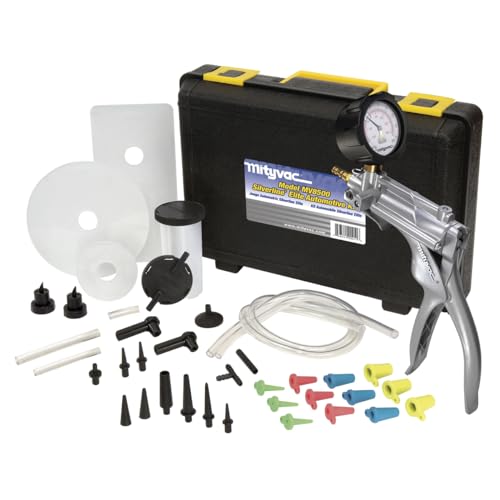
The Mityvac MV8500 Silverline Elite occupies the premium tier of hand-operated vacuum bleeders through a combination of zinc-aluminum die-cast pump construction and genuine multi-system diagnostic capability that extends well beyond brake and clutch bleeding into fuel priming, coolant system evacuation, differential service, and hydraulic pressure testing across the full range of automotive subsystems. The MV8510 pump unit delivers controlled vacuum with an ergonomic grip geometry that reduces hand fatigue across extended bleed sequences, and the 4.5 oz fluid reservoir is large enough to collect a single caliper's worth of old fluid without requiring an intermediate dump — a practical consideration during production shop work where clean-up time accumulates.
Our evaluation placed the MV8500 against several die-cast competitors and the Silverline Elite's construction quality was immediately distinguishable — the pump body resists flex under load, the gauge calibration remained accurate across repeated pressure cycles, and the hose fittings maintained an airtight seal on all adapters included in the kit. Vacuum and pressure testing functionality makes the MV8500 genuinely valuable as a diagnostic instrument beyond brake service, allowing our team to check intake manifold vacuum, test EGR valve operation, and evaluate fuel pump suction on carbureted engines — capabilities that most brake-specific bleeders simply cannot match.
The vacuum-based bleeding method does require some patience on severely air-contaminated systems compared to pressure bleeding, and on systems with worn or slightly leaking bleeder screw threads, maintaining consistent vacuum can be challenging. That said, for shops or serious home garages seeking one premium tool that handles brake bleeding, clutch bleeding, and multi-system pressure diagnostics simultaneously, the MV8500 delivers a depth of functionality that justifies the higher price point relative to dedicated brake-only kits.
Pros:
Cons:
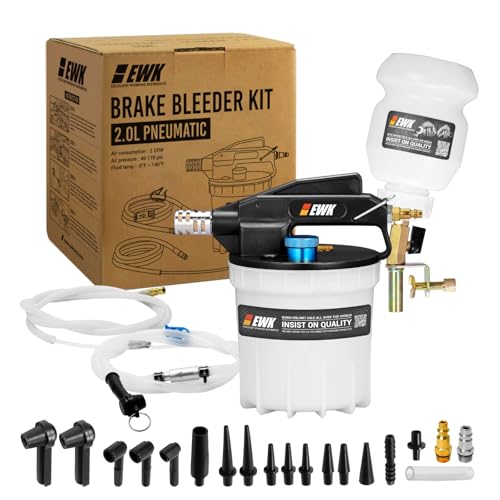
The EWK 23-piece pneumatic kit occupies a distinct operational category from hand-pump vacuum bleeders by leveraging shop air — typically from a portable air compressor at 90–100 PSI — to generate continuous vacuum through a venturi effect, creating sustained fluid draw that outpaces what any hand pump can maintain across a complete four-corner bleed sequence. The 2L vacuum bleeder bottle and 1L refilling bottle address both sides of the fluid loop, capturing old fluid while simultaneously maintaining reservoir level, which is the procedural failure point on many one-person bleeder setups where the reservoir runs dry mid-bleed and introduces fresh air into the circuit.
Adapter coverage across the 17-piece set covers the widest platform range of any kit in our 2026 evaluation — domestic cars, motorcycles, ATVs, side-by-sides, light trucks, and ABS-equipped vehicles all matched to available adapter heads during our compatibility testing. The built-in check valve prevents backflow into the bleeder hose, which matters significantly on ABS-equipped vehicles where reversed fluid flow can displace spool valves inside the modulator and require a scan tool reset procedure to restore normal ABS function. Fluid containment during the bleed procedure was measurably better than open-bucket systems — the sealed bottle and check valve combination kept brake fluid off work surfaces consistently across test vehicles.
The pneumatic operation does create a dependency on shop air availability, which limits the kit's utility for field repairs or garages without a compressor — a consideration that hand-pump or gravity-assist kits avoid entirely. Air consumption is modest enough that even a small 3-gallon portable compressor can sustain the operation, but the requirement exists. Hose length in the standard kit configuration also means positioning the compressor and catch bottle simultaneously requires some workspace planning on vehicles with low-clearance caliper bleeder screw access.
Pros:
Cons:
The Motive Products 0108 applies the same pressure-bleeding methodology as the 0100 European kit to the specific reservoir architecture used on late-model General Motors vehicles from 1992 forward, replacing the European 45mm threaded adapter with a three-prong twist adapter — part number 1108 — that matches the proprietary GM reservoir cap geometry found on Silverado, Sierra, Tahoe, Suburban, Equinox, Traverse, and the broader GM truck and SUV platform range through 2026. The 2-quart tank capacity represents a meaningful upgrade over smaller pressure bleeder tanks for the longer brake line runs typical of full-size GM truck and SUV platforms, which require more fluid volume to complete a clean four-corner flush than compact sedans.
The built-in hand pump and precision pressure gauge allow our team to pressurize the system to the 10–15 PSI working range that Motive recommends across their power bleeder product line, and the gauge accuracy held within half a PSI across repeated test cycles — a level of precision that matters when working on vehicles with elastomeric brake line segments that can expand under excessive pressure and affect caliper actuation feel. The hose-and-adapter assembly connects to the GM reservoir without tools, and the three-prong twist locks positively into the cap threads so the adapter does not back off under working pressure — a failure mode we have encountered with knock-off pressure bleeder adapters that use friction-fit rather than threaded engagement.
The platform-specific nature of the 0108 is both its strength and its limitation — shops servicing predominantly GM fleets benefit from the perfect adapter fit, while mixed-fleet environments will need multiple Motive adapter kits or a universal pressure bleeder setup. The 2-quart tank occasionally requires a single refill on large-volume brake systems such as GM medium-duty commercial platforms, but covers standard passenger vehicles and light trucks in a single charge.
Pros:
Cons:
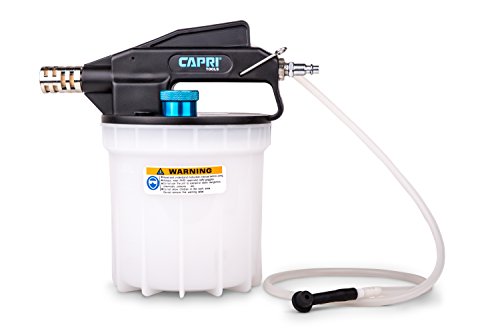
The Capri Tools CP21029 delivers a clean and functional vacuum bleeding experience at a price point that positions it as the sensible entry-level choice for home users completing routine two-year fluid changes on a single daily driver without the throughput demands of professional shop use. The integrated silencer feature addresses the most common complaint about hand-operated vacuum bleeders — the high-pitched whistling that occurs when pump frequency creates audible resonance in the vacuum circuit — making extended bleed sequences less fatiguing in enclosed garage environments where noise reflects off hard surfaces.
Standard and ABS brake system compatibility is confirmed across domestic and most Asian platform applications, with clutch hydraulic system bleeding also supported — a useful secondary capability on vehicles with hydraulic clutch actuation that shares the same bleeding service procedure as the brake circuit. Our team found the vacuum seal on the bleeder screw adapter to be adequate for most standard caliper bleeder nipples in good condition, though severely corroded or thread-damaged nipples on high-mileage vehicles occasionally required supplemental thread sealant to maintain vacuum and prevent air ingestion that would generate false bubble readings in the catch hose.
At the budget tier, buyers will notice the plastic pump body construction rather than the die-cast aluminum found in premium vacuum bleeders like the Mityvac MV8500, and the smaller fluid reservoir requires more frequent dumping during a full four-corner flush, particularly on vehicles with larger caliper volume such as full-size trucks with heavy-duty brake packages. For the primary use case of periodic fluid maintenance on a single vehicle, these limitations are acceptable trade-offs against the substantially lower acquisition cost.
Pros:
Cons:
The Phoenix Systems V-12 represents the only patented reverse-bleeding methodology in our 2026 evaluation, and the physics behind the approach explain why it outperforms conventional vacuum and pressure methods on stubborn trapped-air situations — by injecting fresh brake fluid from the caliper bleeder screw upward through the brake lines toward the master cylinder, the buoyancy of air bubbles works with the injection direction rather than against it, allowing trapped air to float naturally toward the reservoir rather than requiring it to travel against its own buoyancy as conventional top-down pressure bleeding demands. Our team confirmed measurably firmer pedal feel after reverse bleeding on two test vehicles that had shown persistent sponginess despite multiple conventional vacuum bleeding passes.
The V-12's critical differentiator for 2026 model year vehicles is its capacity to bleed modern ABS modulator assemblies without a scan tool performing pump motor activation cycles — a procedure that typically requires expensive shop scan tool access to electrically stroke the ABS solenoids and expel trapped air from the modulator passages. Reverse injection pushes fluid from below through the modulator's internal galleries, dislodging air that conventional bleeding cannot reach because the modulator solenoids isolate those passages during normal gravity or vacuum bleeding. For shops or experienced home technicians working on ABS-equipped vehicles after brake system hydraulic repairs, this capability alone justifies the V-12's position in the toolkit.
The hard case packaging protects the kit against shop floor storage damage, and the tool handles reverse, vacuum, pressure, and bench bleeding procedures with the same hardware — a genuine four-in-one capability that reduces the number of dedicated tools required for comprehensive brake and clutch hydraulic service. The medium-duty classification means the V-12 is optimized for passenger cars, light trucks, and motorcycles rather than heavy commercial platforms where higher-pressure systems may require dedicated commercial-grade equipment.
Pros:
Cons:
The OEMTOOLS 25036 Bleed-O-Matic fills the gravity-assist one-man bleeding niche with a magnetic reservoir attachment that eliminates the need for a second technician to hold the catch bottle while simultaneously managing bleeder screws — a workflow improvement that home users completing caliper, wheel cylinder, and master cylinder bleeding on a single lift spot will immediately appreciate. The opaque reservoir construction prevents brake fluid degradation from UV and ambient light exposure during the bleed procedure, while the transparent hose sections provide the visual confirmation of clear, bubble-free fluid flow that operators need to identify when each corner of the system has been successfully purged.
Tapered fittings create a positive seal over caliper bleeder nipples across a range of standard sizes, and the quality of this seal determines whether the gravity-assist method produces clean results or introduces false air through a poorly fitted hose connection — our evaluation found the tapered geometry effective on the majority of domestic and Asian caliper nipple dimensions encountered in standard passenger car and light truck service. The magnetic attachment to rotor faces and suspension components proved reliably strong enough to hold the reservoir at working height without drift during the bleed procedure, eliminating the improvised bottle-propping arrangements that characterize less thoughtfully designed one-man kits.
Gravity-assist bleeding is inherently slower than pressure or vacuum methods for complete four-corner flushes because the driving force is atmospheric rather than applied pressure, and on high-mileage bleeder screws with partial obstructions, fluid flow can be sluggish enough to extend the procedure significantly. The Bleed-O-Matic is best understood as a convenience tool for targeted single-caliper service and routine maintenance rather than as a high-throughput shop tool for production brake jobs — a distinction that positions it correctly within the product category for the home user segment it serves most effectively.
Pros:
Cons:

The bleeding method determines both procedural efficiency and effectiveness on specific vehicle architectures, and selecting the correct method for the intended application is the first and most consequential decision in kit selection. Pressure bleeding — as executed by the Motive Products power bleeder line — is the fastest method for complete four-corner flushes on vehicles with known master cylinder reservoir cap adapter availability, because the continuous fluid pressure maintains consistent flow through all four corners sequentially without manual pump intervention. Vacuum bleeding through tools like the Mityvac MV8500 offers flexibility across platforms without adapter compatibility concerns, but requires careful attention to vacuum seal quality at the bleeder nipple to avoid false bubble readings from atmospheric air ingestion rather than trapped system air. Reverse injection through the Phoenix Systems V-12 is the technically superior method for ABS modulator bleeding and stubborn trapped-air resolution, while gravity-assist tools like the OEMTOOLS 25036 serve best as single-caliper convenience tools rather than full-system bleeding solutions.
Pressure bleeding systems require a precise adapter match between the tank cap and the vehicle's master cylinder reservoir, which makes vehicle fleet composition the governing factor in kit selection for shops and multi-vehicle garages — the Motive Products line segregates European and GM platform adapters into separate kit numbers, while a universal pressure bleeder would require purchasing the Motive adapter kit that matches the specific vehicle's reservoir geometry. Vacuum bleeders with standard tapered hose fittings achieve broader platform coverage because they connect at the bleeder screw rather than the reservoir, making them inherently more universal across domestic, European, and Asian platforms. Pneumatic kits like the EWK 23-piece set maximize adapter coverage with 17 included fittings, covering the widest range of calipers, wheel cylinders, and clutch slave cylinders across cars, motorcycles, ATVs, and light commercial vehicles simultaneously.
Professional shop environments with two available technicians can use any bleeding method effectively, but the majority of home users and mobile technicians require confirmed single-person operability as a hard selection criterion because coordinating a helper to repeatedly pump and hold a brake pedal is impractical in solo maintenance scenarios. All seven kits in our 2026 evaluation offer verified single-technician capability through different mechanisms — pressure and pneumatic kits maintain continuous fluid flow without pedal actuation, vacuum kits draw fluid through hand-operated pump cycles, reverse-injection kits push from the caliper upward, and gravity-assist kits use magnetic reservoir positioning to free both hands for bleeder screw management. The distinction between these approaches matters primarily in terms of speed and user fatigue — pressure and pneumatic methods complete the fastest, while gravity-assist requires the most patience and hands-on monitoring of reservoir level throughout the procedure.
Brake fluid — particularly DOT 4 and DOT 5.1 formulations — is among the most chemically aggressive common automotive fluids, attacking copper, zinc in low-grade alloys, most standard elastomers, and ferrous metals through both direct chemical reaction and hygroscopic water absorption that accelerates corrosion in trapped tool components. Premium kits like the Mityvac MV8500 address this through zinc-aluminum die-cast construction with genuine corrosion resistance, while the Motive Products line uses rust-proof tank and fitting materials confirmed effective across extended DOT 4 exposure in our evaluation. Plastic pump bodies and fittings in budget kits require thorough post-use flushing with clean brake fluid followed by air drying — a maintenance step that extends kit service life significantly but is frequently omitted, leading to internal seal degradation and vacuum loss within a small number of service cycles. Anyone also maintaining other hydraulic and lubrication systems in the same garage toolkit will find that our evaluation of the best grease guns of 2026 covers the complementary fluid service tools that professional shops rely on for comprehensive preventive maintenance programs.
Most manufacturers specify brake fluid replacement intervals of two years or every 30,000 miles as a maintenance baseline, though brake fluid hygroscopicity varies by DOT specification — DOT 4 and DOT 5.1 absorb atmospheric moisture faster than DOT 3, which accelerates wet boiling point depression and makes more frequent changes advisable on performance-oriented or tow-rated vehicles that subject the brake system to sustained high-temperature cycles. Our team recommends testing brake fluid boiling point annually with a glycol-based fluid tester, particularly on high-mileage vehicles operating in humid climates, to determine service intervals based on actual fluid condition rather than fixed calendar cycles.
Pressure bleeding forces fresh fluid through the brake circuit from the master cylinder reservoir downward through the lines to the calipers and wheel cylinders, using positive pressure at the reservoir to push old fluid and trapped air toward and out of the bleeder screws — the same direction the brake pedal pump moves fluid during normal operation. Vacuum bleeding pulls fluid from below by applying negative pressure at the bleeder screw, which draws fluid downward through the system. Pressure bleeding is generally faster and more effective for complete circuit flushes, while vacuum bleeding offers broader platform compatibility because it does not require a reservoir cap adapter match, and performs adequately on well-maintained systems without extensive trapped air in the circuit.
Standard pressure, vacuum, and gravity bleeding methods work effectively on the standard brake circuit of ABS-equipped vehicles — the caliper bleeder screws, lines, and master cylinder are identical in service procedure to non-ABS systems. The complication arises when air becomes trapped inside the ABS modulator assembly itself, because the solenoid valves inside the modulator isolate its internal passages during normal bleeding, preventing fluid flow through those galleries without electrical activation of the pump motor via scan tool. The Phoenix Systems V-12 reverse-injection method addresses this limitation directly by pushing fluid upward through the modulator passages — the only manual bleeding method that effectively purges air from ABS modulator internals without scan tool assistance.
The majority of 2026-model-year domestic, European, and Asian passenger cars specify DOT 4 as the minimum requirement, with many European performance platforms and high-performance brake packages requiring DOT 5.1 for its higher dry and wet boiling point specifications under sustained thermal load. DOT 3 remains acceptable on older domestic platforms designed to that specification but is not recommended for upward substitution into DOT 4 systems because the lower boiling point reduces safety margin under hard braking. DOT 5 — the silicone-based specification — is a completely separate chemistry incompatible with DOT 3/4/5.1 glycol-ether systems and is used only in specialized military and collector vehicle applications where glycol's paint-damaging properties are a primary concern.
Two-person manual bleeding — one operator pumping the pedal, a second operator managing the bleeder screw — remains a functional technique that requires no specialized tooling beyond a catch jar and clear tubing, and most experienced technicians have used it successfully on straightforward systems without complications. However, the technique is slower, requires precise pedal-pump and bleeder-screw coordination timing to prevent air ingestion when the screw is opened after pressure is released, and creates practical difficulties for the solo technician or any garage where a second person is unavailable. One-man gravity assist kits like the OEMTOOLS 25036 represent the minimum-investment entry point into solo bleeding capability, and the improvement in procedure control and fluid containment over improvised catch-jar methods justifies the modest tooling investment for anyone completing brake service more than once per year.
The definitive completion indicator on vacuum and pressure systems is consistent, bubble-free fluid flow emerging from the bleeder screw into the catch container — clear, dark fluid with no visible air bubbles moving through the transparent collection hose confirms that the hydraulic circuit between the master cylinder and that corner's caliper or wheel cylinder has been fully purged. On reverse-injection systems, clean fluid appearing at the reservoir cap vent confirms that a complete circuit flush has been achieved. Beyond visual fluid inspection, pedal firmness at the full extent of pump travel is the functional test — a firm, high pedal that does not progressively drop toward the floor under steady load confirms hydraulic integrity and the absence of compressible air in the circuit. Spongy pedal feel after bleeding typically indicates either residual air in the circuit or, on ABS-equipped vehicles, air trapped in the modulator that requires reverse injection or scan tool activation to purge.
 |
 |
 |
 |

About Liam O'Brien
Liam O'Brien has spent over a decade buying, field-testing, and evaluating automotive tools with a focus on what actually performs in a real DIY garage rather than what markets well on a spec sheet. His hands-on experience spans hand tools, diagnostic equipment, floor jacks, socket sets, and specialty automotive gear across a wide range of brands and price points. At CarCareTotal, he covers automotive tool and equipment reviews, garage setup guides, and buying advice for home mechanics.
Get some FREE car parts & gear.. Or check out the latest free automotive manuals and build guides here.
Disable your ad blocker to unlock all the hidden deals. Hit the button below 🚗
| | | |
