by Marcus Chen
Brake fluid can lose more than 100°F of boiling capacity in as little as two years simply by absorbing atmospheric moisture, a fact that transforms a seemingly minor maintenance item into a genuine safety concern for every driver. When fluid boils inside your calipers under hard braking, it produces compressible vapor bubbles that cause the pedal to sink toward the floor — a phenomenon known as vapor lock — and the consequences at speed are catastrophic. Selecting the correct brake fluid for your vehicle, your driving style, and your climate is therefore one of the most consequential decisions you will make as a car owner in 2026. For additional context on how different fluid grades compare, our DOT 4 vs. DOT 3 comparison guide breaks down the technical distinctions in plain terms.
The brake fluid market spans a wide spectrum, from affordable DOT 3 formulations designed for everyday commuters to fully synthetic, ultra-high-performance fluids engineered for professional motorsport applications where caliper temperatures regularly exceed 500°F. Each DOT classification carries minimum boiling point thresholds established by the National Highway Traffic Safety Administration, but the best products in each category surpass those minimums by a significant margin, delivering superior protection against vapor lock, corrosion, and viscosity degradation across a wide range of temperatures. Understanding where your driving habits fall on that spectrum will guide you toward the right choice without overspending on racing-grade fluid you do not need.
Our team evaluated seven of the most highly regarded brake fluids currently available, examining their dry and wet boiling points, compatibility with ABS and modern braking systems, corrosion inhibitor packages, and value per liter. Whether you maintain a daily driver, a weekend track car, or a performance-oriented vehicle that sees spirited road use, the recommendations below represent the strongest options across every segment of the performance maintenance market. Use the table of contents below to navigate directly to the section most relevant to your needs.
Contents
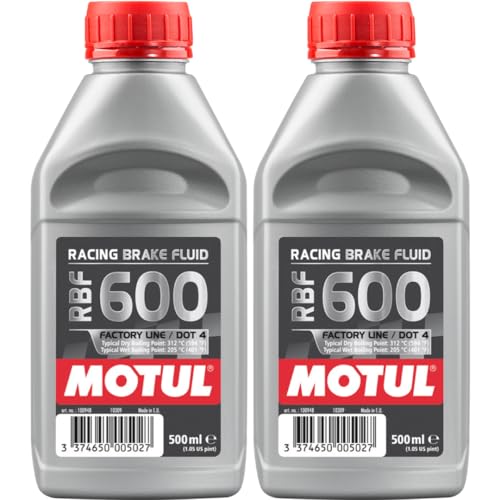






Motul's RBF 600 has earned an exceptional reputation among track day enthusiasts and performance drivers who subject their braking systems to temperatures that would cause conventional fluids to fail without warning. With a dry boiling point of 594°F (312°C) and a wet boiling point of 421°F (216°C), this 100% synthetic, non-silicone formula exceeds DOT 4 minimums by a substantial margin, providing the thermal headroom required when you are pushing hard through multiple corners in succession. The formulation is engineered specifically for hydraulic brake and clutch systems, making it an ideal choice for performance motorcycles as well as high-output automobiles.
Motul's proprietary synthetic base chemistry delivers remarkable thermal stability, meaning the fluid resists viscosity changes and additive breakdown even after repeated heat cycling through a full track session. The non-silicone composition ensures full compatibility with the rubber seals, hoses, and master cylinder components found in virtually all modern OEM braking systems, eliminating the compatibility concerns that accompany silicone-based DOT 5 fluids. For drivers who prioritize pedal feel and consistent modulation under extreme conditions, the RBF 600 delivers a progressive, confidence-inspiring response from the first application to the last lap of the day.
The 500ml packaging is compact and sufficient for a flush and bleed on most vehicles, though heavy users and those maintaining multiple cars may find it more economical to purchase multiple units simultaneously. Motul recommends replacing this fluid annually for track use, which is a reasonable interval given the hygroscopic nature of glycol-based fluids and the elevated thermal stress experienced during motorsport applications.
Pros:
Cons:
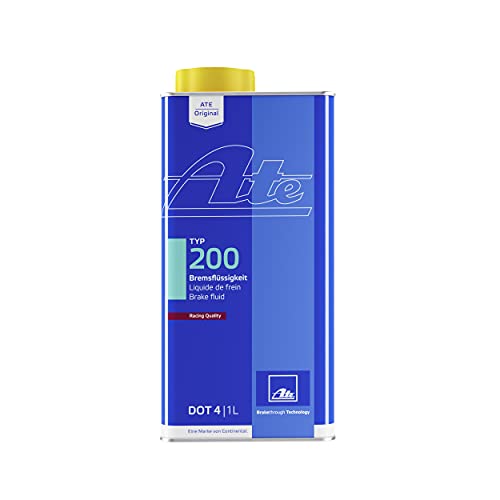
ATE is a brand synonymous with European OEM braking systems, supplying components and fluids to BMW, Mercedes-Benz, Porsche, and Audi among many others, which lends the TYP 200 a level of pedigree that aftermarket-only brands simply cannot match. The fluid's most technically distinctive characteristic is its exceptional water-locking property, which minimizes the rate at which the wet boiling point declines over time as the fluid absorbs atmospheric moisture. In practical terms, this means your boiling point remains closer to the dry specification for longer, extending the effective service interval compared to fluids with weaker hygroscopic resistance.
The non-foaming formulation ensures that filling and bleeding procedures are clean and precise, eliminating air bubble entrapment that can introduce pedal sponginess and compromise system response. ATE's corrosion inhibitor package, developed through decades of OEM collaboration, protects the ferrous and aluminum components within your calipers, master cylinder, and brake lines against oxidation and chemical degradation, preserving the integrity of the entire hydraulic circuit. The 1-liter can provides ample volume for a complete system flush on most passenger vehicles.
With a dry boiling point that comfortably exceeds the DOT 4 minimum, the TYP 200 is well-suited to spirited road driving and occasional track days at moderate intensity, though drivers who compete seriously at circuit events will find the Motul RBF 600 or Castrol SRF more appropriate for sustained high-temperature operation. For the enthusiast who owns a German performance vehicle and demands OEM-grade fluid chemistry with superior moisture resistance, the ATE TYP 200 is a clear first choice in 2026.
Pros:
Cons:
The Castrol SRF represents the apex of commercially available brake fluid technology, and its reputation within the professional motorsport community is essentially unassailable among drivers who have experienced vapor lock firsthand at high-speed circuits. Developed using an exclusive European formula, the SRF achieves a typical wet boiling point of 518°F (270°C) — a figure that exceeds the dry boiling point specification of most DOT 4 fluids on the market — meaning it maintains extraordinary thermal resistance even after absorbing significant atmospheric moisture. This characteristic makes it the single most vapor lock-resistant fluid available to the consumer market in 2026.
Castrol's anti-vapor lock engineering is particularly valuable during endurance events and on circuits with heavy braking zones such as hairpin corners and chicanes where calipers accumulate heat with no opportunity for recovery between applications. The superior braking consistency the SRF delivers under arduous conditions translates directly to shorter stopping distances and more predictable pedal modulation when a fraction of a second matters most. The fluid is fully compatible with all conventional braking system materials, including the seals and hoses used in modern ABS and stability control systems.
The premium price point of the SRF is the only meaningful barrier to wider adoption, and it is entirely justified for drivers who compete at events where brake failure carries real consequences. For daily street use or casual track days at low intensity, this level of performance exceeds what is necessary, and you would be better served by the Motul RBF 600 or ATE TYP 200 from a value perspective. However, if you are serious about motorsport at any level, the SRF is the definitive choice and should be considered a non-negotiable investment in your safety and lap times.
Pros:
Cons:
For the vast majority of drivers who operate standard passenger vehicles under ordinary road conditions, the Prestone AS401 delivers reliable, specification-compliant performance at a price point that makes routine fluid changes financially painless and therefore more likely to actually happen on schedule. The 32-ounce formulation utilizes a carefully engineered blend of polyglycol ethers that ensures hot brake system operation will not produce the compressible vapor bubbles responsible for pedal fade, providing the extra margin of safety that everyday emergency braking scenarios demand without the complexity of a motorsport-grade product. Prestone's formula is rated for use in ABS, disc, and drum brake systems, covering virtually the entire spectrum of vehicles on American roads today.
The synthetic chemistry provides performance consistency across a broader temperature range than conventional DOT 3 fluids, particularly in cold climates where low-temperature viscosity can compromise initial pedal response after a vehicle has been parked overnight. Prestone has maintained its DOT 3 formulation through decades of real-world fleet use, and the reliability record of this product in everyday applications is among the most thoroughly validated of any fluid in this category. You will find this product at virtually every automotive retailer, making it the most convenient choice for routine maintenance when you are not near a specialty supplier.
While the Prestone AS401 does not approach the boiling point specifications of the DOT 4 and racing-grade products reviewed above, it meets and exceeds the DOT 3 minimum requirements and is precisely calibrated for the thermal demands of normal street driving. Drivers who have upgraded to performance brake components, including larger rotors, multi-piston calipers, or high-friction pads, should step up to a DOT 4 product to match the higher heat generation those components produce. As discussed in our guide to the best 0W-20 synthetic oils, matching fluid specification to the thermal demands of your specific components is a principle that applies equally to both lubrication and hydraulic systems.
Pros:
Cons:
Valvoline's dual-certified DOT 3 and DOT 4 formulation occupies a uniquely practical position in the brake fluid market, delivering DOT 4 performance levels while remaining fully compatible with systems that specify either grade — an important convenience for households that maintain multiple vehicles with different fluid requirements. The low-moisture formula provides excellent vapor lock protection by limiting the rate at which the fluid absorbs atmospheric water, preserving the boiling point specification for a longer effective service interval than single-grade alternatives at comparable price points. This characteristic is particularly valuable for vehicles that are stored seasonally or driven infrequently, where the brake system sits undisturbed for extended periods during which moisture infiltration is most likely to occur.
The formulation mixes freely with conventional fluids of either DOT grade, which simplifies top-up procedures in the field and eliminates the compatibility risk that arises when mixing products of uncertain origin in an existing system. Valvoline's corrosion protection chemistry safeguards the diverse range of metals and alloys used in modern braking systems, including the aluminum bore surfaces in most contemporary master cylinders and the ferrous components within drum brake wheel cylinders. The 32-ounce bottle provides sufficient volume for a full system flush and bleed on most compact and mid-size passenger vehicles.
For drivers who value the simplicity of a single fluid that handles multiple vehicles without compatibility concerns, the Valvoline DOT 3 and 4 is a genuinely well-executed product. The ideal use case is the everyday driver who performs brake fluid changes on a two-year service interval, maintains a vehicle that sees occasional spirited road use but no formal track events, and prefers a product from an established American brand with a deep service record in OEM and retail markets.
Pros:
Cons:
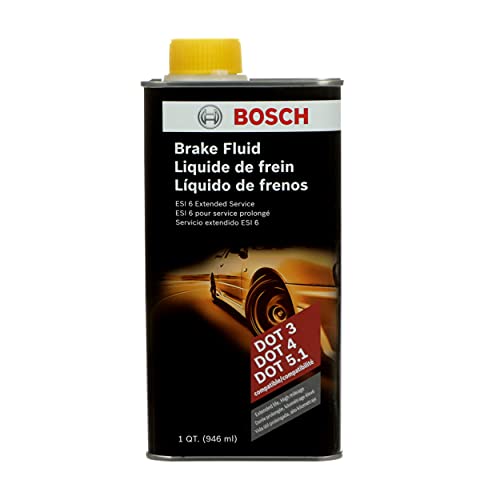
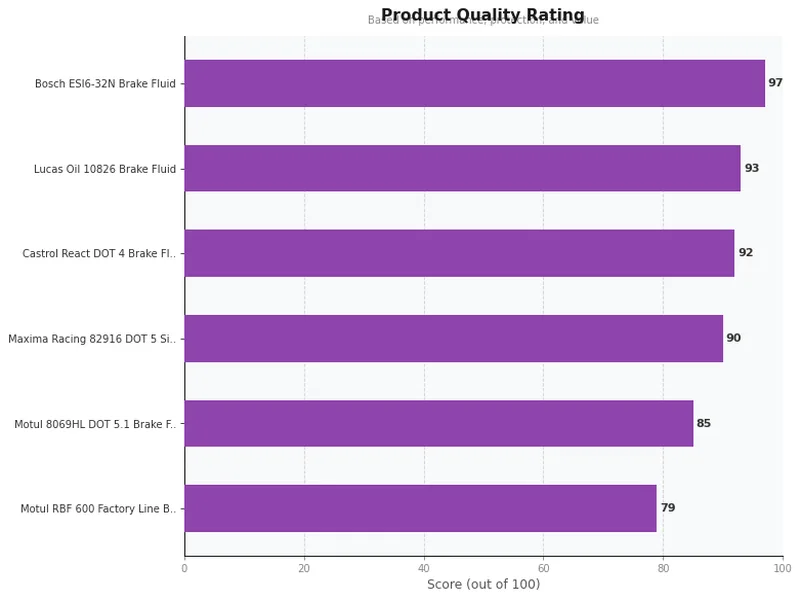
Bosch's ESI6 represents a genuine engineering advancement in the brake fluid category, simultaneously achieving both low viscosity and a high wet boiling point of 365°F — a combination that no preceding fluid product has managed to deliver together at this price tier. The next-generation formulation is designed for the sophisticated braking systems found in modern vehicles, where electronic stability control, autonomous emergency braking, and multi-channel ABS require fluid to flow rapidly through narrow solenoid valve passages during millisecond-duration intervention events. Conventional fluids with higher viscosity restrict this flow, introducing latency into precisely the safety-critical moments when response speed is most consequential.
The extended service interval is one of the ESI6's most commercially compelling attributes, with Bosch claiming 100% longer service life than DOT 3, 50% longer than DOT 4, and 10% longer than DOT 5.1, all while maintaining a viscosity 30% lower than DOT 5.1 specifications. For drivers who prefer to extend their maintenance intervals without compromising fluid condition, this translates directly into reduced long-term cost of ownership and fewer service appointments over the life of the vehicle. The ESI6 is backward compatible with vehicles specifying DOT 3, DOT 4, or DOT 5.1 fluid, covering the substantial majority of all brake systems manufactured since 1990 and making it a near-universal replacement option.
Bosch's global engineering credibility in the braking systems space — the company supplies ABS control units, calipers, and sensors to essentially every major automaker — lends the ESI6 a level of application-specific validation that aftermarket-only brands cannot replicate. If your vehicle is equipped with advanced electronic braking aids, operates in a climate that experiences significant temperature swings across seasons, or is approaching its scheduled fluid change interval without a clear replacement product in mind, the ESI6 is the most future-oriented and technically comprehensive choice on this list. For additional context on maintaining your vehicle's safety systems holistically, our article on wheel bearing replacement costs and symptoms provides useful guidance on the broader category of undercarriage maintenance.
Pros:
Cons:
Motul's DOT 5.1 formulation occupies the highest standard classification within the glycol-based brake fluid hierarchy, delivering a dry boiling point of 516°F (272°C) that substantially exceeds both DOT 3 and DOT 4 specifications while remaining fully miscible with those grades — a critical distinction that separates DOT 5.1 from silicone-based DOT 5 fluid, which is incompatible with all glycol-based products. The 2-pack configuration provides a full liter of fluid, which is precisely the quantity required for a complete system flush and bleed on most passenger cars and motorcycles, making it an economically sensible purchase format for maintenance-conscious owners who flush their systems on a defined annual or biennial schedule.
The formulation is specifically engineered for ABS-equipped vehicles, with a viscosity profile optimized for the rapid, cyclic pressure modulation that anti-lock systems perform during threshold braking events on low-traction surfaces. Motul's 100% synthetic base provides the chemical stability and thermal resistance that makes this fluid appropriate for vehicles with larger brake packages, including those fitted with performance rotors, upgraded calipers, or track-oriented brake pad compounds that generate elevated operating temperatures even during normal aggressive street driving. The fluid's compatibility with both brake and hydraulic clutch systems makes it equally useful for motorcycles, where both functions often share fluid from a common reservoir.
The performance level of the Motul DOT 5.1 sits between the brand's own RBF 600 and the standard street-duty DOT 4 offerings, making it the logical choice for drivers who want a meaningful upgrade over baseline DOT 4 performance without paying the premium price of a dedicated racing fluid that they will flush after every track session. The 2-pack also provides the convenience of having a backup bottle readily available for top-up purposes between full flush intervals, which is particularly useful for vehicles that see high-mileage use on an annual basis.
Pros:
Cons:
The DOT classification system establishes minimum dry and wet boiling point thresholds that every product in each category must meet or exceed before it can be legally sold as a specific grade. DOT 3 fluid must achieve a dry boiling point of at least 401°F and a wet boiling point of at least 284°F, while DOT 4 raises those thresholds to 446°F dry and 311°F wet, and DOT 5.1 requires 500°F dry and 356°F wet. The wet boiling point — measured after the fluid has absorbed 3.7% water by weight — is the more practically meaningful figure, because real-world fluid in your vehicle is always in some state of moisture absorption from the moment it is installed. Higher wet boiling points indicate that the fluid resists degradation from moisture ingress more effectively and maintains its vapor lock protection for a longer service interval, which is why premium products like the Castrol SRF and Motul RBF 600 advertise their wet boiling points prominently.
For a thorough technical comparison of the two most common grades, you can reference our detailed DOT 4 vs. DOT 3 breakdown, which examines the performance differences in terms that are directly applicable to vehicle selection decisions in 2026. The fundamental rule is straightforward: always use the grade specified in your owner's manual as a minimum, and consider upgrading to the next classification if your driving habits involve sustained hard braking, elevated ambient temperatures, or any form of track use.
The relationship between driving application and appropriate fluid grade is more consequential than most vehicle owners appreciate, and selecting a fluid that is under-specified for your actual use case creates a genuine safety risk rather than merely a performance compromise. Daily commuters who drive sedately on public roads and brake gently and progressively in normal traffic conditions will find DOT 3 synthetic fluid entirely adequate, with a two-year replacement interval appropriate for maintaining the wet boiling point above the minimum threshold. Drivers who routinely use engine braking through mountain passes, tow heavy loads, or brake repeatedly from highway speeds in stop-and-go highway construction zones should use DOT 4 as a minimum, because the additional thermal demands of those scenarios can approach the margins of DOT 3 specifications under sustained conditions.
Performance vehicle owners, autocross competitors, and track day participants operating at even moderate intensity should use a high-spec DOT 4 such as the Motul RBF 600 or ATE TYP 200 as a baseline, with the Castrol SRF representing the appropriate choice for full circuit racing where brake temperatures regularly reach 500°F or beyond. The Motul DOT 5.1 occupies a well-defined intermediate position between standard DOT 4 products and the dedicated racing fluids, making it the strongest recommendation for serious enthusiasts who engage in regular spirited road driving or occasional track days without the commitment of a full racing program.
The viscosity of brake fluid has become an increasingly important specification as electronic stability systems, autonomous emergency braking, and multi-channel ABS have proliferated across the vehicle market in the 2020s. These systems rely on electronically controlled solenoid valves that modulate brake pressure in milliseconds, and fluid that is too viscous resists rapid flow through the narrow passages within these components, introducing lag that compromises the system's ability to respond at the speeds required during emergency interventions. The Bosch ESI6's low-viscosity formulation is specifically designed to address this challenge, and vehicles equipped with advanced driver assistance systems benefit measurably from fluids that prioritize flow characteristics alongside boiling point specifications.
Standard DOT 4 and DOT 5.1 fluids are fully compatible with the ABS systems installed on the vast majority of contemporary vehicles, and the products reviewed here all meet the compatibility requirements for disc, drum, and ABS-equipped braking architectures. The critical compatibility concern in the brake fluid category is the distinction between glycol-based products (DOT 3, 4, and 5.1) and silicone-based DOT 5 fluid — these two chemistry families are fundamentally incompatible with each other and must never be mixed. Every product reviewed in this guide is glycol-based and compatible with every other glycol-based fluid, which simplifies top-up and transition decisions considerably.
Brake fluid is a consumable that degrades continuously from the moment it is installed, as atmospheric moisture permeates the system through flexible brake hoses and reservoir seals at a rate that depends on environmental humidity, mileage, and operating temperatures. The standard industry recommendation for most glycol-based fluids is a complete flush and replacement every two years, regardless of mileage, because the wet boiling point degradation that occurs over that period is sufficient to meaningfully compromise performance margins in emergency braking scenarios. Racing-grade fluids such as the Castrol SRF and Motul RBF 600 are recommended for annual or even per-event replacement at the track, while the Bosch ESI6's extended-life formula is engineered to maintain specification compliance for significantly longer periods in normal street use.
The total cost of ownership calculation should account not only for the price per liter of the fluid itself but also for the labor cost of the flush and bleed procedure, the quantity of fluid required for a complete change on your specific vehicle, and the replacement interval the formula supports. A more expensive fluid with a longer certified service interval often represents superior long-term value compared to an inexpensive product that requires more frequent replacement, particularly when dealer or shop labor costs are factored into the calculation. DIY maintenance using a vacuum bleeder or a pressure bleeder kit significantly reduces the per-service cost and is within the capability of any owner with basic mechanical confidence.
The standard recommendation for most glycol-based brake fluids is a complete flush and replacement every two years, regardless of mileage, because atmospheric moisture absorption degrades the wet boiling point on a timeline driven by time and humidity rather than distance traveled. Some extended-life formulations such as the Bosch ESI6 are engineered for longer intervals, and your owner's manual may specify a different schedule based on the OEM's testing. Track use requires more frequent replacement — often annually or after each event — because the elevated thermal stress accelerates fluid degradation. In 2026, many vehicles equipped with vehicle health monitoring systems include brake fluid condition alerts based on conductivity measurements, which can provide a more precise replacement trigger than calendar-based intervals.
Mixing DOT 3 and DOT 4 is technically permissible and will not cause immediate system damage, because both formulations are glycol-based and chemically compatible. However, mixing the two grades results in a blended fluid that performs at the lower specification of the two components, effectively reducing the boiling point protection of any DOT 4 you have added to a system containing residual DOT 3. The correct approach is always to flush the system completely before introducing a new grade or brand, ensuring that the installed fluid performs to its full advertised specification rather than a diluted approximation. If you are topping up a system in an emergency without access to the correct grade, mixing is acceptable as a short-term measure, but a complete flush at the earliest opportunity is essential.
The dry boiling point measures the temperature at which freshly manufactured, moisture-free brake fluid vaporizes, while the wet boiling point measures the same threshold after the fluid has absorbed 3.7% water by weight — the standard degradation level established by regulatory testing protocols as representative of aged in-service fluid. The wet boiling point is the more meaningful practical figure, because real-world brake fluid in your vehicle begins absorbing moisture immediately after installation and continues doing so throughout its service life. A fluid with an impressive dry boiling point but a comparatively low wet boiling point offers less real-world protection than its headline specification suggests, which is why premium products like the Motul RBF 600 and Castrol SRF emphasize their wet boiling points as primary performance indicators.
DOT 5 brake fluid is silicone-based and is fundamentally incompatible with DOT 3, DOT 4, and DOT 5.1 fluids, all of which use glycol-based chemistry. Mixing silicone DOT 5 with any glycol-based fluid causes chemical reactions that produce gels, sludge, and corrosive compounds that can destroy seals, hoses, and bore surfaces throughout the entire hydraulic circuit. DOT 5 is designed primarily for military and collector vehicle applications where moisture absorption is particularly problematic during long storage periods. It is not recommended for ABS-equipped vehicles because its compressibility characteristics are incompatible with rapid pressure cycling. Every product reviewed in this guide is glycol-based and therefore incompatible with DOT 5 — do not mistake the nomenclature similarity between DOT 5 and DOT 5.1 for chemical compatibility, as they are entirely different formulation families.
Brake fade occurs in two distinct forms: pad fade, which results from overheated brake pad compound releasing gases that create a lubricating layer between pad and rotor, and fluid fade, which results from vaporized brake fluid creating compressible gas bubbles within the hydraulic circuit that cause the pedal to lose its firm feel and travel toward the floor without generating proportional clamping force. The right brake fluid prevents fluid fade by maintaining its liquid state above the temperatures your brakes will actually reach during the most demanding conditions your driving style creates. Choosing a fluid with a wet boiling point that comfortably exceeds your operating temperature envelope is the definitive preventive measure, and the products in the upper tier of this list — particularly the Castrol SRF and Motul RBF 600 — are engineered specifically to eliminate fluid fade even in extended motorsport scenarios.
Unopened brake fluid in a sealed container has a shelf life of approximately two years from the manufacturing date for glycol-based formulations stored at room temperature away from direct sunlight. The primary degradation mechanism is moisture permeation through the container itself, which occurs slowly even through sealed metal cans and plastic bottles over extended periods. Fluid stored in a partially used bottle degrades significantly faster due to the air space above the fluid introducing a larger moisture reservoir. When purchasing brake fluid for future use, check the manufacturing or expiration date printed on the container, store it in a cool, dry location away from temperature extremes, and use the entire bottle in a single flush procedure rather than partially depleting a container and resealing it for later use.
 |
 |
 |
 |

About Marcus Chen
Marcus Chen has over twelve years of hands-on experience modifying cars across a range of platforms — from commuter builds to track-focused setups — with deep expertise in suspension tuning, wheel and tire fitment, and performance upgrades that improve driving dynamics without sacrificing day-to-day reliability. He has worked with both bolt-on and engineered modifications and brings a methodical, results-focused approach to evaluating performance parts. At CarCareTotal, he covers performance upgrades, suspension and handling, and wheel, tire, and drivetrain modifications.
Get some FREE car parts & gear.. Or check out the latest free automotive manuals and build guides here.
Disable your ad blocker to unlock all the hidden deals. Hit the button below 🚗
| | | |
