by Sarah Whitfield
Most passenger cars have two axles — one connecting the front wheels and one connecting the rear — making the answer to "how many axles does a car have" straightforward for virtually every standard vehicle on the road. That count increases with larger trucks and commercial rigs, but the typical sedan, crossover, or hatchback operates on exactly two axles from the factory.
An axle is a shaft or rod that connects a pair of opposing wheels, transmitting rotational torque from the drivetrain while simultaneously bearing the vehicle's structural load. Counting axles in any vehicle is as simple as dividing the total wheel count by two — with a standard passenger car showing two front wheels on one axle and two rear wheels on the other, arriving at that familiar total of two.
Understanding axle layout has genuine practical value beyond satisfying curiosity. It explains how a car distributes driving force between front and rear, how drivetrain components interact under load, and where to look first when symptoms like vibration or clicking sounds appear during acceleration or cornering. Drivers exploring related drivetrain topics will also benefit from this guide on how long a clutch lasts, since drivetrain wear patterns often develop in predictable sequences across connected components.
Contents
The axle is one of the most fundamental mechanical components on any wheeled vehicle, predating the automobile by thousands of years. In modern passenger cars, the axle serves a dual purpose: it acts as the structural link between paired wheels, and it serves as the conduit through which the engine's rotational force reaches the road surface. According to Wikipedia's engineering overview of axles, the basic concept remains unchanged from ancient cart design, even as modern automotive axles incorporate constant-velocity joints, precision bearings, and differential gearing that ancient engineers never could have conceived.
The front and rear axles on a passenger car perform distinctly different functions depending on drivetrain configuration. In front-wheel-drive vehicles — which represent the majority of passenger cars sold today — the front axle handles both steering inputs and engine torque delivery simultaneously, requiring complex constant-velocity joints that accommodate both rotation and angular movement. In rear-wheel-drive configurations, the front axle carries only structural weight and steering responsibilities, while the rear axle bears the full burden of driving force.
All-wheel-drive and four-wheel-drive systems distribute torque across both axles at once, introducing additional components like center differentials, transfer cases, and electronically controlled coupling mechanisms at each shaft. This mechanical complexity produces better traction in demanding conditions but also creates more potential maintenance points compared to a simpler two-wheel-drive setup. Modern independent suspension designs on both axles improve handling and ride quality considerably compared to the older solid-axle configurations still found on heavy-duty trucks.
Not every axle on a vehicle transmits engine power. A drive axle connects directly to the drivetrain and rotates under engine force to propel the vehicle forward. A dead axle — sometimes called a tag axle or beam axle — supports weight without receiving any rotational energy from the powertrain. Trailers rely on dead axles exclusively, and some heavy commercial trucks add a rear tag axle solely to distribute payload weight across more contact points without the expense of another driven unit. In standard front-wheel-drive passenger cars, the rear axle functions as a passive dead axle, rotating only because the wheels roll along the pavement.
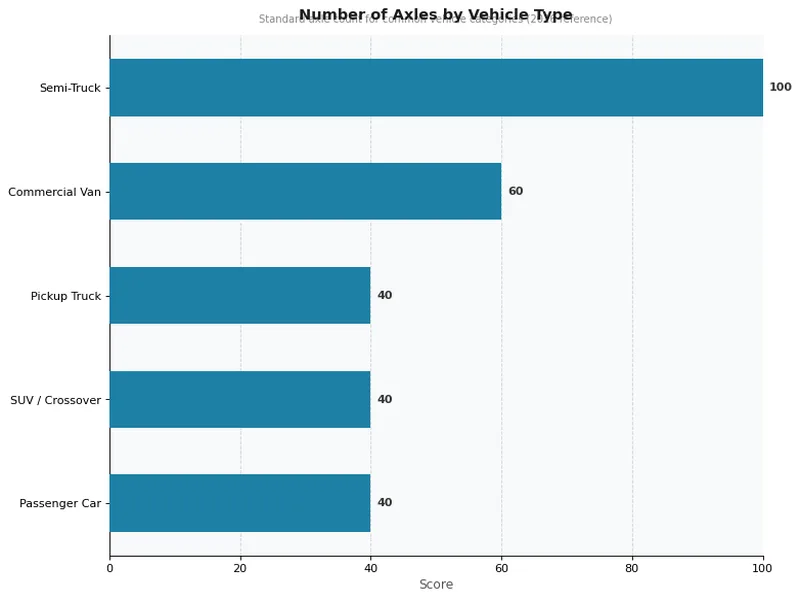
Axle count scales directly with vehicle size and payload demands. The table below covers the most common vehicle categories and their typical axle configurations, giving a clear picture of where the standard two-axle answer applies and where it stops being accurate.
| Vehicle Type | Typical Axle Count | Drive Configuration | Notes |
|---|---|---|---|
| Motorcycle | 1 | Rear-wheel drive | Front fork is not a traditional axle assembly |
| Passenger car / sedan | 2 | FWD, RWD, or AWD | Standard configuration for virtually all personal vehicles |
| SUV / crossover | 2 | FWD, RWD, or AWD | Larger unibody SUVs follow same two-axle layout |
| Standard pickup truck | 2 | RWD or 4WD | Dually rear wheels still share one rear axle shaft |
| Box truck / medium-duty | 2–3 | RWD | Tandem rear axles appear on heavier payload variants |
| Semi-tractor (solo) | 3 | Tandem rear drive axles | One front steer axle plus two rear drive axles |
| Full tractor-trailer | 5 | Mixed | Tractor (3) plus trailer (2) equals five total axles |
| School bus | 2–3 | RWD | Longer buses may add a tag axle behind the rear drive axle |
The two-axle layout serves the needs of virtually all passenger vehicles, balancing mechanical simplicity with sufficient load-bearing capacity for everyday driving. A standard sedan weighing around 3,500 pounds distributes that mass across four tire contact patches, with each axle rated well above the static load it carries under normal conditions. Adding a third axle increases cost, drivetrain weight, and mechanical complexity without providing meaningful benefit at passenger vehicle weights, which is why no manufacturer has ever offered a three-axle passenger car for the consumer market.
Three-axle vehicles appear once payload requirements push beyond what two axles can safely manage. It is worth noting that dually pickup trucks — those with four rear tires — still count as two-axle vehicles, because both sets of rear tires share a single axle shaft. True three-axle trucks feature a distinct middle drive axle and a separate rear tag axle, commonly seen on concrete mixers and larger delivery vehicles. Commercial semi-tractors with two rear drive axles count as three axles total, and a complete tractor-trailer combination reaches five axles once the trailer's two axles are included in the count.
Axles in passenger cars are genuinely durable components, but they depend on intact protective housings and adequate lubrication to reach their potential service life. Neglecting two straightforward inspection points — CV boots and wheel bearings — accounts for the majority of premature axle failures in vehicles with otherwise sound mechanical histories.
The constant-velocity joint sits at each end of a front-wheel-drive or all-wheel-drive axle shaft, allowing the wheel to steer and compress through suspension travel while still receiving engine torque. A ribbed rubber boot encases each CV joint, holding lubricating grease inside and blocking road grime, water, and debris from contaminating the joint. Inspecting these boots during every oil change catches tears before grease loss leads to rapid joint wear — a torn CV boot that goes unaddressed for several thousand miles often converts a straightforward boot replacement costing around $50 into a full axle shaft replacement costing several hundred dollars. Pairing axle boot checks with routine service intervals makes this inspection easy to sustain, and drivers looking to solidify their maintenance schedule can reference this guide on how often to change an oil filter for a practical framework to bundle multiple checks efficiently.
Wheel bearings sit inside the axle hub, allowing each wheel to spin freely while still carrying the vehicle's full corner weight. Most modern vehicles use sealed wheel bearing assemblies that require no user-serviceable lubrication, but older vehicles with serviceable hub bearings benefit from periodic repacking with a quality grease rated for automotive bearing use. Choosing the right product makes a meaningful difference in bearing longevity — the best wheel bearing greases resist water intrusion and high-temperature breakdown significantly better than generic or off-brand alternatives. Signs of a worn bearing include a persistent humming or growling noise that shifts in pitch when steering left or right, a pattern that distinguishes bearing noise from tire noise reliably.
A clicking or snapping noise that appears only during tight, low-speed turns is one of the most reliable early indicators of a worn CV joint — catching it at this stage, before vibration develops during straight-line acceleration, keeps the repair straightforward and affordable.
The most distinctive symptom of a failing CV joint is a sharp clicking or snapping sound during slow, tight turns — the kind encountered in parking lots and driveways. This noise comes from a worn joint that has lost its precise mechanical tolerance and begins knocking against its retaining cage during the extreme angles required in tight cornering. As wear progresses beyond this early stage, the clicking transitions to noticeable vibration during straight-line acceleration and eventually to a pronounced clunking sensation transmitted through the floorboard under throttle input.
Vibration during acceleration that disappears during coasting points strongly toward an axle issue rather than a tire balance problem, since an unbalanced tire produces vibration at specific vehicle speeds regardless of throttle input. A shaking steering wheel during acceleration on front-wheel-drive vehicles can trace directly to front axle wear, since the drive axle and steering knuckle occupy the same physical space on that drivetrain layout. Visible grease splattered around the inside of the wheel or on surrounding suspension components confirms a torn boot and active joint contamination, requiring prompt attention.
Axle problems respond well to methodical diagnosis rather than guesswork based on sound alone. A visual inspection of CV boots requires nothing more than a flashlight and a quality floor jack to lift the vehicle safely, providing clear visibility of the boot condition, any grease splatter, and the overall state of the axle shaft. For a broader framework covering vehicle diagnosis by symptom category, the troubleshooting section provides organized guidance on reading automotive symptoms accurately before committing to a repair path.
The decision between repairing an axle component and replacing the entire shaft assembly depends on how far the damage has progressed at the time of inspection. Understanding where that threshold falls saves money in some cases and prevents false economy in others.
Axle repair — rather than full replacement — makes economic sense in a narrow set of circumstances. A torn CV boot that has not yet allowed grease loss or contamination to reach the joint itself represents the best candidate for a boot-only repair. If the boot tore recently and grease still coats the joint with no visible grit or corrosion present, replacing just the boot and repacking the joint with fresh grease produces a reliable result. This approach works best on newer vehicles with lower mileage, where the underlying joint remains in sound mechanical condition and has not yet developed the looseness that produces audible symptoms.
Once a CV joint begins making noise, boot replacement alone solves nothing — the joint itself is already mechanically compromised and will continue to deteriorate regardless of lubrication. At that point, replacing the entire axle shaft assembly — which includes both the inner and outer CV joints along with the connecting shaft — makes more sense mechanically and often economically as well. Remanufactured axle shafts carry warranties and cost a fraction of OEM pricing, making full-shaft replacement the standard recommendation among professional technicians for any axle producing audible symptoms. Just as timing belt replacement costs often seem high until weighed against the engine damage that a snapped belt causes, axle shaft replacement is one of those repairs where deferred action reliably produces a larger bill down the road.
Most standard passenger cars have two axles — one front axle connecting the two front wheels and one rear axle connecting the two rear wheels. This applies to sedans, coupes, hatchbacks, crossovers, and most SUVs on the road today.
An axle is a central shaft or rod that connects two opposing wheels on the same end of a vehicle. It transmits rotational torque from the drivetrain to the wheels while also supporting the vehicle's weight at each corner through the suspension and hub assembly.
No. All-wheel-drive and four-wheel-drive vehicles still have two axles — one front and one rear. The difference from two-wheel-drive vehicles is that both axles receive engine torque simultaneously rather than only one, but the total axle count remains the same.
A standard semi-tractor has three axles — one front steering axle and two rear tandem drive axles. A complete tractor-trailer combination typically reaches five axles total when the trailer's two axles are included in the count.
A drive axle connects directly to the engine's drivetrain and rotates under power to propel the vehicle forward. A dead axle — also called a tag axle or beam axle — supports vehicle weight but receives no rotational power from the engine, functioning passively as wheels roll along the road.
The most common symptoms include a clicking or snapping sound during slow tight turns, vibration during acceleration that goes away when coasting, a clunking sensation through the floor under throttle, and visible grease splatter near the wheel from a torn CV boot. Any of these symptoms warrants inspection before they worsen.
With proper maintenance and no significant impacts from road hazards or curb strikes, axle shafts in passenger vehicles commonly reach 150,000 miles or more. CV joint boots tend to degrade faster than the joints themselves due to heat and road exposure, making regular visual inspections the most effective way to extend overall axle life.
Driving with a noticeably failing axle is not advisable. A severely worn CV joint risks complete mechanical failure, which can cause sudden and unexpected loss of vehicle control at any speed. Mild clicking symptoms warrant prompt scheduling of an inspection, while vibration or clunking during acceleration should be treated as an urgent repair need.
Knowing that most passenger cars run on two axles is just the starting point — understanding what those axles do, how to maintain them, and how to recognize early warning signs is what keeps a vehicle reliable over the long haul. Anyone who has recently noticed clicking during turns, vibration under acceleration, or grease near a wheel should schedule an axle inspection with a trusted mechanic before minor wear becomes a roadside emergency. Exploring the full range of diagnostic and maintenance resources available in the troubleshooting section provides a solid foundation for staying ahead of drivetrain issues on any vehicle.
 |
 |
 |
 |

About Sarah Whitfield
Sarah Whitfield spent ten years as an ASE-certified automotive technician before transitioning to full-time automotive writing, giving her a diagnostic skillset that goes well beyond what most reviewers bring to the subject. She specializes in OBD-II code analysis, electrical system troubleshooting, and the intermittent failure modes that frustrate owners and confound general mechanics. At CarCareTotal, she covers car troubleshooting guides, diagnostic tools, and repair resources for drivers dealing with warning lights, strange symptoms, and hard-to-diagnose problems.
Get some FREE car parts & gear.. Or check out the latest free automotive manuals and build guides here.
Disable your ad blocker to unlock all the hidden deals. Hit the button below 🚗
| | | |
