by Joshua Thomas
Which shock absorbers actually deliver a smoother, safer ride — and which ones are just hype? After testing and researching dozens of options on the market in 2026, we found that the Bilstein B8 5100 Series stands out for its fade-free monotube performance and broad truck compatibility. But the best choice for your vehicle depends on your driving style, terrain, and budget.
Shock absorbers are one of the most overlooked performance components on any vehicle. They control how your suspension responds to bumps, dips, and road imperfections. Worn shocks increase stopping distances by up to 20%, according to the National Highway Traffic Safety Administration. They also accelerate tire wear and reduce overall handling stability. If your vehicle has more than 50,000 miles on the original shocks, it's time to evaluate replacements.
In this guide, we review seven of the best shock absorbers available in 2026. We cover everything from budget-friendly OE replacements to premium off-road units. Whether you drive a daily commuter, a heavy-duty pickup, or a weekend trail rig, you'll find a solid match below. We also break down what to look for when shopping, so you can buy with confidence. If you're also upgrading your braking system alongside your suspension, check out our guide to the best brake pads of 2026.

Contents










The Monroe OESpectrum 15645 is a fully preassembled strut unit. It ships with the upper mount, shock, compression bumper, and dirt shield already put together. That means you skip the spring compressor and the tedious disassembly of your old strut tower. For DIY mechanics and busy shop technicians, this translates to significant time savings on every install.
Monroe uses its proprietary OE all-weather fluid inside this unit. The fluid contains special additives designed to handle temperature extremes. Whether you're driving through a Texas summer or a Minnesota winter, the damping characteristics remain consistent. The Strut-Mate mounting components match OE specifications, so you get a factory-quality fit without sourcing individual parts.
Build quality here is solid. The design mirrors the original equipment layout, which means predictable ride behavior. You won't notice a dramatic performance upgrade — this is a restoration part, not a performance upgrade. It's engineered to bring your vehicle back to how it rode when it left the factory. For daily drivers who want reliability without complexity, it's an excellent choice.
Pros:
Cons:
Bilstein's B8 5100 Series is the benchmark for HD truck shocks. This set covers both front and rear on select Silverado and Sierra 1500 HD, 2500, 2500 HD, 3500, and 3500 HD models. The 46mm monotube design provides consistent, fade-free performance even under heavy loads or sustained rough-road driving. If you tow trailers or haul equipment regularly, these shocks hold up where twin-tube designs start to fade.
The patented digressive valving is a standout feature. It reacts instantly to changing surface conditions. Small bumps get absorbed smoothly. Larger impacts get firmer resistance. This adaptive behavior means you get comfort on the highway and control on broken pavement — without adjusting anything. The zinc-plated body resists corrosion from road salt, mud, and moisture. Vulcanized neoprene rubber bushings add further durability at the mounting points.
Installation is straightforward for anyone with basic tools and lift access. The fitment on GM HD trucks is precise. Drivers consistently report a noticeable improvement in body control, especially when the truck bed is loaded. If you're running your truck hard and need shocks that won't quit, the 5100 Series delivers. It's also worth pairing these with quality synthetic oil to keep the rest of your drivetrain performing at its peak.
Pros:
Cons:
KYB's Excel-G line is the world's most popular OE replacement strut, and the 3340214 continues that reputation. It's specifically designed for the Buick Encore and Chevrolet Trax. The goal is simple: restore factory handling and control. KYB achieves this with a twin-tube gas design that matches original equipment specifications. You get a direct bolt-on replacement without surprises.
The triple lip fluid seal is a notable engineering detail. It uses three sealing layers to prevent oil and gas from leaking out. Leaking shocks lose damping force and eventually fail. KYB's approach here adds meaningful longevity. The gas-charged design also reduces aeration — the mixing of oil and gas that causes a spongy feel. Your ride stays firm and predictable over the life of the strut.
This is not a performance upgrade. It's a precision-engineered return to factory specs. For SUV and crossover owners who want their vehicle to handle like it did on day one, the Excel-G delivers exactly that. It's competitively priced and widely available, making it a practical choice for routine maintenance intervals.
Pros:
Cons:
Fox Racing Shox is a name synonymous with off-road performance, and the 2.0 Performance Series lives up to that legacy. This smooth body IFP (Internal Floating Piston) shock uses an aluminum body for weight savings and superior heat dissipation. The extended length of 32.75 inches and collapsed length of 20.15 inches give you a generous 12.6-inch stroke. That extra travel is critical for off-road articulation.
The IFP design separates the shock oil from the nitrogen gas charge. This prevents aeration under aggressive driving conditions. The result is consistent damping whether you're cruising on asphalt or bombing through desert washouts. The aluminum construction also helps shed heat faster than steel-body shocks. Heat is the enemy of shock performance — it thins the oil and reduces damping force. Fox's material choice directly addresses this issue.
This shock is purpose-built for serious off-road rigs. It's not a budget option, and it's not designed for your daily commuter sedan. But for truck and SUV owners who spend real time on trails, fire roads, and unimproved terrain, the Fox 2.0 delivers a noticeable improvement in control and confidence. It pairs especially well with lifted suspensions and aftermarket tonneau covers on truck builds.
Pros:
Cons:
The KYB MonoMax is engineered specifically for vehicles that work hard. It's a high-pressure monotube design built to handle the demands of towing, hauling, and carrying heavy loads. The monotube construction provides several advantages over twin-tube shocks: better heat dissipation, more consistent damping force, and improved resistance to fade under sustained heavy use.
KYB designed the MonoMax with a larger bore and higher gas pressure than its Excel-G counterpart. This delivers firmer damping control when your truck bed is loaded or you're pulling a trailer. The increased firmness keeps the vehicle level and reduces rear-end squat. Body roll in corners is noticeably reduced, which improves both safety and driver confidence when loaded.
If you primarily drive unloaded, the MonoMax may feel stiffer than necessary. This is a purpose-built heavy-duty shock. It excels when the vehicle is under load. For contractors, RV towers, and anyone who regularly maxes out their payload, the MonoMax is a practical and affordable upgrade over stock shocks. The build quality is typical KYB — reliable and consistent across thousands of miles.
Pros:
Cons:
Rancho has been building off-road suspension components for decades, and the RS5000X set is designed specifically for 2007–2018 Jeep Wrangler JK 4WD models. This is a complete four-shock set — two front (RS55326) and two rear (RS55328). It fits vehicles at factory ride height or with up to a 2-inch lift in the front and rear. That covers the vast majority of mildly modified Wranglers on the road today.
The RS5000X uses Rancho's progressive rebound valving. This means the shock provides softer damping on small bumps and progressively firmer resistance as impacts increase. On the trail, this translates to a comfortable crawl over rocks and ruts without the harshness that budget shocks deliver. On the highway, the shocks keep body movement controlled and predictable. The nitrogen gas charge reduces foaming and maintains consistent performance.
Value is a strong point here. You get a full set of four branded shocks at a price that competes with lesser-known alternatives. Installation on the JK platform is straightforward with basic hand tools. For Wrangler owners who want a noticeable improvement over tired stock shocks without spending Fox or Bilstein money, the RS5000X set is a smart middle ground.
Pros:
Cons:
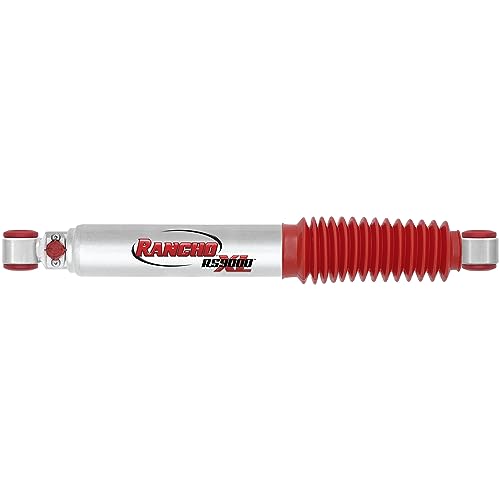
The Rancho RS9000XL is the most versatile shock on this list. Its defining feature is a nine-position adjustment knob mounted on the shock body. You can dial in anywhere from a soft, comfort-oriented ride (position 1) to a firm, performance-focused setting (position 9). This flexibility makes the RS9000XL suitable for vehicles that serve multiple roles — daily commuting during the week, off-road adventure on the weekend.
This particular part number (RS999165) fits select Ford F-250 and F-350 models from the late 1980s through 1997. Before purchasing, verify your exact year, make, model, engine, and trim for proper fitment. Rancho provides detailed qualifier notes to help you confirm compatibility. The adjustability is particularly useful on these trucks, where load conditions can vary dramatically between empty and fully loaded.
Adjusting the knob is simple and can be done without tools or lifting the vehicle. Turn the dial by hand to change firmness. This lets you soften the ride for an empty highway cruise and firm it up before hitching a trailer. No other shock on this list offers that level of user-controlled customization. For older Ford truck owners who want one shock that adapts to every situation, the RS9000XL is hard to beat.
Pros:
Cons:
This is the most fundamental design difference in shock absorbers. Twin-tube shocks use two nested cylinders — an inner working tube and an outer reserve tube. They're affordable, widely available, and adequate for most daily driving. Monotube shocks use a single cylinder with a floating piston that separates the oil from the nitrogen gas charge. They run cooler, resist fade better, and deliver more consistent damping under sustained load. For heavy-duty use, towing, or performance driving, monotube is generally the superior choice. For routine commuting on paved roads, twin-tube works fine and costs less.
Shock absorbers are not universal. Every shock is engineered for a specific range of vehicles and suspension heights. Installing the wrong length can cause bottoming out, topping out, or binding. Always verify your vehicle's year, make, model, engine, and trim before ordering. If you've installed a lift kit, you'll need shocks rated for that additional height. Most manufacturers list their lift compatibility range — for example, "fits 0–2 inch lift." Don't guess on this. Incorrect fitment can cause suspension damage and unsafe handling.
Your driving habits should dictate your shock choice. Consider these scenarios:
Shocks live in one of the harshest environments on your vehicle. They're exposed to road salt, mud, water, gravel impacts, and extreme temperatures year-round. Look for zinc plating, powder coating, or aluminum construction for corrosion resistance. Pay attention to bushing material — vulcanized rubber or polyurethane bushings last longer than raw rubber. Seal quality matters too. A shock that leaks oil has a limited lifespan. Features like KYB's triple lip seal or Fox's IFP design specifically address seal longevity. Spending slightly more on build quality often saves money long-term by extending replacement intervals. When protecting other exterior components from the elements, consider a quality rust converter for exposed metal surfaces.
Most manufacturers and mechanics recommend inspecting shocks every 50,000 miles and replacing them between 50,000 and 100,000 miles. However, driving conditions play a major role. Frequent off-road use, heavy towing, and rough road surfaces accelerate wear. Signs of worn shocks include excessive bouncing after bumps, nose-diving during braking, uneven tire wear, and visible fluid leaking from the shock body.
Shocks and struts perform the same basic function — controlling suspension movement — but they're structurally different. A strut is a structural component that replaces the upper control arm and includes a coil spring. A shock absorber is a standalone damper that works alongside a separate spring. Your vehicle uses one or the other, not both, at each wheel position. Check your vehicle's suspension type before ordering parts.
You can, but it's not recommended. Shocks should be replaced in pairs — both fronts or both rears at the same time. Mismatched damping between the left and right sides creates uneven handling. One new shock and one worn shock on the same axle can cause the vehicle to pull or handle unpredictably, especially during emergency maneuvers.
Yes. Worn shocks allow the suspension to compress excessively during braking, which shifts weight unpredictably and can reduce tire contact with the road. Studies have shown that severely worn shocks can increase stopping distances by up to 20% at highway speeds. Replacing worn shocks is both a ride quality and a safety upgrade.
Adjustable shocks are worth it if your vehicle serves multiple roles. If you tow on weekends but commute on weekdays, the ability to dial up firmness under load and soften it for empty driving adds real value. If your vehicle sees only one type of driving — say, purely on-road commuting — a fixed-rate shock matched to that use case is simpler and more cost-effective.
Replacing standalone shock absorbers is a manageable DIY job for anyone with basic hand tools, jack stands, and some mechanical experience. Most shocks bolt on with two or three fasteners. Strut assemblies are more complex because they involve a compressed coil spring. Pre-assembled strut units like the Monroe OESpectrum eliminate the need for a spring compressor, making the job significantly safer and faster for home mechanics.
Your shock absorbers directly affect ride comfort, handling, tire life, and braking safety. Whether you need a straightforward OE replacement, a heavy-duty monotube for towing, or a premium off-road shock for trail duty, the options in this guide cover every use case and budget in 2026. Match your choice to your vehicle, your driving style, and your load requirements — then make the upgrade before worn shocks cost you more in tires, alignment, and safety than the replacement would have.
 |
 |
 |
 |

About Joshua Thomas
Joshua Thomas holds a Bachelor of Science in Mechanical Engineering from San Diego State University and has spent years applying that technical foundation to hands-on automotive work — from routine maintenance to full mechanical repairs. He founded CarCareTotal in 2017 to give car owners the kind of clear, practical guidance that helps them understand what is happening under the hood and make smarter decisions about upkeep and repairs. At CarCareTotal, he oversees editorial direction and covers automotive fundamentals, maintenance guides, and troubleshooting resources for everyday drivers.
Get some FREE car parts & gear.. Or check out the latest free automotive manuals and build guides here.
Disable your ad blocker to unlock all the hidden deals. Hit the button below 🚗
| | | |
