Audio ›
by Joshua Thomas
You pull into a parking lot, windows down, and another car rolls past with a bass line that vibrates your steering wheel from twenty feet away. Your factory speakers play music — they just do not move you. You want real low-end presence without gutting your trunk or running wire through the entire cabin. That is exactly the market these seven products were engineered to serve, and in 2026 the under-seat powered subwoofer category has never been more competitive or more capable.

Under-seat subwoofers occupy a specific and practical niche in the car audio world: they deliver amplified low-frequency output from an enclosure small enough to slip beneath a front or rear seat, typically measuring under four inches in height. According to Wikipedia's overview of subwoofer technology, dedicated low-frequency drivers begin to outperform full-range speakers below approximately 80 Hz, which is precisely where factory audio systems fall apart. Every unit on this list includes a built-in amplifier, so you do not need to research a separate power source — though if you are building a more advanced system, our guide to the best car amplifiers for bass covers external options in depth.
This 2026 roundup evaluates seven under-seat subwoofers across the criteria that matter most to real buyers: output power, physical dimensions, input flexibility, crossover control, and installation complexity. Whether you drive a compact sedan, a full-size truck, or an SUV with limited cargo space, one of these units delivers the bass upgrade your system needs without a weekend-long installation project.
Contents









The Kicker 11HS8 has been a benchmark in the under-seat category for years, and its continued relevance in 2026 speaks to the strength of its core engineering. At 13 7/8 inches long, 9 3/8 inches wide, and a remarkably slim 3 1/8 inches tall, this unit slides beneath virtually any front or rear seat without modification. Kicker rates the internal amplifier at 150 watts RMS — a figure that, in this form factor, produces genuinely felt bass rather than merely audible rumble, and the enclosure tuning delivers clean output down into the mid-30 Hz range without the port noise that plagues cheaper competitors.
Installation is straightforward even for buyers without professional audio experience, because the HS8 accepts both RCA line-level inputs and high-level speaker inputs from your factory head unit. The variable low-pass crossover and adjustable gain give you meaningful control over how the subwoofer integrates with your existing speakers, and the variable bass boost adds up to 12 dB of lift at a selectable frequency when you want the system to hit harder. The cast aluminum enclosure functions as a heat sink, keeping amplifier temperatures controlled during extended listening sessions, which is a detail that separates Kicker's build quality from budget alternatives.
Pros:
Cons:
When you need more cone area and deeper low-frequency extension than an 8-inch driver can deliver, the KICKER 46HS10 steps in with a 10-inch woofer housed in a rigid all-aluminum frame that keeps distortion low under heavy power. Kicker's engineering team achieved a surprisingly slim profile for a 10-inch application, making this unit viable under rear seats in full-size trucks and SUVs where vertical clearance is more generous than in compact vehicles. The all-aluminum enclosure construction provides structural rigidity that prevents resonance from coloring the bass output, which you will notice immediately as tighter, more defined low frequencies rather than the one-note boom associated with poorly damped enclosures.
The included wired remote control is one of the most practically useful features on this list, allowing you to raise or lower bass level from the driver's seat without touching the radio volume or reaching under the seat. Kicker also includes an adjustable low-pass crossover, a variable +6 dB bass boost, and a phase switch, plus two auto turn-on options — DC offset sensing and signal sensing — so you can match the unit to your head unit's output characteristics without guessing. For buyers who already own the HS8 and want more output, the step up to the HS10 is the most straightforward upgrade path available.
Pros:
Cons:
Pioneer designed the TS-WX010A specifically for drivers who want meaningful bass improvement without replacing their factory head unit, and the high-level input capability makes that goal achievable with a simple tap of the speaker wires running to your existing door speakers. The peak rating reaches 160 watts, delivered by a pre-loaded, pre-amplified enclosure that requires no external amplifier — an all-in-one construction that reduces installation time to under an hour for most vehicles. Pioneer's adjustable low-pass crossover spans 50 Hz to 125 Hz, giving you precise control over which frequencies the subwoofer reproduces and preventing overlap with your main speakers' bass output.
The enclosure itself is sealed rather than ported, which prioritizes accuracy and tightness over maximum boom, a characteristic that audiophiles and music-focused listeners typically prefer over the exaggerated one-note bass that ported budget units produce. Pioneer's built-in amplifier class and crossover architecture ensure that the TS-WX010A integrates cleanly with most factory audio systems found in Toyota, Honda, Ford, and GM vehicles through 2026 model years. If you are upgrading an OEM system rather than building a custom audio installation from scratch, this unit represents one of the most friction-free paths to better bass available at this price point.
Pros:
Cons:
Alpine's PWE-S8 carries the brand's reputation for audio fidelity into the compact powered subwoofer segment, and the 120W RMS (240W peak) specification reflects a conservative, honest power rating rather than the inflated peak figures that dominate budget product listings. The 8-inch high-excursion cone is engineered specifically to move significant air within the constraints of a small sealed enclosure, producing bass that sounds controlled and musical rather than muddy or indistinct. Alpine's crossover design and amplifier voicing are tuned to complement the woofer's characteristics, which results in a coherent system rather than a collection of mismatched components bundled together as a cost-cutting measure.
The PWE-S8 installs under or behind the seat and accepts both RCA and speaker-level inputs, making it compatible with virtually every head unit on the market today. Alpine's build quality standards are evident in the enclosure construction, connector quality, and wiring harness included with the unit — details that become important after several years of temperature cycling and vibration exposure inside a vehicle. For buyers who have researched the best powered car subwoofers more broadly and want the under-seat format without compromising on audio quality, the Alpine PWE-S8 delivers the clearest, most accurate bass reproduction on this list.
Pros:
Cons:
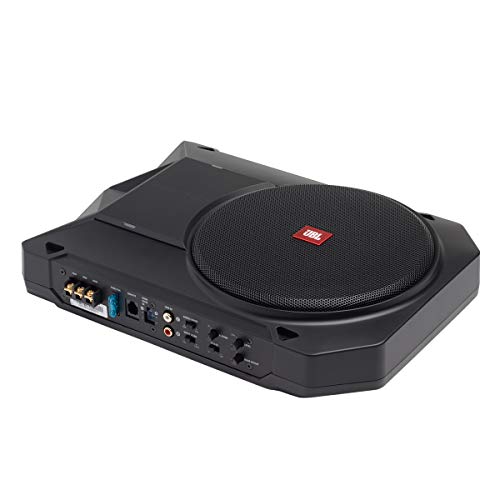
The JBL Basspro SL2 earns its position on this list primarily through its extraordinary slim profile: at just 2 13/16 inches tall, this unit fits under seats that would reject every other subwoofer on this page. The dimensions — 13 9/16 inches long by 9 7/8 inches wide — cover a generous footprint, but the 2.8-inch height makes it the logical choice for compact cars, sports vehicles, and any application where vertical clearance under the seat is severely limited. JBL rates output at 125W RMS with a 0 dB to +9 dB bass boost at 70 Hz, and the frequency response of 35 Hz to 120 Hz confirms genuine low-extension capability rather than the padded specifications some competitors publish.
JBL's engineering heritage in professional and consumer audio informs the Basspro SL2's tuning — the enclosure and driver combination favors accuracy and musicality over exaggerated boom, consistent with the brand's overall audio philosophy. The unit includes both RCA and speaker-level inputs, a variable low-pass crossover, and automatic signal-sensing turn-on, so installation involves no vehicle-specific complications. For buyers in vehicles with under-seat heights below three inches — a category that eliminates most competitors — the Basspro SL2 is not just the best choice, it is often the only viable choice on this entire list.
Pros:
Cons:
The Kenwood KSC-SW11 delivers a compelling value proposition: a cast aluminum enclosed subwoofer with a built-in 150W amplifier, measuring just 11 inches long, 7.5 inches wide, and 2.75 inches tall — compact enough to install under a seat, behind a seat, in a truck's rear bench storage area, or in an SUV's rear hatch without occupying meaningful cargo space. The 8 1/4 x 5 1/8-inch driver configuration within the enclosure produces a 32 Hz to 120 Hz frequency response that covers the full range of low-frequency content in modern music, from deep electronic sub-bass to midbass guitar body resonance that adds warmth to a system's overall presentation.
Kenwood includes both RCA and speaker-level inputs, an auto-sensing preamp input, and a variable crossover that lets you dial in the integration point with your existing speakers. The cast aluminum enclosure is the most significant build quality differentiator at this price tier — aluminum is stiffer, more thermally conductive, and better at damping resonance than the plastic or stamped steel enclosures found on cheaper alternatives, and those properties directly affect bass clarity and long-term reliability. If your budget rules out the premium options on this list, the KSC-SW11 is the unit that does not feel like a compromise.
Pros:
Cons:
The Infinity Basslink SM2 distinguishes itself through a combination of engineering sophistication and practical feature set that positions it above the budget tier without reaching premium pricing. The 8-inch (200mm) woofer is designed specifically for shallow-profile enclosure use — a proprietary geometry that maximizes low-distortion cone excursion within the physical constraints of a slim ABS housing, delivering bass clarity that proprietary driver designs typically achieve and off-the-shelf drivers cannot. Infinity's Class D amplifier runs cool and draws minimal current from your vehicle's electrical system, two characteristics that matter significantly during extended listening sessions in warm weather or when your alternator is already managing a heavy electrical load.
The intelligent electronic architecture is where the Basslink SM2 earns its place at the top of the control-feature hierarchy on this list. High-pass filters and limiters protect the driver from overexcursion at high volume levels, which is the failure mode that destroys most compact subwoofers within a year of purchase. The included wired remote control integrates cleanly with most center console or dashboard mounting locations, giving you fingertip bass level adjustment without diverting your attention from the road. For buyers who prioritize driver protection, long-term reliability, and daily usability over raw peak wattage figures, the Basslink SM2 is the most thoughtfully engineered product in this 2026 lineup.
Pros:
Cons:
Before you evaluate any specification, measure the vertical clearance beneath your seat with the seat positioned at your normal driving height. Under-seat subwoofer heights on this list range from 2 13/16 inches (JBL Basspro SL2) to 3 1/8 inches (Kicker HS8), and a difference of a quarter inch determines whether a unit installs cleanly or contacts the seat frame when you adjust position. Width and length matter too — verify that the footprint clears seat mounting rail hardware, which occupies floor space along both sides of the seat base in most modern vehicles. Manufacturers publish nominal dimensions, but real-world installation often requires an additional half-inch of clearance on all sides for wiring and ventilation.
Every under-seat subwoofer on the market publishes two power figures: RMS (root mean square, the continuous sustained output) and peak (the momentary maximum). RMS is the number that matters for everyday use, system integration, and long-term reliability — peak figures are marketing constructs that reflect a brief burst the amplifier cannot sustain without distortion or thermal shutdown. When comparing products, look exclusively at RMS ratings: the Kicker HS8 at 150W RMS, the Alpine PWE-S8 at 120W RMS, and the JBL Basspro SL2 at 125W RMS are directly comparable figures, while peak ratings that are double or triple these numbers tell you nothing useful about real-world performance.
Your head unit's output type determines which input on a subwoofer you will use, and verifying compatibility before purchase prevents the frustration of receiving a product you cannot connect to your existing system. Factory head units output speaker-level signals only — no RCA jacks — so you need a subwoofer with high-level (speaker-level) inputs, which all seven products on this list provide. Aftermarket head units typically include RCA preamp outputs, which connect directly to the subwoofer's line-level RCA inputs for a cleaner, lower-noise signal path. Several units on this list offer auto turn-on via signal sensing or DC offset detection, which eliminates the need to run a remote turn-on wire from your head unit — a meaningful installation simplification for factory radio applications.
A properly adjusted low-pass crossover is what separates a subwoofer that sounds integrated from one that sounds like a separate, disconnected bass source bolted onto your audio system. The crossover determines the highest frequency the subwoofer reproduces — setting it too high creates overlap with your door speakers and produces boomy, indistinct bass, while setting it too low creates a gap in the frequency response that sounds hollow and thin. Most factory speaker systems start rolling off below 80 Hz, so a crossover set between 80 and 100 Hz is a reasonable starting point for most vehicles. Pioneer's TS-WX010A offers the widest adjustable crossover range on this list (50–125 Hz), giving you the most flexibility to tune the integration point to your specific speaker system.
For most daily listening applications in passenger vehicles, 100 to 150 watts RMS delivers more than adequate bass presence without straining your vehicle's electrical system. Units at 120–150W RMS — including the Kicker HS8, Alpine PWE-S8, and JBL Basspro SL2 — perform well for genres from hip-hop to classical. Higher wattage becomes relevant only if you are regularly listening at near-maximum volume or if your vehicle's cabin is particularly large, such as a full-size truck or three-row SUV.
No. Every subwoofer on this list is self-amplified — the amplifier is built into the enclosure, so you connect it directly to your head unit's speaker-level or RCA outputs without purchasing or installing a separate amplifier. This all-in-one design is the defining characteristic of the powered under-seat subwoofer category, and it is the primary reason these units install significantly faster than traditional component subwoofer and amplifier combinations.
Yes, for the vast majority of vehicles and head unit combinations. Installation involves running a power wire from the battery, grounding the unit to the vehicle chassis, connecting the signal input from your head unit or door speakers, and optionally routing a remote turn-on wire. Most buyers with basic automotive knowledge complete the installation in one to two hours. Vehicles with complex factory audio systems — including Bose, Harman Kardon, or manufacturer-specific amplified setups — may require additional adapters or professional assessment to avoid signal issues.
The KICKER 46HS10 is the strongest recommendation for trucks, because full-size truck cab designs offer rear seat areas with sufficient under-bench depth to accommodate the 10-inch driver, and truck cabins benefit from the additional cone area and output the HS10 provides. The included wired remote control makes bass level adjustment accessible from the driver's seat without reaching behind the center console, which is a practical advantage in large-cab applications. The Kenwood KSC-SW11's compact footprint makes it a strong alternative if your truck has a more compact extended-cab configuration.
An under-seat powered subwoofer trades some maximum output capability and low-frequency extension for a dramatically simpler installation process and no loss of cargo space. Trunk-mounted systems using larger enclosures and higher-powered separate amplifiers produce objectively more bass output and reach lower frequencies, but they require more wiring, more installation time, and permanently occupy trunk or cargo area. For most casual listeners upgrading a factory system, an under-seat unit delivers 80 to 90 percent of the listening satisfaction for 20 percent of the installation complexity.
A properly installed under-seat subwoofer with an auto turn-on circuit draws zero current when the vehicle is off, because the amplifier shuts down automatically when it detects no signal or no ignition power. During normal operation, these units draw between 10 and 20 amperes at typical listening levels, which is well within the margin that a healthy alternator manages without impact on battery charge state. The Infinity Basslink SM2's Class D amplifier is notably efficient in this regard, drawing minimal current even at elevated output levels, making it a strong choice for vehicles with smaller alternators or multiple electrical accessories.
 |
 |
 |
 |

About Joshua Thomas
Joshua Thomas holds a Bachelor of Science in Mechanical Engineering from San Diego State University and has spent years applying that technical foundation to hands-on automotive work — from routine maintenance to full mechanical repairs. He founded CarCareTotal in 2017 to give car owners the kind of clear, practical guidance that helps them understand what is happening under the hood and make smarter decisions about upkeep and repairs. At CarCareTotal, he oversees editorial direction and covers automotive fundamentals, maintenance guides, and troubleshooting resources for everyday drivers.
Get some FREE car parts & gear.. Or check out the latest free automotive manuals and build guides here.
Disable your ad blocker to unlock all the hidden deals. Hit the button below 🚗
| | | |
