Audio ›
by Rachel Park
You're cruising down the highway, your factory stereo doing its best, but something is missing — that chest-thumping, seat-vibrating bass that makes your favorite playlist come alive. You start searching online and quickly discover that adding a powered subwoofer is the fastest, cleanest way to transform your car's audio without rewiring the entire system. The challenge is sorting through dozens of options to find the one that actually fits your vehicle, your music taste, and your budget.
A powered subwoofer — sometimes called an amplified or active subwoofer — combines the driver, enclosure, and amplifier into a single self-contained unit, which eliminates the guesswork of matching separate components. Whether you drive a compact sedan, a full-size truck, or an electric vehicle with limited power draw, there is a purpose-built solution on this list designed specifically for your situation. The car audio category has exploded with innovation in 2026, and today's powered subs deliver performance levels that would have required professional installations just a few years ago.
Our team evaluated these seven powered subwoofers across dimensions including power output, enclosure design, installation simplicity, and real-world bass reproduction — from tight, accurate lows to room-filling, wall-rattling pressure. Below you will find our definitive picks for every use case, a detailed buying guide, and honest answers to the questions we hear most often from buyers.

Contents








The Rockford Fosgate Punch P300-12 earns its place at the top of this list by delivering a complete, professional-grade audio upgrade in a single self-contained package. The 12-inch Punch subwoofer sits inside a custom-tuned sealed enclosure powered by a dedicated 300-watt amplifier, and the result is deep, accurate bass that reproduces everything from hip-hop kick drums to cinema-quality low-frequency effects with equal authority. Running signal, power, and ground is genuinely all you need — there is no amplifier to mount, no separate enclosure to bolt down, and no crossover settings to manually calculate, which makes this an achievable weekend installation even for first-timers.
The built-in 12dB/octave low-pass crossover gives you precise control over which frequencies reach the driver, and the adjustable bass EQ lets you dial in extra punch or smooth, natural reinforcement depending on your preference. The 0°/180° phase switch is particularly useful when integrating this sub with factory speakers that may be slightly out of alignment with the subwoofer signal timing, and the included remote bass level control means you can adjust the impact from the driver's seat without reaching into the trunk. The wedge-shaped enclosure (15" H × 19.8" W × 11"/7" D) fits snugly against the rear cabin wall of most mid-size sedans and SUVs, sitting flat so it does not eat into usable cargo space.
In terms of real-world performance, the P300-12 produces the kind of low-end extension that smaller 8-inch units simply cannot match — you feel 35-40Hz content as physical pressure rather than just hearing it as sound. The sealed enclosure design prioritizes accuracy and transient response over sheer loudness, so your bass sounds tight and musical rather than boomy and one-note. If you want the definitive single-box solution and your trunk can accommodate the footprint, this Rockford Fosgate is the benchmark in 2026.
Pros:
Cons:
Alpine built the PWE-S8 specifically for drivers who want meaningful bass improvement without surrendering a single cubic inch of usable interior space, and the execution here is impressive by any standard. The 8-inch high-excursion cone driver produces 120 watts RMS — peaking at 240 watts — from an enclosure designed to slide under the front seat of most vehicles, keeping your entire rear seat usable and your trunk completely free. Alpine's reputation for audio engineering excellence is well-earned, and this unit benefits from years of compact subwoofer refinement that competitors simply cannot match with first-generation products.
The high-excursion cone design compensates for the smaller driver diameter by increasing pistonic travel, which allows the PWE-S8 to produce lower frequencies at higher SPL levels than a standard 8-inch driver in the same enclosure would achieve. You connect it via speaker-level or RCA inputs depending on your head unit configuration, and Alpine includes the necessary cabling to make either connection method straightforward. The low-profile enclosure sits flat beneath the seat, and the amplifier section's compact Class-D design runs efficiently with minimal heat generation even during extended listening sessions — an important consideration when airflow beneath a seat is limited.
If you drive a compact car, a two-door coupe, or simply value interior flexibility over maximum bass output, the Alpine PWE-S8 is the right answer. It adds genuine low-frequency depth to your audio system — you will notice bass lines and kick drums that your factory speakers were simply rolling off — without any visible or practical intrusion into your daily driving experience. Pair it with an upgraded head unit and component speakers for a complete audio overhaul that costs far less than aftermarket dealer installations.
Pros:
Cons:
The Kenwood KSC-SW11 takes the under-seat subwoofer concept to its logical extreme, packaging an 8.25" × 5.125" driver with a 150-watt built-in amplifier inside a cast aluminum enclosure that measures just 11" × 7.5" × 2.75" — thin enough to disappear beneath a seat in virtually any vehicle configuration. The cast aluminum housing is not an aesthetic choice — it conducts heat efficiently away from the amplifier section, which means the KSC-SW11 runs cooler under sustained heavy use compared to plastic-encased competitors, and it also adds structural rigidity that prevents the enclosure from resonating at high output levels.
Auto-sensing input detection is one of the standout convenience features here — the unit automatically switches between its RCA preamp-level inputs and speaker-level inputs depending on which signal it detects, so you do not need to manually configure the input mode or fumble with jumpers during installation. The 32Hz–120Hz frequency response covers the full useful range of subwoofer operation, and the 150-watt amplifier has more than sufficient headroom to drive the driver to satisfying output levels without audible compression or distortion. The frequency range is particularly notable at the low end, as 32Hz reaches into the deepest sub-bass territory that most car audio enthusiasts listen to.
Kenwood's KSC-SW11 represents the ideal solution for truck owners who need bass under the rear seat, sedan drivers who want trunk space for luggage, or SUV owners who cannot sacrifice cargo capacity for a full-size enclosure. If you have compared this product category to other vehicle upgrades — such as the best HID headlights of 2026 that transform visibility without major modifications — the KSC-SW11 delivers a comparable "maximum impact, minimum intrusion" philosophy applied to audio.
Pros:
Cons:
The BOSS Audio Systems BAB10 leads with a 1200-watt maximum power figure that draws immediate attention, and while you should always apply appropriate skepticism to peak wattage claims from budget-tier manufacturers, the BAB10's real-world performance at its actual RMS output level is genuinely competitive for the price point it occupies. The 10-inch subwoofer sits in a low-profile sealed enclosure that fits in trunk spaces where a full-size wedge box would not, and the pulse-width modulated amplifier design delivers the specified power output with better efficiency and lower heat generation than older linear amplifier topologies.
The variable low-pass filter is the most useful tuning tool on the BAB10, allowing you to set the cutoff frequency so that only the lowest frequencies reach the subwoofer while your door speakers handle midrange content cleanly — this crossover function is essential for achieving a coherent, integrated soundstage rather than the disconnected bass-blob effect that poorly tuned subwoofers produce. BOSS includes a remote subwoofer control, which you can mount within arm's reach of the driver's position to adjust bass level on the fly, adapting the output between bass-heavy genres and vocal-forward content without pulling over. The physical dimensions of the BAB10 make it genuinely viable in vehicles with limited cargo compartments.
This is the honest recommendation for budget-conscious buyers: the BAB10 delivers real bass improvement at a price point that makes sense for older vehicles, secondary cars, or first-time subwoofer installations where you want to experience the impact of added low-end before committing to a premium system. It is not the last subwoofer you will ever buy, but it is a very capable first one, and the low-profile enclosure design means you can upgrade the internal driver later without replacing the entire system if you choose to build on it.
Pros:
Cons:
MTX Audio's RT8PT takes a fundamentally different approach to enclosure design by housing the 8-inch subwoofer in a cylindrical tube enclosure rather than the rectangular boxes that dominate this category, and the acoustic consequences of that choice are audible — the vented tube design produces noticeably louder bass output at equivalent power levels compared to sealed rectangular alternatives because the port extends the low-frequency response and recovers energy that a sealed enclosure would simply absorb as heat. At 240 watts peak and 120 watts RMS, the RT8PT matches the Alpine PWE-S8 on paper but sounds meaningfully louder in practice due to the ported design's efficiency advantage.
The construction quality stands out immediately when you handle the RT8PT — the butyl rubber surround on the driver is the same material used in audiophile-grade home subwoofers, offering superior flexibility, durability, and resistance to temperature extremes compared to foam surrounds that degrade over time. The aviation-grade carpet covering the enclosure is not just aesthetic; it resists scuffs, stains, and abrasion far better than standard trunk carpet material, which matters when you are sliding this unit in and out of a cargo space repeatedly. RCA connectivity makes the input hookup clean and simple from any head unit with a dedicated subwoofer output.
The external bass control included with the RT8PT is a genuine differentiator at this price level, allowing real-time adjustment of the subwoofer level to suit different music genres and listening scenarios. Truck owners who store the RT8PT behind the rear seat will particularly appreciate being able to boost the bass when the road gets loud on the highway and bring it back down for quieter listening environments. If your priority is maximum bass output from a compact package rather than the subtlest possible installation, this MTX delivers impressive results for its size and price.
Pros:
Cons:
Pioneer designed the TS-WX140DA with a specific challenge in mind — electric vehicle owners who want enhanced bass without compromising their driving range — and the engineering decisions behind this product reflect a genuine understanding of that constraint. The 170-watt Class-D amplifier draws only 4.3 amps at maximum output, which is dramatically less current consumption than comparably powerful subwoofers using conventional amplifier designs, and in an EV where every amp-hour of battery capacity matters, that efficiency difference translates directly into preserved driving range. The 8" × 5.25" driver's oval geometry allows the enclosure to maintain a low profile while still moving meaningful air volume.
The three selectable listening modes — Deep, Dynamic, and Natural — represent a thoughtful feature implementation rather than a marketing gimmick, because electric vehicles have fundamentally different acoustic environments than gasoline-powered cars. Without engine noise masking low-frequency content, an EV cabin is exceptionally quiet, which means bass that sounds appropriate in a loud ICE vehicle can feel overwhelming and boomy in an EV's near-silent interior. The Natural mode tunes the output to sound balanced in quiet environments, Dynamic mode adds impact for bass-heavy listening, and Deep mode extends the low-frequency roll-off for bass enthusiasts who want maximum extension. This is real acoustic engineering applied to a modern problem.
EV owners shopping for audio upgrades in 2026 face a unique set of considerations compared to traditional car audio buyers, similar to how EV owners must think carefully about charging infrastructure — a comparison that echoes the considerations outlined in our guide to the best Level 2 EV chargers for home use. The Pioneer TS-WX140DA is the answer specifically tuned to your vehicle type, and it performs equally well in gasoline vehicles where its space efficiency and listening mode flexibility remain genuinely useful features for any driver.
Pros:
Cons:
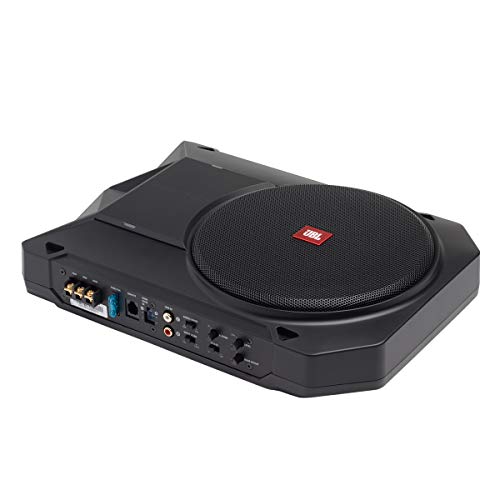
JBL's Basspro SL2 brings the engineering credibility of one of audio's most recognized professional brands to the under-seat powered subwoofer category, and the difference between this product and similarly dimensioned alternatives is immediately apparent in the bass quality — specifically the level of control and articulation that the JBL-tuned driver and amplifier system achieves within such a constrained physical package. At 125 watts RMS with a bass boost capability of 0dB to +9dB centered at 70Hz, the Basspro SL2 gives you both the baseline output to reinforce your door speakers and the tuning range to sculpt the bass character to your preference, all from an enclosure measuring 13.5" × 9.875" × 2.8125".
The 35Hz–120Hz frequency response is exceptionally wide for a unit of this size, with the 35Hz lower bound reaching into the range where bass guitar fundamental notes and electronic music sub-bass tones live — the content that entry-level subwoofers from lesser brands simply cannot reproduce at any meaningful volume. JBL's Slip-Stream port technology, inherited from their professional speaker division, optimizes airflow through the enclosure's vent structure to extend bass output and reduce port noise that often plagues low-profile ported designs at high output levels. The installation footprint fits beneath front seats in the vast majority of vehicles produced in 2026 without blocking legroom adjustment.
When you are evaluating the JBL Basspro SL2 against alternatives in this size class, the brand pedigree matters in a concrete way — JBL's acoustic engineering history spanning professional concert systems and studio monitors translates into superior driver tuning and enclosure design at the consumer product level. If you have upgraded other aspects of your vehicle's performance and appearance — the way savvy car owners approach everything from their car lift setup to their audio system — the Basspro SL2 represents the caliber of investment that delivers returns every time you start the engine.
Pros:
Cons:
The subwoofer driver diameter is the single most significant factor in determining how low and how loud your system can play. Larger drivers — 10 and 12 inches — move more air per cycle, which translates directly into deeper, more powerful low-frequency reproduction. However, larger drivers require larger enclosures, so your available installation space must inform this decision before anything else does. Measure your trunk, under-seat clearance, or cargo area accurately before selecting a driver size, and account for the full enclosure dimensions rather than just the driver diameter.
Enclosure type matters almost as much as driver size. Sealed enclosures produce tighter, more accurate bass with better transient response — you hear a kick drum strike as a precise event rather than a bloom of low frequencies. Ported (vented) enclosures trade some accuracy for louder output, particularly in the midbass range, which appeals to listeners who prioritize impact and volume over precision. The tube enclosure used by the MTX RT8PT is a variation of ported design that offers excellent efficiency in a cylindrical form factor. Understanding which bass character you prefer guides your enclosure choice as much as your vehicle's physical constraints do.
RMS wattage is the only power specification that matters when comparing powered subwoofers — it represents the continuous power output the amplifier can sustain indefinitely without distortion or thermal shutdown. Peak wattage figures, which appear prominently in marketing materials particularly from budget brands, describe instantaneous transient capacity that exists for milliseconds under ideal conditions and tells you essentially nothing about real-world performance. When you see a subwoofer rated at 1200 watts peak, understand that the RMS figure — which manufacturers often omit or bury — is usually 20 to 25 percent of that number.
For reference: 80–120 watts RMS produces noticeable, satisfying bass reinforcement in a compact vehicle; 150–300 watts RMS delivers powerful, room-filling output that you feel physically; anything beyond 300 watts RMS is genuinely loud and suited to large SUVs, trucks, or enthusiasts who attend sound pressure level competitions. Match your amplifier's RMS output to your listening environment and volume preferences rather than chasing the largest peak wattage figure available at your price point.
Powered subwoofers accept signal via two primary input methods — RCA line-level inputs connected to your head unit's dedicated subwoofer output, or speaker-level inputs that tap into your existing speaker wiring without requiring any head unit modification. If your head unit includes a dedicated subwoofer output or a dedicated RCA preamp output, use the RCA connection for the cleanest, lowest-noise signal path. If you are working with a factory head unit that lacks RCA outputs, speaker-level inputs allow you to connect the subwoofer to an existing speaker pair, with the subwoofer's internal circuitry extracting and amplifying the bass content.
Beyond the signal connection, all powered subwoofers require a direct 12-volt power connection from the battery, a ground connection to the vehicle chassis, and a remote turn-on wire that activates the amplifier only when the head unit is operating — preventing battery drain when the vehicle is parked. The remote turn-on wire typically comes from the head unit's remote output, or you can tap it from any switched 12-volt accessory circuit in the fuse box. Most vehicles can accommodate these connections in an afternoon with basic hand tools, and the kits from all seven subwoofers on this list include the necessary hardware to complete a clean installation.
The baseline controls present on any well-designed powered subwoofer — a variable low-pass crossover, a gain (input level) control, and a subsonic filter — represent the minimum tuning capability you should accept regardless of budget. The low-pass crossover sets the upper frequency limit for the subwoofer, typically adjustable from 40Hz to 120Hz, allowing you to create a smooth handoff between the subwoofer and your door speakers without a gap or an overlap in the frequency response. The gain control matches the subwoofer's sensitivity to your head unit's output voltage, preventing distortion from mismatched levels.
Premium features worth paying for include a phase switch — which allows you to align the subwoofer's output timing with your door speakers, eliminating cancellation that occurs when drivers are acoustically out of phase — and a remote bass level control that mounts within reach of the driver's seat. The phase switch is genuinely useful rather than a feature-list checkbox, particularly in vehicles where the subwoofer is in the trunk while door speakers are mounted several feet forward. A remote level control transforms your subwoofer from a fixed-output device into a dynamic tool you adjust in real time based on the music and your environment.
A powered (active) subwoofer contains a built-in amplifier integrated into the same enclosure as the driver, requiring only power, ground, and signal connections for complete operation. A passive subwoofer is just the driver in an enclosure — it requires a separate external amplifier to function. Powered subwoofers are simpler to install and tune, while passive setups offer more flexibility to swap components and upgrade amplifier or driver independently. For most car audio enthusiasts who want genuine bass improvement without a major system build, powered subwoofers are the practical choice in 2026.
A properly wired powered subwoofer will not drain your battery, because the remote turn-on wire connects the amplifier's power circuit to a switched 12-volt source that activates only when the ignition and head unit are on. When the vehicle is parked and the ignition is off, the subwoofer draws zero current from the battery. The only scenario where battery drain occurs is incorrect wiring — if you connect the remote turn-on wire to a constant 12-volt source rather than a switched one, the amplifier runs continuously. Follow the wiring diagram included with your specific unit and use the remote output from your head unit as the trigger source.
The decision comes down to installation space, bass character preference, and vehicle type. An 8-inch subwoofer fits under seats and in small cargo areas, produces faster transient response, and integrates well with door speakers in compact vehicles — but it physically cannot produce the same low-frequency extension or SPL output as a 12-inch driver at equivalent power. A 12-inch subwoofer requires more enclosure volume, typically mandating trunk or cargo area installation, but rewards you with deeper bass extension and significantly more output capability. If your vehicle gives you the space, the 12-inch produces a qualitatively different listening experience; if space is genuinely limited, a premium 8-inch like the Alpine PWE-S8 or JBL Basspro SL2 is the correct compromise.
The vast majority of powered subwoofers on this list are designed for DIY installation by anyone with basic automotive electrical knowledge and a set of hand tools. The wiring process — running power from the battery through a fuse holder, grounding to the chassis, connecting signal via RCA or speaker-level inputs, and running the remote turn-on wire — is straightforward and well-documented in the included installation manuals. Professional installation becomes worthwhile when you are building a more complex system with multiple amplifiers and speakers, or when you want the wiring concealed inside door panels and beneath carpet for a truly clean appearance. For a single powered subwoofer installation in a trunk or under a seat, a confident DIY approach saves installation labor costs without meaningful risk.
RMS (Root Mean Square) wattage represents the continuous power output that an amplifier can deliver indefinitely under real-world operating conditions without distortion or thermal damage. Peak wattage describes the maximum instantaneous power the amplifier can produce for brief transient events measured in milliseconds — a figure that is largely meaningless for evaluating real-world performance or for comparing products across brands. When you compare a 120-watt RMS unit to a "1200-watt peak" unit, the actual sustained output capability may be identical or the nominally lower-rated unit may actually outperform the other. Always compare RMS figures when evaluating powered subwoofers, and regard any product that omits its RMS rating with significant skepticism.
Yes — all seven subwoofers on this list include speaker-level inputs designed specifically for compatibility with factory head units that lack RCA preamp outputs. You connect the speaker-level inputs to your existing rear speaker wiring, and the subwoofer's internal circuitry detects and amplifies the low-frequency content from that signal. The result is meaningful bass improvement without any modification to the factory head unit. For the cleanest possible signal path and the lowest noise floor, upgrading to an aftermarket head unit with dedicated RCA outputs is the preferred approach — but it is not a prerequisite, and factory-equipped vehicles drive all of these powered subwoofers effectively through speaker-level connections.
The best powered subwoofer is the one that fits your space, matches your listening style, and makes every drive feel like a private concert — and in 2026, there has never been a better time to find exactly that.
 |
 |
 |
 |

About Rachel Park
Rachel Park specializes in the interior and exterior upgrades that meaningfully change how a car looks, sounds, and feels on a daily basis. She has hands-on experience with head unit installations and audio system builds, LED and HID lighting conversions, interior refresh projects, and cosmetic exterior work — evaluated from both a DIY accessibility and quality-of-result perspective. At CarCareTotal, she covers car audio and electronics, lighting upgrades, and interior and exterior styling accessories.
Get some FREE car parts & gear.. Or check out the latest free automotive manuals and build guides here.
Disable your ad blocker to unlock all the hidden deals. Hit the button below 🚗
| | | |
