by Sarah Whitfield
The average car starter replacement runs between $350 and $650 when you factor in both parts and labor — yet the starter motor itself accounts for less than half that total on most vehicles. Understanding how much does a car starter cost requires breaking down the variables: vehicle make, OEM versus aftermarket sourcing, labor rates in your region, and whether you're tackling the job yourself. If you've already dealt with car battery replacement costs, you know that electrical component pricing varies wildly depending on the platform. A starter failure leaves you stranded with zero warning signs in many cases, making it one of those repairs you need to budget for proactively.
Starter motors are permanent-magnet or gear-reduction DC motors that engage a pinion gear with the engine's flywheel ring gear. When the solenoid activates, it bridges high-amperage current from the battery to the motor windings while simultaneously pushing the pinion into mesh. That mechanical simplicity is deceptive — modern starters are integrated into tight engine bays with limited access, which is where labor costs balloon. Transverse-mounted V6 engines in front-wheel-drive platforms are notorious for burying the starter beneath intake manifolds or exhaust components.
Your total out-of-pocket depends on decisions you make before the wrench turns. Here's a complete breakdown of pricing, tools, and strategy to help you handle this repair intelligently.
Contents
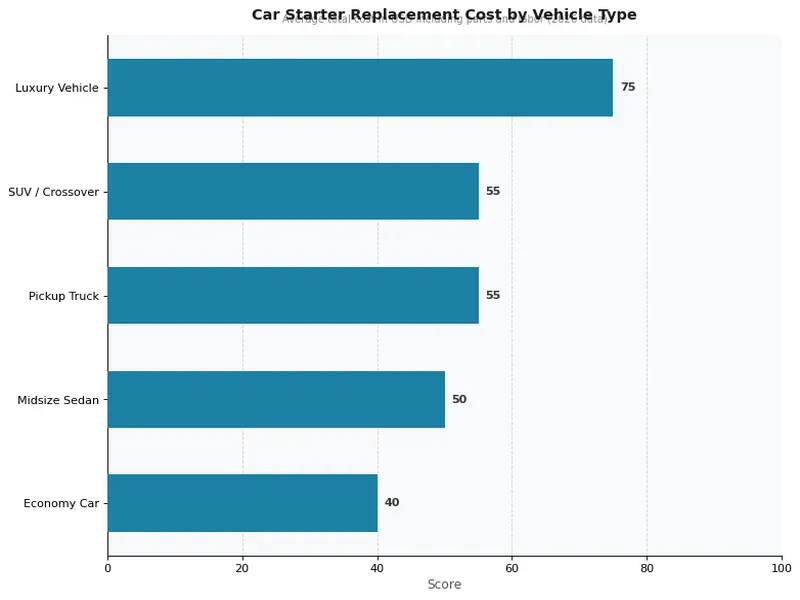
How much does a car starter cost depends heavily on what you drive. Economy sedans with inline-four engines use compact gear-reduction starters that retail for $80–$150 aftermarket. Full-size trucks with V8 powertrains require higher-torque units that push $150–$300 for the part alone. European luxury vehicles — BMW, Mercedes, Audi — routinely hit $250–$450 for OEM starters due to proprietary designs and tighter engineering tolerances.
| Vehicle Category | Parts Cost | Labor Cost | Total Estimate |
|---|---|---|---|
| Economy Sedan (Civic, Corolla) | $80–$150 | $100–$200 | $180–$350 |
| Midsize Sedan (Camry, Accord) | $100–$200 | $150–$250 | $250–$450 |
| Full-Size Truck (F-150, Silverado) | $150–$300 | $150–$300 | $300–$600 |
| Luxury/European (BMW, Mercedes) | $250–$450 | $250–$500 | $500–$950 |
| SUV/Crossover (RAV4, Explorer) | $120–$250 | $150–$300 | $270–$550 |
| Diesel Truck (Cummins, Duramax) | $200–$400 | $200–$400 | $400–$800 |
OEM starters from a dealership parts counter carry a 40–100% premium over aftermarket equivalents. A Denso OEM starter for a Toyota Tacoma lists around $280 at the dealer; the same Denso unit through an independent parts supplier runs $170–$200. Aftermarket brands like TYC, DB Electrical, and ACDelco (GM's aftermarket line) offer functional equivalents at further discounts, typically $80–$160 for the same application. Core charges — refundable deposits on the old unit — add $15–$50 to the transaction price.
Independent shops charge $80–$130 per hour in most U.S. markets. Dealerships run $130–$200 per hour. Starter replacement is typically billed at 1.0–2.5 hours depending on accessibility. A top-mounted starter on an inline-four with rear-wheel drive (like older Crown Victorias) is a 45-minute job. A starter buried under the intake manifold on a transverse V6 (like a 2008 Buick Enclave) is a 3-hour ordeal requiring manifold removal. Your geographic location matters too — shops in Manhattan and San Francisco bill 30–50% above national averages.
Starter motors are engineered for intermittent duty — brief high-current bursts followed by long rest periods. The typical starter motor is rated for 40,000–80,000 cycles over its service life. Most passenger vehicles accumulate 75,000–150,000 miles before the starter demands replacement, though driving patterns influence that range significantly.
Starters mounted near exhaust manifolds absorb radiant heat that degrades solenoid contact plates and brush insulation. Repeated thermal expansion and contraction fatigues solder joints inside the solenoid. Short-trip driving compounds this — you're cycling the starter multiple times daily without giving the motor adequate cool-down periods between engagements. Vehicles in stop-start urban traffic wear starters at roughly twice the rate of highway-dominant drivers.
If your starter cranks slowly on hot restarts but works fine cold, the solenoid contacts are likely pitted — replacement is imminent, not optional.
A weak battery forces the starter to draw harder against reduced voltage, generating excess heat in the armature windings. Corroded battery terminals introduce resistance that mimics a low-voltage condition. If you've recently dealt with battery amperage issues, check whether that period of underperformance shortened your starter's remaining life. Parasitic draws that slowly drain the battery overnight create chronic low-voltage starting conditions that accumulate damage over months.
The cost delta between DIY and shop installation is substantial — $200–$500 in saved labor on most vehicles. But the difficulty curve varies enormously across platforms, and an honest assessment of your skill level prevents costly mistakes.
Top-mounted starters on rear-wheel-drive vehicles with longitudinal engines are entry-level repairs. Trucks like the Chevy Silverado 5.3L and Ford F-150 5.0L have starters accessible from underneath with a jack and two stands. The job requires disconnecting the battery, removing two mounting bolts, and detaching the solenoid wiring harness. Total wrench time for a competent DIYer: 30–60 minutes. Your parts-only cost on these platforms runs $120–$200, saving $200–$350 versus shop pricing.
Front-wheel-drive vehicles with transverse V6 engines frequently bury the starter between the engine and firewall, underneath the intake manifold. The 3.5L Ford Edge, 3.6L Chevy Traverse, and Honda Odyssey J35 are notorious examples. These jobs require intake manifold removal, coolant line disconnection, and careful reassembly with new gaskets. Attempting this without a proper torque wrench and gasket set risks vacuum leaks, coolant leaks, or snapped bolts in aluminum heads. Pay the shop rate. If your vehicle has a bad ignition switch rather than a failed starter, you'll save money by diagnosing correctly before committing to either repair.
A starter swap is one of the more tool-accessible repairs on most platforms, but you need the right equipment staged before you begin. Working underneath a vehicle with inadequate support is the single most dangerous DIY mistake in automotive repair.
Swivel sockets and wobble extensions earn their cost on starter jobs where bolt access is limited to 15–20 degrees of ratchet swing. A magnetic pickup tool retrieves dropped bolts from bellhousing crevices — starters live in gravity-hostile locations. For vehicles requiring intake manifold removal, you need a calibrated torque wrench, new intake gaskets (never reuse), and fresh coolant. Budget $30–$60 for these consumables beyond the starter itself.
Over a 200,000-mile ownership span, most vehicles need one starter replacement. High-mileage commuter cars in urban environments may need two. Building this into your maintenance and troubleshooting budget prevents emergency repair sticker shock.
Factory powertrain warranties typically cover the starter for 5 years or 60,000 miles. Extended service contracts from third-party providers vary widely — some exclude "electrical components" by default, which may or may not include the starter depending on contract language. Read the exclusions list, not the coverage summary. Aftermarket starters from major brands carry 1–3 year warranties with unlimited mileage, making them a strong value proposition for vehicles past factory coverage.
Remanufactured starters account for roughly 60% of the replacement market. These units are disassembled, inspected, and rebuilt with new brushes, solenoid contacts, bearings, and bushings. Quality remanufacturers like Bosch, Remy (formerly Delco Remy), and WAI test every unit on a dynamometer before packaging. Pricing runs 30–50% below new-unit costs, making remanufactured starters the best cost-per-mile option for vehicles you plan to keep another 50,000–100,000 miles. Avoid no-name offshore rebuilds sold through marketplace vendors — failure rates on untested units run 5–10x higher than branded remanufactured products.
A dead battery produces dim dash lights and slow or no cranking. A failed starter typically presents with full electrical power — headlights bright, dash illuminated — but produces a single click or no engagement when you turn the key. Tap-testing the starter with a wrench while someone cranks the ignition can temporarily free stuck brushes, confirming the starter as the culprit.
Once the engine is running, the starter is completely disengaged and has no effect on drivability. The risk is that a failing starter will refuse to engage on your next start attempt, stranding you wherever you park. There is no "limp home" mode for a dead starter — you need a tow or a bump-start on manual transmission vehicles.
Solenoid-only replacement is possible on some older starters with externally mounted solenoids (common on Ford and GM platforms through the early 2000s). Modern integrated starters make solenoid-only repair impractical — labor to access the starter is identical either way, so installing a complete unit eliminates the risk of a second failure from worn brushes or bearings.
A quality replacement starter — OEM, branded aftermarket, or certified remanufactured — lasts 75,000–150,000 miles under normal driving conditions. Vehicles with start-stop systems use enhanced starters rated for 250,000+ cycles, but these units cost 2–3x more than conventional starters.
National auto parts chains do not perform starter installation. They offer free diagnostic testing (bringing the starter to the counter) and core exchange programs. Some locations maintain referral lists for local mobile mechanics who handle installation at reduced labor rates compared to brick-and-mortar shops.
The starter itself is rarely the expensive part — it's the labor to reach it that determines whether you're paying $200 or $800, so know your vehicle's layout before you commit to a repair plan.
 |
 |
 |
 |

About Sarah Whitfield
Sarah Whitfield spent ten years as an ASE-certified automotive technician before transitioning to full-time automotive writing, giving her a diagnostic skillset that goes well beyond what most reviewers bring to the subject. She specializes in OBD-II code analysis, electrical system troubleshooting, and the intermittent failure modes that frustrate owners and confound general mechanics. At CarCareTotal, she covers car troubleshooting guides, diagnostic tools, and repair resources for drivers dealing with warning lights, strange symptoms, and hard-to-diagnose problems.
Get some FREE car parts & gear.. Or check out the latest free automotive manuals and build guides here.
Disable your ad blocker to unlock all the hidden deals. Hit the button below 🚗
| | | |
