Car Care ›
by Diego Ramirez
How long does it take to buy a car — a few hours or a few weeks? The answer depends on preparation, financing method, and whether the purchase happens at a dealership, online, or through a private seller. Our team at CarCareTotal has researched every stage of the process, and the short answer is this: most people spend between 3 and 15 hours total, spread across several days or weeks. The full timeline, however, tells a more nuanced story.

According to the National Automobile Dealers Association, the average dealership visit for a purchase takes about 3 to 4 hours. But that figure only accounts for the in-person portion. The research, financing, and post-purchase steps add significant time. Knowing how old someone has to be to buy a car is just the beginning — understanding the full timeline prevents frustration and helps anyone walk into a dealership prepared.
Below, we break down each phase of the car-buying process, compare timelines across different purchase methods, and share strategies our team has found to cut total time significantly.
Contents
The car-buying process splits into three distinct phases: pre-purchase research, the transaction itself, and post-purchase tasks. Each phase carries its own time demands, and skipping any of them leads to problems.
Most people spend the majority of their car-buying time before ever stepping foot in a dealership. Our team's findings suggest this phase breaks down as follows:
The research phase is where first-time buyers and experienced buyers diverge most. Someone who already knows the make and model they want can compress this to a single weekend. Someone starting from scratch often needs two to three weeks.
The in-person dealership experience is where most people feel the time drag. Here is a breakdown of where those 3–4 hours go:
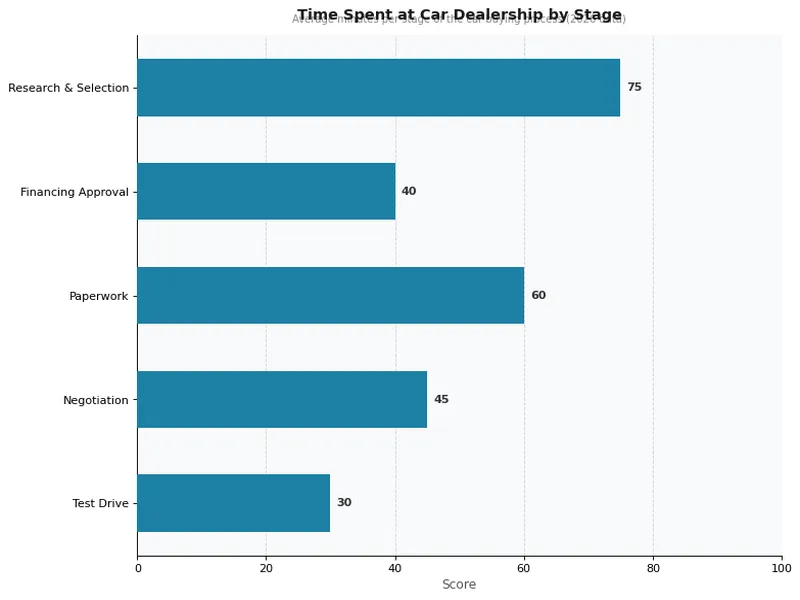
Pro Tip: Arriving at the dealership with pre-approved financing eliminates the credit approval wait entirely and gives leverage during price negotiation. Our team has seen this save 45 minutes to an hour.
Experience level is one of the biggest factors in how long the car-buying process takes. The gap between a first-time buyer and a seasoned car owner is substantial.
First-time buyers face challenges that add hours — sometimes days — to the process:
Anyone wondering about age-related requirements should also review how old someone has to be to test drive a car, since this affects when the shopping process can even begin.
Repeat buyers carry several advantages:
Our team estimates that experienced buyers complete the entire process — research through purchase — in roughly 60% of the time a first-timer needs.
Financing is the single biggest time variable in the car-buying process. The method chosen can add anywhere from zero extra time (cash purchase) to several weeks (subprime credit approval).
| Financing Method | Time to Complete | Best For |
|---|---|---|
| Cash purchase | 0 hours (no financing needed) | Anyone with savings ready |
| Bank/credit union pre-approval | 1–3 days before shopping | Buyers wanting the best rate |
| Dealer financing (good credit) | 30–60 minutes at dealership | Convenience seekers with 700+ score |
| Dealer financing (fair credit) | 1–3 hours at dealership | Buyers with 600–699 score |
| Dealer financing (poor credit) | 1–5 days (multi-lender submissions) | Buyers below 600 score |
| Online lender pre-approval | 15 minutes to 2 days | Comparison shoppers |
| Buy-here-pay-here lot | 1–2 hours total | Buyers with no credit options |
Pre-approval through a bank or credit union is the fastest path for most people. The application takes 15–30 minutes, approval arrives within 1–3 business days, and the buyer walks into the dealership with a firm budget and rate in hand.
Budget surprises create delays. These common overlooked expenses force people back to the drawing board mid-purchase:
Warning: Dealer documentation fees vary wildly by state. Some states cap them (California at $85), while others have no limit. Researching the local cap beforehand prevents sticker shock in the F&I office.
Understanding total ownership costs matters beyond the purchase day. For instance, knowing how much car batteries cost and factoring in routine maintenance helps anyone build a realistic long-term budget.
The purchase channel dramatically affects the total timeline. Here is how the three most common methods compare.
The traditional dealership route remains the most common and the most time-consuming:
Total dealership time: 2.5–5.5 hours. Most visits land around 3.5 hours. Knowing how much car salesmen make provides useful context — commission structures explain why negotiation takes as long as it does.
Online car-buying platforms (Carvana, Vroom, CarMax online) have compressed the timeline significantly:
Total active time: 1.5–4 hours. The trade-off is the delivery wait. Online buying is ideal for anyone who values less in-person pressure but does not need the car immediately.
Buying from a private seller offers potential savings but demands more legwork:
Total time: 8–20+ hours spread across 1–3 weeks. Private sales require the most effort but often yield the best prices on used vehicles.
Our team has identified the most effective strategies for cutting total car-buying time, whether at a dealership or elsewhere.
Pro Insight: Contacting the dealership's internet sales department — rather than walking onto the lot — typically results in faster, more transparent pricing. Internet sales managers often work on volume and move through deals more quickly than floor salespeople.
The purchase itself is not the finish line. Several tasks remain after driving off the lot, and they add meaningful time to the overall process.
The first week of owning a new (or new-to-the-owner) vehicle involves several important tasks that extend the total time investment:
When factoring in all post-purchase tasks, the true total time to buy a car and make it fully road-ready ranges from 15 to 40 hours for most people. The purchase itself is just the most visible part of a longer process.
 |
 |
 |
 |

About Diego Ramirez
Diego Ramirez has been wrenching on cars since his teenage years and has built a deep practical knowledge of automotive maintenance and paint protection through years of hands-on work. He specializes in fluid service intervals, preventive care routines, exterior protection products, and the consistent habits that extend a vehicle's lifespan well beyond average. At CarCareTotal, he covers car care guides, cleaning and detailing products, and exterior maintenance and protection reviews.
Get some FREE car parts & gear.. Or check out the latest free automotive manuals and build guides here.
Disable your ad blocker to unlock all the hidden deals. Hit the button below 🚗
| | | |
