Car Care ›
by Joshua Thomas
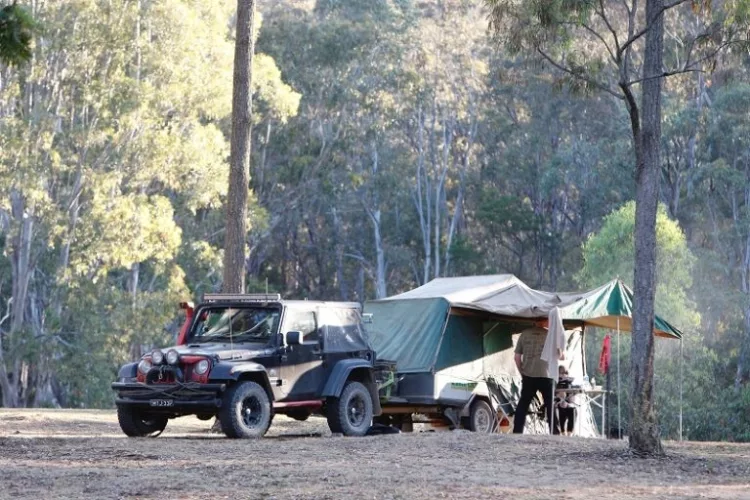
A buddy backed his JL Wrangler and a loaded cargo trailer down a boat ramp last summer and ended up completely sideways before the wheels reached water. He had loaded the trailer rear-heavy, skipped the tongue weight check entirely, and had no warning until the Wrangler started walking beneath the pull. Getting the right answer to how much can a Jeep Wrangler tow means understanding generation-by-generation differences, real-world limitations, and the towing discipline this platform demands before you ever hook up a trailer and leave the driveway.
Contents
The Wrangler's towing story spans four distinct generations — YJ, TJ, JK, and JL — plus the Gladiator pickup variant, and those five platforms deliver rated capacities ranging from 2,000 lbs all the way to 7,650 lbs. Which generation you're driving defines your ceiling before any other variable enters the calculation, and confusing those numbers is how owners end up in situations like the boat ramp story above.
The YJ (1987–1995) and TJ (1997–2006) share an identical 2,000-lb towing rating, which reflects their shorter wheelbase and the modest output ceiling of the 4.0L inline-six powering both generations. You can tow a small utility trailer, a personal watercraft, or a lightweight pop-up camper with either platform without issue, but anything heavier pushes you past the factory safety margin immediately. The cooling systems on these older units weren't engineered for sustained tow-load heat cycles, so you'll see the temperature gauge climbing when you push near 2,000 lbs on a warm day across any meaningful distance.
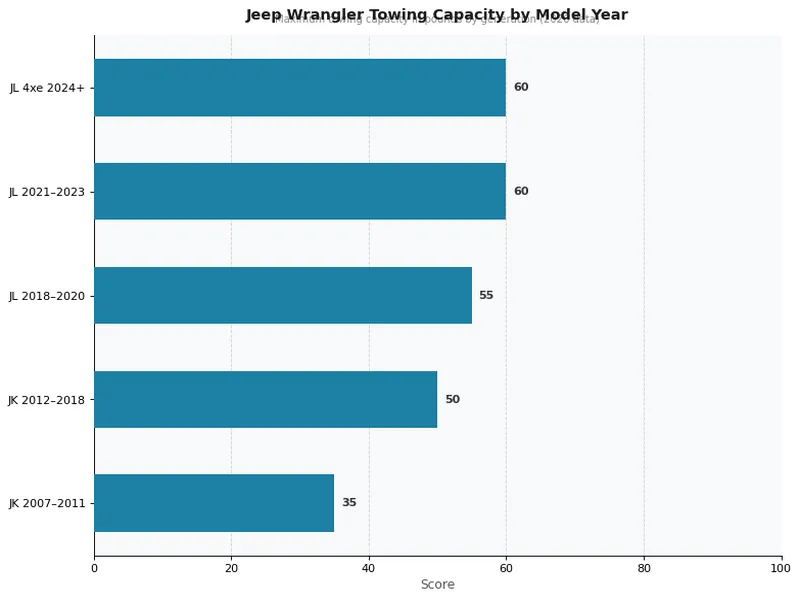
With the JK (2007–2018), Jeep raised the towing rating to 3,500 lbs across both the two-door and four-door Unlimited body styles, which opened up a meaningfully larger class of trailers for Wrangler owners who needed more real-world capacity. The early 3.8L V6 supports this rating technically, but the later 3.6L Pentastar V6 delivers substantially more pulling confidence at sustained highway grades where the 3.8L starts to feel breathless under load. The JK four-door Unlimited's longer wheelbase also reduces trailer sway sensitivity compared to the shorter two-door, making it the smarter tow platform when you operate regularly near the rated limit.
| YJ | 2000 lbs |
| TJ | 2000 lbs |
| JK | 3500 lbs |
| JL | 3500 lbs |
| Gladiator | 7650 lbs |
The JL Wrangler (2018–present) holds the same 3,500-lb rating as its JK predecessor, but the available turbocharged 2.0L four-cylinder and the EcoDiesel variant both deliver that capacity with better thermal efficiency under sustained load than the naturally aspirated Pentastar manages at freeway speed. The Gladiator pickup, however, rewrites the conversation entirely with its 7,650-lb maximum towing rating — a number that places it in direct competition with mid-size trucks rather than the SUV segment where the standard Wrangler competes.
Before you commit to the Wrangler as a regular tow vehicle, you need an honest accounting of both its genuine platform strengths and the real limitations built into its DNA, because treating it like a full-size truck will put you in trouble faster than most owners anticipate.
The Wrangler's body-on-frame construction gives you a stiff, predictable tow platform that unibody crossovers can't match at a comparable price point, and that structural rigidity translates into more confident trailer handling on rough terrain and uneven approach roads.
The Wrangler's boxy aerodynamic profile creates substantial wind drag at freeway speeds, and that drag amplifies sharply when you add a trailer behind the square face of the tailgate. Fuel economy — already a documented weakness across all generations — drops precipitously under tow load, frequently falling below 12 MPG with a loaded 3,000-lb trailer at sustained highway speed. The shorter wheelbase on two-door models compounds trailer sway sensitivity, particularly when trailer cargo isn't distributed properly and weight sits rearward of the trailer axle.
Always position 10–15% of the total trailer weight on the tongue — rear-heavy loads trigger sway oscillations that even experienced drivers struggle to correct once they build speed and amplitude on the highway.
Staying inside the rated capacity is the starting point, but safe towing practice requires systematic pre-trip and on-road discipline that extends well beyond the number on the spec sheet. According to NHTSA's vehicle rollover research, improperly loaded trailers are a leading contributor to towing-related rollovers, and the Wrangler's higher center of gravity makes that statistical risk more acute than it is for lower, wider platforms.
Work through this sequence before every departure with a trailer attached — not just the first trip of the season, but every single time you hitch up:
The Wrangler's shorter wheelbase demands more active management than longer tow vehicles once you're rolling at highway speed, and you need to account for that difference in every driving decision. Increase your following distance to a minimum of four seconds, plan for braking distances that run 30–40% longer than your unloaded experience, and use 4L with active engine braking on sustained descents rather than riding the service brakes downhill until they fade and fade hard. If sway starts, accelerate gently and steer straight — braking mid-oscillation converts a manageable situation into a jackknife within seconds.
Towing is one of the highest thermal and mechanical stress conditions your Wrangler's drivetrain will encounter, and protecting that capability over years of use requires a maintenance discipline that exceeds standard service intervals by a meaningful margin. The longevity data on Jeep Wranglers shows a direct correlation between diligent fluid service and high-mileage drivetrain survival under sustained tow duty.
Beyond scheduled fluid work, inspect brake pad thickness and rotor surface condition before every towing season — the additional mass you're decelerating with a loaded trailer compounds wear faster than the weight differential alone would suggest from a static calculation.
Several targeted upgrades deliver outsized returns on towing confidence without transforming the platform beyond its designed capability range:
The Wrangler community circulates several persistent towing myths that get repeated on forums with enough conviction to sound authoritative, but following them exposes your drivetrain to accelerated wear and puts your passengers at measurable safety risk.
Installing a suspension lift does not increase your Wrangler's towing capacity — it reduces it by amounts Jeep's engineers can quantify precisely through driveshaft angle changes, center-of-gravity elevation, and altered hitch geometry. All three of those variables compound trailer sway risk and stress drivetrain components working at angles outside their design envelope, and no brand of spring or shock absorber changes that physics. Your effective towing capability after a 3" lift is lower than it was at stock ride height — no exceptions based on component quality or claimed engineering tolerances.
Many Wrangler owners assume the nominal capacity applies uniformly across all trims within a generation, but Jeep differentiates towing capability by axle ratio, wheelbase, and transmission type in ways the window sticker doesn't emphasize. A base JL Sport with 3.45 axle gearing operates at a lower effective ceiling under sustained towing conditions than a Rubicon with 4.10 gearing and the Max Tow Package, even though both carry the same 3,500-lb headline number in marketing materials. Cross-reference your specific vehicle's option codes against Jeep's official towing guide, and explore our car care resources for Jeep-specific maintenance guidance that keeps your rated towing capability intact season after season.
The JL Wrangler is factory-rated at 3,500 lbs across all powertrain variants, including the 2.0L turbocharged four-cylinder, the 3.6L Pentastar V6, and the EcoDiesel inline-six. This rating applies when the vehicle is equipped with the factory class III receiver hitch and trailer wiring harness — aftermarket hitch installations should be matched to the OEM specification to maintain the rated ceiling.
A JK or JL Wrangler can tow most small pop-up campers and lightweight travel trailers that fall under 3,500 lbs loaded gross weight, but you need to weigh the loaded trailer — not rely on the manufacturer's dry weight rating — before hitching up, because gear, water, and accessories routinely push dry-rated trailers past the Wrangler's ceiling by several hundred pounds.
A suspension lift decreases your effective towing capacity, not increases it. The altered driveshaft operating angles, elevated center of gravity, and changed hitch receiver height relative to the trailer coupler all degrade towing stability and place additional stress on drivetrain components working outside their designed geometry. Jeep's factory towing ratings are validated at stock ride height, and a lift moves you outside those tested parameters immediately.
The Jeep Gladiator is rated at 7,650 lbs with the Max Tow Package — more than double the 3,500-lb limit of the JL Wrangler. The Gladiator achieves this through its extended wheelbase, reinforced frame rails, and a stronger rear axle setup that the standard Wrangler's shorter body-on-frame platform doesn't share, despite the two vehicles using the same front-end architecture and powertrain lineup.
The TJ Wrangler (1997–2006) carries a factory towing rating of 2,000 lbs, identical to the earlier YJ generation. This capacity covers small utility trailers, personal watercraft, and lightweight pop-up campers, but you reach the ceiling quickly with anything more substantial, and the TJ's cooling system isn't designed for sustained tow-load heat cycles in warm weather across long distances.
 |
 |
 |
 |

About Joshua Thomas
Joshua Thomas holds a Bachelor of Science in Mechanical Engineering from San Diego State University and has spent years applying that technical foundation to hands-on automotive work — from routine maintenance to full mechanical repairs. He founded CarCareTotal in 2017 to give car owners the kind of clear, practical guidance that helps them understand what is happening under the hood and make smarter decisions about upkeep and repairs. At CarCareTotal, he oversees editorial direction and covers automotive fundamentals, maintenance guides, and troubleshooting resources for everyday drivers.
Get some FREE car parts & gear.. Or check out the latest free automotive manuals and build guides here.
Disable your ad blocker to unlock all the hidden deals. Hit the button below 🚗
| | | |
