Car Care ›
by Diego Ramirez
According to industry estimates, water intrusion from a failed roof seal is the leading cause of RV structural damage — responsible for over 90% of costly interior repairs reported by RV owners each year. Your RV roof takes a beating from UV rays, temperature swings, road vibration, and precipitation, and a compromised sealant can turn a $20 repair into a $5,000 mold remediation job. In 2026, the market offers more sealant options than ever — lap sealants, tape systems, liquid coatings, and flexible cartridge products — each engineered for specific roof materials and failure points.
Choosing the right RV roof sealant depends on your roof type (EPDM rubber, TPO, fiberglass, or aluminum), the nature of the damage (seam separation, vent gaps, or widespread coating failure), and how you plan to apply it. A self-leveling lap sealant handles edge work and screw heads with minimal effort. A butyl tape system delivers aggressive bonding across large tear repairs. A liquid-applied coating rebuilds an entire roof surface. Understanding these distinctions is what separates a lasting fix from a band-aid.
This guide reviews the 7 best RV roof sealants of 2026, ranked by performance, compatibility, and real-world durability. Whether you own a weekend pop-up camper or a full-time Class A motorhome, one of these products belongs in your maintenance kit. For more vehicle care essentials, browse the full car care product guides on this site.

Contents









Dicor's 501LSW-1 has been the professional RV technician's go-to lap sealant for years, and in 2026 it still holds the top spot in its category. This 10.3 oz cartridge-style sealant is designed specifically for self-leveling application along roof edges, around vent pipes, air vents, and screw heads — exactly the spots where water infiltration starts. It flows into gaps under its own weight, eliminating the brush-work and finger-tooling required with standard caulks.
Dicor 501LSW-1 bonds to an unusually broad material list: aluminum, mortar, wood, vinyl, galvanized metal, fiberglass, and concrete. It is explicitly rated compatible with both EPDM and TPO sheeting — the two dominant RV roof membrane types. The white color blends cleanly with white EPDM roofs and remains flexible after cure, which is critical for surviving road vibration and freeze-thaw cycles without cracking. Professional RV service centers report this product as their standard for annual lap sealant maintenance, applying a fresh bead each season before the inspection passes.
One limitation: 501LSW-1 is a lap sealant, not a coating system. It handles point repairs and seam maintenance — not widespread delamination or full-surface renewal. For that application, see the liquid coatings lower in this list. At its price point and in its purpose-built niche, nothing beats it.
Pros:
Cons:
EternaBond is not a caulk, not a coating — it is a microsealant-backed repair tape that bonds chemically to virtually any roofing substrate you apply it to. The 4-inch wide, 50-foot roll format makes it the most efficient solution for sealing long seam failures, tears in membrane material, flashings, and penetration points around skylights and vents. Each roll is continuous — no splices — and the adhesive penetrates surface irregularities at the microscopic level for a bond that independent testing describes as stronger than the material being bonded.
The material compatibility list is extraordinary. EternaBond bonds reliably to EPDM, TPO, most PVC, CSPE/Hypalon, CPE, SBS, APP-modified membranes, asphalt BURs, coal tar BURs, all metal roofs, tile, shingle, aluminum, galvanized steel, gypsum board, wood, polyethylene, polypropylene, polystyrene, fiberglass, brick, concrete, masonry, and OSB. In practice, you are never going to encounter an RV roof surface this product cannot bond to. It requires a clean, dry surface and firm hand pressure for activation — no special tools or adhesives needed.
EternaBond is designed as a permanent repair, not a temporary patch. Once properly applied, it resists UV degradation, extreme temperatures, and pooled water. If your RV has a membrane tear or a failed seam longer than a few inches, this tape delivers the most durable fix available without professional intervention. Keep it paired with a good wheel chock setup — check out the best wheel chocks of 2026 for stabilizing your rig during roof work.
Pros:
Cons:
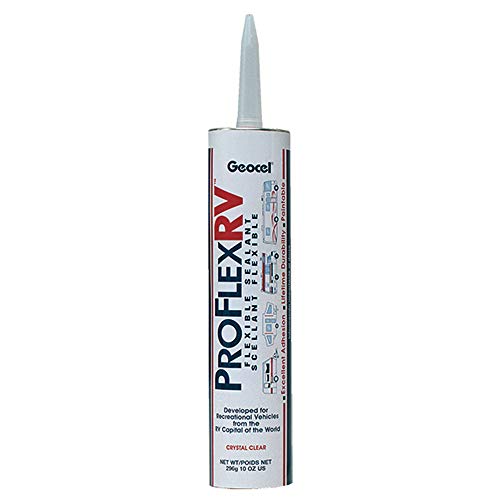
Geocel's Pro Flex RV earns its place as the top flexible cartridge sealant by solving a problem other products ignore: wet-surface adhesion. Its formulation achieves excellent bonding even when the substrate is damp — a significant practical advantage for RV owners dealing with field repairs in humid or rainy conditions. The clear finish is another differentiator; it disappears visually against nearly any roof color or material, making it the right choice for cosmetically sensitive applications like windshield perimeters, window frames, and trim joints.
The product is resealable and can be reapplied over itself, which matters for multi-season maintenance cycles. You do not need to strip and clean the old sealant completely before reapplication — a labor-saving attribute when working on older rigs with layered repair histories. Its flash point of 93°C confirms a reasonably stable chemistry that holds up under summer roof temperatures without softening or migrating.
Pro Flex RV is a premium-priced cartridge product, and it delivers on that premium with multi-surface versatility, all-weather application capability, and a professional clear finish. If you are sealing around windows, vents, or A/C units where appearance matters, this is the product to reach for. The same attention to detail that drives RV roof maintenance applies to other vehicle systems — if you are doing a full exterior refresh, the best car buffers of 2026 are worth a look for paintwork.
Pros:
Cons:
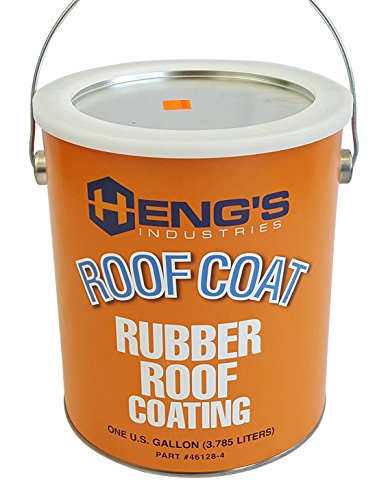
HENG'S Industries has been manufacturing RV-specific maintenance products for decades, and their rubber roof coating brings that experience into a 1-gallon, accessible price point. Designed specifically for EPDM rubber roofs, it seals seams, tears, vent penetrations, and air conditioning units in a single brushable or rollable application. The formula expands and contracts with the roof membrane through temperature cycles — the core technical requirement for any rubber roof coating that needs to survive multi-season use without cracking or peeling.
UV resistance is built into the formulation, blocking the solar degradation that slowly bleaches and hardens untreated EPDM over time. The product is non-polluting and non-toxic, which matters if you are working in a confined space or applying it near water catchment areas. Impact resistance is listed as a feature — relevant for hail-prone regions and for rigs that travel under low tree branches.
The 1-gallon size suits maintenance coating on smaller RVs and pop-up campers, or targeted repair work on sections of a larger roof. For full-surface restoration of a Class A or Class C motorhome roof, you will need multiple gallons or should consider the 5-gallon Liquid Rubber option reviewed below. HENG'S delivers solid performance at a price that makes annual reapplication practical — the single most effective strategy for extending rubber roof life.
Pros:
Cons:
Liquid Rubber's 5-gallon RV roof sealant is the premium choice for complete roof restoration in 2026. Where most products address specific failure points, Liquid Rubber is designed to rebuild the entire roof membrane — creating a seamless, flexible waterproof layer from edge to edge. The elastomeric formulation remains flexible across the full range of temperatures encountered in RV use, from sub-freezing winter storage to summer desert heat, without cracking, peeling, or losing adhesion.
The solar reflective technology is a standout feature. By reflecting radiant heat back away from the roof surface, it actively reduces interior temperatures during peak summer conditions — a documented benefit that extends to lower A/C load, reduced fuel consumption, and longer roof membrane life. This is not a marketing claim unique to Liquid Rubber; solar reflective roof coatings are a validated technology used in commercial flat-roof applications and increasingly adopted in the RV sector for exactly these reasons.
Compatibility spans EPDM, TPO, fiberglass, and aluminum roofs. For EPDM and TPO, Liquid Rubber recommends pairing with their dedicated EPDM Primer for optimal adhesion — a detail that adds a step but ensures a professional-grade bond. The 5-gallon volume covers a Class A motorhome roof in a two-coat application. This is a DIY product that produces contractor-quality results when surface prep is followed correctly. If you are investing in a full roof restoration, this is the product that delivers the longest service life of anything in this roundup.
Pros:
Cons:

Camco's 41464 self-leveling lap sealant competes directly with the Dicor 501LSW-1 at a competitive price point, offering nearly identical performance characteristics at a cost that makes multi-tube seasonal purchases easy to justify. The self-leveling chemistry flows into roof edges, vent pipe gaps, and screw head voids under gravity, creating a uniform seal without the mess of hand-tooling. For RV owners who do annual lap sealant inspections — the single most effective maintenance habit for extending roof life — this product delivers professional-grade results at a DIY-friendly cost.
The industrial-grade multi-surface formula handles EPDM rubber, TPO, fiberglass, wood, aluminum, steel, and masonry. This breadth makes it genuinely versatile for the range of attachment points found on a modern RV roof — where metal vents meet rubber membrane, where wood fascia transitions to fiberglass, and where steel screws penetrate through multiple layers. Camco markets this as a "Superior Weather Guard Formula," and the multi-surface bonding capability backs that claim.
For budget-conscious RV owners who perform their own maintenance, Camco 41464 is the smart purchase. Stock several tubes before a long travel season and you are prepared for any lap sealant need that arises on the road — whether at a campsite or a trailhead parking lot. Pair it with a reliable trailer lock to secure your rig while you work, and your RV protection game is fully covered.
Pros:
Cons:
Every other product in this guide addresses rubber membrane or multi-surface applications. Dicor's RP-FRC-1 focuses exclusively on fiberglass — and that specialization shows in its performance. This 100% acrylic coating system is engineered specifically for maintenance of fiberglass RV roofs when used with Dicor's complementary Clean & Prep product. It does not pretend to be a universal solution; it is the right tool for a specific, common RV roof type that deteriorates differently than EPDM.
The super-flexible acrylic formula provides two critical benefits simultaneously: waterproofing and solar heat reflection. The white coating reflects the sun's heat, reducing interior temperatures during warm months — a thermal benefit that pays dividends in comfort and reduced A/C wear. Flexibility is essential for fiberglass, which flexes under load and temperature change; a brittle coating cracks at the stress points and creates exactly the infiltration paths it was applied to prevent.
Used as a system with Dicor primer, RP-FRC-1 upgrades an old, chalky, or oxidized fiberglass roof to near-new condition visually and functionally. The 1-gallon size is appropriate for most single-application coverage needs, and the product's acrylic base makes cleanup straightforward. If your RV sits on a fiberglass roof, this is the only specialized coating in this roundup built specifically for your surface type.
Pros:
Cons:
The single most important buying criterion is roof material compatibility. Applying an incompatible sealant can accelerate membrane degradation rather than prevent it. Know your roof type before purchasing:
Not every RV roof problem requires the same solution. Match your product category to the scale of damage:
An RV roof faces direct sun exposure for years. UV degradation is what turns a sound sealant brittle over time. Any product you apply should carry explicit UV resistance in its specs. Equally critical is thermal flexibility — the ability to expand and contract with the roof substrate through temperature cycles without cracking. In practice, look for these terms in product descriptions:
A sealant without documented flexibility will crack within 1-2 seasons under thermal stress, particularly in climates with wide temperature swings between summer storage and winter travel.
Real-world repairs do not always happen in ideal conditions. Understand each product's application requirements before you buy:
Industry guidance recommends inspecting lap sealant at every campsite and performing a full reapplication at least once per year. In regions with intense UV exposure or extreme temperature variation — the American Southwest and mountain states, for example — twice-yearly inspection and touch-up is a sound practice. Liquid coatings like HENG'S and Liquid Rubber typically carry 1-3 year reapplication cycles depending on product and exposure. Never skip an annual inspection: catching a minor separation before it admits water is a $20 repair versus a potential $5,000 delamination job.
A lap sealant is a caulk-like cartridge product applied in a bead along specific joints, edges, vent perimeters, and screw heads — anywhere two roofing materials meet. It is a point-repair and seam-maintenance product. A roof coating is a brush- or roller-applied liquid that covers the entire roof surface, rebuilding or reinforcing the waterproof membrane across the full area. Most RV maintenance programs use both: annual lap sealant refreshes at all joints, and periodic full-roof coating to restore the membrane's protective properties.
In most cases, yes. Self-leveling lap sealants like Dicor 501LSW-1 and Camco 41464 are designed to be applied over existing sealant that is still adhering to the substrate — as long as the old sealant is not crumbling or contaminated with mold. Geocel Pro Flex explicitly states it may be applied over itself. Liquid coatings require more aggressive surface prep: the roof must be clean, and any loose or lifted areas of old coating must be removed before the new product is applied. Always read the manufacturer's surface preparation instructions before applying over existing sealant.
Both materials are widely used and both perform reliably when properly maintained. EPDM (ethylene propylene diene monomer) is the older technology — it is more widely understood, easier to repair with available products, and generally less expensive to replace. TPO (thermoplastic polyolefin) is lighter, more tear-resistant, and more reflective of solar heat in its natural state. The sealing products you use must be compatible with your specific membrane type — this is why checking compatibility before purchasing any sealant or coating is the first step in any RV roof maintenance decision.
Proper surface preparation is the most critical factor in sealant performance and longevity. Follow these steps: (1) Sweep off all debris and standing water. (2) Wash the surface with an RV-specific roof cleaner or mild soap; avoid petroleum-based cleaners on EPDM. (3) Allow the surface to dry completely — except when using Geocel Pro Flex, which tolerates damp conditions. (4) Inspect all existing sealant for cracks, lifting edges, or voids and remove any material that is no longer adhering. (5) Apply primer if the product specifies it (Liquid Rubber on EPDM/TPO, Dicor RP-FRC-1 on fiberglass). Skipping prep is the leading cause of premature sealant failure.
Four primary failure mechanisms are documented: UV degradation breaks down the polymer chains in sealant over time, causing brittleness and cracking. Thermal cycling — the expansion and contraction of roof materials across temperature swings — stresses sealant that lacks sufficient flexibility. Improper surface preparation prevents adequate adhesion from forming in the first place, leading to edge lifting and water infiltration. Finally, incompatible products — particularly petroleum-based solvents applied to EPDM — chemically degrade the membrane or sealant. Selecting a UV-resistant, flexible, and material-compatible product — and preparing the surface correctly — eliminates all four failure vectors.
 |
 |
 |
 |

About Diego Ramirez
Diego Ramirez has been wrenching on cars since his teenage years and has built a deep practical knowledge of automotive maintenance and paint protection through years of hands-on work. He specializes in fluid service intervals, preventive care routines, exterior protection products, and the consistent habits that extend a vehicle's lifespan well beyond average. At CarCareTotal, he covers car care guides, cleaning and detailing products, and exterior maintenance and protection reviews.
Get some FREE car parts & gear.. Or check out the latest free automotive manuals and build guides here.
Disable your ad blocker to unlock all the hidden deals. Hit the button below 🚗
| | | |
