Car Care ›
by Diego Ramirez
How often should a vehicle's air filter get swapped out, and does it really make a difference? The answer depends on driving habits, environment, and the type of filter installed, but knowing how often to replace car air filter components prevents a cascade of engine problems that cost far more than the filter itself. Most manufacturers recommend a replacement interval between 15,000 and 30,000 miles, yet real-world conditions can shorten that window dramatically. A clogged air filter starves the engine of clean airflow, reducing fuel economy, power output, and overall car care longevity.
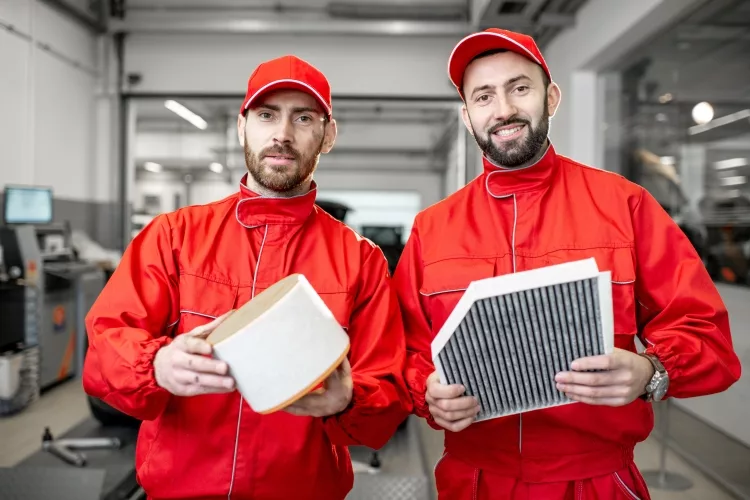
The air filter sits inside a plastic housing near the top of the engine bay, making it one of the easiest maintenance items to inspect and replace without any special tools. Despite that simplicity, a surprising number of drivers overlook it entirely until performance issues surface. Understanding the factors that accelerate filter degradation turns a reactive headache into a proactive five-minute task that protects the engine for thousands of additional miles.
Contents
An engine needs a precise mixture of fuel and air to combust efficiently, and the air filter ensures that incoming airflow arrives free of dust, pollen, bugs, and road debris. The filter medium — typically pleated paper, cotton gauze, or synthetic foam — traps particles as small as 5 microns before they reach the throttle body and combustion chambers. Without that barrier, abrasive grit enters the cylinders and scores the piston walls, accelerating wear on rings, valves, and cylinder linings over time.
As trapped debris accumulates, the filter creates increasing resistance to airflow, which forces the engine to work harder to draw in the same volume of air. Modern fuel-injected engines compensate by adjusting the air-fuel ratio through the mass airflow sensor (MAF), but compensation has limits. Once restriction exceeds the EPA's recognized thresholds for optimal combustion, fuel economy drops measurably and exhaust emissions rise alongside it.
Pro Tip: Hold a used air filter up to a bright light — if no light passes through the pleats, the filter has reached the end of its useful life regardless of mileage.
Several symptoms point directly to a restricted air filter before any dashboard warning illuminates. A noticeable drop in acceleration response, especially during highway merging, often signals insufficient airflow reaching the combustion chambers. Reduced fuel economy of even one to two miles per gallon over several fill-ups is another early indicator worth investigating under the hood.
A clean air filter appears off-white or light gray, while a filter due for replacement looks dark gray or brown with visible debris lodged in the pleats. Some drivers also notice a slightly rough or hesitant idle, particularly on cold starts, because the engine management system struggles to maintain stable combustion with limited air supply. If the check engine light activates alongside these symptoms, checking OBD2 codes can confirm whether the MAF sensor is reporting out-of-range readings caused by filter restriction.
Under standard commuting conditions on paved roads, most manufacturers specify an air filter replacement every 15,000 to 30,000 miles, which translates roughly to once every one to two years for the average driver covering 12,000 to 15,000 miles annually. Highway driving in temperate climates with low dust exposure generally allows filters to reach the upper end of that range without issue, while stop-and-go city traffic pushes replacements closer to the lower end because engines cycle through more air volume per mile at lower speeds.
Gravel roads, construction zones, agricultural areas, and desert climates load filters with particulate matter at two to three times the normal rate. Drivers who regularly encounter these conditions should inspect the filter every 10,000 miles and plan on replacement closer to 12,000 to 15,000 miles. Pet owners who frequently transport animals also benefit from shorter intervals, since pet hair and dander circulate through the engine bay — the same particulate issue that affects cabin cleanliness extends to the engine intake.
Warning: Never attempt to clean a disposable paper air filter with compressed air — the pressure tears the filter media and allows unfiltered air into the engine.
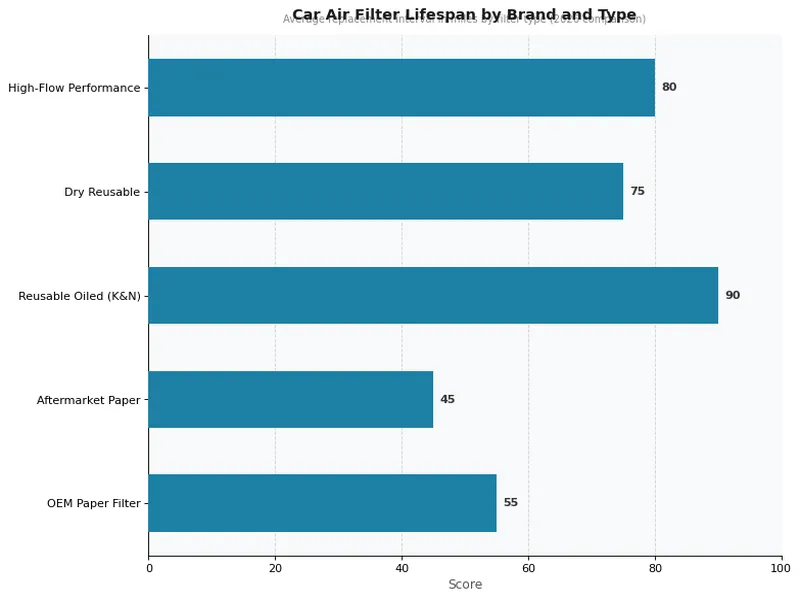
| Filter Type | Material | Typical Lifespan | Washable | Price Range |
|---|---|---|---|---|
| Standard disposable | Pleated paper | 15,000–30,000 miles | No | $10–$25 |
| Performance reusable | Oiled cotton gauze | 50,000+ miles (with cleaning) | Yes | $40–$70 |
| Synthetic performance | Dry synthetic media | 50,000+ miles (with cleaning) | Yes | $45–$65 |
| Heavy-duty disposable | Multi-layer paper | 20,000–40,000 miles | No | $15–$35 |
| Foam pre-filter wrap | Open-cell foam | 10,000–15,000 miles | Yes | $8–$15 |
Reusable performance filters from brands like K&N and AEM carry a higher upfront cost but last the life of the vehicle when cleaned and re-oiled according to the manufacturer's schedule, typically every 50,000 miles under normal conditions. Disposable paper filters from Fram, Wix, and Mann remain the most popular choice because they require no maintenance — simply remove the old one and drop in the replacement, a task that takes under five minutes on most vehicles.
A persistent garage myth claims that a slightly dirty filter actually boosts power by creating turbulence that mixes fuel and air more thoroughly. Engine dynamometer testing consistently disproves this — any restriction beyond the filter's design capacity reduces volumetric efficiency and costs measurable horsepower, not the other way around.
OEM filters carry the manufacturer's part number but are almost always produced by the same third-party companies (Denso, Mann-Hummel, Mahle) that sell equivalent filters under their own branding at lower prices. Using a quality aftermarket filter with matching dimensions does not void any warranty, a protection guaranteed under federal law. The same principle applies to other routine maintenance items like oil filter replacements and engine oil top-offs.
Modern engines with sophisticated fuel management systems are actually more sensitive to airflow restriction, not less. Turbocharged and direct-injection powertrains depend on precise air metering, and a clogged filter throws off the entire calibration, triggering adaptive fuel trims that reduce both power and efficiency.
Skipping air filter replacements beyond the recommended interval creates a compounding chain of problems that extends well past the filter housing. Reduced airflow forces richer fuel mixtures, which fouls spark plugs, contaminates catalytic converters, and increases carbon deposits on intake valves. One independent shop survey found that vehicles brought in for sluggish acceleration had a neglected air filter as the root cause in nearly 25 percent of cases.
Insider Note: Technicians often find that a simple air filter swap resolves complaints about poor fuel economy that drivers assumed required expensive sensor replacements or injector cleaning.
In extreme cases, a collapsed or torn filter allows unfiltered air and debris directly into the intake tract, causing premature wear that shortens engine life by tens of thousands of miles. That kind of internal damage dwarfs the cost of even the most expensive performance filter on the market, and it underscores the importance of bundling filter checks with other routine tasks like coolant maintenance and battery inspections.
The simplest approach ties air filter inspection to every other oil change, creating a natural rhythm that prevents the task from slipping through the cracks. Since most oil change intervals fall between 5,000 and 7,500 miles, checking the air filter every 10,000 to 15,000 miles aligns well with manufacturer recommendations for normal driving conditions. Keeping a dated note on the filter housing or in the glovebox maintenance log makes it easy to track mileage between replacements.
Spring and fall bring the highest pollen and leaf debris loads in most climates, making the transition between seasons an ideal time for a filter inspection. Drivers in areas with heavy agricultural activity or wildfire seasons should add a mid-season check during those peak particulate months. Pairing these checks with other seasonal maintenance like clutch inspections keeps the vehicle in peak operating condition throughout the calendar without requiring separate trips to the shop.
Most manufacturers recommend replacing the engine air filter every 15,000 to 30,000 miles under normal driving conditions. Checking the filter visually at each oil change helps determine whether early replacement is warranted based on actual contamination levels.
A restricted air filter forces the engine to consume more fuel to compensate for reduced airflow, which can decrease fuel economy by up to 10 percent in older carbureted vehicles and 2 to 4 percent in modern fuel-injected engines with adaptive fuel management.
Severe air filter restriction can trigger a check engine light when the mass airflow sensor detects readings outside its normal operating range. The most common associated diagnostic codes relate to lean fuel trim conditions or MAF sensor performance issues.
Reusable cotton or synthetic filters offer comparable filtration with the advantage of long-term cost savings since they only need periodic cleaning rather than full replacement. Disposable paper filters remain excellent for drivers who prefer zero-maintenance convenience at a lower upfront price.
A moderately dirty filter does not pose an immediate safety hazard, but prolonged driving with a severely clogged filter degrades engine performance, increases emissions, and accelerates internal engine wear that leads to expensive repairs over time.
A replacement air filter typically costs between $10 and $25 for a standard disposable unit, and installation takes less than five minutes on most vehicles with no tools required. Dealership replacement services charge $30 to $75 including labor.
The cabin air filter and engine air filter are separate components with different functions. The engine air filter protects internal engine components from airborne debris, while the cabin filter cleans the air entering the passenger compartment through the HVAC system.
 |
 |
 |
 |

About Diego Ramirez
Diego Ramirez has been wrenching on cars since his teenage years and has built a deep practical knowledge of automotive maintenance and paint protection through years of hands-on work. He specializes in fluid service intervals, preventive care routines, exterior protection products, and the consistent habits that extend a vehicle's lifespan well beyond average. At CarCareTotal, he covers car care guides, cleaning and detailing products, and exterior maintenance and protection reviews.
Get some FREE car parts & gear.. Or check out the latest free automotive manuals and build guides here.
Disable your ad blocker to unlock all the hidden deals. Hit the button below 🚗
| | | |
