Car Care ›
by Diego Ramirez
According to a 2025 Grand View Research report, the North American truck bed liner market surpassed $900 million in annual revenue — and DIY spray-on and roll-on products now account for roughly 35% of all installations. Professional bedliner jobs from dealers typically run $400–$700, making the economics of a quality DIY kit compelling for truck owners willing to invest a weekend afternoon.

The 2026 DIY bedliner landscape spans aerosol rattle cans, roll-on polyurethane kits, and professional-grade 2K urethane systems with dedicated spray guns. Each format trades off ease of application against durability, texture control, and coverage area. Aerosol coatings suit small touch-up jobs and trailer fenders, while full-kit systems from brands like U-POL Raptor and Herculiner deliver protection that rivals shop-applied liners at a fraction of the cost. For truck owners also tackling other car care projects, a bedliner installation pairs well with broader underbody maintenance and rust prevention work.
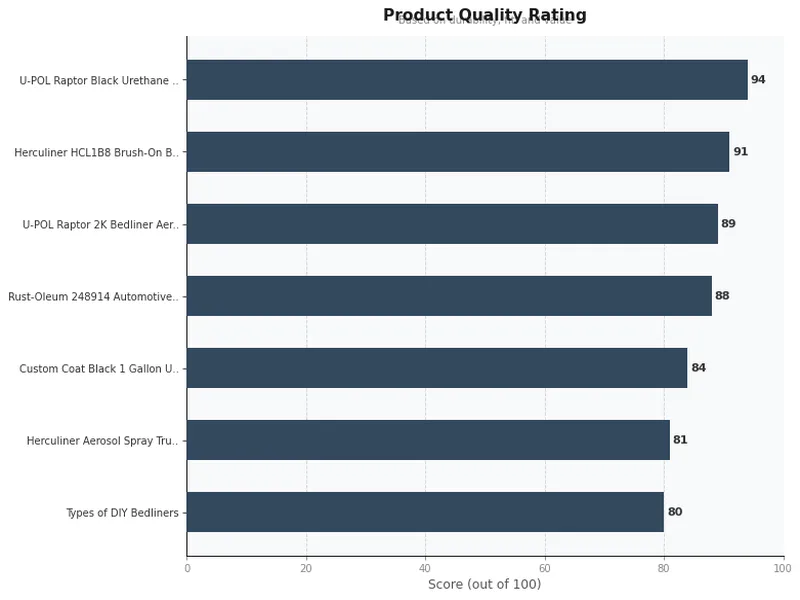
This roundup evaluates seven leading DIY bedliner products available in 2026 across spray, roll-on, and brush-on application methods. Each product was assessed on adhesion strength, UV resistance, texture consistency, coverage per unit, and overall value per square foot of bed coverage. Whether the goal is protecting a daily-driven work truck or prepping a trailer deck for heavy cargo, the options below cover every budget and skill level.
Contents







The Dupli-Color ETRC104A0 is a replacement roller cover designed specifically for the Dupli-Color Truck Bed Coating system. At 0.25 oz, this is not a bedliner product itself — it is an accessory component that ensures even, consistent application of the Dupli-Color coating compound. The textured roller surface is engineered to deposit the right amount of material per pass without excessive dripping or pooling.
For truck owners already invested in the Dupli-Color ecosystem, keeping spare roller covers on hand is practical. The rollers tend to stiffen between coats if not cleaned immediately, and having a fresh cover available for second or third coats maintains consistent texture across the entire bed surface. The compact design fits the standard Dupli-Color roller handle without any adapter or modification.
That said, this product serves a narrow purpose. Buyers seeking a complete bedliner solution will need the full Dupli-Color Truck Bed Coating kit separately. The roller cover alone does not include coating material, primer, or prep supplies.
Pros:
Cons:
The 3M 03584 is an asphalt-based rubberized undercoating sold in 16 oz aerosol cans, packaged in a six-pack. While marketed primarily as an undercoating rather than a bed-specific liner, its formulation has made it a popular choice among truck owners who want corrosion protection across multiple vehicle surfaces — wheel wells, quarter panels, interior fenders, and underbody panels. The rubberized finish provides meaningful sound deadening, reducing road noise transmitted through sheet metal into the cabin.
Application is straightforward aerosol spray. The nozzle delivers a reasonably uniform pattern, though maintaining consistent distance (10–12 inches) is important to avoid runs on vertical surfaces. The asphalt base cures to a semi-flexible black coating that resists chipping from gravel impacts. Unlike urethane-based truck bed liners, this undercoating does not develop the aggressive anti-skid texture associated with dedicated bedliner products.
The six-can pack provides enough material for comprehensive undercarriage coverage on a full-size truck, or partial bed coverage combined with wheel well and fender treatment. For truck owners doing a full underside restoration — especially on older vehicles where rust has begun compromising panels — the 3M undercoating serves as a protective layer after wire-brushing and priming. Pairing this with other maintenance work like selecting a quality oil drain pan for underbody service makes for an efficient weekend project.
Pros:
Cons:
The Rust-Oleum 248914 is a dedicated truck bed coating in a 15 oz aerosol can. Unlike the 3M undercoating above, this product is specifically formulated as a bedliner with the textured, anti-skid finish that truck owners expect. The Stops Rust formula provides corrosion protection on bare metal, previously painted surfaces, and lightly rusted areas. Coverage rates at approximately 20 sq. ft. per can, meaning a standard 6.5-foot truck bed typically requires 3–4 cans for complete coverage with proper coat thickness.
The any-angle spray comfort tip is a legitimate ergonomic advantage. Bed rail undersides, tailgate channels, and tie-down pockets demand awkward spray angles that standard nozzles cannot deliver without sputtering. Rust-Oleum's valve technology maintains consistent pressure and spray pattern regardless of can orientation. Dry-to-touch time is approximately one hour, with recoat windows that allow multi-coat applications within a single work session.
Coverage per can is the limiting factor. A full bed application consuming 3–4 cans brings the per-project cost closer to entry-level roll-on kits while delivering a thinner final coating. The aerosol format works best for smaller surfaces — trailer fenders, toolbox beds, utility vehicle cargo areas — or as a touch-up solution for existing bedliner coatings that have worn through in high-contact areas.
Pros:
Cons:
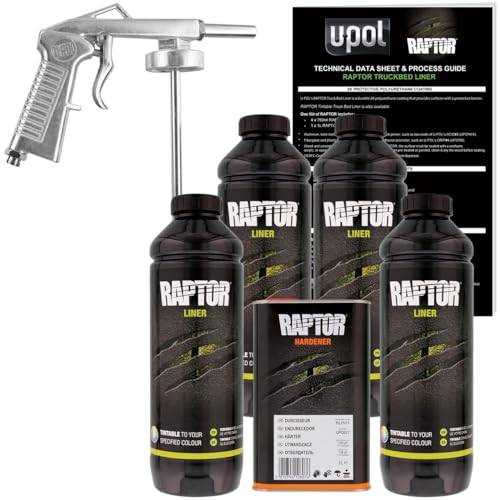
The U-POL Raptor Black represents the professional end of the DIY bedliner spectrum. This 2K (two-component) urethane system ships with four 750 ml bottles of black base coating, one liter of hardener, and a dedicated spray gun. The kit provides enough material to coat a 6-foot to 8-foot truck bed with the thick, textured finish that defines commercial-grade bedliner installations. According to polyurethane chemistry, two-component systems produce significantly harder, more chemically resistant films than single-component alternatives.
The application workflow is straightforward: mix hardener into each bottle, shake thoroughly, attach the spray gun, and apply. Raptor also supports roller and brush application for buyers who prefer manual control over texture depth. The coating bonds directly to OEM paint and self-etching primer, eliminating the need for specialized adhesion promoters in most cases. Its rapid-drying formula allows multiple coats within an hour, which is critical for achieving the recommended 3–4 coat thickness for maximum durability.
Raptor's UV-resistant formula addresses one of the primary failure modes of cheaper bedliners — chalking and fading after prolonged sun exposure. The urethane base also stays flexible across temperature extremes, reducing the cracking risk that affects rigid coatings in freeze-thaw climates. Sound deadening and vibration damping are measurable side benefits. The included spray gun is functional for a single project but lacks the build quality of professional HVLP equipment — experienced users sometimes substitute their own guns for finer atomization control.
Pros:
Cons:
Herculiner HCL1B8 is widely regarded as the original DIY roll-on truck bed liner, and the 1-gallon kit remains one of the most popular options in 2026. The three-step application process — prep, apply, let dry — requires no spray equipment, no compressor, and no specialized skills. A standard paint roller (included in the kit) handles the entire application. The gallon container provides enough material for a full-size truck bed with proper coat thickness.
The formulation produces a tough, heavily textured finish that develops significant anti-skid properties. Herculiner cures harder than comparable water-based products, according to J-B Weld's product testing data. Functional cure occurs in 10–12 hours, with full cure at 24 hours. The coating bonds to metal, concrete, wood, fiberglass, rubber, most plastics, and PVC — making it genuinely versatile beyond truck bed applications. Trailer decks, boat floors, walkways, and equipment surfaces are all viable substrates.
The roll-on application method delivers thicker, more uniform coats than aerosol sprays, with the trade-off being a slightly coarser texture compared to spray-gun applied urethane systems. The aggressive texture is excellent for cargo grip but can be rough on knees and hands during bed loading. Buyers who also maintain their vehicles' exterior protection should consider pairing bed work with trim restoration — a topic covered in our plastic restorers guide.
Pros:
Cons:
The J-B Weld Herculiner quart is the smaller sibling of the gallon kit, offering the same tough polyurethane formula in a size suited for compact truck beds, touch-ups, and non-automotive applications. The quart volume covers approximately 12–16 square feet depending on coat thickness — sufficient for a compact pickup bed, a utility trailer floor, or targeted repairs on an existing liner that has worn through.
The formulation is identical to the gallon version. The same three-step prep-apply-dry process applies, with the same 10–12 hour functional cure and 24-hour full cure timelines. The textured finish resists chipping, flaking, and peeling while providing the anti-skid surface that prevents cargo shifting. Rust prevention is built into the formula — the coating seals metal surfaces from moisture contact.
Buyers should calculate their coverage needs carefully. Two quarts approaches the per-ounce cost of the gallon kit, making the quart economical only for jobs that genuinely require less than a gallon of material. For mid-size truck beds, the gallon kit is almost always the better value. The quart earns its place for targeted applications: patching worn spots, coating toolbox interiors, treating step bumpers, or lining equipment storage compartments.
Pros:
Cons:
The U-POL VOC Raptor Tintable is the color-customizable variant of the Raptor line. The 4-liter kit ships with a tintable base that accepts standard automotive tints, enabling buyers to match their truck's body color, create contrasting accents, or apply any custom shade. The included spray gun handles application, following the same fill-shake-spray workflow as the black Raptor kit. VOC-compliant formulation meets stricter emission standards in states like California.
Performance characteristics mirror the black Raptor. The 2K urethane system resists rust, corrosion, salt exposure, moisture, and extreme temperatures. The cured coating remains flexible enough to dampen vibrations and deaden road noise while maintaining a durable protective shell. Waterproof properties make it equally viable for marine applications, trailer beds, and off-road equipment enclosures.
The tinting process adds a step to the workflow. Buyers need to source compatible automotive tint separately and calculate the correct tint-to-base ratio for their desired color depth. Lighter colors generally require more tint volume. The base has a slight amber tone that can shift the final color — testing a small batch before committing to the full application is strongly recommended. For truck owners who want the bed to blend seamlessly with the exterior paint, the tintable Raptor offers a capability that no other DIY bedliner kit in this roundup can match. Those also installing accessories like a trailer hitch may want to coat surrounding areas for a unified appearance.
Pros:
Cons:
The application method is the most consequential choice in a DIY bedliner project, as it determines the equipment needed, the skill required, and the final coating quality.
Chemical composition determines longevity, flexibility, and resistance properties:
A standard 6.5-foot truck bed has approximately 45–55 square feet of total surface area including sidewalls and tailgate. Coverage varies dramatically by product:
Calculating cost per square foot reveals the true economics. Bulk formats (gallon kits, multi-liter systems) consistently deliver better value than aerosol cans for full-bed applications.
Every bedliner product performs only as well as the surface preparation underneath it. Prep steps are consistent across all product types:
Skipping or rushing surface prep is the single most common cause of bedliner adhesion failure. Even premium 2K urethane systems will delaminate from contaminated or un-scuffed surfaces. A properly prepped bed with a mid-range product will outperform a poorly prepped bed with the most expensive liner available.
A properly applied 2K urethane system like U-POL Raptor can last 5–10 years under normal use, approaching the longevity of professional Rhino or Line-X installations. Roll-on products like Herculiner typically last 3–5 years before requiring touch-ups in high-wear areas. Aerosol coatings have the shortest lifespan, generally requiring reapplication within 1–2 years under regular cargo use. Surface prep quality is the single largest variable affecting any DIY bedliner's longevity.
Most urethane and polyurethane bedliners can be applied over existing coatings, provided the existing surface is scuffed, clean, and well-adhered to the metal beneath. Loose, peeling, or flaking old liner must be removed completely — applying new coating over failing old coating guarantees delamination. Test adhesion by cross-hatching a small area with a razor and applying tape. If the old coating lifts with the tape, it needs to come off before recoating.
Most products perform optimally between 60°F and 85°F (15°C–30°C) with relative humidity below 65%. Temperatures below 50°F slow chemical cure significantly and can result in soft, poorly crosslinked films. Temperatures above 90°F accelerate cure too rapidly, potentially causing bubbling or poor flow-out. Direct sunlight during application can cause surface skinning before the full coat thickness cures. A garage or shaded outdoor area provides the best working conditions.
Spray-gun applied systems (U-POL Raptor) typically require 3–4 coats, with each coat achieving 3–5 mils of dry film thickness. Roll-on products (Herculiner) generally need 2–3 coats, as each roller pass deposits a thicker film. Aerosol products require 4–6 light coats to build sufficient thickness. Total recommended dry film thickness across all products is 15–25 mils for cargo-bed protection. Measuring with a mil gauge after cure confirms adequate build.
Removing the tailgate is not strictly necessary but is strongly recommended. With the tailgate in place, the hinge area, latch mechanism, and the inner face of the tailgate are extremely difficult to coat uniformly. Removal takes 10–15 minutes on most trucks (support it on sawhorses) and allows complete access to all bed surfaces. It also prevents overspray on exterior tailgate paint, which is costly to repair.
All products reviewed here have applications beyond truck beds. Herculiner explicitly supports metal, wood, fiberglass, concrete, rubber, and PVC substrates. Common non-bed applications include trailer decks, boat floors, equipment cases, ATV fender wells, walkway treads, and garage floor sections. U-POL Raptor is popular for full-vehicle coatings on off-road rigs and military-style builds. The 3M rubberized undercoating is specifically designed for multi-surface undercarriage use.
 |
 |
 |
 |

About Diego Ramirez
Diego Ramirez has been wrenching on cars since his teenage years and has built a deep practical knowledge of automotive maintenance and paint protection through years of hands-on work. He specializes in fluid service intervals, preventive care routines, exterior protection products, and the consistent habits that extend a vehicle's lifespan well beyond average. At CarCareTotal, he covers car care guides, cleaning and detailing products, and exterior maintenance and protection reviews.
Get some FREE car parts & gear.. Or check out the latest free automotive manuals and build guides here.
Disable your ad blocker to unlock all the hidden deals. Hit the button below 🚗
| | | |
