Car Care ›
by Diego Ramirez
Our team still remembers the day a colleague's teenage brother walked into a Toyota dealership at 16, fully expecting to take a Camry around the block. He had his learner's permit, a parent waiting in the lobby, and complete confidence. The floor manager stopped him before he reached the inventory floor. That moment captures the confusion around how old do you have to be to test drive a car — a question we've fielded consistently across our car care coverage and buying guides. The answer is 18, and the reasoning behind it runs deep.

Franchised dealerships — those tied to manufacturer agreements and brand signage — treat 18 as a non-negotiable threshold. This isn't arbitrary policy. It's anchored in contract law: a minor cannot legally enter a binding agreement, and every test drive begins with signing a liability waiver. Without that signed document, the dealership absorbs full legal exposure for any damage, injury, or incident on the road. That's a risk no dealership management team accepts.
The rules shift slightly for private sellers and independent used-car lots, but only in limited ways. Our team dug into state DMV requirements, dealership liability protocols, and insurance frameworks to map out exactly where the lines are — and where any genuine flexibility exists.
Contents
The minimum age question starts with a legal concept most people never think about standing on a dealer lot: the capacity to contract. Under established contract law principles, anyone under 18 lacks the legal capacity to enter binding agreements. Liability waivers — which every franchised dealership requires before a test drive — are contracts. A minor's signature is legally voidable, meaning the dealership gets no real protection from it whatsoever. The document is essentially decorative.
This creates a hard constraint that doesn't bend for skill, experience, or license status. A 17-year-old with thousands of documented driving hours still can't produce a legally enforceable signature on that waiver. Our team confirmed this interpretation against multiple automotive legal resources, and it holds consistently across all 50 states. The liability framework is rooted in federal contract law, not state-specific regulation, which is why the 18-year floor is geographically uniform.
Dealership insurance compounds the issue further. Commercial auto policies covering dealer inventory include specific clauses that restrict demonstration drives to licensed adults. Insurers price those policies on actuarial tables that assume an adult driver population — allowing minors would shift that risk profile and void coverage on any incident simultaneously. Add manufacturer franchise agreements that embed liability conduct standards, and the 18-year minimum becomes locked in from multiple directions at once.
Sales staff at franchised dealerships have no discretion here. Understanding how car salesmen operate within dealership hierarchies makes it clear why floor managers and sales consultants can't make exceptions — the decision is embedded in insurance and franchise contracts far above the transaction level. Our team has never encountered a legitimate franchised dealer that deviated from this standard.
Private-party sales are the clearest exception. When an individual sells a vehicle directly to another individual, no formal liability waiver is required. The seller hands over keys, the prospective buyer drives, and the legal formalities of a commercial transaction don't apply in the same way. A 16-year-old with a valid license and a parent present can often drive a vehicle being sold privately without hitting any formal age barrier — the seller accepts whatever risk exists on their own terms.
Independent used-car lots occupy a genuine grey zone. Smaller operators without manufacturer agreements may have more flexibility in practice, and some will allow a test drive with a parent or guardian co-signing the liability waiver. Our team found this varies significantly by lot, by state, and by individual ownership. There's no universal standard the way there is at franchised dealerships, which means the outcome depends heavily on who runs the specific lot.
At franchised dealerships, a parent or legal guardian signing the liability waiver as the contracting party sometimes creates a workable path. The guardian takes on the legal exposure, signs the binding document, and accompanies the minor on the drive. A number of dealers accommodate this arrangement — particularly for families clearly in the market for a vehicle the minor will eventually own or share.
Families with a 17-year-old approaching 18 often ask whether the buying process can start early. In most cases, yes — browsing, financing pre-qualification, and feature discussions are all fair game. The formal test drive typically waits for the 18th birthday, though. Our team recommends using that lead time productively: researching known maintenance costs like timing belt replacements and checking reliability records for target models so the first behind-the-wheel session is a confirmation exercise, not an exploratory one.
Every test drive carries a cost the sticker price never reflects. Dealer floorplan insurance covering inventory vehicles includes provisions for demonstration drives, with premiums calculated partly on the risk profile of the driver population. Allowing minors would shift that profile meaningfully, pushing premium structures upward across the entire lot — not just for the individual transaction. Insurers price systematically, not per-customer.
Beyond premiums, there's direct exposure on any single incident. A low-speed contact during a test drive generates repair costs plus the administrative overhead of a claim on pre-sold inventory. For new vehicles, that damage hits through depreciation. For used vehicles priced below deductible thresholds, it's an out-of-pocket loss. Neither scenario is something a dealer absorbs voluntarily when a simple age policy eliminates it entirely.
For families with young buyers, the 18-year minimum restructures the purchase timeline in non-obvious ways. Financing approvals, trade-in valuations, and inventory availability all have limited shelf lives — a deal assembled at 17 may not survive intact to the 18th birthday intact. Our team consistently recommends planning test drives 30 to 60 days before a targeted purchase date, which pushes the research phase earlier than most buyers expect.
| Buyer Age | Franchised Dealer | Independent Used Car Lot | Private Seller | Key Notes |
|---|---|---|---|---|
| Under 16 | No test drive | No test drive | At seller's discretion | No valid license in most states |
| 16–17 (licensed) | Not permitted — waiver unenforceable | Often permitted with guardian co-sign | Generally permitted | Guardian must sign any required waiver |
| 18–24 | Permitted, standard process | Permitted | Permitted | Some luxury dealers request proof of income |
| 25+ | Standard process, no restrictions | Standard process | Standard process | Most favorable actuarial risk profile |
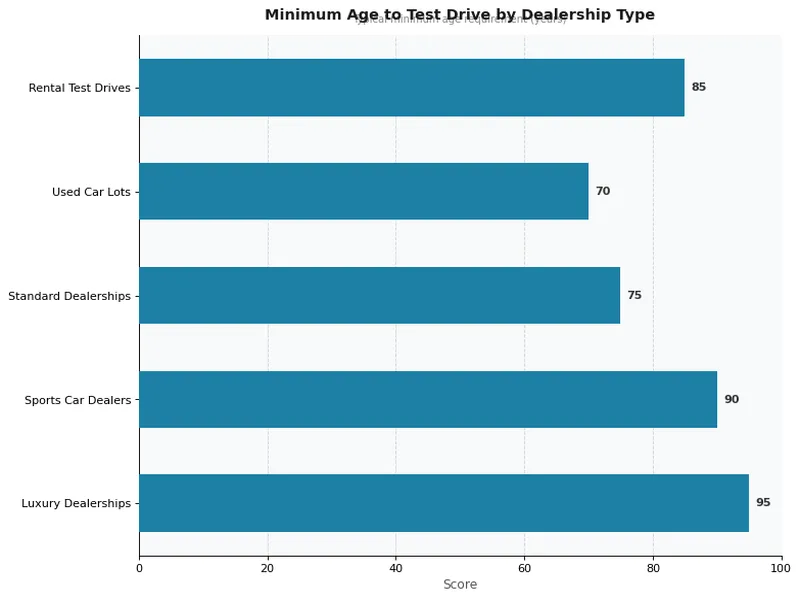
Franchised new-car dealers hold the strictest line without exception. Manufacturer agreements, insurance requirements, and corporate liability protocols all converge at 18. Staff have no authority to deviate regardless of circumstances. Independent used-car lots operate with more flexibility but also with less formal infrastructure — liability waiver quality varies, policies shift by owner, and the outcome of any individual request is genuinely unpredictable. Private sellers have no institutional constraints at all, though personal liability still exists if an incident occurs during the drive.
The practical implication is straightforward. Most people shopping new cars at 18 or older won't encounter any friction around this issue. The question becomes relevant primarily for younger buyers, parents helping teenagers select a first vehicle, or anyone accompanying a minor who expects to participate in the test drive. Knowing the dealership tier before walking in saves time and manages expectations before anyone reaches the front desk.
Luxury and exotic dealerships layer additional requirements on top of the 18-year baseline. Ferrari, Lamborghini, and comparable brands routinely require proof of financial qualification before a test drive — age verification is just the first gate. Porsche and BMW dealerships in high-volume markets often ask for evidence of serious purchase intent before releasing performance models for demonstration drives. During any test drive of a vehicle with significant capability, knowing what active warning lights on the instrument cluster actually indicate is practical knowledge — dealers expect drivers to flag anomalies immediately rather than complete the drive with a lit dash.
Post-purchase add-ons are standard territory at this price tier. Window tinting, protective films, and interior treatments are routine considerations — understanding what professional window tinting actually costs helps buyers budget for total ownership beyond the initial transaction.
The 18-year minimum creates a clean, consistently enforceable standard that protects dealerships, buyers, and the general public simultaneously. Dealerships get a legally defensible line they can hold without making judgment calls about individual competence or maturity. Insurance markets price coverage predictably against a defined driver population. The rule works precisely because it eliminates ambiguity — there are no edge cases, exceptions, or staff discretion calls that open the dealer to inconsistent liability exposure.
For the test drive itself, arriving prepared matters as much as age eligibility. Knowing how clutch systems wear in manual-transmission vehicles and understanding what to feel for during acceleration, braking, and cornering extracts more useful information from a single drive than an uninformed session three times as long. Age is the legal threshold, not the determinant of what gets learned during the drive.
The 18-year rule creates genuine inefficiencies for families purchasing vehicles for teenagers. A parent buying a car their 16-year-old will drive daily can't assess how that minor actually handles the vehicle — the person who'll operate it hasn't been behind the wheel. Some dealers accommodate this informally, but the gap between what's legally clean and what's practically useful is real and consistently frustrating for families in this situation.
There's also the used-car market inconsistency. A 17-year-old with a valid license shopping a private sale faces entirely different rules than one visiting a franchised dealer. The fragmented policy landscape means the answer to how old do you have to be to test drive a car genuinely depends on where the shopping happens — and knowing that before making the trip saves a wasted afternoon. After any purchase, protecting the interior investment starts immediately — our team recommends reviewing how to keep a car smelling new as part of any new ownership routine, since early habits determine long-term condition.
The standard minimum age at franchised dealerships in the United States is 18. The requirement is rooted in contract law — anyone under 18 cannot legally sign a liability waiver, making any signature from a minor legally voidable and leaving the dealership with no enforceable protection from it.
At franchised dealerships, the answer is almost universally no — even with a parent present, most dealers won't permit a minor behind the wheel of dealer inventory. Private sellers and some independent used-car lots may allow it when a parent or guardian co-signs any informal agreement and accompanies the driver throughout the test.
Franchised new-car dealers are essentially uniform at 18, driven by insurance requirements and manufacturer franchise agreements. Independent used-car lots and private sellers operate with considerably more flexibility. The 18-year standard is institutional policy at franchised dealers, not individual discretion — staff cannot make exceptions regardless of circumstances.
Yes, without any issue. A parent or guardian can test drive any vehicle independently, and dealerships have no concern with this arrangement. The minor simply doesn't get behind the wheel during the dealership visit. This is the standard approach for families purchasing a first car for a teenager under 18.
There is no formal upper age limit at most dealerships. Some high-performance and exotic car dealers may informally assess physical capability for elderly drivers in edge cases, but this is handled on a case-by-case basis rather than through formal policy. A valid driver's license remains the primary qualification at any age.
Standard protocol at franchised dealerships includes a valid driver's license, age verification confirming 18 or older, and a signed liability waiver. Luxury and exotic car dealers frequently add proof of insurance and evidence of financial qualification before releasing high-value inventory for any demonstration drive.
The contract law basis for the 18-year rule is consistent across all 50 states — minors cannot enter binding contracts anywhere in the U.S. What varies is how independent dealers and private sellers handle informal arrangements in practice, but franchised dealership policy is effectively uniform nationwide regardless of state-specific driving laws.
 |
 |
 |
 |

About Diego Ramirez
Diego Ramirez has been wrenching on cars since his teenage years and has built a deep practical knowledge of automotive maintenance and paint protection through years of hands-on work. He specializes in fluid service intervals, preventive care routines, exterior protection products, and the consistent habits that extend a vehicle's lifespan well beyond average. At CarCareTotal, he covers car care guides, cleaning and detailing products, and exterior maintenance and protection reviews.
Get some FREE car parts & gear.. Or check out the latest free automotive manuals and build guides here.
Disable your ad blocker to unlock all the hidden deals. Hit the button below 🚗
| | | |
