by Liam O'Brien
If you want the single most complete cabinet system on the market right now, the NewAge Products Bold Series 7-Piece Set earns the top spot because it combines serious weight capacity with a finished, professional look that most competitors can't match. That said, your garage is unique — the floor space you have, the stuff you need to store, and your budget all push you toward different solutions, and this guide covers all of them. Whether you're starting from scratch or filling in the gaps around what you already own, you'll find something here that fits.
A disorganized garage is one of those slow-burn frustrations. You know where everything is — sort of — until you really need something, and then it takes twenty minutes of digging to find a 10mm socket buried under a bag of fertilizer. In 2026, garage storage systems have matured enough that you can get steel cabinet sets, overhead racks, wall rails, and heavy-duty shelving at price points that used to be reserved for commercial shops. The hard part isn't finding a product. It's figuring out which type of system fits your workflow and your space. That's what this guide is for. If you're also working on rounding out your garage toolkit, check out our picks for the best garage heaters of 2026 and the best mechanic's creepers — both pair well with a freshly organized workspace.
We tested and researched seven of the best garage storage systems available right now, looking at build quality, ease of assembly, storage capacity, flexibility, and long-term durability. Below you'll find honest reviews of each, a buying guide to help you make sense of the options, and answers to the most common questions we hear. You can also browse our full tools and garage equipment section for more recommendations across the category.

Contents
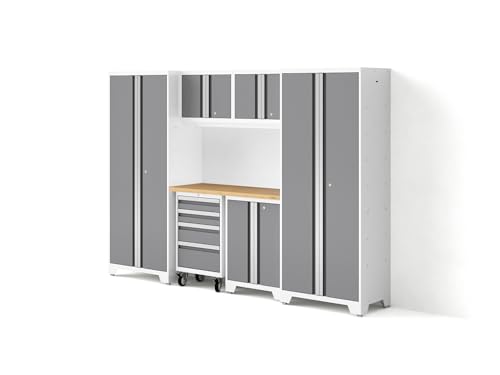







The NewAge Products Bold Series 7-Piece Set is the kind of system you buy once and stop thinking about. The white powder-coated finish with a stainless steel worktop gives it a clean, showroom look, but the real story is the weight capacity. The two multi-use lockers handle up to 800 pounds each — that's not a typo — while the base cabinets and rolling tool drawer cabinet each take 600 pounds. Wall cabinets add another 100 pounds of storage above your head. For a home garage, those numbers are more than sufficient for anything you'd realistically store.
The height-adjustable steel shelves inside each cabinet are a detail that earns its keep over time. As your storage needs shift — new tools, seasonal gear, automotive supplies — you can reconfigure the interior without buying new pieces. The rolling tool drawer cabinet locks and wheels smoothly, which matters when you're reorganizing or cleaning the floor. The stainless worktop is thick enough to handle real work without denting or warping under a vise or heavy parts. This is a proper workbench surface, not a display piece.
Assembly is the one area where you'll earn your new garage. The seven-piece nature of this system means a full afternoon of work, and the process is easier with a second person. Once it's together, though, there's very little movement or flex in the structure. The system feels anchored even when loaded heavily, which is exactly what you want from a cabinet set at this level. If you're the type who wants everything in one purchase — no add-ons, no compatibility headaches — this is a strong answer.
Pros:
Cons:
Not every garage organization problem needs a cabinet. If your floor space is limited or you want to keep tools and sports equipment visible and accessible without digging through drawers, the Rubbermaid FastTrack system is one of the most effective wall-mounted solutions available in 2026. This 24-piece kit includes six rails and eighteen hooks, giving you immediate coverage across a substantial wall section. The rail system is the foundation — once the rails are mounted, you can rearrange hooks, shelves, and accessories without touching a drill again.
The 1,750-pound total weight capacity across the system is impressive for wall-mounted storage, and Rubbermaid's heavy-duty steel construction backs that number up. The rails mount directly to studs and stay put even with bikes, ladder stands, and heavy sports gear hanging from them. What really makes this system worth recommending is the long-term flexibility. As your garage needs evolve — new hobbies, different vehicles, kids growing out of one sport and into another — you can buy additional compatible accessories and just snap them in. No drilling, no permanent commitment.
The included hook variety covers most common use cases right out of the box: large hooks for bikes and ladders, utility hooks for hoses and extension cords, and smaller hooks for hand tools. If you've been relying on pegboard for years, the FastTrack feels like a genuine upgrade. The rail channel design means nothing ever slips or loosens under load the way pegboard hooks tend to. This is also an excellent complement to a full cabinet system — run rails along one wall for active-use tools and use floor cabinets for longer-term storage.
Pros:
Cons:
VIYET positions the 10-Piece system as a complete garage transformation in a single purchase, and for the serious DIYer or suburban homeowner who wants a workbench, enclosed storage, and tool organization under one order, it delivers on that promise. Ten pieces gives you considerably more coverage than a seven-piece set, and the included workbench is genuinely integrated into the design rather than bolted on as an afterthought. The reinforced frames and double-wall doors address one of the most common failure points in mid-range steel cabinets — the doors themselves, which take constant abuse from being thrown open and shut in an active shop.
VIYET's pre-drilled holes and precision-engineered components make assembly faster than most competing systems. They claim hours rather than days, and that tracks with real-world experience for someone who's reasonably comfortable with basic assembly. The scratch-resistant powder coating holds up against the kind of incidental contact that happens in an active garage — scraped tools, chemical spills, bumped edges. The coating also sheds moisture rather than trapping it, which matters in garages that go through seasonal temperature swings.
The trade-off with a newer brand in this category is the uncertainty around long-term support. If a component fails three years from now, replacement parts availability is a real question. That's worth weighing if you're planning a permanent setup. For now, the build quality is solid enough that it's not a dealbreaker — just something to keep in mind. At this price point with this much coverage, the VIYET system punches well above its weight class and deserves serious consideration if you want maximum storage capacity in a single shot.
Pros:
Cons:
The Torin 9-Piece system takes a thoughtful approach to the question of security. Every cabinet in the set is fully lockable, which matters if you have kids in the house, share the garage with others, or simply want to protect expensive tools. The tall lockable cabinets feature three adjustable shelves with 150-pound capacity each, and the four-drawer rolling cabinet — equipped with front casters that include braking function — handles 75 pounds per drawer. That rolling chest is genuinely useful in an active shop. You can wheel it to wherever you're working and lock it in place.
The fully welded steel structure across all nine pieces is a meaningful spec compared to competitors that use bolt-together construction throughout. Welded frames resist racking and flex under heavy loads in a way that bolted frames simply don't. Side holes allow you to connect the cabinets together for additional stability, which makes the overall unit feel more like a built-in than a collection of separate pieces. Magnetic door latches keep everything closed neatly, and the black and grey color scheme looks sharp against most garage walls.
The wall cabinets in the set — three of them — add high storage for items you don't reach for every day, keeping your floor and countertop clear for active work. One practical note: the door handles need to be installed from back to front, which is a slightly unusual step that trips some people up during assembly. Read that section of the instructions carefully before you start and it won't be an issue. Overall, this is an excellent choice for anyone prioritizing security and structural integrity alongside raw storage capacity. If you're also thinking about what else to keep in your newly organized garage, our best jumper cables of 2026 roundup is worth a read for another essential.
Pros:
Cons:
If your garage floor and walls are already at capacity, the answer is to look up. SafeRacks' overhead system turns dead ceiling space into up to 120 cubic feet of storage per rack, and this two-pack gives you two 4x8 platforms. Each rack handles 600 pounds, and the adjustable height — ranging from 24 to 45 inches below the ceiling — lets you tune clearance for taller vehicles or accommodate lower ceiling garages. The 14-gauge industrial steel C-channel beams are the kind of spec that matters for overhead storage, where a structural failure isn't just inconvenient, it's dangerous.
The powder-coat finish protects against the moisture and temperature cycling that overhead garage conditions throw at metal hardware. The secure fastening system anchors into joists rather than just drywall, and SafeRacks provides a nationwide network of certified installation professionals if you'd rather have someone else go up there. The average installation time is around four hours for a capable DIYer, which is honest and not overly optimistic. Plan for a full morning or afternoon and you won't be rushing.
Overhead storage is ideally suited for seasonal items — holiday decorations, camping gear, off-season sports equipment — that you need occasionally but not weekly. The visual result of moving that category of stuff off your floor and above your car is significant. You're reclaiming square footage that probably never existed before. The SafeRacks system is among the most trusted in this specific category, with a long track record and active customer support. If you're debating between adding a floor cabinet and going overhead, the answer often comes down to what you're storing. For seldom-accessed bins and boxes, overhead wins.
Pros:
Cons:
Sometimes the best solution is also the simplest one. Open shelving doesn't have the sleek look of a full cabinet system, but it has something cabinets don't: complete accessibility. You can see everything, grab anything, and rearrange in seconds. This 71-inch, five-tier unit carries a combined load capacity of 2,050 pounds across its shelves — spread over a 71x35x16-inch footprint, that's serious weight for a residential shelving unit. The premium steel construction with high-density MDF boards handles automotive fluids, tool bags, landscaping equipment, and anything else a working garage accumulates.
What this shelving unit does particularly well is scale to the stuff you're actually storing rather than forcing your storage to conform to a cabinet's fixed interior. Big storage bins, bulky seasonal items, awkwardly shaped equipment — it all fits on an open shelf in a way that it never quite fits inside a cabinet. The adjustable shelves let you set heights per tier to maximize the use of vertical space for whatever you have. Assembly is straightforward enough that the manufacturer claims 10 minutes, which is optimistic but speaks to how simple the design is. Realistically, allow 20–30 minutes and you'll be well ahead of most cabinet assemblies.
The primary trade-off with open shelving is aesthetics and dust. If you want a clean, enclosed look, you'll want a cabinet system. If you want maximum capacity per dollar and don't mind the industrial appearance, this unit delivers. For garages that are working spaces first and showpieces second, the math strongly favors open shelving. It's worth noting that this unit pairs well with any of the wall-mounted or overhead options — use it for heavy bulk storage and let a FastTrack rail or SafeRacks overhead system handle the rest.
Pros:
Cons:
The Proslat PVC slatwall system approaches wall organization differently from the FastTrack rail approach. Instead of individual rails, slatwall covers the entire wall surface — this 8x4-foot section covers 32 square feet and installs as 10 interlocking panels. The result is a wall that can accept hooks, bins, shelves, and accessories anywhere across its entire face, not just where a rail happens to run. If you've worked with commercial retail displays or high-end workshop walls, the principle is familiar. For home garages, it's a step up in flexibility from anything rail-based.
The PVC construction here is a deliberate choice over metal slatwall, and it has real advantages in a garage environment. PVC doesn't rust, doesn't conduct cold, and is lighter to handle during installation. The 75-pound-per-square-foot capacity — across 32 square feet, that's a substantial total — handles most wall storage demands. The charcoal color looks sharp and doesn't show dirt or grime the way lighter finishes do. Installation goes directly to studs or over drywall into studs, and all required trims and hardware are included in the box.
The slatwall format does require you to invest in compatible hooks and accessories separately, since this kit is the wall panels themselves rather than a bundled storage solution. Proslat's accessory ecosystem is extensive, but budget for those additional pieces when you're pricing this out. For a garage where you want complete wall coverage and maximum hook-placement freedom, this is the most elegant solution on the list. It also complements floor cabinets and overhead racks cleanly — you're not choosing between systems, you're layering them. According to the National Fire Protection Association, proper garage organization that keeps materials off the floor and away from ignition sources is an important component of garage fire safety — a benefit that a comprehensive wall storage solution like this directly supports.
Pros:
Cons:
Before you price anything, think about what you actually need to store. Garage storage fails when people buy a system that looks good but doesn't match the physical reality of their stuff. Long-handled tools, bikes, ladders, and garden equipment need wall hooks or tall vertical storage. Heavy automotive supplies, power tools, and hardware need enclosed cabinets or strong open shelving. Seasonal items that you access twice a year are ideal candidates for overhead racks. Bulky bins and bins-on-bins work best on open shelving. If you try to force everything into one format — all wall hooks, or all floor cabinets — you'll end up with a system that works for some things and fails for others. Map out your categories first, then choose accordingly.
The most functional garages use all three storage zones: floor, wall, and ceiling. Floor cabinets (like the NewAge Bold Series, VIYET, or Torin sets) handle the heaviest loads and provide workspace surfaces. Wall-mounted systems (FastTrack rails, Proslat slatwall) keep active-use tools visible and accessible without burning floor space. Overhead racks (SafeRacks) get seasonal and seldom-needed bulky items completely out of the way. You don't need to buy everything at once. Most people start with floor cabinets, add wall rails, then go overhead when the floor and walls are optimized. Budget for all three zones over time and you'll end up with a garage that actually functions as a workspace. If you're equipping a full home shop, our guide to the best OBD2 scanners is another useful companion — having the tools organized means actually knowing where your diagnostic gear lives.
Manufacturer weight ratings are totals — they assume even distribution across all shelves or all hooks. In practice, most people load storage unevenly, concentrating heavy items on one or two shelves while lighter items sit elsewhere. This means you should aim for a system with rated capacity noticeably higher than what you plan to store. If you think you'll load 400 pounds of tools into a cabinet, a 600-pound-rated cabinet is reasonable. A 400-pound-rated cabinet at maximum capacity has no safety margin. For overhead storage specifically, conservative loading is important — these systems are installed over vehicles and people, and failure consequences are severe. Use wall-mounted and floor systems for heavy, frequently repositioned loads. Keep overhead racks for light-to-medium items like storage bins, even if the system is technically rated for more.
Every garage storage product promises easy assembly. Reality varies. Single-piece shelving units genuinely assemble in under an hour. Seven to ten-piece cabinet systems are a different story — plan for a full day, especially if you're working alone. A few practical tips: read the full instruction manual before you start, lay out all components and confirm counts against the parts list, and if a cabinet system includes a rolling chest, assemble that separately and wheel it into position last. On the serviceability side, consider the brand's track record. Established names like NewAge, Rubbermaid, and SafeRacks have accessible customer support and replacement parts programs. Newer entrants may offer more at lower prices but carry more uncertainty around long-term support. Factor that into your decision if you're planning a permanent setup.
A two-car garage has enough space to benefit from a layered approach. A full cabinet set like the NewAge Bold Series or Torin 9-Piece handles floor storage, a wall rail system like the Rubbermaid FastTrack keeps active tools accessible along one wall, and a SafeRacks overhead system takes care of seasonal bins and bulky items. You don't need to install everything at once — start with cabinets and add wall and ceiling storage as budget allows. The goal is to keep the floor clear of anything that doesn't need to be there so both vehicles can actually fit.
Yes, for most people. Steel cabinets outlast plastic alternatives significantly, handle heavier loads without bending or warping, and provide genuine security when locked. The upfront cost is higher, but the per-year cost over a 10–15 year lifespan is competitive with cheaper options you'd need to replace. The caveat is that not every steel cabinet is the same quality — look for welded frames over bolt-together construction where possible, and pay attention to shelf load ratings rather than just total system capacity.
It depends entirely on the system and the installation. The Rubbermaid FastTrack rates its full kit at 1,750 pounds, but that assumes all rails are mounted correctly into studs. Wall anchors alone — without stud attachment — cannot reliably support heavy loads over time. Always mount rails and slatwall panels into studs. For overhead racks like the SafeRacks system, ceiling joist attachment is essential, and each rack handles up to 600 pounds when installed correctly. If you're unsure about your ceiling structure, SafeRacks' certified installer network is worth using.
Slatwall is a panel system with horizontal grooves that accept specialized hooks, bins, and shelves anywhere along the groove. It differs from pegboard in that the grooves run continuously, meaning hooks can be positioned at any horizontal point rather than at fixed peg-hole intervals. Slatwall generally holds more weight per square foot than standard pegboard, looks more finished, and doesn't suffer from hooks loosening and falling the way pegboard hooks often do under load. PVC slatwall like the Proslat system adds the benefit of moisture and rust resistance. For a working garage, slatwall is a meaningful upgrade over standard pegboard.
For floor cabinets and shelving, mixing brands works fine as long as the heights are compatible — most standard cabinets run 72–84 inches tall, so they'll sit at similar heights side by side even from different manufacturers. Wall rail accessories, however, are typically not cross-compatible. Rubbermaid FastTrack hooks only work on FastTrack rails, and Proslat accessories only fit Proslat grooves. Overhead racks from different brands are independent systems and don't need to be compatible with anything else. The bottom line: mix floor systems freely, but stay within a single brand's ecosystem for wall rail and slatwall accessories.
Open shelving is better when you need to store large, irregularly shaped items and want immediate visual access to everything you own. It's also significantly more affordable per cubic foot of storage. Enclosed cabinets are better when you want to protect contents from dust, moisture, and prying hands — especially if you have children in the house or store chemicals and sharp tools. Many experienced garage organizers use both: heavy open shelving for bulk items and bins on one wall, and enclosed cabinets for tools, automotive supplies, and anything that benefits from security or dust protection.
 |
 |
 |
 |

About Liam O'Brien
Liam O'Brien has spent over a decade buying, field-testing, and evaluating automotive tools with a focus on what actually performs in a real DIY garage rather than what markets well on a spec sheet. His hands-on experience spans hand tools, diagnostic equipment, floor jacks, socket sets, and specialty automotive gear across a wide range of brands and price points. At CarCareTotal, he covers automotive tool and equipment reviews, garage setup guides, and buying advice for home mechanics.
Get some FREE car parts & gear.. Or check out the latest free automotive manuals and build guides here.
Disable your ad blocker to unlock all the hidden deals. Hit the button below 🚗
| | | |
