Car Care ›
by Diego Ramirez
A rattling engine at a cold morning startup once led a weekend mechanic down a rabbit hole of oil viscosity charts, forum debates, and contradictory advice. The root cause turned out to be simple: the wrong oil weight for the climate. Understanding the 10w30 vs 10w40 engine oil difference eliminates that guesswork entirely. Both grades share an identical cold-weather rating but diverge meaningfully at operating temperature — a distinction that affects wear protection, fuel economy, and long-term engine health. For those also weighing lighter viscosities, the comparison between 5W30 and 10W30 covers the cold-flow side of the equation.

The SAE viscosity grading system assigns multi-grade oils two numbers: the first (10W) describes flow behavior in cold conditions, and the second (30 or 40) describes viscosity at 100°C. A higher hot-viscosity number means a thicker oil film at operating temperature. That single-digit difference between 30 and 40 carries real-world consequences for engines operating under varying loads, temperatures, and clearances.
This guide breaks down the technical properties, practical selection criteria, and maintenance strategies behind both grades — with a focus on matching the oil to the engine, not the brand on the shelf.
Contents
The Society of Automotive Engineers (SAE) classifies engine oils by viscosity at two reference temperatures. The "10W" prefix in both grades indicates identical cold-cranking performance. Both oils meet the same low-temperature pumpability threshold — roughly down to -25°C (-13°F). The divergence sits entirely in the second number.
A "30" grade oil maintains a kinematic viscosity of 9.3–12.5 mm²/s at 100°C. A "40" grade oil runs thicker: 12.5–16.3 mm²/s at the same temperature. That difference translates directly into oil film thickness on bearing surfaces, cylinder walls, and cam lobes at full operating temperature.
Pro Tip: The owner's manual viscosity recommendation accounts for factory bearing clearances. Deviating without a specific reason — such as increased oil consumption or extreme ambient temps — introduces unnecessary risk.
The practical impact of the 10w30 vs 10w40 engine oil difference becomes clear in measurable properties. Below is a comparison of key characteristics across both grades.
| Property | 10W30 | 10W40 |
|---|---|---|
| Cold Cranking Viscosity (CCS) | ≤7,000 mPa·s at -25°C | ≤7,000 mPa·s at -25°C |
| Kinematic Viscosity at 100°C | 9.3–12.5 mm²/s | 12.5–16.3 mm²/s |
| HTHS Viscosity (150°C) | ≥2.9 mPa·s | ≥3.7 mPa·s |
| Oil Film Thickness | Thinner | Thicker |
| Fuel Economy Impact | Slight advantage | Neutral to slight penalty |
| Volatility (Noack) | Lower evaporation loss | Marginally higher |
| Typical OEM Use Case | Standard passenger vehicles | Performance / high-temp / older engines |

The HTHS (High Temperature High Shear) viscosity is particularly telling. At 150°C under shear stress — conditions mimicking a loaded bearing — 10W40 maintains a substantially thicker protective film. This matters for engines running consistently hot or under heavy mechanical loads.
Modern engines are manufactured with tighter tolerances than their predecessors. Most OEMs specify 10W30 — or even thinner grades — to maximize hydraulic efficiency in variable valve timing systems and reduce parasitic drag. Running 10W40 in a new engine designed for 30-weight oil can cause sluggish VVT response and marginally higher fuel consumption.
High-mileage engines tell a different story. Bearing clearances widen with wear. Cylinder wall cross-hatching degrades. Ring seal efficiency drops. A step up to 10W40 compensates for these enlarged tolerances by maintaining adequate oil film thickness where a thinner oil might not. Engines consuming more than one quart per 3,000 miles often benefit from the switch.
Those monitoring their engine's electrical health alongside fluid maintenance can use a multimeter to check charging system voltage — a weak alternator compounds oil degradation by running the engine harder than necessary.
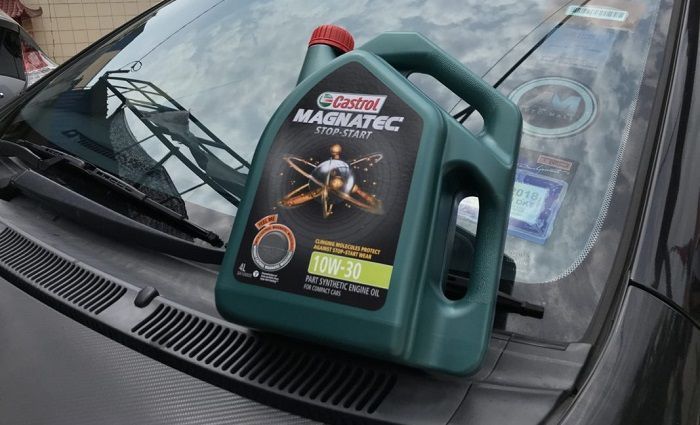
Both oils share the same cold-start performance envelope. The selection difference is entirely about sustained high-temperature protection. In regions where ambient temperatures regularly exceed 35°C (95°F), 10W40 provides a measurable safety margin. Desert climates, stop-and-go urban driving in summer heat, and towing in warm conditions all push oil temperatures higher.
Conversely, in temperate and cold climates — where engines rarely sustain peak oil temperatures — 10W30 delivers adequate protection with the added benefit of reduced internal friction. This is why most North American and European OEMs default to 30-weight recommendations for standard driving conditions.
Warning: Using 10W40 in an engine calibrated for 10W30 during winter driving provides zero cold-start benefit — both grades perform identically below -25°C — while increasing warm-up fuel consumption unnecessarily.
Mixing 10W30 and 10W40 of the same base type (both conventional or both synthetic) creates no chemical compatibility issues. The resulting blend produces a viscosity somewhere between the two grades. In an emergency top-off situation, this is perfectly acceptable.
However, running a mixed blend long-term introduces unpredictability. The exact viscosity of the mixture depends on the ratio, and neither the additive package nor the VI improvers are optimized for the resulting grade. Best practice: top off with whatever is available, then return to a single grade at the next full oil change.
The synthetic vs. conventional decision is independent of the 10W30/10W40 choice — but it amplifies the differences. Synthetic 10W40 maintains its viscosity profile across a wider temperature range than conventional 10W40. It also resists thermal breakdown longer, which extends useful oil life.

Full synthetic oils use fewer viscosity index improvers (VII polymers) to achieve their multi-grade rating. This matters because VII polymers are the first additives to shear down under mechanical stress. A synthetic 10W40 at 50,000 miles will hold closer to its original viscosity than a conventional 10W40 at 3,000 miles. For high-mileage engines where the step up to 40-weight is warranted, synthetic formulations deliver the most consistent protection.
Regular car care and maintenance — including timely oil changes — remains the single most impactful factor in engine longevity regardless of which grade is chosen.
Before switching grades, assessing current oil condition provides baseline data. Pull the dipstick and evaluate color, consistency, and level. Dark black oil with a gritty texture indicates excessive thermal breakdown or contamination — the grade switch alone will not solve an underlying issue like coolant intrusion or excessive blow-by.
For a more precise assessment, a used oil analysis (UOA) from a lab like Blackstone Laboratories provides wear metal counts, viscosity at 100°C, fuel dilution percentage, and TBN (Total Base Number) remaining. This data reveals whether the current grade is maintaining adequate film strength or breaking down prematurely.
Pro Insight: A single UOA costs roughly $30 and reveals more about engine health than any visual inspection. Trending results across multiple intervals exposes wear patterns invisible to the naked eye.
Switching between these grades requires no special flushing procedure. They share the same base oil compatibility and additive chemistry families. The process follows a standard oil change.
No break-in period is required. The engine's oil pressure sensor will confirm adequate pressure at idle within seconds of startup. If an engine has been running 10W30 for its entire service life and a switch to 10W40 is being considered, the most common triggers are increased oil consumption, persistent low oil pressure at hot idle, or a move to a significantly hotter climate. Keeping the air intake system clean is equally important — owners should know how often to change the car air filter to prevent contaminants from accelerating oil degradation.
The 10w30 vs 10w40 engine oil difference matters most when viewed through the lens of long-term wear accumulation. A single oil change with the "wrong" grade causes negligible harm. Running the suboptimal grade for 100,000 miles compounds marginal wear into measurable bearing erosion or ring wear.
Oil analysis at regular intervals — every other oil change is a practical cadence — creates a data-driven feedback loop. Key metrics to trend include iron (cylinder wear), copper and lead (bearing wear), silicon (dirt ingestion), and viscosity at 100°C (shear stability). If viscosity at 100°C drops below the grade's minimum specification before the drain interval, the oil is shearing out of grade and a different formulation or shorter interval is warranted.
Engines do not wear uniformly. An engine that shows elevated iron and low copper may have cylinder wall issues unrelated to bearing clearances — making the viscosity grade less relevant than addressing the root cause. Conversely, elevated copper and lead with stable iron suggests bearing wear where a step up from 10W30 to 10W40 could slow the progression.
The optimal strategy treats oil viscosity as one variable in a multi-factor equation. Oil quality, change intervals, filtration efficiency, operating temperature management, and fuel quality all interact. A high-quality synthetic 10W30 changed at 7,500 miles will outprotect a budget conventional 10W40 changed at 5,000 miles in most scenarios. The grade number is not a substitute for oil quality or maintenance discipline.
For vehicles that sit for extended periods between drives, cold-start protection matters more than hot-viscosity differences. Engines that warm up properly before sustained load — understanding how long to let a car warm up — experience dramatically less startup wear regardless of whether 10W30 or 10W40 is in the crankcase.
In many cases, yes. High-mileage engines with widened bearing clearances and increased oil consumption often benefit from 10W40's thicker film at operating temperature. However, "older" alone is not sufficient justification — the decision should be based on observed oil consumption rates, oil pressure readings at hot idle, and ideally used oil analysis data showing wear trends.
The thicker oil film creates marginally more hydrodynamic drag, which can reduce fuel economy by 1–2%. In real-world driving, this difference is often within measurement noise. If the engine genuinely needs the thicker oil for protection, the trade-off is justified — a spun bearing costs far more than a fraction of an MPG.
Both 10W30 and 10W40 carry the same "10W" winter rating and perform identically during cold starts down to approximately -25°C. The difference only manifests once the engine reaches operating temperature. In cold climates, 10W40 provides no cold-start advantage and adds unnecessary viscous drag during warm-up.
The owner's manual is the primary reference. It specifies the OEM-recommended viscosity grade based on factory bearing clearances and oil pump capacity. Deviations should be driven by measurable conditions: increased oil consumption, low hot-idle oil pressure, sustained high-temperature operation, or used oil analysis indicating viscosity shear below grade minimums.
The 10W30 vs. 10W40 decision ultimately comes down to matching oil film thickness to engine clearances and operating conditions. Start with the owner's manual recommendation, monitor oil consumption and pressure over time, and invest in at least one used oil analysis to establish a baseline. Armed with actual data rather than forum opinions, selecting the right grade becomes a straightforward engineering decision — not a guessing game.
 |
 |
 |
 |

About Diego Ramirez
Diego Ramirez has been wrenching on cars since his teenage years and has built a deep practical knowledge of automotive maintenance and paint protection through years of hands-on work. He specializes in fluid service intervals, preventive care routines, exterior protection products, and the consistent habits that extend a vehicle's lifespan well beyond average. At CarCareTotal, he covers car care guides, cleaning and detailing products, and exterior maintenance and protection reviews.
Get some FREE car parts & gear.. Or check out the latest free automotive manuals and build guides here.
Disable your ad blocker to unlock all the hidden deals. Hit the button below 🚗
| | | |
