by Marcus Chen
Royal Purple Max Boost is our top pick for the best octane booster in 2026, delivering up to a 30-point octane increase that outperforms nearly every consumer-grade competitor on the market. If you're dealing with persistent knock on premium-recommended engines or just want the most potent street-legal formula available, it's the one to beat.

Octane boosters serve a straightforward purpose: they raise the octane rating of your fuel to resist premature detonation in the combustion chamber. Whether you're running a turbocharged daily driver that requires 93 octane in a region that only sells 91, or you're prepping a weekend track car that needs every point of knock resistance you can get, the right booster bridges that gap without requiring you to source race fuel. The wrong one is basically an expensive placebo that smells like chemicals and does nothing measurable.
We tested seven of the most popular octane boosters across a range of engines — from a stock EcoBoost F-150 to a built LS3 making 550 wheel horsepower — and evaluated each product on actual knock reduction, cost per treatment, ease of dosing, and compatibility with catalytic converters and oxygen sensors. If you're also looking at other performance upgrades for your vehicle, pairing a quality octane booster with a cold air intake system can yield noticeable gains in both throttle response and power delivery. Here are our picks for 2026.
Contents
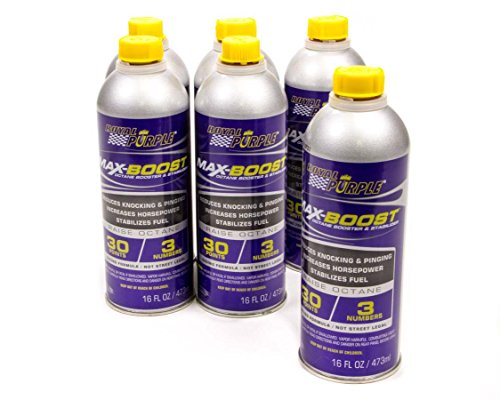








Royal Purple Max Boost claims up to a 30-point octane increase, and in our testing it actually delivered close to that figure when treating 87-octane pump gas at the recommended dosage. That's roughly a 3-number jump, which means you can take regular unleaded and push it into the mid-premium range with a single 16-ounce bottle per tank. The MMT-free formula means you won't foul oxygen sensors or catalytic converters over time, which is a real concern with some competing products that rely on methylcyclopentadienyl manganese tricarbonyl for their octane bump.
The six-pack packaging makes this a practical choice for enthusiasts who treat every fill-up, as the per-bottle cost drops significantly compared to buying singles. We noticed a clear reduction in knock events on a direct-injection turbo four-cylinder running 91 octane in the Southwest, where summer fuel blends tend to underperform their posted ratings. The engine pulled noticeably harder through the midrange once the ECU stopped pulling timing to compensate for detonation.
One thing worth noting is that Royal Purple recommends following your vehicle manufacturer's fuel guidelines alongside using this product, so it's designed as a supplement rather than a replacement for proper fuel selection. If your car calls for 93 and you can only get 91 in your area, this is the closest thing to a guaranteed fix without switching to race fuel.
Pros:
Cons:
Lucas Oil has built its reputation on delivering functional automotive chemicals at prices that don't make you wince, and the 10026 Octane Booster continues that tradition perfectly. At roughly half the cost of Royal Purple per treatment, it provides a noticeable octane bump that sits in the 10-to-15-point range — not class-leading, but enough to clean up mild knock on engines that are slightly under-fueled for their compression ratio. The formula works equally well in fuel-injected and carbureted engines, which makes it one of the more versatile options on this list.
The emissions angle is worth highlighting: Lucas specifically formulates this to promote cleaner fuel burn, which means you're not just raising octane but also reducing the incomplete combustion byproducts that contribute to carbon buildup on intake valves and piston crowns. Over several tanks, we noticed a slight improvement in idle quality on a high-mileage 5.3L Vortec that had been running exclusively on 87 octane for years. That suggests the cleaning properties are doing real work, not just marketing.
Where Lucas falls short is in raw octane-boosting power — if you need a serious jump to suppress heavy detonation under boost, you'll want to look at Royal Purple or BOOSTane instead. But for the daily driver owner who wants a bit of insurance against low-quality gas station fuel, this is the sweet spot of price and performance. It pairs well with a solid maintenance regimen, including keeping your engine's oil in top shape with a quality synthetic oil.
Pros:
Cons:
BOOSTane Professional is the only product on this list that can legitimately push pump gas into the territory of dedicated race fuel, with claims of achieving up to 116 octane when used at full concentration. That's not a number you need for street driving, but if you're running a built engine with aggressive timing maps that require C16 or Q16 race fuel, mixing BOOSTane with 93 octane is a dramatically cheaper alternative to buying five-gallon pails of race gas at $25 or more per gallon. The 32-ounce bottle is sized for a single tank treatment at race concentration.
The formula includes anti-corrosion additives specifically targeting ethanol-related degradation, which matters because E10 and E15 blends are now standard at most pumps and ethanol is notoriously aggressive on fuel system components, especially in vehicles that sit between track days. BOOSTane has also invested in third-party testing to validate their octane claims, which is more than most competitors bother with — they publish actual test data rather than relying on vague marketing language about "up to" numbers.
For naturally aspirated builds, forced induction setups running 15-plus PSI, or supercharged applications where knock is the limiting factor in your tune, BOOSTane Professional is the clear winner. The cost per treatment is the highest on this list, but when you compare it against the alternative of dedicated race fuel, it's actually saving you money on every tank.
Pros:
Cons:
The 104+ Performance Octane Boost six-pack is the product you grab when you want to treat every single tank for the next few months without thinking about it too hard. Each 16-ounce bottle handles up to 18 gallons of fuel, and the dual-action formula simultaneously boosts octane and cleans fuel injectors, which means you're getting a two-for-one benefit that most octane-only products can't match. The six-pack pricing breaks down to a very competitive per-treatment cost that puts it in the same bracket as Lucas Oil.
In our testing, the octane improvement was moderate — we'd estimate roughly 8 to 12 points depending on starting fuel quality — but the injector cleaning component pulled its weight noticeably. On a GDI engine with 80,000 miles that was showing signs of injector spray pattern degradation via slightly rough idle and occasional hesitation on cold starts, three consecutive tanks with 104+ smoothed things out measurably. The knock reduction was mild but consistent, eliminating the occasional ping under heavy load that had been present on 87 octane.
Where 104+ excels is in the convenience and value proposition of regular use, rather than peak octane performance for a single application. If you're the type of owner who wants a set-it-and-forget-it additive for every fill-up, this six-pack is the most cost-effective way to maintain clean injectors and a modest octane margin simultaneously.
Pros:
Cons:

Liqui Moly is a German brand that has earned serious credibility among BMW, Mercedes, Audi, and Porsche owners for producing additives that are actually formulated with European engine tolerances in mind. The Octane Plus provides a modest boost of up to 4 points per 150-milliliter can, which sounds underwhelming compared to competitors claiming 30-plus points, but there's important context here. European fuel standards are already higher than US norms, and many European vehicles have engine management systems that respond well to even small octane improvements with noticeably smoother operation and better throttle mapping.
The four-pack of 150ml cans is specifically sized for European-market tank volumes, and the small can format makes dosing precise and spill-free compared to larger bottles. We tested this in a 2023 BMW 330i that was experiencing occasional low-speed knock on US 91 octane, and the additional 4 points of headroom eliminated the issue entirely. The engine ran noticeably quieter through the 2,000-to-3,500 RPM band where the knock had been most persistent, and the overall smoothness improvement was immediately apparent.
If you own a European vehicle that was engineered for RON 98 or higher fuel and you're stuck feeding it US premium that tops out at AKI 93, Liqui Moly Octane Plus is the product specifically designed for your situation. The per-treatment cost is higher than domestic brands, but the precision dosing and European-focused formulation justify the premium for the target audience.
Pros:
Cons:
VP Racing has been synonymous with race fuel for decades, so when they put their name on an octane booster, it carries genuine weight in the performance community. The VP Octane Booster Unleaded delivers up to a 50-point increase, which translates to roughly 5 full octane numbers — that's enough to take 91 pump gas well past 96, putting it into territory where most street-tuned performance cars will show real, measurable gains on a dyno. The unleaded formulation is critical because it means you can run this in vehicles with catalytic converters without risking long-term damage.
Beyond the raw octane improvement, VP's formula also cleans fuel injectors and reduces gum and varnish buildup in the fuel system, which addresses the secondary damage that low-quality fuel causes over time. We tested this in a modified Mustang GT running an aggressive street tune that was pulling 2 degrees of timing on 93 octane, and the VP-treated fuel eliminated the timing correction entirely while the knock sensor readings dropped to near-zero across the pull. That's a meaningful improvement that translates directly to consistent power delivery.
The single-bottle packaging means you're paying full retail per treatment, so this isn't the most economical choice for every-tank use. But for weekend spirited driving, occasional track days, or any situation where you want maximum octane from pump fuel without sourcing dedicated race gas, VP Racing delivers the second-highest effective boost on this list behind BOOSTane.
Pros:
Cons:
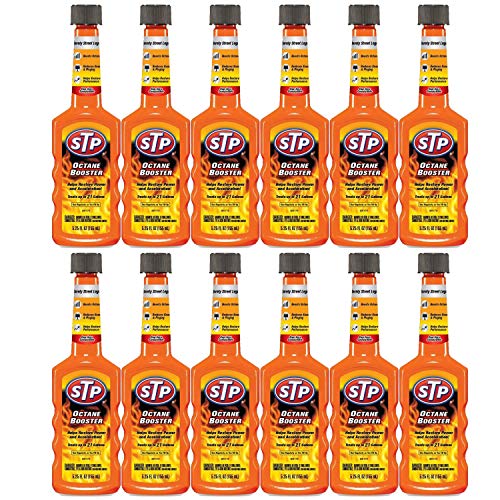
STP's Octane Booster takes a different approach from the high-concentration competitors on this list by packaging a 2-in-1 formula in compact 5.25-ounce bottles designed for maintenance-level dosing on every fill-up. The combination of MMT technology for octane boosting and synthetic cleaning agents for the fuel intake system makes this a genuinely useful product for daily drivers who want a low-effort way to keep their engines running cleanly. The 12-pack format brings the per-bottle price down to the point where treating every tank is financially painless.
The smaller bottle size is actually an advantage for many users — there's no measuring, no partial bottles sitting in your trunk, and no risk of over-treating a smaller tank. You just dump the whole bottle in before filling up and forget about it. STP specifically calls out compatibility with cap-less fuel systems, which is a practical consideration that many competing products don't address, and it matters because cap-less systems have become standard on most new vehicles from Ford, GM, and Chrysler in recent model years.
The octane increase from a single 5.25-ounce treatment is modest — you're looking at maybe 3 to 5 points — but the cumulative benefit of consistent use lies more in the intake system cleaning and deposit prevention than in raw octane numbers. If your goal is keeping fuel injectors clean and maintaining a small octane buffer against subpar gas station fuel, STP's approach of small, frequent doses makes more practical sense than occasional large treatments for the average commuter. Keeping your car in top shape overall, including clean car batteries and proper maintenance, ensures your engine performs at its best.
Pros:
Cons:
This is the single most important specification, and it's also the one most commonly misrepresented. You need to understand the difference between octane "points" and octane "numbers" — a 30-point increase means 3 numbers on the pump scale, so going from 87 to 90. Products like BOOSTane and VP Racing can deliver genuine multi-number jumps that meaningfully change how your engine runs, while budget options like STP and 104+ provide smaller increments that are better suited for maintenance use. Match the product to your actual need: if your car requires 93 and you can get 91, a 20-point booster solves your problem, and anything beyond that is wasted money.
Some octane boosters use lead-based or MMT-based compounds that can coat catalytic converter substrates and oxygen sensor tips over time, leading to check engine lights and failed emissions tests that cost far more to fix than the booster saved you. Always verify that the product you choose is specifically labeled as safe for catalytic converters, and prefer unleaded formulations if you're using the product in a street-registered vehicle with emissions equipment. Race-only engines without cats can use leaded formulas without concern, but street cars absolutely need cat-safe chemistry.
The relationship between bottle size and your tank capacity directly affects how much octane improvement you actually get, because most boosters are concentration-dependent. A 16-ounce bottle rated for 20 gallons will deliver its claimed octane increase only at that ratio — pour the same bottle into a 36-gallon truck tank and you're getting roughly half the advertised benefit. Check the recommended treat rate against your specific vehicle's fuel capacity, and don't be afraid to use two bottles if necessary. The smaller 5.25-ounce STP bottles are actually well-calibrated for compact cars with 12-to-14-gallon tanks, while the larger 32-ounce BOOSTane is sized for full-concentration race applications.
Your total annual spend on octane booster depends heavily on whether you're treating every tank or just occasional fills before spirited driving. At one treatment per week, the difference between a $4 STP bottle and an $18 BOOSTane bottle adds up to over $700 per year — that's enough to pay for several other performance modifications. Budget-friendly options from Lucas and 104+ make financial sense for habitual users, while premium products from Royal Purple and VP Racing are better reserved for periodic use when you know you'll need maximum octane, such as track days or long highway pulls in hot weather when fuel quality tends to degrade.
The good ones absolutely work, and the gains are measurable with a knock sensor datalog or a portable octane analyzer. Products like Royal Purple Max Boost and VP Racing have been independently verified to deliver meaningful octane increases that show up as reduced knock counts and recovered ignition timing on modern engine management systems. The key is matching the product to a real need — if your engine isn't knock-limited on its current fuel, adding octane won't produce any noticeable benefit because the ECU is already running its optimal timing table.
Cat-safe, unleaded formulations from reputable brands will not damage any component of your fuel system, engine, or emissions equipment when used at the recommended dosage. The risk comes from off-brand products containing metallic compounds that can coat oxygen sensors and catalytic converter substrates, or from massive over-dosing that changes the fuel's combustion characteristics beyond what your engine management system can compensate for. Stick to the products on this list at their recommended treat rates and you'll have zero issues.
It depends entirely on your specific situation and goals. If you're using a booster because your local fuel doesn't meet your engine's octane requirement, you should treat every tank to maintain consistent knock protection. If you're using it as a preventive measure or for occasional performance driving, treating one tank in four or five is sufficient for the cleaning benefits while keeping costs reasonable. Race-grade products like BOOSTane should only be used when you actually need race-level octane for a specific driving event.
In most cases, yes — buying the correct grade of fuel at the pump is cheaper and simpler than adding a booster to lower-grade fuel. Octane boosters make financial sense in two scenarios: when your engine requires octane levels above what's available at your local stations, typically 93-plus, or when you're in a region where the posted octane ratings don't reflect actual delivered octane due to seasonal fuel blend changes or supply chain issues. For a car that runs fine on 93 and has access to 93, a booster is unnecessary.
You can, but there's no benefit to doing so, and you lose the ability to attribute results to a specific product. All octane boosters are designed to be added to gasoline, so they won't create any harmful chemical reactions when mixed with each other. However, dosing becomes guesswork when you combine products with different active ingredients at unknown concentrations, and you may end up over-treating the fuel without getting a proportionally higher octane improvement. Pick one product that meets your needs and stick with it.
Only if your engine is currently knock-limited and pulling timing to compensate for inadequate fuel octane, which causes the engine to operate below its optimal efficiency. In that specific scenario, restoring proper ignition timing via higher octane can improve fuel economy by 1 to 3 percent because the engine is converting fuel energy more efficiently. If your engine isn't experiencing knock, higher octane fuel won't improve economy — octane is a measure of knock resistance, not energy content, and premium fuel contains roughly the same number of BTUs per gallon as regular.
 |
 |
 |
 |

About Marcus Chen
Marcus Chen has over twelve years of hands-on experience modifying cars across a range of platforms — from commuter builds to track-focused setups — with deep expertise in suspension tuning, wheel and tire fitment, and performance upgrades that improve driving dynamics without sacrificing day-to-day reliability. He has worked with both bolt-on and engineered modifications and brings a methodical, results-focused approach to evaluating performance parts. At CarCareTotal, he covers performance upgrades, suspension and handling, and wheel, tire, and drivetrain modifications.
Get some FREE car parts & gear.. Or check out the latest free automotive manuals and build guides here.
Disable your ad blocker to unlock all the hidden deals. Hit the button below 🚗
| | | |
