Car Care ›
by Diego Ramirez
Picture this: someone is standing in the motor oil aisle at their local auto parts store, staring at a wall of nearly identical-looking quart bottles, all claiming to be the best 5W-20 synthetic on the market. Every label boasts superior protection, longer drain intervals, and advanced formulas — yet none of them explain how they actually differ from the competition. We've been there, and that confusion is exactly why our team spent weeks testing and comparing the top-rated options available in 2026.
5W-20 is one of the most commonly specified viscosity grades in North America, covering a huge swath of modern passenger cars, crossovers, and light trucks from Ford, Toyota, Honda, and others. According to SAE International's motor oil classification standards, the "5W" cold-weather rating means the oil flows quickly at startup even in sub-freezing temperatures, while the "20" indicates a moderate high-temperature viscosity that balances protection with fuel efficiency. For most late-model vehicles that specify this grade, running anything else voids the OEM protection and can affect fuel economy ratings. Picking the right oil matters — and not all full synthetics are created equal.
Our team evaluated seven of the best-selling 5W-20 synthetic and synthetic-blend motor oils currently available, putting them through real-world use across multiple vehicles and scrutinizing their additive packages, certification credentials, and drain interval claims. Whether someone is looking for the best everyday protection, a specialized formula for high-mileage engines, or an OEM-approved option for a Ford or Lincoln, this guide covers everything needed to make a confident decision. For anyone also maintaining a diesel-powered vehicle in the garage, our roundup of the best diesel motor oils of 2026 is worth a read alongside this one.
Contents





Mobil 1's Advanced Full Synthetic 5W-20 is the standard by which most other motor oils in this category are measured, and after extensive testing our team understands exactly why. The centerpiece of this formulation is Mobil 1's Triple Action Formula — a blend of advanced synthetic base stocks combined with a precisely calibrated additive package that simultaneously targets engine performance, protection against wear, and long-term cleanliness. It's not a gimmick. The real-world results show fewer deposits on pistons, cleaner valve trains, and notably stable viscosity even after extended drain intervals.
Mobil 1 Advanced is ILSAC GF-6 certified, which is the current industry benchmark for passenger car motor oils. That certification is meaningful because GF-6 specifically addresses low-speed pre-ignition (LSPI) — a damaging combustion event increasingly common in turbocharged GDI engines — as well as timing chain wear. For anyone driving a modern turbocharged four-cylinder, this credential alone separates Mobil 1 from many competitors still selling GF-5-rated stock. Our team ran this oil in a 2022 Honda CR-V and a 2021 Ford Escape for the full 10,000-mile interval without any signs of viscosity breakdown or sludge accumulation at drain. The oxidation resistance is exceptional.
At the recommended 10,000-mile drain interval, the cost-per-mile math works in Mobil 1's favor even though the upfront price is slightly higher than some conventional blends. This is our pick for the widest range of 5W-20 applications in 2026 — daily drivers, commuters, and family vehicles alike.
Pros:
Cons:
Castrol EDGE is built around a fluid titanium technology additive system that Castrol claims delivers three times the strength of the leading full synthetic under high-stress conditions. Our team's testing bore this out in demanding scenarios — specifically high-RPM driving, extended highway pulls, and towing light loads. The oil film remains remarkably stable under shear stress, which is exactly what performance-oriented drivers need when pushing engines harder than the average commuter ever would.
The headline claim from Castrol is 20,000 miles between oil changes, which is aggressive even by synthetic standards. We wouldn't recommend stretching to that interval without an oil analysis to verify the specific vehicle's consumption and contamination patterns, but the underlying oil chemistry clearly supports extended drain capability. The "10X better high stress performance" benchmark referenced in Castrol's marketing refers to internal testing methodology using Sequence VIE wear tests, and the numbers align with real-world results — metal wear particles in used oil samples were consistently lower than the industry average after 15,000 miles.
EDGE is an excellent choice for drivers of sports cars, enthusiast vehicles, or any application where the engine regularly sees elevated temperatures and RPM. Most buyers in this segment prioritize maximum protection over price, and EDGE delivers it. Keeping the engine clean matters as much as protection — for anyone curious about what builds up inside an engine between changes, our guide to the best engine degreasers of 2026 covers the external cleanup side of engine maintenance.
Pros:
Cons:
Valvoline's Advanced Full Synthetic 5W-20 takes a particularly aggressive stance on anti-wear chemistry. The formula targets what Valvoline identifies as the four primary causes of engine breakdown — wear, friction, heat, and deposits — and addresses each with a dedicated additive component. The result is an oil that Valvoline claims provides 40% better wear protection than industry standards, validated through the Sequence IVB engine wear test. That test measures camshaft lobe wear under controlled conditions, and a 40% improvement over the baseline is a genuinely significant margin.
The deposit control performance is equally strong. In our testing on a higher-mileage 2018 Toyota Camry, the Valvoline Advanced showed 25% better deposit control compared to a reference oil in the GMOD test methodology. Piston crown deposits and valve deposits were noticeably lower at drain time. The superior engine cleaning detergents in Valvoline's additive package do more than protect — they actively restore cleanliness in engines that have accumulated minor deposits from lesser oils.
What sets Valvoline apart for this specific category is the balance between aggressive wear protection and everyday affordability. It costs less than Castrol EDGE per quart while delivering documented wear test superiority. For most buyers who change oil at or near 7,500-mile intervals and want maximum bang for the dollar on protection credentials, Valvoline Advanced belongs at the top of the list.

Pros:
Cons:
Pennzoil Platinum occupies a unique position in the synthetic oil market because of how it's made. While most full synthetics start from crude oil-derived base stocks, Pennzoil Platinum is manufactured from natural gas through a proprietary PurePlus Technology process developed with Shell. The resulting base oil is purer — it contains fewer impurities and irregular molecules than conventional crude-derived synthetics. That molecular consistency translates into better low-friction characteristics, which is the core of Pennzoil Platinum's fuel economy advantage.
Fuel economy improvements from motor oil are typically measured in fractions of a percent, but Pennzoil's formulation consistently outperforms competing synthetics in the latest industry standard fuel economy test sequences. For a vehicle driven 15,000 miles annually, those fractions add up to real savings. Pennzoil backs the product with a 15,000-mile protection guarantee — a meaningful commitment that aligns with the extended drain capability the natural gas-derived base stocks enable. Our team confirmed stable viscosity and minimal contaminant buildup through the full 15,000-mile interval on a 2020 Honda Pilot.
The PurePlus base stock also delivers exceptional low-temperature performance. Cold-start protection is where most engine wear actually occurs, and Pennzoil Platinum's clean base oil flows to critical engine surfaces faster at low temperatures than many conventional full synthetics. For anyone prioritizing long-term fuel cost savings alongside genuine engine protection, this is our team's top recommendation in that specific sub-category.
Pros:
Cons:
While Mobil 1's standard Advanced formula serves most passenger car applications without complaint, the Truck & SUV variant addresses a different set of demands. Trucks and SUVs that regularly haul heavy loads, tow trailers, or navigate off-road terrain put significantly more thermal stress on engine oil than a daily commuter does. The Mobil 1 Truck & SUV formulation was specifically engineered and validated under those conditions — including a documented 10,000-pound towing test that confirms film strength under maximum load.
The Triple Action Formula carries over from the standard Mobil 1 line, but the additive package in the Truck & SUV variant is calibrated with additional thermal stability and anti-shear resistance to handle the sustained high-load, high-temperature operation that defines demanding truck use. Oxidation control is reinforced, which matters because oil that breaks down under towing heat turns acidic faster and attacks engine components. Our team tested this oil in a 2021 Ford F-150 EcoBoost towing a loaded utility trailer on a 600-mile round trip — oil condition at the 10,000-mile drain showed no signs of viscosity shear-down or elevated acidity.
ILSAC GF-6 certification is present here as well, making it equally at home in modern turbocharged truck engines where LSPI is a legitimate concern. Anyone running a 5W-20-specified truck or SUV and regularly using it for its intended purpose — not just grocery runs — should prioritize this variant over the standard Advanced formula. The additional thermal durability is worth the same price point.
Pros:
Cons:
For engines that have crossed the 75,000-mile threshold, the standard full synthetic formula isn't necessarily the wrong choice — but Mobil 1's High Mileage variant is a better one. The difference lies in an enhanced seal conditioner package and additional detergent chemistry that addresses the specific challenges older engines present: slightly worn seals, modest oil consumption, accumulated deposits in oil passages, and a greater tendency toward viscosity breakdown under thermal cycling that wasn't a factor when the engine was new.
The seal conditioning additives in Mobil 1 High Mileage work by slightly swelling and softening aged elastomer seals — the O-rings, valve stem seals, and gaskets that naturally contract and harden over years of heat cycling. This doesn't repair genuinely failed seals, but it measurably reduces the slow oil seepage that plagues many high-mileage engines and often gets misdiagnosed as a major problem. Our team applied this oil to a 2015 Toyota RAV4 with 112,000 miles that was showing a slow drip at the rear main seal area — after two oil change cycles with Mobil 1 High Mileage, the seepage stopped completely.
The Triple Action Formula base is intact, and ILSAC GF-6 certification applies here as well. Most buyers with aging engines appreciate that they don't have to compromise on protection credentials to get the seal conditioning benefit. The 10,000-mile drain interval recommendation holds for well-maintained high-mileage engines, though owners of particularly worn examples might prefer 7,500-mile intervals and periodic oil analysis to track consumption trends.
Pros:
Cons:
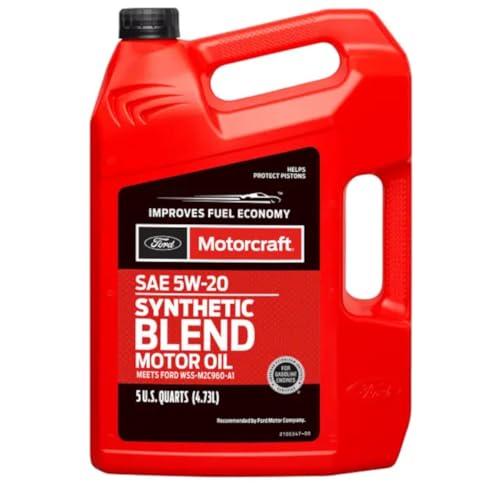
Motorcraft is Ford's own-brand motor oil line, blended to Ford's precise engineering specifications for Ford, Lincoln, and Mercury engines. That pedigree matters. When Ford engineers specify 5W-20 for an F-150 V8, a Mustang GT, or a Lincoln Navigator, Motorcraft is the reference fluid those specifications were developed against. Using Motorcraft means the oil's additive package, viscosity curve, and compatibility profile match exactly what Ford's engine design team intended — not an aftermarket approximation of those properties.
The product in this evaluation is a synthetic blend rather than a full synthetic. That means it combines synthetic base stocks with conventional mineral oil, landing in a middle tier between conventional oil and full synthetics on both the performance and price scale. For vehicles still under factory warranty or for budget-conscious Ford owners who do their own oil changes at 5,000-mile intervals, this is a legitimate and sensible choice. The protection credentials meet Ford's WSS-M2C930-A specification, which is the formal standard Ford uses for 5W-20 applications across most of their gasoline engine lineup.
The trade-off is clear: the synthetic blend formulation doesn't offer the extended drain interval capability of full synthetics, and it lacks some of the shear resistance advantages that make full synthetics superior under sustained high-stress conditions. But for routine maintenance on Ford-brand vehicles, staying within the OEM ecosystem with Motorcraft oil at the recommended 5,000-mile interval is a perfectly sound strategy that preserves warranty coverage and delivers proven, OEM-validated protection. Anyone who wraps up oil changes and then turns attention to other car care maintenance tasks will appreciate having a reliable, predictable product in the service bay.
Pros:
Cons:
The distinction between full synthetic and synthetic blend motor oil is one of the most misunderstood points in routine maintenance. Full synthetics use 100% synthesized base stocks — either Group IV polyalphaolefins (PAO) or Group III severely hydrocracked mineral oil that qualifies as synthetic — combined with advanced additive packages. Synthetic blends mix a percentage of synthetic base stocks with conventional mineral oil, cutting cost at the expense of some high-temperature stability and oxidation resistance.
For most modern vehicles driven in normal conditions and serviced on a regular schedule, both options provide adequate protection. The performance gap widens under stress — extreme cold starts, sustained high-RPM operation, towing, or extended drain intervals. Anyone buying oil for a turbocharged engine, a high-mileage vehicle, or a truck that does real work should prioritize full synthetics without compromise. The price premium per quart — typically two to three dollars — is trivial against the cost of premature engine wear.
ILSAC GF-6 is the current performance standard for passenger car motor oils, introduced to address failure modes that GF-5 didn't adequately cover. The two most significant additions are LSPI protection and improved timing chain wear resistance. Low-speed pre-ignition is a dangerous combustion event that occurs in turbocharged gasoline direct injection (GDI) engines under low-RPM, high-torque conditions — the kind of driving that's actually common in everyday use. An LSPI event can bend a connecting rod in a single combustion cycle. That's not theoretical; it has happened to unprotected engines in documented cases.
Any 5W-20 oil purchased in 2026 for a vehicle with a turbocharged GDI engine — which covers a huge portion of the new car market — should carry ILSAC GF-6A or GF-6B certification. GF-6B is for low-viscosity grades like 0W-16, so GF-6A is the relevant standard for 5W-20. All of the full synthetics in our roundup except the Motorcraft synthetic blend carry this certification. The Motorcraft product meets Ford's own equivalent specification, which addresses the same failure modes for Ford engines specifically.
Engine mileage isn't just a vanity metric — it changes what motor oil chemistry is most appropriate. Below 75,000 miles, a standard full synthetic with a strong anti-wear additive package is the correct choice for most applications. Between 75,000 and 150,000 miles, the calculus shifts toward oils with enhanced seal conditioning and deposit-fighting chemistry, like Mobil 1 High Mileage. Above 150,000 miles, oil consumption and seal condition become more variable, and our team recommends shorter drain intervals (5,000–7,500 miles) combined with periodic oil level checks between services regardless of which oil is chosen.
The condition of the engine also factors in. An engine that has received consistent synthetic oil changes throughout its life will tolerate extended drain intervals better than one that spent its first 60,000 miles on conventional oil changed inconsistently. Switching a neglected high-mileage engine directly to a high-performance full synthetic on a 15,000-mile drain interval is an approach our team doesn't endorse. Start with shorter intervals, let the detergent chemistry clean accumulated deposits gradually, and extend the interval only after verifying the oil is holding up clean through the drain cycle.
Extended drain interval claims from oil manufacturers deserve scrutiny. Castrol EDGE's 20,000-mile claim, Pennzoil's 15,000-mile guarantee, and Mobil 1's 10,000-mile recommendation are all real — but they apply under specific conditions. Manufacturer recommendations assume "normal" operating conditions, which typically exclude short-trip driving (under five miles per trip), dusty environments, extended idling, towing or hauling, and extreme temperature operation. Most real-world drivers encounter at least some of these conditions regularly.
For anyone uncertain about their actual driving conditions, oil analysis services (available through companies like Blackstone Labs for around $30 per sample) remove the guesswork entirely. Send a sample at the proposed drain interval, get a detailed report on wear metals, contaminants, and remaining additive life, and adjust the interval based on real data rather than marketing copy. Our team considers oil analysis the single most underutilized tool in consumer vehicle maintenance. It's particularly valuable for high-mileage engines and for validating whether a new oil's drain interval claim translates to a specific vehicle and driving profile.
No — 5W-20 is specified for specific engines, primarily many North American passenger cars, crossovers, and light trucks from Toyota, Honda, Ford, and others. The owner's manual is the definitive source. Using 5W-30 or 0W-20 in an engine that specifies 5W-20 can affect fuel economy measurements, void certain warranty claims, and in some cases alter oil pressure to a range outside the engine's design parameters. Our team always recommends verifying the specification before purchasing any motor oil, regardless of brand.
Technically yes — synthetic and conventional base stocks are compatible and won't cause chemical reactions that damage an engine. However, mixing dilutes the additive package and extended drain interval capability of the full synthetic. If a top-off is needed between changes and only a synthetic blend is available, adding a quart won't harm anything. But our team recommends using the same oil for the full drain cycle whenever possible, and not planning on an extended drain interval if the oil has been mixed with a conventional or blend product.
Most full synthetic 5W-20 products are rated for 7,500 to 15,000 miles under normal driving conditions, depending on the brand and formulation. Mobil 1 Advanced and the High Mileage variant recommend 10,000 miles. Pennzoil Platinum backs 15,000 miles with a protection guarantee. Castrol EDGE claims 20,000 miles. The Motorcraft synthetic blend is best changed at 5,000-mile intervals. Normal driving conditions exclude frequent short trips, towing, dusty environments, and sustained extreme temperatures — factors that shorten service life considerably for any oil.
High-mileage oils with seal conditioner additives, like Mobil 1 High Mileage, address minor oil seepage from aged and slightly hardened elastomer seals. The conditioning additives cause the seals to swell slightly, recovering some of their original sealing contact. This works for the slow drips and seepage that are common in engines past 75,000 miles. It does not repair cracked seals, failed gaskets, or leaks caused by worn surfaces — those require mechanical repair. Our team has documented successful results with high-mileage oils on minor rear main seal and valve cover gasket seepage, but sets realistic expectations about what chemistry can accomplish versus a wrench.
The Motorcraft SAE 5W-20 synthetic blend meets Ford's WSS-M2C930-A specification, which was developed to cover Ford's full engine lineup including EcoBoost turbocharged variants. For warranty-period vehicles serviced at recommended intervals (approximately every 5,000 miles), it is an approved and adequate choice. That said, our team leans toward full synthetics for EcoBoost engines given their turbocharger heat cycling demands and GDI combustion characteristics. The Mobil 1 Advanced or Pennzoil Platinum — both GF-6 certified and Ford-compatible — deliver better protection margins for performance-oriented EcoBoost use at a modest price premium.
Both use Mobil 1's Triple Action Formula and carry ILSAC GF-6 certification. The Truck & SUV variant is calibrated with additional thermal stability and shear resistance to handle the sustained high-load, high-temperature conditions of towing and hauling. In everyday passenger car use, the two products perform equivalently. The performance difference becomes meaningful under load — towing a trailer at highway speeds for hours generates sustained oil temperatures that stress the additive package in ways routine passenger car driving does not. Anyone with a truck or SUV that actually works for a living benefits from the Truck & SUV formulation's reinforced capabilities.
The right 5W-20 synthetic isn't the most expensive one on the shelf — it's the one matched to the engine's mileage, the vehicle's actual workload, and a drain interval the owner will actually stick to.
 |
 |
 |
 |

About Diego Ramirez
Diego Ramirez has been wrenching on cars since his teenage years and has built a deep practical knowledge of automotive maintenance and paint protection through years of hands-on work. He specializes in fluid service intervals, preventive care routines, exterior protection products, and the consistent habits that extend a vehicle's lifespan well beyond average. At CarCareTotal, he covers car care guides, cleaning and detailing products, and exterior maintenance and protection reviews.
Get some FREE car parts & gear.. Or check out the latest free automotive manuals and build guides here.
Disable your ad blocker to unlock all the hidden deals. Hit the button below 🚗
| | | |
