by Liam O'Brien
If you need one recommendation right now: the BIG RED TR6350 Torin Rolling Pneumatic Creeper is the best all-around pick for 2026 — it delivers comfort, durability, and genuine versatility that flat board creepers simply can't match. That said, the right creeper depends entirely on the kind of work you do, so read on before you decide.
A mechanic's creeper is one of those tools you underestimate right up until you spend 45 minutes on bare concrete chasing a brake line leak. Whether you're dropping a transmission, replacing wheel bearings, or just doing a routine oil change, the right creeper protects your back, keeps your tools within reach, and lets you move freely under the vehicle. The 2026 market offers more variety than ever — traditional flat board creepers, padded rolling stools, topside engine creepers for reaching into truck bays, and even USA-made professional models built to outlast the rest of your tool collection. If you're rounding out your shop setup, our tools guide covers everything from diagnostic gear to garage organization. And if you're already running compression tests on that engine you're about to work on, our guide to the best compression testers is worth a read before you start.
For this review, we evaluated seven of the best-selling mechanic's creepers across distinct categories: flat creepers, rolling pneumatic stools, combination creeper-seats, high-capacity topside engine creepers, and foldable options. According to Wikipedia's overview of the creeper tool, these devices have been a shop staple since the early 20th century — but modern designs have transformed them into purpose-built ergonomic tools. We break down each one below with honest pros, cons, and a clear verdict on who it's right for.
Contents








Before you replace your entire creeper, consider whether your current one just needs better wheels. The Wilmar 248259 Nylon Creeper Caster Upgrade is a pack of two replacement casters designed to bring new life to aging shop creepers with worn, cracked, or stiff wheels. At 3 inches in diameter and 0.62 inches wide, these nylon casters fit a broad range of standard creeper frames and roll noticeably smoother on concrete, epoxy-coated floors, and even rough painted surfaces.
The nylon construction hits a practical sweet spot — harder than rubber for smoother rolling on flat surfaces, but light enough that they don't add unnecessary weight to the creeper. Installation is straightforward on most creeper frames with standard bolt patterns, though you'll want to confirm your creeper's caster mounting hole dimensions before ordering. If your creeper frame is otherwise sound, this is one of the most cost-effective upgrades you can make rather than scrapping a good creeper over bad wheels. Speaking of shop maintenance, a clean garage floor makes a real difference in how smoothly creepers roll — check out our guide to the best garage floor coatings if you're also thinking about a floor upgrade.
This isn't a standalone creeper — it's an accessory. But for mechanics who've invested in a quality creeper and just need fresh casters, the Wilmar 248259 delivers solid performance at a fraction of replacement cost. The pack of two gives you enough to replace worn casters at one end of your creeper or to have a spare on hand.
Pros:
Cons:
The BIG RED TR6350 is our top overall pick for 2026, and it earns that spot by doing everything a shop seat should do without overcomplicating the design. This is a rolling pneumatic creeper stool — which means it adjusts in height using a pneumatic cylinder, like an office chair, letting you dial in your working position whether you're at the front of an engine bay, seated beside a wheel well, or working at a low bench. The large, segmented tool tray built into the base is genuinely useful: it holds ratchets, sockets, pliers, and small parts without them rolling off, which saves you from constantly getting up to fetch tools from your cart.
The padded vinyl seat is thickly cushioned and holds up well to extended shop sessions. If you've ever finished a brake job on a hard metal stool and felt it in your tailbone for the next two days, you'll immediately appreciate the difference. The pneumatic height adjustment works smoothly and locks reliably — there's no sag or slow descent that you sometimes see on cheaper pneumatic stools. The casters roll well on smooth concrete and epoxy floors, though they're not the best on rough or cracked surfaces. This stool is ideal for work you do seated beside or over the engine bay, not for getting under the vehicle.
For home mechanics and professional technicians alike, the TR6350 represents serious value. It's robust enough for daily shop use, comfortable enough for long sessions, and practical enough that the tool tray actually gets used rather than ignored. If you do most of your work at waist height — carburetors, brakes, suspension components — this is the seat that belongs in your garage in 2026.
Pros:
Cons:
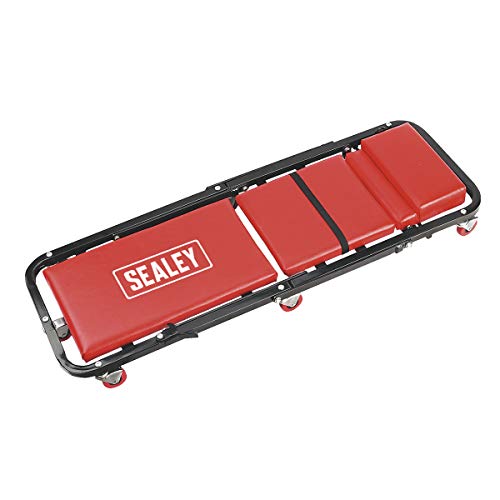
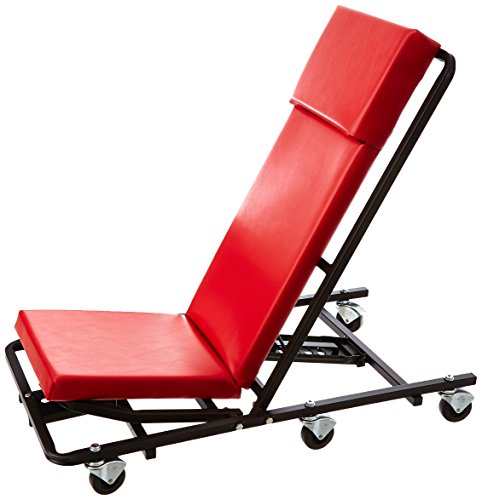
The Sealey Scr79 is a combination creeper and seat built on a powder-coated tubular steel frame — a design that's been trusted in professional UK workshops for years and continues to earn its place in 2026. The standout feature is the five-position adjustable head and back rest, which lets you recline at different angles depending on whether you're sliding under a car or sitting upright for engine work. That flexibility makes the Scr79 a genuine two-in-one tool rather than just a marketing claim.
Seven smooth-rolling 60mm ball bearing swivel castors are the headline spec here, and they live up to it. Seven contact points spread the load better than a standard four-caster creeper, and the ball bearing construction means these wheels glide rather than drag across the shop floor. The padded vinyl cushions on the seat and back provide real comfort — not the thin foam padding you get on budget creepers that compresses flat within a month. The powder-coated steel frame resists rust and takes the occasional tool drop without denting or bending out of shape.
If you split your time between under-car work and seated engine-bay tasks, the Sealey Scr79 eliminates the need to own two separate pieces of equipment. It's a well-built, thoughtfully designed piece of shop furniture that positions itself as a long-term investment rather than a disposable tool. For mechanics who want one versatile unit at a competitive price point, this is a strong contender.
Pros:
Cons:
The K Tool International 74961 is built for professional technicians who spend hours in the shop every day and need equipment that keeps up. The adjustable headrest is the first thing you notice — it lets you customize the recline angle to match the exact clearance under whichever vehicle you're working on, which makes a real difference when you're doing intricate work rather than just sliding back and forth. The fully padded construction, from the seat to the back support, provides consistent cushioning that doesn't flatten out after a few months of use.
Six 2-inch oil-resistant rubber casters are the practical core of this creeper's mobility system. Oil resistance is not a marketing gimmick in a real shop environment — standard rubber casters absorb oil and brake fluid over time, which makes them swell, drag, and eventually crack. The K Tool 74961's casters resist that degradation, which means they keep rolling smoothly even in workshops where fluids regularly hit the floor. The epoxy-coated steel frame adds corrosion resistance and a clean, professional appearance that holds up to the wear of daily shop life.
This is a purpose-built professional tool. It won't win on price against entry-level creeper seats, but it delivers on every spec that matters for sustained daily use. If you're a technician who bills hours and needs equipment that doesn't become a liability, the K Tool 74961 is worth every dollar. It's the kind of shop furniture you buy once rather than replacing every year.
Pros:
Cons:
The VEVOR Top Automotive Creeper is built for a specific and challenging problem: reaching into the engine bay of a truck, SUV, or lifted vehicle without destroying your back, shoulders, and ribs against the bumper. This is a topside creeper — you lean across it from the front of the vehicle to reach the engine — and the VEVOR version does it better than most at this price point. The nine-stage height adjustment covers 42.5 to 64.8 inches (1080–1645mm), which means it works for standard sedans and tall pickups alike. Three angle options add further flexibility so you can match the creeper's platform to the hood line of whatever you're working on.
The 400-pound weight capacity is the headline spec, and it's backed by genuine engineering: 3mm thick steel construction, an H-shaped base for stability, and reinforced high-strength bolts at every critical joint. This isn't a rating achieved by eliminating safety margins — the frame is genuinely overbuilt for the task. The padded deck protects your midsection during extended lean-in work, and the mobility system uses two lockable swivel casters plus two 360-degree casters, so you can lock it firmly in place when you're working at height. That locking mechanism is not optional for this kind of work — without it, topside creepers become a safety hazard.
The black coating handles rust resistance adequately for a shop environment, and the overall fit and finish is better than you'd expect at this price. If you own a lifted truck, a Jeep, or any vehicle where reaching the back of the engine bay requires stretching dangerously over the front end, the VEVOR solves a real problem. It's not the most compact tool in the shop when folded, but for what it does, it's one of the best values in the topside creeper category for 2026. If you're also looking at shop vacuums to keep your workspace clean while doing engine work, see our guide to the best shop vacuums for cars.
Pros:
Cons:
The Traxion 3-100 takes everything a topside engine creeper needs to do and adds one critical capability: it folds flat for compact storage. If your garage doubles as a parking space or you're working in a tight shop where floor space is at a premium, that fold-away design changes the equation significantly. When deployed, you get a padded deck and adjustable height to position it across different vehicle heights. When you're done, it collapses down to a fraction of its working footprint and can be stored against a wall or in a corner without taking over the room.
The red and black color scheme is sharp, but more importantly, the build quality is solid enough to handle regular use. The adjustable height system lets you dial in the right working elevation for your specific vehicle, and the padded deck provides enough cushioning to make sustained lean-in work tolerable rather than painful. Traxion positioned this as a weekend-warrior and semi-professional tool, and that's exactly what it is — it won't outlast a dedicated professional shop unit, but for home mechanics and enthusiasts who want topside access without permanently sacrificing floor space, it's an excellent solution.
Where the Traxion 3-100 earns its spot on this list is the combination of function and practicality. Most topside creepers force you to choose between a well-built unit that lives in the middle of your bay or a flimsy folding one that you don't fully trust with your weight. The Traxion 3-100 bridges that gap well enough that you won't constantly be second-guessing your purchase.
Pros:
Cons:
Made in the United States and built for professional mechanics who want a flat creeper that doesn't quit, the Whiteside Manufacturing Professional 44" Adjustable Creeper is a purpose-built tool for under-vehicle work. At 44 inches long, it gives tall mechanics enough length to work comfortably without their legs dangling off the end. The "either end adjustable" design — referenced in the MTL2UP model designation — means you can adjust the headrest position from either end of the creeper, which adds versatility for mechanics who work in varying positions under different vehicles.
Whiteside has been manufacturing creepers domestically for decades, and the build quality reflects that pedigree. This is not an import product assembled to a price point — it's constructed with the tolerances and material choices that professional shops demand. The casters are rated for smooth, reliable rolling on shop floors, and the frame doesn't flex under normal working loads the way cheaper creepers sometimes do. If you're looking for something that will still be in your shop ten years from now, the Whiteside earns that confidence.
The case for this creeper is straightforward: if you do substantial under-car work and want a flat creeper made in America that's built to last, this is your pick. It doesn't have the gadget factor of a pneumatic stool or the flexibility of a combo creeper-seat, but for the specific job of getting under vehicles comfortably and staying there for as long as the work requires, the Whiteside 44" is excellent. For any mechanic doing serious undercar work, this pairs naturally with a good set of diagnostic tools — our OBD2 Bluetooth adapter guide covers that side of the equation if you haven't locked in a scanner yet.
Pros:
Cons:

Not every creeper is built for every job. Before you buy, think about the type of work you do most, where you do it, and how much space you have. Here's what actually matters when you're comparing options.
The single biggest decision is the creeper type. Flat board creepers are the classic format — you lie on your back and roll under the vehicle. They're best for undercar work: exhaust, brakes, suspension, oil changes. Rolling seat creepers (like the BIG RED Torin) put you in an upright seated position for work at wheel height or bench level — great for brakes, tires, and engine bay tasks where you don't need to get fully under the car. Topside engine creepers are positioned across the front of the vehicle so you can lean into a deep engine bay without straining your back over the bumper edge — essential for work on tall trucks and SUVs. Know which type fits your most common repairs before you buy.
Padding quality is the difference between a tool you reach for eagerly and one you tolerate. Thin foam pads compress flat after a few months of use and give you nothing more than a barely cushioned metal surface. Look for thick vinyl-covered foam on both the main deck and the headrest, and verify that the headrest is adjustable — a fixed headrest that doesn't match your height and working angle defeats the purpose. If you're buying a rolling seat, the seat cushion density matters even more since you're placing your full body weight on it for extended periods.
Casters are where cheap creepers expose themselves. Look for ball-bearing swivel casters rated for your floor surface. On smooth epoxy or sealed concrete, nylon wheels roll quietly and smoothly. On rougher surfaces — older concrete, painted garage floors — rubber casters with ball bearings handle imperfections better. In a professional shop where fluids hit the floor regularly, oil-resistant rubber casters (like those on the K Tool 74961) are worth the premium. More casters (five to seven) generally means better weight distribution and smoother rolling, especially with heavier bodies or loaded tool trays.
Most flat creepers and rolling stools are rated for 250–350 pounds, which covers the majority of users. If you're a larger mechanic or you need to put tools and parts on the creeper alongside yourself, look for units rated at 400 pounds or above. Frame material matters too: powder-coated or epoxy-coated steel resists corrosion from fluid exposure; tubular steel frames handle flex better than stamped flat steel under load. For topside creepers specifically, never skimp on weight capacity — you're putting your full body weight over the vehicle with less floor contact stabilizing the unit, so the engineering margin matters more than it does for a flat creeper.
A mechanic's creeper is a low-profile platform on wheels that lets you lie on your back and roll under a vehicle to access the undercarriage. It keeps you off bare concrete, reduces strain on your back and joints, and lets you maneuver freely during repairs like oil changes, brake work, exhaust repairs, and suspension work. Topside and seat-style creepers extend that concept to work done at vehicle height or over the engine bay.
A flat creeper is a padded board on wheels — you lie on your back and roll under the vehicle. A creeper seat (or rolling stool) keeps you in an upright seated position, which is better for work done beside the vehicle at wheel height or inside an engine bay. Some combo creepers, like the Sealey Scr79, function in both orientations with an adjustable backrest. Choose based on whether your work requires you to get fully under the vehicle or stay beside it.
For most mechanics, a 250–300 pound rated creeper is sufficient. If you're over 200 pounds or plan to put tools on the creeper with you, look for 350–400 pound ratings to maintain a comfortable safety margin. For topside engine creepers specifically, a higher weight rating indicates better structural engineering, so don't go below 300 pounds even if you're lighter — the dynamics of leaning over a vehicle amplify the load on the frame compared to lying flat.
For smooth sealed concrete or epoxy-coated garage floors, nylon ball-bearing casters roll quietly and efficiently. For rougher surfaces, rubber casters handle imperfections better and are gentler on the floor finish. In shop environments where oil, brake fluid, and other chemicals regularly contact the floor, oil-resistant rubber casters are the best choice — standard rubber casters degrade over time when exposed to petroleum products. More swivel points generally equal smoother rolling, especially on older uneven floors.
Yes — if you own a truck, SUV, or lifted vehicle and regularly work on your engine. Reaching across the engine bay of a tall vehicle without a topside creeper means balancing over the bumper edge, which is uncomfortable, tiring, and can cause you to drop tools into the engine bay. A topside creeper positions you correctly and takes the strain off your midsection. For sedan owners who mostly do undercar work, a flat creeper is more useful, but truck owners will immediately appreciate the difference a topside unit makes.
Yes, and epoxy-coated floors are actually ideal for creeper use. The smooth, sealed surface reduces rolling resistance and keeps debris from catching on casters. Nylon and ball-bearing casters work exceptionally well on epoxy floors. If you're also planning a floor upgrade to improve how your shop tools perform, check out our guide to the best garage floor coatings for options that are durable, chemical-resistant, and creeper-friendly.
 |
 |
 |
 |

About Liam O'Brien
Liam O'Brien has spent over a decade buying, field-testing, and evaluating automotive tools with a focus on what actually performs in a real DIY garage rather than what markets well on a spec sheet. His hands-on experience spans hand tools, diagnostic equipment, floor jacks, socket sets, and specialty automotive gear across a wide range of brands and price points. At CarCareTotal, he covers automotive tool and equipment reviews, garage setup guides, and buying advice for home mechanics.
Get some FREE car parts & gear.. Or check out the latest free automotive manuals and build guides here.
Disable your ad blocker to unlock all the hidden deals. Hit the button below 🚗
| | | |
