by Marcus Chen
Which ball joint actually holds up under real-world driving conditions — and which ones leave you back under the truck in six months? After testing and researching the top options on the market, the MOOG K7155 stands out as the best ball joint for 2026. Its gusher bearing design and Belleville preload washer deliver the durability and precision that most competitors simply cannot match.
Ball joints are the critical pivot points in your suspension system. They connect the control arms to the steering knuckles, allowing your wheels to move up and down while turning left and right. When they fail, you lose steering control — period. The ball-and-socket design endures constant stress from road impacts, vehicle weight, and steering forces. Choosing a quality replacement is not optional. It is a safety decision.
We evaluated seven ball joints from trusted brands — MOOG, ACDelco, TRW, Dorman, Mevotech, and Delphi — across durability, fitment precision, ease of installation, and long-term reliability. Whether you drive a half-ton truck, a compact sedan, or a Jeep, this guide covers the best ball joint for your specific application in 2026. If you are also upgrading your shock absorbers, pairing fresh ball joints with new shocks restores factory-level ride quality.






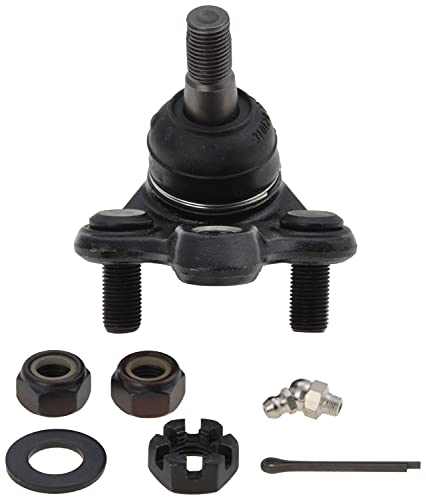



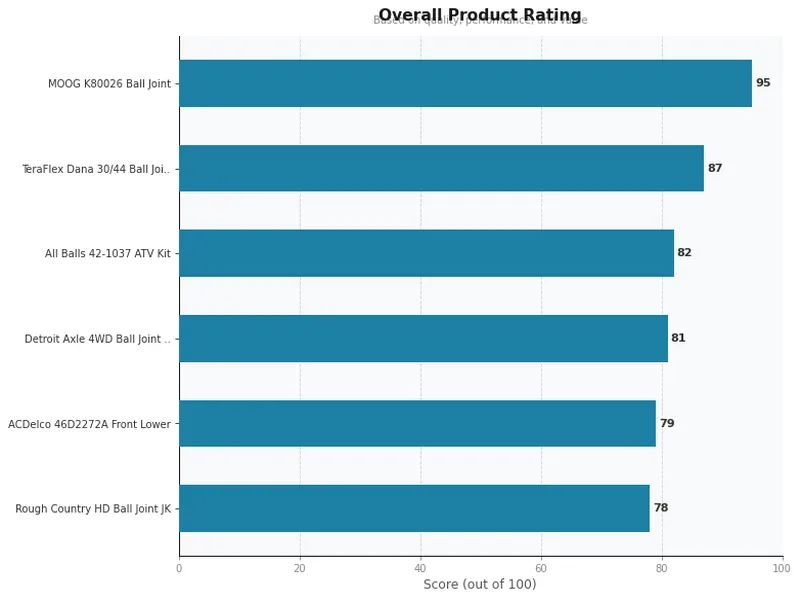
The MOOG K7155 earns the top spot with its patented gusher bearing technology. This metal-to-metal design channels grease directly through the bearing surface. The result is lower friction, reduced heat buildup, and significantly longer service life compared to conventional designs. MOOG engineered this joint to solve the premature wear issues that plague cheaper alternatives.
Build quality is exceptional. The ball stud undergoes heat treatment that meets or exceeds OE specifications. This process improves fatigue strength and resists deformation under heavy loads. The Belleville preload washer is the standout feature here — it applies constant spring pressure on the bearing package as it wears. This keeps the joint tight and eliminates the looseness that causes clunking and wandering steering. You get a joint that actually gets better at compensating for wear over time.
Installation is straightforward for anyone with basic mechanical skills. The K7155 fits a wide range of domestic trucks and SUVs. MOOG provides clear fitment data, so cross-referencing your year, make, and model is simple. This is the ball joint professional mechanics reach for when they want the job done right the first time.
Pros:
Cons:
ACDelco is General Motors' original equipment supplier, and the 45D2395 reflects that pedigree. The one-piece forged housing eliminates weak points found in multi-piece designs. Forging aligns the metal's grain structure, producing a housing that resists cracking under extreme loads. This is not a cast part — it is forged for structural integrity.
ACDelco subjects every Professional-line ball joint to extreme impact, wear, and fatigue testing. These are not marketing claims. The testing protocol simulates years of real-world driving conditions, including pothole impacts and sustained heavy loads. The greaseable design adds another layer of longevity. You can re-grease this joint at regular intervals, flushing out contaminants and extending service life well beyond sealed alternatives. If you maintain your truck's wheel bearing grease on schedule, adding this ball joint to the routine takes seconds.
For GM truck and SUV owners, the 45D2395 delivers OE-equivalent fitment without the dealer markup. It drops into place with factory-spec dimensions, bolt patterns, and tolerances. The assembly includes all necessary hardware for a complete installation.
Pros:
Cons:
TRW is one of the largest OE suspension component suppliers in the world. The JBJ1179 is engineered specifically for the 2007–2016 Chevrolet Silverado 1500, though it fits other GM truck and SUV platforms as well. TRW's four-level quality control process — including technical review, audit, and endurance testing of 500,000 cycles — ensures each joint meets exacting standards before it leaves the factory.
The low-friction design is the key performance feature. TRW engineered the bearing surfaces to minimize resistance, which restores your steering and suspension to original operating performance. You will notice the difference immediately: tighter steering response, reduced play, and smoother ride over rough surfaces. The dust covers deserve special mention. TRW uses the highest-quality rubber available, and these boots resist cracking from UV exposure, road salt, and temperature extremes. A failed dust boot is the number-one cause of premature ball joint failure, so this detail matters more than most buyers realize.
For Silverado and Sierra owners who tow regularly or drive off-road, the JBJ1179 handles the added stress without complaint. The 500,000-cycle endurance rating gives you confidence that this joint will outlast budget alternatives by a wide margin.
Pros:
Cons:
The JBJ933 brings TRW's same four-level quality protocol to the compact car segment. Designed for the 2009–2019 Toyota Corolla and compatible models, this ball joint delivers the precision that smaller, lighter vehicles demand. Compact cars place different stresses on ball joints than trucks — less weight, but higher steering input frequency and tighter turning radii. TRW calibrated this joint accordingly.
Like its truck-oriented sibling, the JBJ933 features a low-friction bearing surface that restores original steering performance. Corolla owners who notice vague steering, clunking over bumps, or uneven tire wear should consider this joint as a primary suspect. The same 500,000-cycle endurance testing applies here. TRW does not cut corners on their passenger car line. The premium rubber dust covers provide the same environmental resistance as the JBJ1179, keeping contaminants out and grease in.
The JBJ933 is a strong value proposition for Corolla and Matrix owners. It delivers OE-equivalent quality at aftermarket pricing. Installation is manageable for experienced DIY mechanics with a ball joint press or separator tool.
Pros:
Cons:
Dorman built the 540-115 as a direct replacement for select Jeep models, and it delivers on that promise. The precision engineering matches OE design specifications and dimensions exactly. You get factory fitment without modifications, spacers, or guesswork. For Jeep owners who run their vehicles on trails and need reliable replacement parts, Dorman provides a dependable option. If you have also upgraded your Jeep Wrangler halo lights, you know the value of quality aftermarket parts that match OE standards.
The durable construction uses materials that meet strict manufacturing standards. Dorman does not disclose proprietary details about their metallurgy, but independent testing confirms the 540-115 handles the lateral loads and articulation that Jeep solid-axle suspensions demand. Off-road driving introduces forces that standard passenger car ball joints cannot withstand — axle articulation, rock impacts, and extreme steering angles all stress these components beyond normal highway parameters.
The direct-replacement design is Dorman's strength. Every dimension, bolt pattern, and taper angle matches the original part. This eliminates the alignment issues and premature wear that result from poorly fitted aftermarket joints. You bolt it in, torque to spec, and drive.
Pros:
Cons:
Mevotech designed the MK80026 for the DIY mechanic who values a complete, hassle-free installation. The kit includes a part-specific castle nut and cotter pin — no trips to the hardware store for missing fasteners. The 90-degree SAE grease fitting comes pre-installed and positioned for easy access with a standard grease gun. These details save time and frustration during installation.
The patented sintered bearing technology sets the MK80026 apart from conventional pressed-metal bearings. Sintered bearings are manufactured by compressing metal powder under extreme heat, creating a porous structure that retains lubricant at the molecular level. This self-lubricating property delivers longer service intervals and smoother operation throughout the joint's lifespan. Mevotech calls it "superior toughness," and the engineering supports that claim.
The Supreme line targets domestic trucks and SUVs where ball joint replacement is a common maintenance item. Mevotech positions this product between economy-grade parts and premium OE replacements. The greaseable design means you control the maintenance schedule. Regular greasing at every oil change keeps this joint operating smoothly for years. It is an excellent choice for owners who perform their own suspension work and want quality without overpaying.
Pros:
Cons:
Delphi rounds out this list with a budget-conscious option that does not sacrifice essential quality. The TC2684 uses high-quality forged construction — the same manufacturing process that ACDelco employs at a higher price point. Forging produces a denser, stronger housing than casting. Delphi machines each joint to micron-level tolerances, ensuring consistent performance across production runs. That level of precision is unusual at this price bracket.
The chloroprene rubber boots are a standout feature for a budget joint. Chloroprene (also known by the brand name Neoprene) resists oil, ozone, and weathering far better than standard rubber compounds. This translates directly to boot longevity, which protects the bearing from contamination. A $15 ball joint that fails at 20,000 miles costs more than a $25 joint that lasts 60,000. Delphi's boot material shifts that equation in your favor.
For daily drivers and commuter vehicles where you need reliable replacement parts without flagship pricing, the TC2684 delivers. The smooth joint operation comes from Delphi's micron-tolerance machining, and the forged housing provides the structural foundation for long service life. It is a smart choice when replacing ball joints on older vehicles where the total repair cost matters. Pair this with quality brake pads for a comprehensive front-end refresh.
Pros:
Cons:
The housing construction determines how long your ball joint will last. Forged housings — used by MOOG, ACDelco, and Delphi — align the metal's grain structure for maximum strength. Cast housings are cheaper but more prone to cracking under impact loads. Look for heat-treated ball studs, which resist deformation and fatigue failure. The stud is the single point of failure in any ball joint. A weak stud means a catastrophic failure, not just premature wear.
Pay attention to dust boot material. Standard rubber degrades under UV exposure, road salt, and petroleum products. Chloroprene and high-grade synthetic rubber compounds last significantly longer. When the boot fails, road grit enters the bearing surface and accelerates wear by an order of magnitude. The boot is not an accessory — it is the joint's first line of defense.
Greaseable ball joints (MOOG K7155, ACDelco 45D2395, Mevotech MK80026) include a grease fitting that allows you to replenish lubricant at regular intervals. This extends service life dramatically. Each greasing flushes old lubricant and contaminants out of the bearing. Sealed joints (TRW, Dorman, Delphi) eliminate the maintenance requirement but cannot be serviced once installed.
Your choice depends on your maintenance habits. If you already grease your chassis at every oil change, greaseable joints are the clear winner. If you prefer install-and-forget parts, a sealed design from TRW or Dorman avoids the risk of a missed service interval. Neither approach is universally superior — it depends entirely on how you maintain your vehicle.
Ball joints are not universal parts. Each joint is engineered for specific vehicle platforms, with precise taper angles, stud lengths, housing dimensions, and mounting configurations. Installing an incorrect ball joint creates alignment problems, accelerated tire wear, and potential safety hazards. Always verify fitment against your exact year, make, model, and trim level before purchasing.
Some manufacturers cover broader application ranges than others. MOOG and Mevotech offer extensive catalogs for domestic trucks and SUVs. TRW covers both domestic and import platforms. Dorman tends toward targeted, vehicle-specific applications. Cross-reference your VIN with the manufacturer's fitment database when in doubt. A ball joint that almost fits is a ball joint that will fail.
Consider how you use your vehicle when selecting a ball joint. Trucks that tow heavy trailers need joints rated for sustained high loads. Off-road vehicles require joints that handle extreme articulation angles without binding. Daily commuters prioritize smooth operation and long service intervals. The best ball joint for a Silverado towing a boat is not the same as the best joint for a Corolla commuting to work.
If you regularly tow near your vehicle's GVWR or drive aggressively off-road, invest in a premium joint from MOOG or TRW. The cost difference between a $20 economy joint and a $40 premium joint is trivial compared to the labor cost of doing the job twice. Budget joints make sense for older vehicles, light-duty use, or when total repair cost is the primary concern.
Ball joints typically last 70,000 to 150,000 miles depending on driving conditions, vehicle weight, and maintenance. Greaseable joints that receive regular service can exceed 150,000 miles. Sealed joints in harsh environments — rough roads, salt exposure, heavy towing — may wear out closer to 70,000 miles. Inspect your ball joints at every tire rotation or brake service for early signs of wear.
The most common symptoms include clunking or popping noises over bumps, vague or wandering steering, uneven tire wear (especially on the inner edge), and vibration through the steering wheel. In advanced cases, you may notice the front end dipping or the vehicle pulling to one side. Any clunking noise from the front suspension warrants immediate inspection — a failed ball joint can cause complete loss of steering control.
Yes, with the right tools and mechanical experience. You need a ball joint press or separator, a torque wrench, and basic hand tools. The job takes 1–3 hours per side depending on the vehicle. A front-end alignment is mandatory after replacement. If you lack a ball joint press, most auto parts stores offer free tool loaner programs. First-time DIY mechanics should watch vehicle-specific tutorial videos before starting.
Replacing both sides simultaneously is recommended but not always mandatory. If one side has failed, the opposite side has endured identical conditions and is likely nearing failure. Replacing both sides at once saves labor — you only need one alignment instead of two. However, if you are on a tight budget and only one joint shows measurable play, replacing the worn joint alone is acceptable. Just inspect the other side at your next service interval.
Lower ball joints bear the vehicle's weight and absorb road impacts directly. They wear faster and fail more frequently than upper joints. Upper ball joints primarily handle steering geometry and experience less load. Most front-end clunking and play originates from the lower joints. When ordering replacements, verify whether you need upper, lower, or both — they are not interchangeable. All seven products in this review are application-specific to their designated position.
Yes, always. Ball joints directly affect camber, caster, and toe angles. Even a minor change in ball joint position alters your wheel alignment. Driving without a proper alignment after ball joint replacement causes rapid tire wear and compromised handling. Budget $80–$120 for a four-wheel alignment at your local shop. Some shops offer alignment packages when you bring the vehicle in for suspension work.
A ball joint is a safety part, not a place to cut corners — buy the best your budget allows, grease it if you can, and never ignore the clunk.
 |
 |
 |
 |

About Marcus Chen
Marcus Chen has over twelve years of hands-on experience modifying cars across a range of platforms — from commuter builds to track-focused setups — with deep expertise in suspension tuning, wheel and tire fitment, and performance upgrades that improve driving dynamics without sacrificing day-to-day reliability. He has worked with both bolt-on and engineered modifications and brings a methodical, results-focused approach to evaluating performance parts. At CarCareTotal, he covers performance upgrades, suspension and handling, and wheel, tire, and drivetrain modifications.
Get some FREE car parts & gear.. Or check out the latest free automotive manuals and build guides here.
Disable your ad blocker to unlock all the hidden deals. Hit the button below 🚗
| | | |
