by Marcus Chen
The Flowmaster 40 Series is the best muffler for most buyers in 2026 — decades of street-proven performance and a signature aggressive bark that no competitor has managed to replicate at this price point. Choosing the right muffler goes far beyond sound preference. Material quality, back pressure characteristics, inlet/outlet sizing, and mounting configuration all determine whether a muffler complements or chokes an engine. The wrong choice kills performance gains from other performance upgrades and leaves money on the table.

The aftermarket muffler segment in 2026 spans everything from budget-friendly glasspacks under $30 to premium stainless units north of $150. Each design — chambered, straight-through, glasspack — serves a distinct purpose. Chambered mufflers generate aggressive tone with moderate sound deadening. Straight-through designs like MagnaFlow's perforated core prioritize flow and a deeper, mellower note. Glasspacks are raw, loud, and cheap — ideal for builds where drone is a feature, not a bug. Pairing a muffler upgrade with quality components like upgraded shock absorbers and performance ignition coils creates a well-rounded package rather than a piecemeal build. This guide covers six top picks — plus a bonus premium option — ranked by performance, value, and real-world usability. According to Wikipedia, mufflers work by reflecting sound waves to cause destructive interference, and understanding that principle helps buyers match the right design to their goals.
Whether the goal is a tire-squealing muscle car tone, a deep cruiser rumble, or a track-ready scream, the options below cover every use case. Ratings, build quality, and installation complexity have all been factored into each recommendation.



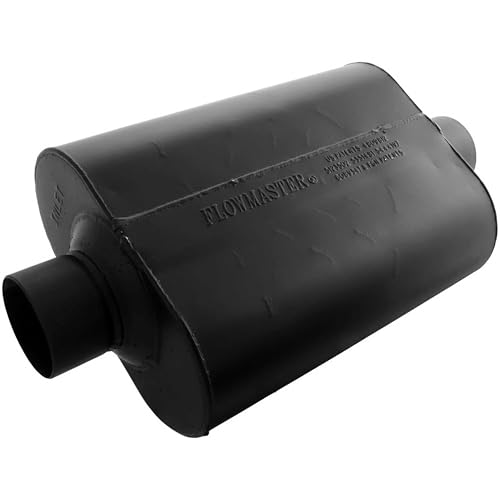



The Flowmaster 40 Series is not a trend. It has been the benchmark chambered muffler for muscle cars, street rods, and trucks since the 1980s, and 2026 hasn't changed that equation. The two-chamber internal design creates Flowmaster's signature bold, aggressive bark — instantly recognizable, impossible to confuse with generic chrome tips from the parts store. Constructed from 16-gauge aluminized steel, it resists corrosion across daily-driven and weekend builds alike.
The 42541 configuration ships with 2.50" offset inlet and 2.50" center outlet, which suits the majority of V8 and performance four-cylinder applications. Exhaust flow improvement is measurable: reduced back pressure translates directly to throttle response gains and modest horsepower increases. For buyers wanting the most authentic Flowmaster tone — not the polished, tamed version — the 40 Series delivers without compromise. Interior resonance is real on long highway runs; buyers who daily-drive should factor that in.
Pros:
Cons:
The Super 44 takes everything that made the 40 Series famous and pushes it further. An additional internal chamber — with both chambers sized and spaced differently — produces a deeper, more throaty tone compared to its predecessor. This is not a subtle difference. Side by side, the Super 44 hits lower frequencies. Delta Flow dual-chamber technology improves scavenging and reduces interior resonance enough that daily driving becomes tolerable without sacrificing aggressive character.
The 943045 runs 3.00" center-in/center-out, making it the right call for high-flow applications and engines already running larger exhaust diameter. Throttle response improvement is consistent across the RPM range — not just at WOT. For buyers upgrading from a stock muffler on a late-model V8 or a classic muscle car build, the Super 44 hits a near-perfect balance between street manners and aggressive outdoor presence.
Pros:
Cons:
MagnaFlow's 12259 is the straight-through answer for buyers who want maximum flow with a refined exhaust note. The perforated core with two-stage acoustic packing maintains exhaust velocity while generating the deep, smooth tone MagnaFlow is known for. It doesn't bark — it growls. This is the right pick for late-model performance vehicles, sports cars, and builds where interior drone is unacceptable but a passive stock tone is equally offensive.
Construction is 100% USA-made stainless steel with a satin finish — a meaningful distinction in 2026 when imported aluminized units flood the market. The 5x8x18" oval body fits tight undercarriage configurations and the 3"/3" inlet/outlet maintains flow without restriction. Dyno testing backs the performance claims: exhaust flow dynamics genuinely improve power output. Buyers prioritizing longevity and tone quality over outright aggression will find no better option at this tier.
Pros:
Cons:

The Cherry Bomb 87521 is what it is: a raw, inexpensive glasspack that prioritizes tone and flow over refinement. The 8-inch body and 2.25" inlet keep it compact. At 12 inches overall length, it fits in spots where a full-size muffler won't. Glasspacks offer almost zero restriction — exhaust passes straight through fiberglass packing with minimal impedance. That means maximum sound and respectable flow gains at minimum cost.
This is not a daily-driver muffler for buyers worried about neighbor relations or passing state inspections in noise-regulated areas. Cherry Bomb's reputation is built on budget builds, beaters, rat rods, and off-road rigs where loudness is the goal. Installation is straightforward — clamp or weld. There are no moving parts to fail. For what it is, the 87521 earns its place on any short-list where the budget is under $30 and aggressive sound is non-negotiable.
Pros:
Cons:
Thrush sits in the shadow of Flowmaster on name recognition alone, but the 17649 punches above its price point. Two-chamber design generates a deep, aggressive tone that competes legitimately with the Flowmaster 40 Series — at a lower price. The 100% welded aluminized steel construction is properly done: no seams pulling apart after a season of heat cycling. The painted silver finish with embossed Thrush logo adds a clean appearance that holds up better than bare steel alternatives.
Buyers looking for aggressive chambered tone on a strict budget should start here before assuming Flowmaster is the only option. The Thrush 17649 consistently earns strong ratings for sound quality relative to price. Corrosion resistance is acceptable but not exceptional in road-salted climates — the same caveat that applies to all aluminized steel products. For a spirited daily driver or mild performance build, the value proposition is hard to beat in 2026.
Pros:
Cons:
The Super 10 is Flowmaster's loudest, most aggressive street muffler. Full stop. The patented Delta Flow single-chamber design maximizes exhaust velocity and minimizes back pressure. The result is race-car volume and snap — a muffler that makes no apologies. Built from 409 stainless steel, it handles extreme heat cycles from drag-strip runs, LS swaps with big-tube headers, and off-road builds where underhood temperatures punish lesser materials. The 2.50" center-in/center-out configuration fits a wide range of muscle car and performance truck applications.
Interior drone on the Super 10 is significant. This is a track and show muffler that tolerates street use rather than a street muffler that occasionally sees track days. Buyers who daily-drive should step back to the Super 44 or 40 Series. For drag cars, dedicated weekend warriors, LS-swapped trucks, and lifted builds where the exhaust note is part of the identity, the Super 10 has no equal in its price range. Pairing this with properly torqued suspension components and fresh ceramic brake pads gives aggressive builds both performance and safety footing.
Pros:
Cons:
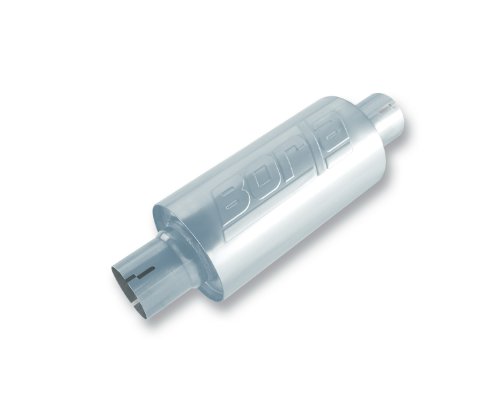
BORLA's 40842S is the premium pick for builders who refuse to compromise on materials or longevity. T-304 stainless steel construction means this muffler outlasts the vehicle in all but the harshest salt-belt conditions. The reversible design is a genuine advantage for custom exhaust fabrication — inlet and outlet are interchangeable, which cuts fabrication time and eliminates fit problems on unusual routing configurations. All-welded construction eliminates the seam failures that plague budget aluminized units after two to three seasons.
The 2.5" center inlet/center outlet, 5" round body, 10" body length, and 15" overall length position this as a compact, high-quality universal unit suitable for muscle cars, sports compacts, and custom builds. Bolt-on installation is straightforward for anyone with basic exhaust fabrication skills. BORLA's tone sits in the moderate-aggressive range — fuller and more refined than Cherry Bomb, less bark than the Flowmaster 40. For buyers making a long-term investment in an exhaust system they won't replace in five years, the BORLA 40842S is the correct answer.
Pros:
Cons:
Design type is the single most important decision. Each category serves a different purpose:
Material choice determines lifespan more than any other factor:
Buyers in the Rust Belt or coastal regions should budget for stainless. Aluminized steel in those environments is a 3-5 year decision at best.
Mismatched pipe diameter kills performance gains. Key sizing rules:
Buyers consistently underestimate the interior resonance trade-off. A ranking from most to least interior drone:
Anyone daily-driving more than 30 minutes should treat the Super 10 and Cherry Bomb as track-only options. Weekend builds and show vehicles can absorb the drone. Commuters cannot. The exterior sound level and the interior experience are two separate variables — buyers who confuse them end up frustrated. Noise ordinances in many municipalities have tightened through 2026; verify local regulations before purchasing the loudest options.
Chambered mufflers use internal walls to reflect exhaust pulses and create destructive interference, producing aggressive, bark-heavy exhaust tones with moderate interior resonance. Straight-through mufflers route exhaust through a perforated core surrounded by acoustic packing material. This design maintains higher exhaust velocity, produces less interior drone, and generates a deeper, smoother tone. Flowmaster's lineup represents the chambered design; MagnaFlow and BORLA represent straight-through construction.
Yes, but the gains depend heavily on the rest of the exhaust system. A performance muffler reduces back pressure, which allows exhaust gases to evacuate the combustion chamber more efficiently. This marginally increases volumetric efficiency and produces measurable horsepower and torque gains — typically 3-10 hp on naturally aspirated V8 builds depending on the full system configuration. Gains are more significant when paired with performance headers and high-flow catalytic converters. A muffler swap alone on an otherwise stock exhaust system produces modest results.
Lifespan depends almost entirely on material and climate. Aluminized steel mufflers like the Flowmaster 40 Series and Thrush 17649 typically last 5-10 years in moderate climates. In salt-heavy winter regions, that drops to 3-5 years. Stainless steel units like the MagnaFlow 12259 and BORLA 40842S last 15-20+ years under normal conditions. T-304 stainless is the correct investment for vehicles driven year-round in harsh environments.
No. Sound level and performance are separate characteristics. The Cherry Bomb glasspack is among the loudest options in this comparison and also among the least refined in terms of tone quality. MagnaFlow's 12259 produces a quieter, deeper note than the Flowmaster Super 10 while matching or exceeding its flow characteristics. Buyers chasing volume for its own sake often end up with excessive interior drone and fatiguing daily commutes. Performance is measured in back pressure reduction and flow rate — not decibels.
Yes. Most universal mufflers can be installed using band clamps rather than welding. Clamp installations are less permanent, easier to reverse, and accessible to buyers without welding equipment. However, welded connections are more durable and less prone to exhaust leaks over time. For permanent builds and track applications, welding is strongly recommended. Clamp installation works well for budget builds, temporary setups, and applications where future muffler swaps are anticipated.
The Flowmaster 40 Series or Thrush 17649 are the strongest recommendations for most truck and SUV applications. Both produce an aggressive deep tone that complements larger engine displacement without becoming intolerable on longer highway drives. Buyers running lifted trucks or dedicated off-road rigs that can accept extreme volume should consider the Flowmaster Super 10. Trucks that double as daily commuters are better served by the Flowmaster Super 44 or MagnaFlow 12259, which balance aggressive outdoor tone with more manageable interior sound levels.
Match the muffler to the mission — the loudest option in the parking lot is rarely the smartest choice on the highway.
 |
 |
 |
 |

About Marcus Chen
Marcus Chen has over twelve years of hands-on experience modifying cars across a range of platforms — from commuter builds to track-focused setups — with deep expertise in suspension tuning, wheel and tire fitment, and performance upgrades that improve driving dynamics without sacrificing day-to-day reliability. He has worked with both bolt-on and engineered modifications and brings a methodical, results-focused approach to evaluating performance parts. At CarCareTotal, he covers performance upgrades, suspension and handling, and wheel, tire, and drivetrain modifications.
Get some FREE car parts & gear.. Or check out the latest free automotive manuals and build guides here.
Disable your ad blocker to unlock all the hidden deals. Hit the button below 🚗
| | | |
