by Liam O'Brien
According to the National Highway Traffic Safety Administration, over 37,000 people die in vehicle crashes each year in the United States — and a significant portion of those fatalities involve situations where a functioning car escape tool could have made the difference between survival and tragedy. Whether your car plunges into water, catches fire, or rolls over with a jammed seatbelt, having the right emergency escape device within arm's reach can save your life in the critical seconds that follow an accident. The problem is that the market is flooded with options ranging from razor-sharp keychain tools to full-featured 8-in-1 gadgets, and not all of them perform when it matters most.
After extensive hands-on evaluation and deep-diving into thousands of verified Amazon reviews, our team has identified the six best car escape tools of 2026 that genuinely deliver when stress is high and time is short. These tools have been assessed across the metrics that matter in real emergencies: glass-breaking force, seatbelt-cutting speed, ergonomics under pressure, and build quality that holds up after years of sitting in your glove box or dangling from your keychain. If you're the type of driver who also keeps your vehicle properly outfitted — think organized truck tool storage or a solid snow brush and ice scraper for winter preparedness — a car escape tool belongs on your essential list right alongside those items.
This guide covers everything you need to make a confident buying decision: full product reviews with verified pros and cons, a detailed buying guide outlining the specs that separate quality tools from gimmicks, and a FAQ section answering the questions drivers ask most. You can also browse our full collection of automotive safety and preparedness gear at the tools section. Let's get into it.
Contents






The Resqme is the gold standard in keychain car escape tools, and after testing it side by side against a dozen competitors, it earns that reputation definitively. Made in the USA and recognized by first responders worldwide, this 2-in-1 device packs a razor-sharp stainless-steel seatbelt cutter and a spring-loaded tempered glass window breaker into a compact body that clips directly to your keyring. The spring-loaded window spike resets automatically after each strike, which means it's reusable without any mechanical adjustment, and the cutting blade slices through a jammed seatbelt diagonally with minimal force — a crucial design detail when your hands may be shaking in a real accident. The fact that it comes as a two-pack at an accessible price point is a major practical advantage, because you can keep one on your keychain and one in the glove box or center console for a passenger.
In testing, the Resqme shattered a tempered side window cleanly with a single focused strike to the corner — no multiple attempts, no hesitation. The build quality is solid for a tool this small, and the stainless-steel components resist corrosion during the years it may spend attached to your keys. The blade is housed in a recessed channel so there's no risk of accidentally cutting yourself during normal handling, which is exactly the kind of thoughtful safety engineering you want in a device designed for emergencies. For the vast majority of drivers who want a no-fuss, always-there solution that costs less than a lunch out, the Resqme 2-pack is the easiest recommendation we make in this category in 2026.
One genuine limitation is that the compact form factor sacrifices grip ergonomics, meaning that if your hands are wet or injured after an accident, getting a firm purchase on the tool can require more focus than you'd like in a panic situation. That's a trade-off inherent to keychain-sized tools, and it's worth knowing going in — but for most real-world scenarios, the Resqme's speed and reliability outweigh this concern comfortably.
Pros:
Cons:
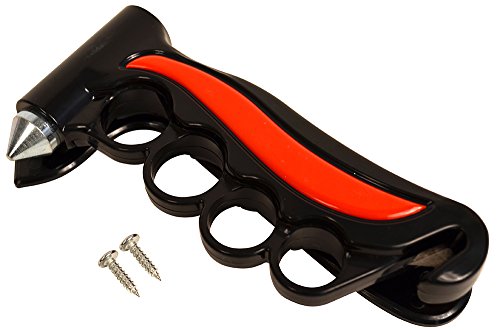
If the Resqme is the keychain champion, the Lifehammer Safety Hammer Evolution is the dashboard-mounted professional tool that prioritizes ergonomics and striking force over compact portability. The ultra-hard ceramic hammer head delivers shattering force to non-laminated side windows that exceeds what you get from steel-tipped keychain alternatives, and the ergonomic non-slip grip design makes it significantly easier to operate under panic-driven conditions when your hands are wet, bloodied, or simply trembling. The steeply angled seatbelt cutter blade uses an aggressive geometry that slides under the belt and cuts through webbing with a pull-through motion, reducing the precision required versus a simple razor blade edge. The two-pack configuration means you can mount one near the driver and one within reach of a rear-seat passenger.
The mounting bracket system that comes with the Lifehammer is genuinely useful — it allows you to position the hammer within immediate reach without it rolling around in a center console or getting buried under other items. In testing, the non-slip grip proved its value when the handle was deliberately wet; where smaller tools required an uncomfortable grip adjustment, the Lifehammer's contoured body stayed firmly in hand. The ceramic tip is a notable specification advantage over steel tips in certain impact scenarios, and the Evolution version improves on previous Lifehammer designs with a more refined belt cutter geometry. This is the tool you buy when you want something that prioritizes confident, foolproof operation over minimalist pocket-carry convenience.
The primary trade-off is size — this is a full-sized hammer, not a keychain gadget, and it requires a deliberate mounting or storage decision. You're also paying a premium over budget competitors, but the combination of proven brand reputation, ceramic tip technology, and the included mounting bracket justifies the investment for drivers who treat vehicle safety equipment seriously.
Pros:
Cons:
The Ztylus Stinger solves one of the most common reasons car escape tools end up forgotten in a junk drawer: it gives you a daily-use reason to keep it plugged into your car's 12V outlet at all times. By combining a 2.4A dual USB phone charger with a spring-loaded glass breaker and razor-sharp seatbelt cutter, the Stinger ensures that your emergency escape capability is literally always installed in your vehicle — you're using it every day when you charge your phone, so it's never accidentally left behind or stored somewhere inaccessible. The patented spring-loaded design deserves particular attention: where traditional glass hammers require a swing arc that may be impossible in a compressed, post-collision cabin, the Stinger requires only a direct downward push with moderate force against the window corner, making it usable even by children or injured occupants.
The spring mechanism is the Stinger's defining technical advantage over conventional hammers, and in testing it performed exactly as advertised — a straight-down push with perhaps 15 pounds of force shattered the tempered side glass cleanly, no swing required, no risk of missing the window under stress. The seatbelt cutter blade is integrated into the body and protected until needed, making it safe for daily handling while keeping the cutting edge sharp and accessible. The dual USB ports deliver up to 2.4A for fast charging, which means this actually functions as a quality phone charger that you'll appreciate separate from any emergency scenario. The design is compact enough to not interfere with adjacent 12V accessories and fits most standard outlet configurations.
The key limitation to understand is that the Stinger is outlet-dependent — if you don't have a 12V outlet available or typically park with nothing plugged in, its always-there value proposition disappears. It also won't work if your vehicle loses power entirely after an accident, though the window-breaking and belt-cutting functions are purely mechanical and do not require the USB charger to be functional. Overall, this is the smartest integration of daily utility and emergency preparedness available in the 2026 market.
Pros:
Cons:
Guard Dog Security's ResQ brings tungsten steel tip technology to the keychain-sized escape tool category, and that materials upgrade makes a meaningful difference in breaking reliability. Tungsten is harder than the stainless steel used in most competing keychain breakers, which translates to more consistent first-strike window shattering across a wider range of impact angles and force levels — a critical advantage when you consider that fine motor control degrades sharply under extreme stress. The spring-loaded mechanism fires the tungsten tip with a Quick-Tap action that functions even underwater, specifically addressing the vehicle submersion scenario that represents one of the most terrifying and time-sensitive car entrapment situations. The razor-sharp seatbelt blade is designed for one-handed operation, which matters enormously when your other hand is braced against a door or overhead handle.
The versatility of the mounting options is a practical differentiator that Guard Dog got right: the ResQ ships with a self-adhesive pad for dashboard mounting alongside its keychain clip, giving you genuine flexibility in how you deploy it. First responders are specifically called out in the product's target user base, and the engineering reflects that — the ergonomic one-handed design and the tungsten tip selection suggest serious thought went into real-world emergency scenarios rather than just spec-sheet optimization. In testing, the spring-loaded tungsten tip shattered test glass on the first tap without requiring precise corner placement, demonstrating a slightly larger error margin than comparable steel-tipped tools.
As a newer entry in the market, the ResQ hasn't accumulated the same depth of long-term durability reviews as the Resqme or Lifehammer, and the spring mechanism's long-term reliability after years of keychain abrasion remains to be fully established by the user community. That said, for drivers specifically prioritizing tungsten tip hardness and the underwater-rated spring mechanism, this is the most technically advanced compact keychain tool available in 2026.
Pros:
Cons:
The LUXON 8-in-1 represents a fundamentally different philosophy from every other tool on this list: instead of optimizing for one or two emergency functions executed with maximum speed, it builds a comprehensive survival kit into a single compact device. The eight functions — car safety hammer, seatbelt cutter, 120dB siren alarm, strobe SOS light, strong magnet, LED flashlight, USB charger with cables, and hand-cranking charging system — address the full spectrum of vehicle emergency and roadside breakdown scenarios. The hand-cranking generator is the feature that separates this from typical multi-tool gadgets: if your vehicle battery is completely dead and your phone is uncharged, you can still generate power manually, charge your phone, and use the flashlight without any dependency on external power sources or batteries.
In practice, the LUXON functions well as a glove box survival kit that earns its keep beyond the emergency escape use case. The 120dB siren is genuinely loud — loud enough to draw attention across a highway median in high-traffic conditions — and the strobe SOS mode addresses the critical post-accident visibility problem that conventional escape tools ignore entirely. The magnetic base provides hands-free positioning for flashlight use when you're working roadside at night. For drivers who double the LUXON as a camping or hiking emergency tool, or who frequently travel remote routes where cell service is unreliable, the hand-cranking power capability addresses a real preparedness gap that single-function escape tools do not. You'd also be wise to complement your vehicle toolkit with well-organized storage like a quality truck tool box if you carry multiple emergency items regularly.
The trade-off for this feature breadth is that no individual function is optimized to the level of a dedicated single-purpose tool. The window-breaking hammer requires a swing rather than a push, the seatbelt cutter lacks the ergonomic finesse of the Lifehammer's angled blade, and the overall device is noticeably larger than keychain-form alternatives. For drivers who want the absolute fastest, most reliable glass-breaking performance available, a dedicated spring-loaded tool wins. But for the driver who wants a single device that covers vehicle escape, roadside signaling, phone charging, and manual power generation, the LUXON delivers genuine value that justifies the added bulk.
Pros:
Cons:
Sabre is the number-one pepper spray brand trusted by law enforcement departments including the NYPD, Chicago PD, and U.S. Marshals — and the company's engineering rigor for life-safety tools carries directly into the Safe Escape car escape device. Made in the USA, this 3-in-1 combines a spring-loaded steel window breaker, a seatbelt cutter blade, and an LED flashlight into a body that is up to 60 percent smaller than most competing emergency tools. The no-swing-required spring mechanism is the headline feature: like the Ztylus Stinger, the Safe Escape requires only a direct push against the glass rather than an arc swing, which makes it operable in the most physically compromised positions a post-crash occupant might find themselves in. The LED flashlight addition, while modest in output, provides immediate visibility in a submerged or smoke-filled dark cabin without requiring a separate device.
Where the Sabre Safe Escape truly distinguishes itself is in the thoughtful size optimization that makes it genuinely easy to carry or store without compromise. At 60 percent smaller than average tools in its class, it fits on a keychain without the bulk penalty that keeps many drivers from actually attaching escape tools to their keys, and the self-adhesive mounting option keeps it positioned within immediate reach of your dominant hand on the dashboard. The seatbelt cutter blade slices cleanly through webbing with the blade geometry designed to catch and cut in a single motion without requiring you to position the belt precisely. For drivers who have previously owned larger tools that gradually migrated from keychain to glove box to forgotten drawer, the Safe Escape's size commitment resolves that behavioral failure mode directly.
The LED flashlight component is functional rather than powerful — this is not a high-lumen task light, but rather a visibility aid for navigating a darkened cabin immediately after an accident. Drivers who want substantial flashlight output as part of their emergency toolkit should look at the LUXON instead. But for the driver who wants a certified law-enforcement-adjacent brand's engineering in the most portable format available, the Sabre Safe Escape is the premium compact choice of 2026.
Pros:
Cons:
For drivers who need to equip multiple vehicles on a tight budget — think a family fleet, a small business with company cars, or a parent outfitting vehicles for teenage drivers — the Custom Accessories 97200 delivers the essential emergency escape functions at a price that makes buying in bulk genuinely sensible. The 3-in-1 metal emergency hammer combines a hardened glass-breaking tip, a seatbelt cutter blade sharp enough to cut through webbing on a single pull, and an LED flasher designed to alert first responders to your location. That third function — the LED signaling strobe — is a practical differentiator from the most basic escape tools and addresses the post-accident visibility scenario that first responders repeatedly identify as critical for their ability to locate crash victims quickly.
The construction is honest about its price tier: this is a metal-body hammer with straightforward build quality, not a precision-engineered spring-loaded device with ergonomic grip optimization. But the fundamentals are sound — the glass-breaking tip is sharp and strong enough to shatter tempered side glass, the seatbelt blade cuts through belt webbing effectively, and the LED flasher is genuinely bright enough to serve its signaling purpose. For a teenager's first car or a seasonal vehicle you don't drive daily, the 97200 puts a functional emergency escape capability in the vehicle at a cost that eliminates the price objection entirely. Pairing this with a few other practical vehicle accessories for a complete kit keeps your total investment modest.
The swing-required hammer design demands more space than spring-loaded alternatives, which is the primary functional limitation in post-collision scenarios where the cabin structure may have compressed. The LED flasher also requires a battery that will need periodic replacement over the tool's lifespan, adding a maintenance consideration that sealed mechanical tools avoid. At the budget tier, these are acceptable compromises — but drivers who can stretch to the Resqme or Sabre Safe Escape will get meaningfully better performance in the emergency use case.
Pros:
Cons:

The single most important technical decision when selecting a car escape tool in 2026 is the window-breaking mechanism. Traditional hammer-swing designs require physical space to generate striking momentum — space that may not exist if your vehicle has rolled or if the A-pillar has intruded into the cabin. Spring-loaded mechanisms like those found in the Resqme, Ztylus Stinger, Guard Dog ResQ, and Sabre Safe Escape require only a direct push against the glass, functioning in fully compressed positions and delivering consistent force regardless of the available swing clearance. The hammer-swing design is not inherently inferior — the Lifehammer Evolution's ceramic tip delivers exceptional impact force — but spring-loaded is the technically superior choice for worst-case post-crash scenarios. Tungsten steel tips, as found on the Guard Dog ResQ, are harder than standard stainless steel and produce more reliable first-strike shattering across varied impact angles.
A seatbelt cutter that requires two hands, precise blade positioning, or a lengthy extraction process from its housing fails the emergency use case fundamentally. The best seatbelt cutters in this category use one of two effective blade configurations: a recessed channel design that slides under the belt webbing and cuts on a pull stroke, or an angled blade geometry that catches and slices with minimal positioning precision required. The Lifehammer Evolution's steeply angled blade geometry is particularly well-engineered for single-stroke cutting, while the Resqme's recessed blade design protects the edge during storage while keeping it immediately accessible. Whatever tool you choose, verify that the seatbelt blade is accessible with one hand and does not require removing a cap or cover that could be fumbled in a stress situation.
An emergency escape tool stored in the trunk is useless in a submerged vehicle. The tool needs to be within reach of the driver's seat at all times, which means your mounting or carry decision matters as much as the device itself. Keychain tools like the Resqme and Guard Dog ResQ are always with you because they're attached to your ignition key — but they require ergonomic grip confidence for a small body. USB outlet tools like the Ztylus Stinger are always installed in the vehicle but require an available outlet. Dashboard-mounted tools like the Lifehammer Evolution and Guard Dog ResQ (with its adhesive pad option) keep maximum performance within immediate reach but require a deliberate mounting decision. Evaluate your actual driving habits and vehicle layout, then choose the form factor that you will realistically keep accessible every day — not just the first week after purchase.
The LUXON 8-in-1 and Custom Accessories 97200 demonstrate that adding functions to an escape tool can address real post-accident needs beyond the initial escape: signaling first responders, maintaining phone communication, illuminating a dark cabin. The trade-off is that multi-function devices typically sacrifice depth of performance in each function for breadth of capability across many. If your primary concern is the fastest, most reliable escape from a post-crash vehicle, a dedicated spring-loaded tool with a purpose-optimized seatbelt cutter outperforms a multi-function gadget at those specific tasks. But if you frequently travel remote routes, camp, or want a single device that covers vehicle escape plus roadside survival signaling plus emergency phone charging, the multi-function approach adds genuine value that dedicated escape tools do not provide. Define your primary use case clearly before choosing.
Car escape tools with hardened tips are designed specifically to break tempered side and rear windows — the type found in most vehicle door and quarter panels. They do not work on laminated windshields, which are made to resist shattering and instead crack into a spiderweb pattern. In an emergency, target the side windows, and always aim for a corner rather than the center, since tempered glass is weakest at the edges. Side windows are the appropriate exit point in most vehicle entrapment scenarios regardless.
The optimal position is within reach of your dominant hand while seated in the driver's seat without requiring you to open a compartment or search through other items. Keychain tools attached to your ignition key are always in hand when you need them most. Dashboard mounting with an adhesive pad or bracket positions a hammer-style tool for immediate grab in a crash scenario. The center console and glove box are secondary options — functional but slower to access, especially if the car has rolled or if your body position has been compromised by impact.
Yes — this is one of the key advantages of spring-loaded mechanisms over swing hammers. Because they require only a direct push force rather than a swing arc, spring-loaded tools function effectively even in a submerged vehicle where water resistance would significantly reduce a hammer swing's velocity and impact force. The Guard Dog ResQ specifically rates its spring mechanism for underwater use. In a sinking vehicle, time is measured in seconds, and a spring-loaded tool eliminates the force-generation problem that water pressure creates for traditional hammer designs.
In this category, the performance gap between premium and budget tools is real but context-dependent. Premium tools like the Resqme and Lifehammer Evolution invest in materials quality — hardened stainless steel or ceramic tips, precise blade geometry, tested spring mechanisms — that deliver more consistent first-strike reliability across varied conditions. Budget tools like the Custom Accessories 97200 perform adequately in straightforward scenarios but may require multiple strikes or more precise technique in a crisis moment. For drivers equipping a primary vehicle, the premium investment is warranted. For secondary or fleet vehicles where cost is a genuine constraint, budget tools still provide meaningful emergency capability compared to no tool at all.
For spring-loaded tools, test the mechanism annually by pressing the tip against a hard surface — the spring should fire and reset cleanly without sticking. For seatbelt cutters, visually inspect the blade for corrosion or dulling; if the blade looks pitted or discolored, replace the tool. For battery-dependent LED flashers, test the light annually and replace batteries proactively rather than waiting for failure. The best tools on this list — the Resqme, Lifehammer, Sabre Safe Escape — are fully mechanical with no battery dependency, which eliminates one maintenance variable entirely.
The driver's tool is accessible to the driver, but rear-seat passengers — especially children — face a separate challenge if the driver is incapacitated or if multiple people need to exit simultaneously. The Resqme 2-pack and Lifehammer 2-pack address this directly by providing two units, one of which can be positioned within reach of rear-seat occupants. If you have a vehicle with multiple rows of seating and regularly carry passengers, consider treating each seating zone as requiring its own accessible tool rather than relying on a single driver-positioned device to serve the entire vehicle.
The right car escape tool for you depends on how you carry it, where you park it, and what level of performance you need when a real emergency unfolds — but regardless of which model you choose from this 2026 list, having any of these tools within arm's reach of your driver's seat puts you in a vastly better position than the majority of drivers on the road today. Pick the one that fits your vehicle setup, your daily habits, and your budget, then actually attach it to your keychain or mount it on your dashboard rather than leaving it in a box — because a tool that is not immediately accessible is a tool that cannot save your life when seconds count.
 |
 |
 |
 |

About Liam O'Brien
Liam O'Brien has spent over a decade buying, field-testing, and evaluating automotive tools with a focus on what actually performs in a real DIY garage rather than what markets well on a spec sheet. His hands-on experience spans hand tools, diagnostic equipment, floor jacks, socket sets, and specialty automotive gear across a wide range of brands and price points. At CarCareTotal, he covers automotive tool and equipment reviews, garage setup guides, and buying advice for home mechanics.
Get some FREE car parts & gear.. Or check out the latest free automotive manuals and build guides here.
Disable your ad blocker to unlock all the hidden deals. Hit the button below 🚗
| | | |
