Interior ›
by Rachel Park
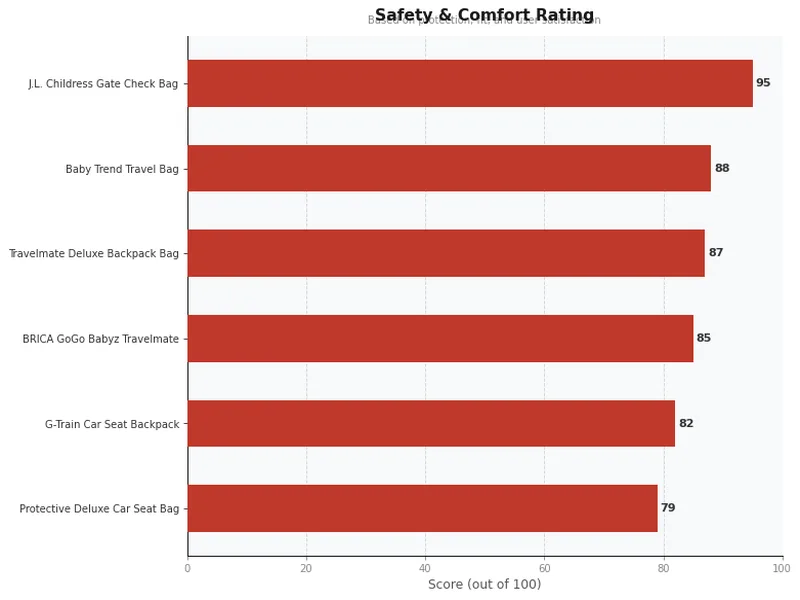
Which car seat travel bag actually keeps your child's seat safe through baggage handling, gate checks, and layovers? After testing options across price points and carry styles in 2026, one name stands out consistently: the J.L. Childress Gate Check Travel Bag. It combines universal fit, AirTag compatibility, and decades of parent-tested reliability into a package that simply works. But the right bag for your family depends on how you travel — and the four picks in this guide cover every scenario.
Traveling with a car seat is one of the more logistically demanding parts of flying with young children. Airlines handle thousands of gate-checked items every day, and car seats without protection routinely come back scratched, cracked, or soiled. According to the National Highway Traffic Safety Administration (NHTSA), car seats that sustain structural damage in transit may no longer meet federal crash-protection standards — meaning a beat-up bag isn't just an inconvenience, it's a safety issue. A quality travel bag is the simplest, cheapest insurance you can buy before your next flight.
This guide covers the four strongest car seat travel bags available in 2026, ranging from budget-friendly gate-check sleeves to premium rolling bags with padded backpack straps. Whether you're flying with an infant carrier, a convertible seat, or a booster, you'll find a match here. For families also shopping for the seat itself, our guide to the best convertible car seats of 2026 pairs well with this review. And if you want to keep your little one entertained and visible on long drives, check out our picks for the best backseat baby mirrors of 2026.
Contents






J.L. Childress has been in the baby travel gear business for over three decades, and the Gate Check Travel Bag is the product that built their reputation. The bag is purpose-built for airport gate checking — the most common and most risky moment in any car seat's travel life. It fits all child car seats, from compact infant carriers up to large convertible seats, and the generously sized opening makes loading a one-person job even when you're already juggling a stroller, a carry-on, and a toddler. The durable polyester construction holds up against conveyor belts, cargo holds, and everything in between.
The standout addition in the 2026 version is the built-in AirTag holder. Instead of rigging up a DIY solution with rubber bands or tape, you get a dedicated, secure mount inside the bag that holds Apple's AirTag (sold separately) firmly in place throughout the journey. For parents who have ever watched their gate-checked gear disappear down a jet bridge and wondered where it would resurface, that tracking capability is genuinely useful. The bag also stores compactly in its own built-in pouch when you don't need it — a small detail that matters when your car interior and luggage are already maxed out. Reinforced stitching and a sturdy carry handle round out the package.
The red colorway makes it easy to spot on a baggage carousel, and the compact storage pouch means you can keep it in your diaper bag without adding bulk between trips. This is the bag most parents will want. It covers all the bases — universal fit, solid materials, AirTag compatibility — at a price point that doesn't sting.
Pros:
Cons:
The Guiseapue car seat travel bag is the newest entry on this list, and it arrives with one meaningful advantage over the competition: size. At 34 x 18 x 18 inches, it's one of the largest bags in this category, and that extra room is intentional. The bag is designed to accommodate virtually every major car seat brand on the market — Doona, Graco, Evenflo, Maxi-Cosi, Britax, Cybex, and Chicco are all called out explicitly. If you've ever bought a travel bag only to discover it doesn't quite zip over your specific seat model, the Guiseapue's generous dimensions solve that frustration upfront.
The nylon construction is worth noting. Most budget-tier bags use thinner polyester that wears quickly with repeated gate checking. Guiseapue's nylon offers better tear resistance and moisture protection — important when your seat gets loaded onto wet tarmacs or sits in a damp cargo hold. The special stitching technique and reinforced threading the manufacturer highlights aren't marketing language; tear-resistant construction at the seams is exactly where most bags fail first. As a newer brand, Guiseapue doesn't have the long review history of J.L. Childress, but the core specs are solid and the price is competitive.
Where this bag falls short is in carry options. You get a basic handle and that's it — no shoulder strap, no backpack straps, no wheels. For a short walk from the check-in counter to the gate, that works. For long airport corridors with a car seat inside, your arm will know about it. If you're a frequent traveler or navigate large airports regularly, consider stepping up to the Britax. But as a first travel bag, the Guiseapue delivers real value.
Pros:
Cons:
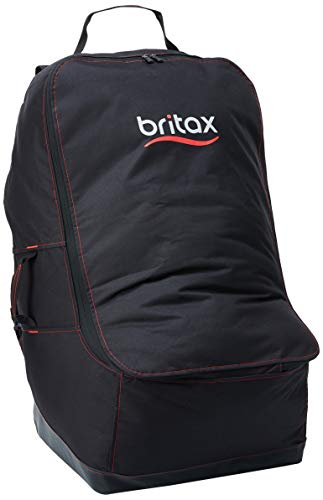
Britax engineered this travel bag for families who fly more than once a year — people who move fast through airports and need a bag that moves with them, not just a bag that bags the seat. The combination of built-in wheels, padded backpack-style shoulder straps, and multiple carry handles gives you three distinct carry modes depending on the situation. Roll it through a long terminal. Strap it on your back when you need both hands free. Grab the handle for quick lifts onto a scale or into an overhead bin. That flexibility is rare in this category, and it's the primary reason to choose this bag over the others.
The water-resistant exterior and rubberized reinforced base address two real-world failure points. Water resistance keeps your seat protected during outdoor gate waits in the rain — something parents in cities with unpredictable weather encounter regularly. The rubberized base takes the abuse of being set down repeatedly on concrete, asphalt, and terminal floors without wearing through. The wide double-zipper opening makes loading and unloading faster than single-zipper alternatives, and the storage pouch that tucks away the shoulder straps is a clean design touch that prevents straps from dragging on the ground when you're in wheel mode.
Britax designed this primarily for their own seat lineup, and it's worth verifying your specific seat model fits before purchasing. That said, the bag accommodates most standard convertible seat dimensions. The luggage ID holder lets you tag the bag clearly so it doesn't get confused with other gate-checked gear. If you fly quarterly or more, the Britax is the bag that earns its price premium over time. Pair it with a reliable GPS tracker for your car and your family travel setup becomes genuinely difficult to disrupt.
Pros:
Cons:
UPPAbaby's travel bag is a brand-specific solution for owners of the Aria, Mesa V2, Mesa V3, and Mesa Max infant car seats. It's not a universal bag, and it's not trying to be. What it offers instead is a precise, tailored fit for those specific seats — including quick-adjustment functionality for traveling without the base — and access to UPPAbaby's TravelSafe Program, which is the differentiating feature no competitor can match. The TravelSafe Program provides coverage for any damage your gear sustains during air travel. Gate-check your seat in this bag and, if it comes back damaged, UPPAbaby covers it. That's a meaningful guarantee that eliminates the anxiety most parents feel when handing over a $300+ car seat to an airline.
The bag itself is built to UPPAbaby's standards. The brand consistently earns high marks for build quality across their product line, and this bag reflects that reputation. The design is clean, the easy-carry handles are well-positioned, and the fit around a Mesa or Aria is tight enough to prevent the seat from shifting inside the bag during transport. Sloppy fit causes internal damage even when the bag's exterior stays intact — a snug, purpose-built bag prevents that entirely.
If you don't own a Mesa or Aria, this bag has no relevance to your search. But if you do, it's the only logical choice. The combination of a perfectly tailored fit and the TravelSafe damage guarantee represents value that far exceeds the ticket price. UPPAbaby owners who travel frequently should consider this an essential accessory alongside a quality car seat travel tray for road trips. The peace of mind alone justifies the purchase.
Pros:
Cons:
Not every travel bag works for every traveler. The right choice depends on how often you fly, what seat you own, and how far you walk between the check-in counter and the gate. Here are the four criteria that separate a good travel bag from a great one in 2026.
A travel bag that doesn't close completely over your seat offers no real protection. Before buying, check the bag's stated dimensions against your car seat's specs — length, width, and height with and without the base. Universal bags from J.L. Childress and Guiseapue cover most seats on the market, but purpose-built bags like UPPAbaby's guarantee a snug fit for specific models. A loose fit allows the seat to shift inside the bag during transit, which can damage the harness mechanism, the shell, or both. Tight fit equals better protection. If you're unsure about sizing, contact the manufacturer directly before purchasing.
The material your bag is made from determines how long it survives airport handling. Look for two things: fabric weight and seam construction. Nylon outperforms polyester for tear resistance in direct comparisons at similar weights. Reinforced stitching at stress points — particularly at handle attachment points and zipper ends — determines whether the bag holds together after fifty uses or falls apart after five. Water resistance is a bonus that pays off when your gate check is processed on a wet tarmac. A rubberized base, like the one on the Britax, adds meaningful longevity for frequent travelers.
How you carry a loaded car seat bag through an airport matters more than most people anticipate before their first trip. A basic handle works for short walks. For anything longer, you'll want shoulder straps or a backpack harness. The Britax's three-carry-mode system — wheels, backpack straps, and carry handle — is the most versatile option in this roundup. If your airport has tram connections and long walking corridors, that versatility justifies the price premium. Casual flyers who stick to smaller regional airports can save money with a simpler bag and a shorter carry. Assess your most common airports honestly before committing.
Gate-checked items occasionally go missing or end up on the wrong flight. In 2026, AirTag integration has become a practical expectation for higher-end travel gear, and the J.L. Childress bag is one of the few in this category to include a dedicated holder rather than requiring a workaround. If tracking your gear matters to you — and for a car seat worth $200–$400 or more, it should — choose a bag with a built-in tracker mount. Alternatively, if you own a UPPAbaby Mesa or Aria, the TravelSafe Program provides coverage that makes the tracking question largely moot: damage gets fixed regardless of what happened during transit.
You don't legally need one, but you strongly benefit from one. Airlines handle gate-checked items alongside checked luggage, which means your seat may encounter conveyor belts, cargo hold stacking, and rough handling. A travel bag protects the shell, harness hardware, and adjustment straps from physical damage, dirt, and moisture. The NHTSA recommends replacing car seats that show structural damage — a travel bag is a low-cost way to avoid that scenario entirely.
Most convertible car seats require a bag that measures at least 30 x 20 x 18 inches to fit comfortably with the seat installed at the standard angle. The Guiseapue bag at 34 x 18 x 18 inches covers the majority of convertible seat models. Always verify your specific seat's dimensions — including handle height on infant carriers — before purchasing. Bags labeled "universal" typically accommodate seats up to a stated maximum dimension, so read the product spec sheet carefully.
Most major U.S. airlines allow you to gate check car seats for free as part of their child passenger policies. This applies to infant carriers, convertible seats, and booster seats. However, policies vary by airline and can change, so confirm directly with your carrier before your trip. Gate checking is separate from checking a car seat at the ticket counter, which some airlines also allow for free. Either way, a protective bag is strongly recommended regardless of which method you use.
For frequent travelers, yes. Car seats and strollers are among the most commonly misrouted gate-checked items because they're handled outside the standard baggage system. An AirTag in a dedicated holder, like the one in the J.L. Childress bag, lets you track your gear's location in real time through the Find My app on your iPhone. If the seat gets separated from your flight, you'll know immediately and can alert airline staff with a precise location rather than a vague description.
In practice, most people use these terms interchangeably, but there's a distinction in design intent. A gate check bag is typically a lighter, slimmer sleeve designed for single-use or low-frequency travel — easy to store but not built for repeated handling. A car seat travel bag is constructed with heavier materials, reinforced seams, and additional carry options intended for regular use. The bags reviewed in this guide all qualify as proper travel bags. If you fly with your child's car seat more than once a year, the investment in a durable travel bag over a disposable gate check sleeve is clearly justified.
Yes. Universal bags like the Guiseapue and J.L. Childress are sized to fit booster seats as well as infant carriers and convertible seats. Booster seats are generally smaller than convertible seats, so fit is rarely a problem. The more relevant consideration for booster seat users is carry weight — a booster packed inside a travel bag with backpack straps is far more manageable in an airport than one with only a handle. If your child is in a booster seat and you fly regularly, the Britax's backpack carry option is worth the added cost.
 |
 |
 |
 |

About Rachel Park
Rachel Park specializes in the interior and exterior upgrades that meaningfully change how a car looks, sounds, and feels on a daily basis. She has hands-on experience with head unit installations and audio system builds, LED and HID lighting conversions, interior refresh projects, and cosmetic exterior work — evaluated from both a DIY accessibility and quality-of-result perspective. At CarCareTotal, she covers car audio and electronics, lighting upgrades, and interior and exterior styling accessories.
Get some FREE car parts & gear.. Or check out the latest free automotive manuals and build guides here.
Disable your ad blocker to unlock all the hidden deals. Hit the button below 🚗
| | | |
