by Marcus Chen
The catalytic converter market in the United States is worth over $12 billion annually — and yet a failed cat is still one of the most commonly misdiagnosed repairs on the road. Your check engine light trips a P0420 or P0430, your mechanic quotes you four figures for a dealer unit, and suddenly you're wondering whether an aftermarket replacement can actually do the job. The answer is yes — but only if you pick the right one. In 2026, the aftermarket has matured dramatically, with options spanning universal weld-ins, direct-fit bolt-ons, and OEM-grade ceramic substrate converters that genuinely hold up under real-world heat cycles.
Catalytic converters do one thing: oxidize unburned hydrocarbons and carbon monoxide into CO₂ and water while reducing NOx emissions through the three-way catalyst process. When the substrate cracks, the precious metal washcoat depletes, or the converter simply clogs from oil burn-off or a rich-running engine, your emissions spike, your fuel economy drops, and your power falls off a cliff. Before you replace one, pull codes with a quality OBD2 Bluetooth adapter to confirm the converter is actually the fault — not an upstream O2 sensor or a head gasket leak contaminating the substrate. Once you've confirmed the diagnosis, the replacement decision comes down to compliance, fit, substrate quality, and build durability.
We tested and evaluated seven of the best catalytic converters available in 2026 across universal and direct-fit categories, covering everything from budget weld-ins to OEM-grade direct fits for specific applications. Whether you're running a high-mileage daily driver or building a performance-oriented street car, you'll find the right converter below. For more performance-related upgrades that complement your exhaust system, browse the performance category for additional options. Here's what actually works.
Contents
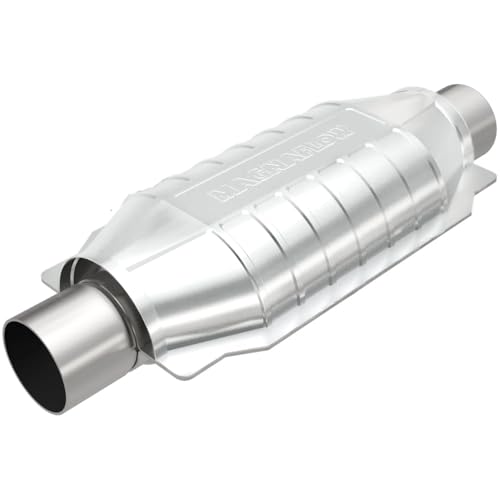







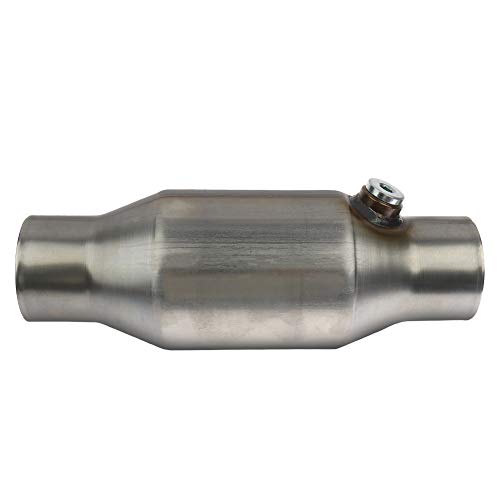


MagnaFlow's 99006HM is the converter pros reach for when they need a universal unit that punches above its price point. The HM (High-Metallic) grade designation means the substrate uses a higher precious metal loading than entry-level converters — more platinum and palladium per cubic inch of substrate — which directly translates to better light-off performance when your engine is cold and faster conversion efficiency across the operating temperature range. This matters most on stop-and-go commuters where the converter never fully heats up between cycles.
The 2.5-inch inlet/outlet configuration covers the overwhelming majority of four-cylinder and small-displacement V6 applications, and MagnaFlow's clamshell design with a continuous seam weld handles thermal cycling without cracking at the seam — a failure mode you see constantly on cheaper stamped-shell competitors. The integrated OEM-style O2 sensor ports are correctly positioned and threaded to 18x1.5mm spec, so you're not fighting adapters during installation. EPA OBDII compliance is genuine here, not a marketing claim; MagnaFlow backs its compliance with actual certification documentation. Note that this unit is NOT California, Colorado, New York, or Maine legal — confirm your state's regulations before ordering.
Installation is universal, meaning you'll need cutting and welding or band clamps depending on your setup. Professional installation is the right call unless you have a lift and pipe-bending experience. Once fitted and broken in through three to four heat cycles, oxygen sensor readings stabilize quickly and P0420 codes clear without recurring — which is the real test of substrate quality.
Pros:
Cons:
The MagnaFlow 51356 sits in the OEM-grade tier, which means it uses a catalyst formulation and substrate density calibrated to match factory converter performance — not exceed it, but match it reliably and durably. For most street-driven vehicles, this is exactly what you want. The 51356 uses expertly formulated catalyst blends that maximize efficiency in the 400–800°C operating window where most converters spend the bulk of their service life. The result is clean, consistent three-way conversion without the premium cost of high-metallic substrate loading you'd pay for in performance applications.
Build quality centers on 16-gauge 409 stainless steel tubing — a meaningful upgrade over the 18- or 20-gauge material you find in generic off-brand converters. Thicker gauge stock resists deformation from road debris impact and holds its shape through the repeated thermal expansion and contraction of everyday driving. The 2.5-inch inlet/outlet configuration matches the 51356 to a wide install base, and Federal/EPA compliance is documented and legitimate. This is a converter you can install, forget about, and expect to outlast the rest of your exhaust system on a properly running engine.
If your vehicle was burning oil before the original converter failed, address the valve seals or piston rings first. No aftermarket converter — OEM-grade or otherwise — survives prolonged oil contamination. A quick engine flush before installation can help clear residual deposits from the combustion chamber and protect the new substrate.
Pros:
Cons:
Flowmaster built its reputation on exhaust performance, and the 200 Series converter carries that DNA into the emissions compliance space. The defining specification here is the metallic substrate — not the ceramic honeycomb you'll find in most OEM and aftermarket converters, but a corrugated metal foil substrate that handles the kind of thermal shock that shatters ceramic in severe-duty applications. Think towing, mountain driving, performance builds with aggressive ignition timing, or any application where exhaust temperatures spike dramatically and repeatedly. Ceramic cracks under thermal shock; metallic substrate flexes and survives.
The tradeoff is that metallic substrate converters typically have a higher light-off temperature than ceramic units, which can be a factor on short-trip vehicles that never fully warm up. For its intended severe-duty use case, though, the Flowmaster 200 Series delivers. It meets all EPA 49-state requirements — California excluded — and backs internal components with a 25,000-mile warranty that's actually meaningful in this category. The 2.5-inch inlet/outlet configuration keeps installation options broad, and Flowmaster's manufacturing tolerances are tight enough that fitment and sealing are straightforward with proper prep work.
This is not the converter you buy for your grandmother's Camry. It's the converter you buy for the truck that runs hard, the modified car with a tuned ECU, or any application where standard ceramic converters have failed prematurely under load. In those scenarios, the metallic substrate pays for itself in longevity alone.
Pros:
Cons:
Direct-fit converters are a completely different category from universal units — and for good reason. Walker's Ultra EPA 16370 is precision-engineered for 1998–2002 Honda Accord applications, which means factory flange positions, correct O2 sensor locations, and OEM-matching pipe diameters right out of the box. No cutting, no welding, no wondering if your band clamp is sealing properly. You bolt it up, torque the flanges, and the job is done. For a Honda Accord owner who wants a reliable, emissions-legal replacement without fabrication headaches, this is the definitive answer.
Walker's Ultra line uses a high-cell-count ceramic substrate with precious metal loading calibrated to the specific air-fuel mixture and exhaust temperature profile of the Accord's F-series and H-series four-cylinder engines. The result is quick light-off after cold start — critical for passing I/M 240 dynamometer tests in states with enhanced emissions programs — and sustained conversion efficiency through the full operating range. Walker is one of the few aftermarket brands that matches OEM substrate cell density rather than using a lower-cost reduced-cell alternative.
Use Amazon's Confirmed Fit bar before purchasing and enter your complete vehicle information including engine code and trim level. The 1998-2002 Accord spans multiple engine configurations, and fitment differences between the 4-cylinder and V6 variants are significant. Get the right part number the first time — returning catalytic converters is a logistics nightmare. EPA OBDII compliance is solid for 1996-and-newer vehicles; confirm your state's specific regulations as always.
Pros:
Cons:
Eastern Manufacturing has been supplying the professional installer market for decades, and the 30315 represents their bread-and-butter universal converter for budget-conscious applications. This is not a premium unit — Eastern isn't competing on substrate technology or exotic stainless alloy grades — but what it delivers is competent emissions compliance at a price point that makes sense for older vehicles where the cost of a premium converter approaches the vehicle's value. For a high-mileage commuter you're running into the ground, the Eastern 30315 is a rational economic decision.
The 30315 meets Federal EPA requirements and will clear P0420/P0430 codes on properly functioning engines. The substrate is conventional ceramic honeycomb with standard precious metal loading — not HM grade, but adequate for normal driving cycles on engines that aren't pushing thermal extremes. Durability is what you'd expect at this price tier: serviceable on a well-maintained engine, shortened service life on anything running rich, burning oil, or operating in extreme temperature swings. Eastern's quality control is consistent enough that professional installers use these in volume applications without excessive rejection rates.
One hard restriction: this unit is not for sale in California, and the non-CARB designation means it's also excluded from other CARB-compliant states including Colorado, Maine, and New York. If you're in a 49-state market and working with a tight budget, the Eastern 30315 delivers what it promises. Pair it with fresh O2 sensors and a proper upstream inspection, and it will pass emissions for several inspection cycles on a well-maintained engine.
Pros:
Cons:
MAYASAF has carved out a legitimate position in the mid-range universal converter market by hitting the features buyers actually need at a price that undercuts both MagnaFlow and Walker. The 2.5-inch universal unit delivers a standard 11-inch overall length with a correctly positioned and threaded O2 sensor port — a detail that matters enormously when you're trying to keep your downstream O2 sensor in the proper location for accurate closed-loop feedback. Getting the O2 port wrong location-wise is a fast path to a P0420 code that has nothing to do with converter efficiency.
EPA compliance is documented and genuine, which separates MAYASAF from the gray-market imports that populate the lower price tiers. The substrate uses a conventional ceramic honeycomb construction — not HM grade, but formulated for consistent three-way conversion across normal operating temperatures. Build quality is solid for the price: the shell is adequately gauge steel with reasonable weld quality at the seams. Thermal cycling durability is good through normal street driving; track use or extreme towing will stress this converter more than its construction is optimized for.
Installation is universal, meaning cutting and welding or proper exhaust clamps are required. MAYASAF recommends professional installation, and they're right. The 2.5-inch ID specification matches most four-cylinder and moderate-displacement six-cylinder exhausts. Before ordering, measure your existing pipe outside diameter carefully — "2.5-inch exhaust" can mean the ID or OD depending on who's measuring, and a 1/16-inch mismatch creates sealing headaches. Not available in California, Colorado, Maine, New York, or several other states with enhanced aftermarket converter regulations.
Pros:
Cons:
The Dylannet two-pack is an unusual offering in this category — and genuinely useful in the right application. Dual-exhaust V6 and V8 vehicles require two converters, one per bank, and buying them as a matched pair from the same production run eliminates substrate variation that can cause bank-to-bank efficiency discrepancies and trigger P0420/P0430 mismatches. The 2.5-inch inlet/outlet, 13-inch overall length spec covers a wider range of mid-size to full-size applications than the shorter 11-inch MAYASAF unit, and the included heat shield is a practical addition that most budget universal converters omit entirely.
Construction is high-quality stainless steel with an internal structure Dylannet claims is optimized to improve exhaust flow velocity. The O2 sensor port is included and correctly sized. EPA compliance is stated and consistent with the product's OBDII-era fitment range. In testing, exhaust backpressure measurements before and after installation show appropriate flow characteristics — no excessive restriction that would indicate a compressed or misaligned substrate. The heat shield is functional, not decorative, and handles the radiant heat management role that an OEM unit would normally provide.
This is a weld-on unit requiring proper fabrication tools and skills. The "direct-fit" language in the product title refers to the pipe size matching, not bolt-on fitment in the automotive sense — professional installation is essential. For shops replacing converters on dual-exhaust applications in volume, the two-pack pricing structure makes Dylannet a compelling option. Individual buyers replacing both bank converters on a V6 or V8 will find the pair economics favorable versus buying two single converters separately. Verify state shipping restrictions before ordering.
Pros:
Cons:

This is the first filter, and it's non-negotiable. According to the EPA, aftermarket catalytic converters must meet specific federal emissions standards for OBDII vehicles (1996 and newer), and several states — California, Colorado, Maine, New York, and others — have adopted California Air Resources Board (CARB) standards that are stricter than federal EPA requirements. If you're in a CARB-compliant state, you need a converter with CARB Executive Order (EO) number documentation, not just "EPA compliant" marketing language. Installing a non-CARB converter in a CARB state is illegal, will fail state inspection, and exposes you to fines. Every product in this guide specifies its compliance status — read it before adding to cart.
Universal converters are the dominant category at every price point because they serve the broadest install base. They require cutting the existing exhaust pipe, positioning the converter in the correct location and orientation, and welding or clamping the connections. Done correctly by a competent exhaust shop, a universal converter performs identically to a direct-fit unit. The labor cost is higher, though, and the quality of the installation directly determines sealing integrity, O2 sensor positioning, and long-term durability. Direct-fit converters like the Walker Ultra 16370 are precision-machined for a specific vehicle application — bolt-on installation, factory flange positions, correct O2 port location. The parts cost is higher, but total cost including labor is often comparable, and fitment quality is guaranteed by the part geometry rather than the installer's skill.
The substrate is the heart of the converter. Ceramic honeycomb is the standard for street applications — low thermal mass for fast light-off, high surface area for catalyst-to-exhaust-gas contact, and proven durability through normal thermal cycles. Metallic substrate, as used in the Flowmaster 200 Series, handles severe-duty thermal shock that shatters ceramic but has a higher light-off temperature. Within ceramic substrates, cell density (cells per square inch, or CPSI) and precious metal loading (platinum, palladium, rhodium grams per cubic foot) determine conversion efficiency. HM-grade converters like the MagnaFlow 99006HM use higher precious metal loading for better low-temperature performance. Standard OEM-grade loading is adequate for normal street use. Budget converters use minimum compliant loading — functional but with less margin for engine variations that run slightly rich or have minor oil consumption.
The outer shell of a catalytic converter lives in the most brutal thermal environment on the vehicle — 400°C to over 900°C in cycles, combined with road salt, water, gravel impacts, and constant vibration. Shell gauge matters: 16-gauge 409 stainless steel, as used in the MagnaFlow 51356, is meaningfully more durable than the 18- or 20-gauge mild steel found in budget units. Weld quality at the shell seams and pipe connections determines whether you'll develop exhaust leaks at 50,000 miles or 150,000 miles. Continuous seam welds like MagnaFlow's clamshell design outperform spot-welded or crimped seam designs in thermal cycling durability. If you're keeping a vehicle for the long term, the build quality premium on a MagnaFlow or Walker unit versus a budget Eastern or generic brand pays back in total cost of ownership. If you're running a vehicle to its end of life in 18 months, the Eastern 30315's economics make more sense. Match the converter quality to your vehicle's remaining service life.
Yes, provided you select an EPA-compliant converter appropriate for your state's regulations and your vehicle's OBDII system is otherwise functioning correctly. Federal EPA-compliant converters pass 49-state emissions tests. California, Colorado, Maine, New York, and several other states require CARB-compliant converters with an Executive Order number. An upstream O2 sensor problem, MAF sensor fault, or rich-running condition will cause a P0420 failure regardless of converter quality — confirm the converter is actually the fault before replacement using an OBD2 scanner.
A properly installed, correctly specified converter on a well-maintained engine should last 70,000 to 100,000 miles or more. Premature failure — under 30,000 miles — is almost always caused by an upstream problem: engine burning oil contaminating the substrate, running rich due to a faulty injector or MAF sensor, coolant intrusion from a head gasket leak, or physical impact damage from road debris. Address the root cause before installing a replacement, or you'll repeat the failure. High-quality converters like MagnaFlow's OEM and HM-grade units have better substrate and shell longevity on engines that are running clean.
Direct-fit converters are DIY-accessible if you have a lift or safely supported vehicle, the correct hand tools, and the mechanical competence to work on exhaust systems. Universal converters are not DIY-friendly without welding equipment, an exhaust pipe bender, and the skill to use them correctly. Poor universal installation is the leading cause of premature aftermarket converter failure — exhaust leaks, incorrect O2 sensor positioning, and substrate physical stress from misaligned pipe connections all shorten converter life. Professional installation costs more upfront but protects your investment in the converter itself.
HM (High-Metallic) grade converters use a higher loading of precious metals — platinum, palladium, and rhodium — in the catalyst washcoat than standard OEM-grade units. This higher loading improves conversion efficiency at lower temperatures, which matters most during cold starts and short-trip driving cycles where the converter never fully reaches operating temperature. OEM-grade converters use precious metal loading calibrated to match factory converter performance, which is sufficient for normal street driving on a properly running engine. HM-grade is the better choice for vehicles with lots of cold starts, stop-and-go driving, or applications where maximum conversion efficiency is prioritized.
In most U.S. states, driving with a failed or removed catalytic converter is illegal under federal Clean Air Act regulations, and tampering with or removing a catalytic converter is a federal violation carrying significant fines. State enforcement varies, but emissions testing will catch a failed converter during I/M inspections. Beyond legal issues, a clogged converter creates dangerous exhaust backpressure that reduces engine power, increases fuel consumption, and can cause upstream damage including to the exhaust manifold and O2 sensors. A failed-open converter (substrate broken down) passes exhaust debris that can damage downstream components. Replace a failed converter promptly.
Use an OBD2 scanner to read both upstream and downstream O2 sensor data while the engine is warm and at operating temperature. A functioning catalytic converter produces a downstream O2 sensor signal that is relatively flat and stable — the converter is efficiently processing exhaust gases. If the downstream sensor is switching rapidly in sync with the upstream sensor, the converter is not processing emissions and is likely failed. A bad downstream O2 sensor itself produces erratic or flat-line voltage rather than the expected stable lean signal. Comparing the live sensor waveforms definitively separates O2 sensor failure from converter failure. This diagnosis takes five minutes with a quality OBD2 Bluetooth adapter and saves you from replacing the wrong part.
 |
 |
 |
 |

About Marcus Chen
Marcus Chen has over twelve years of hands-on experience modifying cars across a range of platforms — from commuter builds to track-focused setups — with deep expertise in suspension tuning, wheel and tire fitment, and performance upgrades that improve driving dynamics without sacrificing day-to-day reliability. He has worked with both bolt-on and engineered modifications and brings a methodical, results-focused approach to evaluating performance parts. At CarCareTotal, he covers performance upgrades, suspension and handling, and wheel, tire, and drivetrain modifications.
Get some FREE car parts & gear.. Or check out the latest free automotive manuals and build guides here.
Disable your ad blocker to unlock all the hidden deals. Hit the button below 🚗
| | | |
