by Liam O'Brien
You're deep in a muddy trail at dusk, your truck buried past the axles, and the only thing standing between you and a miserable night is the rope spooled on your winch drum. That scenario plays out every weekend across trails from Moab to the Appalachians, and it's exactly why choosing the right synthetic winch rope in 2026 deserves serious attention before you load up and head out. Unlike traditional steel cable, modern ultra-high-molecular-weight polyethylene (UHMWPE) synthetic rope has transformed vehicle recovery, offering lighter weight, safer failure modes, and superior handling in wet and abrasive environments.
The market for synthetic winch rope has matured considerably, with options ranging from budget-friendly kits aimed at weekend warriors to professional-grade lines engineered for punishing daily use. Understanding which rope matches your winch rating, your terrain, and your recovery frequency separates a confident purchase from an expensive mistake. Whether you run a Jeep Wrangler on rocky trails, haul work equipment with a heavy-duty pickup, or use your rig for occasional farm recoveries, the right line makes your entire tools and recovery setup dramatically more effective. This guide covers the seven best options tested and reviewed for 2026, along with a detailed buying guide and answers to the most common questions buyers ask before committing to a purchase.

Synthetic rope's safety advantage over steel cable is not a marketing claim — it's physics. When steel cable snaps under load, it stores enormous kinetic energy and recoils with lethal force. UHMWPE fibers, by contrast, release tension gradually and fall to the ground rather than whipping back toward operators and bystanders. That characteristic alone has driven the shift toward synthetic lines across the off-road community, and pairing your winch rope with a quality nerf bar setup and solid recovery anchors rounds out a capable recovery system. Every rope reviewed below was evaluated against real-world performance criteria: breaking strength relative to advertised ratings, UV and abrasion resistance, ease of spooling, and overall value per foot.
Contents
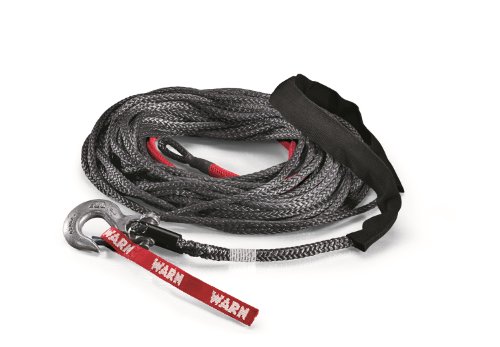







WARN has been setting the standard for winch equipment for decades, and the Spydura 87915 continues that legacy with a rope that delivers premium performance in a package designed for the serious off-road enthusiast. At 3/8-inch diameter by 100 feet in length, it carries a 5-ton (10,000 lb) working capacity that makes it compatible with the most popular winch classes found on mid-size trucks, Jeep Wranglers, and full-size SUVs. The rope's construction uses WARN's proprietary ultra-high-molecular-weight polyethylene formula, which provides a tensile strength-to-weight ratio that no steel cable can match at this price tier. The black urethane coating applied over the rope is a deliberate engineering decision rather than an aesthetic choice — it provides measurable UV and chemical resistance that extends the rope's functional lifespan through seasons of hard use, where sun exposure and exposure to trail chemicals would otherwise degrade uncoated UHMWPE fiber.
Handling this rope after a session with traditional steel cable is a revelation. It coils smoothly, feeds onto the drum without the springback behavior that makes steel cable frustrating to spool under tension, and it poses zero laceration risk to bare hands — a genuine safety improvement that experienced winch operators notice immediately. The included swivel hook end is properly rated and integrates cleanly with standard D-ring shackles and recovery straps, making it ready for deployment without additional hardware purchases. WARN's quality control on this product is visibly consistent across units, which matters when your life and your vehicle are depending on the rope not having a hidden manufacturing defect.
At 100 feet, you get the full working length you need to utilize your winch's full pulling capacity across the drum layers, which is something shorter ropes sacrifice for cost savings. The 10,000 lb rating is honest — it aligns with WARN's engineering standards rather than the inflated "breaking strength" numbers some competitors use for marketing. If you need a rope you can trust completely, this is the one that earns that confidence through consistent build quality and a brand with real accountability behind its specifications.
Pros:
Cons:
The Spydura Pro represents WARN's step up in engineering for operators running higher-rated winches with demanding recovery requirements. At 3/8-inch diameter by 80 feet, it's designed specifically for winches with up to 12,000 lb pull ratings, and the 8.25-ton (16,500 lb) capacity leaves a substantial safety margin for real-world recovery loads that frequently spike well above static pull calculations. What distinguishes the Pro from the standard Spydura is the heat-treated 12-strand construction, a manufacturing process that optimizes the fiber alignment under load to maximize tensile strength without increasing diameter or weight. Compacted diameter construction is another Pro-specific feature — by mechanically compressing the braid during manufacturing, WARN increases the rope's density, which translates directly to higher load-bearing capacity per unit of cross-sectional area and better resistance to crushing deformation when the rope is compressed under tension on the drum.
The loop ends rather than a swivel hook are a deliberate design choice aimed at professional and heavy-use applications where hardware compatibility and load distribution geometry matter more than plug-and-play convenience. Soft loop terminations distribute load across the fiber structure more evenly than metal hook connections, reducing stress concentration at the termination point and improving overall rope longevity in high-cycle applications. If you're running a WARN ZEON 10 or similar high-output winch on a serious expedition rig, the Pro's engineering aligns precisely with the demands you'll place on it across multiple recoveries per trip.
At 80 feet rather than 100, the Spydura Pro gives up some working length compared to the standard model, which is worth considering for applications where you need maximum reach. However, for users prioritizing raw strength and construction quality over length, the 16,500 lb capacity at 80 feet is a compelling trade-off, particularly when paired with a quality snatch block for mechanical advantage in difficult recoveries.
Pros:
Cons:
The TYT kit takes a different approach from the premium single-rope offerings — it bundles a complete recovery accessory set into one purchase that genuinely includes everything you need to start winching effectively. The core rope is a 1/4-inch by 50-foot UHMWPE 12-strand braid with an 8,500 lb breaking capacity, appropriately sized for smaller ATV, UTV, and light 4x4 winch applications where a full 3/8-inch rope would be oversized and unnecessarily heavy. The kit includes a rubber stopper, a heavy-duty hook rated to 25,000 lb, and a reflective safety pull strap — the reflective element is a practical safety addition that makes the pull strap visible during dawn and dusk operations where trail recoveries frequently happen.
The 1.5-meter nylon protective sleeve bundled with the kit covers the rope at the most vulnerable point — the section that contacts the fairlead, guide roller, or abrasive terrain features during recovery. Nylon sleeve coverage at this section meaningfully extends rope life by shielding the UHMWPE fibers from the abrasive cutting action that prematurely destroys unprotected ropes in rocky terrain. TYT's green colorway makes the rope easy to locate in mud, snow, and low-visibility trail conditions, which sounds like a minor point until you've spent ten minutes searching for a dark-colored rope buried in a mud hole.
At 50 feet and 1/4-inch diameter, this rope is clearly positioned for compact rigs — you're not replacing a full-size truck's recovery system with this kit. But for ATV owners, UTV riders, and operators running winches in the 2,500–5,000 lb range, the TYT provides a complete starting point with better accessory quality than you'd expect at this price. The reflective strap is a detail that shows real attention to trail-safe design, and the oversized hook rating relative to the rope's capacity means the hardware won't be the weak link in your recovery chain.
Pros:
Cons:
This 3/8-inch by 100-foot rope from this value-tier brand delivers a compelling combination of full working length, high rated capacity, and a complete accessory kit that outperforms its price category by a meaningful margin. The 23,800 lb breaking strength — note that this is breaking strength, not working load limit, and you should apply a standard 4:1 safety factor for actual use — places it firmly in the range appropriate for full-size truck winches in the 8,000–12,000 lb pull class. Construction is 12-strand high-molecular polyethylene fiber, waterproof and rust-proof by the material's inherent chemical properties rather than any applied coating, which matters for operators who spend extended time in river crossings, mud bogs, and wet Pacific Northwest trail conditions.
The included kit is genuinely useful: a forged 3/8-inch winch hook, a rubber stopper with an Allen wrench for drum attachment, and 4.92 feet of protective sleeve at each rope end to shield the most abrasion-vulnerable sections. The decision to protect both ends rather than just the fairlead end is thoughtful — the drum-side end takes real punishment from the hardware during spooling and unspooling cycles, and sleeve coverage there extends rope life in a way that single-end sleeve designs miss. The forged hook is the correct specification for this application — cast hooks at this load rating are a false economy that experienced recovery operators universally avoid after seeing one fail.
Where this rope earns its "best value for length" designation is the combination of 100-foot reach with full-size 3/8-inch diameter construction at a price point well below the WARN alternatives. For operators who need the working reach that only 100 feet provides — particularly useful when the nearest anchor is far from your stuck vehicle — this rope delivers that capability without forcing a premium brand investment. You're accepting some compromise on long-term wear resistance relative to the WARN Spydura's urethane coating, but the value proposition is clear for seasonal or moderate-frequency users who aren't running recoveries professionally.
Pros:
Cons:
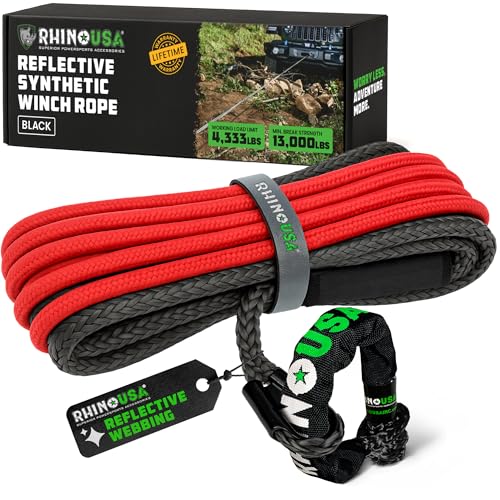
Rhino USA has built a strong reputation in the Jeep and light truck accessory market, and the 3/8-inch by 94-foot synthetic winch line exemplifies why that reputation holds up under scrutiny. Designed specifically for winches in the 7,000–9,000 lb pulling power class — the sweet spot for Jeep Wranglers, 4Runners, and half-ton pickups — this rope's specifications align precisely with the equipment that Jeep Wrangler owners, Gladiator drivers, and 4Runner operators are most likely to be running. The naming of those specific vehicles in the product description is not accidental: Rhino has engineered the rope's length, diameter, and termination hardware to optimize compatibility with the factory-class winches and bumper mounts common to those platforms.
The included soft shackle is the most noteworthy accessory distinction from the competition at this price tier. Soft shackles made from UHMWPE fiber have supplanted steel D-rings in performance off-road circles because they are dramatically lighter, safer in the event of failure, and easier to store and deploy in the field. Pairing a synthetic rope with a synthetic shackle creates a fully "soft" recovery connection that eliminates the hardest, heaviest, and most dangerous components from your recovery rigging — a configuration that professional overlanders and experienced trail guides increasingly specify as standard practice in 2026. The rope's high-strength UHMWPE fiber construction and integrated protective sleeve provide the trail-ready durability that demanding rock crawling and mudding applications require across a full season of use.
Rhino USA's compatibility with Badlands, WARN, Smittybilt, and other major winch brands means this rope drops into your existing setup without fitment concerns, and the brand's customer service reputation for standing behind products when issues arise gives it an edge over anonymous competitors. Just as you'd invest in quality bottle jacks for lifting work, investing in a trusted name for your recovery rope pays off in the field when conditions are worst and gear reliability matters most.
Pros:
Cons:
When your recovery requirements move beyond the capabilities of 3/8-inch rope — think heavy-duty pickup trucks, large SUVs, commercial recovery operations, or vehicles with winches in the 12,000–20,000 lb pull class — the X-BULL 1/2-inch by 85-foot rope steps into a different performance tier that few competitors at this price address adequately. The 32,000 lb tensile strength is the headline figure, achieved through X-BULL's proprietary standard for 12-strand UHMWPE fiber construction with polyester coating that provides both UV resistance and tactile durability during handling. At 1/2-inch diameter, this is a substantially heavier rope than the 3/8-inch options throughout the rest of this list, and that diameter increase carries real implications for drum capacity — verify your winch's drum can accommodate 85 feet of 1/2-inch rope before purchasing.
The forged steel hook included with the X-BULL system is properly specified for the rope's capacity: heat-hardened treatment with advanced E-coating and powder coating layers creates a surface treatment system that resists corrosion and wear across the contact cycles that high-frequency recovery work demands. A 36,000 lb hook rating that exceeds the rope's 32,000 lb tensile strength is the correct engineering approach — your hardware should never be the limiting factor in your recovery chain's rated capacity. The 5-foot sliding protective sleeve protects the drum-to-fairlead section, and the hook safety pull strap completes a kit that requires no additional purchases to put into immediate service.
X-BULL's weight advantage over steel cable is particularly significant at this diameter — a 1/2-inch steel cable at 85 feet weighs roughly three times as much as the UHMWPE equivalent, and that weight difference is tangible when you're pulling and re-spooling the rope repeatedly during a multi-anchor recovery sequence. Combined with the safety advantage of zero dangerous recoil on failure, the X-BULL makes a compelling case for operators who have been clinging to steel cable in the heavy-duty segment out of familiarity rather than engineering merit.
Pros:
Cons:
The STEGODON 3/8-inch by 85-foot rope occupies a well-defined mid-range position between the budget ATV-class options and the premium WARN products, delivering a 25,000 lb breaking strength with 12-strand UHMWPE construction and UV and abrasion-resistant coating that addresses the most common failure modes for synthetic rope in trail use. The special coating treatment applied over the fiber is a meaningful differentiator from bare-braid competitors — without UV resistance at the coating level, UHMWPE fibers degrade measurably when stored on an exposed winch drum through seasons of sunlight exposure, particularly in high-UV environments like the desert Southwest and high-altitude mountain terrain.
STEGODON's emphasis on the rope's non-recoil safety characteristic aligns with the most critical buyer concern in the category — the rope stores no kinetic energy under load, meaning that if it fails during a recovery, it falls rather than snaps back toward operators and bystanders. This safety behavior is a fundamental UHMWPE property rather than a manufacturing enhancement, but STEGODON's explicit mention of it in their specifications reflects an understanding of what buyers in the off-road recovery market actually care about. The rope's floating nature in water — another inherent UHMWPE property — is genuinely useful for mud hole and water crossing recoveries where a sinking rope creates retrieval problems that experienced winch operators have learned to hate.
At 85 feet, the STEGODON gives up 15 feet compared to the 100-foot options on this list, but it maintains the full 3/8-inch diameter that makes it compatible with standard winch drums sized for that spec. The green colorway helps with visibility in field conditions, and the forged hook included in the kit is properly matched to the rope's capacity. If you're upgrading from the factory cable that came with your winch and want a step up in quality without paying full WARN prices, the STEGODON is a logical and well-specified choice that delivers modern synthetic rope performance at an accessible price. For reference, the same disciplined approach to car escape tools — buy proven, tested equipment rather than the cheapest option — applies here: mid-range quality from a known-spec product outperforms mystery-brand bargains when conditions are serious.
Pros:
Cons:

The single most important specification when selecting a synthetic winch rope is ensuring the rope's working load capacity aligns with your winch's rated pull. The standard industry practice is to select a rope with a breaking strength of at least 1.5 times — and preferably 2 times — your winch's maximum pull rating. This safety factor accounts for dynamic loading during recovery, shock loading when a stuck vehicle breaks free suddenly, and the gradual strength reduction that occurs as the rope ages through UV exposure and abrasive wear cycles. A winch rated at 9,500 lb, for example, warrants a rope with a breaking strength of at least 14,000–19,000 lb for responsible field use. The marketed "breaking strength" figures on budget ropes should be treated with appropriate skepticism — WARN's published figures reflect engineering testing standards, while unbranded competitors frequently market peak breaking strength achieved under laboratory conditions that don't reflect real-world recovery dynamics.
Rope diameter directly affects how many feet fit on your winch drum at the required layer count to achieve rated pull. Most winch manufacturers publish drum capacity charts for both 3/8-inch and 1/4-inch rope, and the rated pull capacity assumes the rope is spooled to a specific layer depth — the outer layers of a full drum pull with significantly less force than the inner layers. Matching the correct diameter and length to your drum's specification ensures you're working within the winch manufacturer's tested performance envelope. For most mid-size truck and SUV applications, 3/8-inch diameter at 80–100 feet covers the practical range. ATV and UTV operators typically use 1/4-inch rope at 40–50 feet. The heavy-duty truck and commercial recovery segment moves to 1/2-inch or larger diameter rope to match the higher pull capacities of industrial-grade winches.
Twelve-strand braided UHMWPE construction is the current standard for quality synthetic winch rope — avoid eight-strand or unspecified braid constructions from unverified sources, as these typically sacrifice tensile strength and abrasion resistance for lower manufacturing cost. UV-resistant coating applied over the braid is a meaningful quality indicator for ropes that will spend extended time on exposed winch drums in sunlight, while urethane or polyester coating also improves chemical resistance against fuel, hydraulic fluid, and trail chemicals that inevitably contact the rope during vehicle recovery operations. Termination hardware — hooks, shackles, and loop eyes — should be forged steel with appropriate heat treatment rather than cast construction, and should carry ratings that meet or exceed the rope's breaking strength so that the hardware is never the weakest link in your recovery rigging system.
Protective sleeves at the fairlead contact zone dramatically extend rope life by shielding the fiber structure from the abrasive cutting action of aluminum and steel fairleads during recovery operations. Operators who consistently use protective sleeves on their synthetic ropes report service lives two to three times longer than those running unprotected rope across the same fairlead hardware under comparable conditions. When evaluating complete kits, assess whether the included accessories are properly rated — a hook rated significantly below the rope's breaking strength is a safety liability, not a value addition. Reflective pull straps, soft shackles, and rubber drum stoppers all add real value to recovery operations and represent meaningful savings when bundled with the rope at a reasonable overall kit price.
Synthetic winch rope uses ultra-high-molecular-weight polyethylene (UHMWPE) fibers instead of steel wire strands. This makes it significantly lighter — roughly one-third the weight of equivalent steel cable — while providing comparable or superior breaking strength. The critical safety difference is failure behavior: steel cable stores kinetic energy under tension and recoils violently when it snaps, creating a lethal projectile hazard. Synthetic rope stores no kinetic energy and simply falls when it fails, making it dramatically safer for operators and bystanders. Synthetic rope also resists rust and corrosion inherently, floats in water for easier recovery from mud and water crossings, and does not develop the metal burrs that steel cable develops over time and that lacerate unprotected hands during handling.
Check three specifications: diameter, length, and capacity. Your winch manufacturer publishes drum capacity figures for specific rope diameters — typically both 1/4-inch and 3/8-inch for mid-size winches — that tell you how many feet of each diameter fit on the drum at the layer count required to achieve rated pull. Match the rope diameter and length to your drum's specification. For capacity, select a rope with a breaking strength of at least 1.5–2 times your winch's rated pull to maintain an appropriate safety factor. Most quality rope manufacturers list compatible winch pull ranges directly in their product specifications, which simplifies the matching process for standard consumer winch classes.
Rinse the rope with fresh water after exposure to salt water, mud, or chemical-contaminated terrain, and allow it to dry completely before spooling it tightly on the drum for storage. UV degradation is the primary long-term threat to synthetic rope stored on an exposed winch drum — a drum cover significantly extends rope life for vehicles parked outdoors. Inspect the rope before each use for fraying, discoloration, flat or crushed sections, and any cuts from contact with sharp rocks or metal edges. A rope that shows visible damage at the termination points or across more than a small section of its length should be retired — the cost of replacement is trivial compared to the cost of a failed recovery at a critical moment in 2026's demanding trail conditions.
Apply a minimum 4:1 safety factor between the rope's rated breaking strength and your expected maximum working load for responsible field use. This means a rope with a 20,000 lb breaking strength has a safe working load of 5,000 lb under this standard. The reason for this substantial margin is that real-world recovery loads are dynamic rather than static — the shock load when a stuck vehicle breaks free suddenly can momentarily spike two to three times above the static pull measurement, and fatigue from repeated use and UV exposure progressively reduces a rope's effective breaking strength below its original rated figure. Professional recovery operators and the Society of Automotive Engineers both endorse the 4:1 factor as the minimum prudent standard for overhead and recovery applications.
Minor surface abrasion that affects only the outer protective sheath without penetrating into the load-bearing fiber strands can be managed with commercial rope sealing compounds and careful monitoring during subsequent use. However, any damage that penetrates into the UHMWPE fiber strands — cuts, severe abrasion through multiple strands, or heat damage indicated by discoloration and stiffness — requires rope retirement and replacement. Spliced repairs to UHMWPE synthetic rope require specialized skills and equipment that are beyond the practical capability of field repair, and improperly spliced UHMWPE typically retains only 50–70% of the original breaking strength at the splice. The bottom line: inspect carefully, retire promptly when damage is detected, and treat replacement rope as a routine maintenance cost rather than an exceptional expense.
Synthetic rope is compatible with both roller fairleads and aluminum hawse fairleads, but the hawse fairlead is strongly preferred for synthetic rope applications. Steel roller fairleads, while functional, present sharp contact edges at the roller gaps that can cut into synthetic fiber over repeated use cycles. Aluminum hawse fairleads provide a smooth, continuous curved contact surface that distributes the rope's load across a broad area without the sharp edge risk of roller designs. If you're converting from steel cable to synthetic rope on a winch that uses a steel roller fairlead, upgrading to an aluminum hawse fairlead at the same time is the correct approach and represents a modest incremental investment that meaningfully extends the service life of your synthetic rope.
 |
 |
 |
 |

About Liam O'Brien
Liam O'Brien has spent over a decade buying, field-testing, and evaluating automotive tools with a focus on what actually performs in a real DIY garage rather than what markets well on a spec sheet. His hands-on experience spans hand tools, diagnostic equipment, floor jacks, socket sets, and specialty automotive gear across a wide range of brands and price points. At CarCareTotal, he covers automotive tool and equipment reviews, garage setup guides, and buying advice for home mechanics.
Get some FREE car parts & gear.. Or check out the latest free automotive manuals and build guides here.
Disable your ad blocker to unlock all the hidden deals. Hit the button below 🚗
| | | |
