by Liam O'Brien
Improperly secured cargo causes more than 25,000 accidents and roughly 440 fatalities every year on U.S. highways, according to the Federal Motor Carrier Safety Administration — and the most preventable factor in nearly every one of those incidents is a strap that failed, slipped, or was never rated for the load. Whether you are hauling a motorcycle to the track, lashing furniture to a flatbed, or strapping ATVs onto an open trailer, the ratchet strap you choose determines whether your cargo arrives safely or becomes a roadside catastrophe. In 2026, the market offers straps engineered for everything from weekend warrior light loads to professional flatbed freight, and navigating the differences between break strength ratings, webbing materials, hook styles, and ratchet mechanisms requires a clear-eyed comparison of the options available to you.

A quality ratchet strap is defined by three numbers that most buyers overlook: break strength, working load limit (WLL), and the assembly rating, which is typically one-third of break strength. When you see a strap advertising a 3,000-pound break strength, its legitimate working load is only 1,000 pounds — meaning you should never exceed that WLL in real-world use without risking progressive webbing fatigue. Polyester webbing is the industry standard for good reason: it resists UV degradation, does not absorb moisture the way nylon does, and maintains consistent tension across temperature extremes. The straps reviewed here were evaluated against those criteria with particular attention to hook design, ratchet mechanism quality, and the practical details that separate a strap you can trust with a 10-hour highway haul from one that rattles loose by the second exit ramp. If you are also outfitting your vehicle for towing, our best towing mirrors guide covers the visibility upgrades that pair naturally with serious cargo work.
We tested and evaluated seven of the most capable ratchet straps available in 2026 across light-duty, medium-duty, and heavy-duty applications, ranging from retractable convenience straps designed for motorcycle and ATV tie-downs to professional-grade 10-packs rated for commercial flatbed use. Our shortlist covers every budget tier and use case, so whether you need a compact carry-bag kit for your truck bed or a DOT-compliant commercial solution for regular hauling work, you will find a specific, authoritative recommendation below. You can also browse our broader selection of automotive tools and accessories to build out a complete cargo management setup that handles every hauling scenario you encounter.
Contents









When you need a professional-grade solution for flatbed trailer work, the US Cargo Control 10-pack sets the benchmark that other straps get measured against. Each strap delivers a 10,000-pound assembly break strength with a working load limit of 3,333 pounds, and at 30 feet per strap, you have genuine reach across wide trailer beds without needing extenders or secondary straps to close the gap. The zinc-coated wide ratchet mechanism resists rust and corrosion through repeated outdoor exposure, and the double J hooks come fitted with built-in defenders that protect both the hook and the anchor point from metal-on-metal abrasion — a detail that matters enormously when you are running the same equipment 200 days a year and cannot afford hardware that chews through your D-rings. US DOT and CVSA compliance is verified with working load limit tags printed directly on each strap, and the WSTDA T1 certification gives you documented proof of quality should you ever face a commercial inspection on the road.
The 5.7-pound weight per strap is on the heavier side compared to lighter recreational options, but that weight is a direct consequence of the polyester webbing gauge and the robust ratchet hardware required to handle the load ratings this strap carries. The yellow color scheme follows the commercial standard for easy visual identification under load, and the 10-pack quantity makes this the right purchase for anyone outfitting a trailer from scratch or replacing an entire worn set at once. If you regularly haul heavy equipment, construction materials, or any cargo that demands DOT-compliant tie-downs, this is the strap set you need in your inventory without qualification.
Pros:
Cons:
VULCAN has been manufacturing cargo control systems since 1959, and that 65-plus years of experience is visible in every detail of this chain-anchor ratchet strap. The 3,600-pound safe working load combined with chain anchors rather than standard J hooks makes this strap the preferred choice in professional trucking environments where anchor point compatibility and load shift resistance are non-negotiable requirements. Chain anchors distribute tension differently than flat hooks, allowing you to connect to anchor configurations that a J hook simply cannot engage reliably — an advantage that becomes immediately apparent when you are working with older trailers, unusual tie-down rails, or custom flatbed setups that do not conform to modern anchor standards. VULCAN's bright yellow certified polyester webbing is both UV resistant and cut resistant, which means the webbing retains its structural integrity through seasons of outdoor storage and repeated use cycles that would degrade lesser materials.
The Detroit manufacturing heritage carries real weight here — VULCAN designs and tests these straps in-house, and the fourth-generation family ownership means quality accountability at every level of production rather than the outsourced specification-writing that characterizes many competing brands. At 27 feet, the strap length suits most standard flatbed trailer configurations, and the classic yellow color provides the high visibility required for safe inspection during load checks. Professional operators who run flatbeds daily will find the VULCAN's combination of chain anchors, certified webbing, and verified working load limit to be exactly what they need for consistent, compliant cargo securement across thousands of loads.
Pros:
Cons:
The SmartStraps 14-foot premium ratchet strap set occupies a deliberate middle ground between the heavy-duty commercial options and the compact light-duty kits, making it the practical choice for recreational users who regularly haul boats, motorcycles, appliances, and other medium-weight cargo from large pickups or medium trailers. The 3,000-pound break strength and 1,000-pound safe working load is appropriate for these applications, and the flared-out handle with padded grip and release pawl is one of the more ergonomically considered ratchet designs in this price range — your hand fatigue during long tightening sessions is noticeably reduced compared to bare metal handle competitors. The pre-threaded webbing design prevents the frustrating feed errors that plague first-time users and slow down experienced haulers in poor lighting conditions, which is a thoughtful quality-of-life improvement that earns SmartStraps genuine repeat business. If you are comparing options for securing a motorcycle before a trip, our fifth wheel hitch covers guide covers complementary towing accessories worth having in your toolkit.
The included EcoCase reusable storage container keeps straps organized between uses, preventing the tangled strap mess that accumulates in every truck bed and garage corner when organization is an afterthought. At 14 feet, the length suits pickup bed applications comfortably, and the four-pack quantity gives you full coverage for a motorcycle, ATV, or small watercraft without needing to purchase supplemental straps. SmartStraps delivers a package that prioritizes usability and convenience alongside adequate load ratings, making it the right recommendation for recreational haulers who value a smooth, frustration-free experience over maximum break strength they will never need.
Pros:
Cons:
FORTEM approaches the light-duty ratchet strap market with a kit philosophy that gives you everything needed for secure cargo transport without requiring supplemental purchases, and the execution is thorough enough to make this the default recommendation for anyone hauling motorcycles, kayaks, or household goods in a standard truck bed or car roof rack situation. The four-pack includes four ratchet buckles with rubber grips, four soft loop straps, and four S-hook straps, all contained in a compact carrying pouch that fits neatly under a truck seat or in a gear bag. The rubber grip handles are a genuinely useful ergonomic feature on 1-inch-wide straps where standard thin handles would otherwise concentrate pressure uncomfortably in your palm during sustained ratcheting. At a 550-pound working load limit and 1,650-pound break strength, these straps are calibrated correctly for light cargo applications and should never be pushed into medium or heavy service where their ratings create unacceptable risk margins.
The soft loops included in this kit deserve specific recognition because they solve a real problem: J hooks and S hooks make contact with painted surfaces, chrome tubes, and delicate finishes in ways that cause scratches and dents even when coated. Soft loops wrap around frame tubes, handlebars, or cargo bed attachment points without metal-on-surface contact, and their inclusion in this kit at no additional cost adds practical value that justifies the purchase even for buyers who already own standard hook straps. The carrying pouch keeps the hardware tangle-free and portable, which makes the FORTEM kit a natural choice for riders and outdoor enthusiasts who need reliable cargo security without the bulk of commercial-grade straps taking up permanent truck bed real estate.
Pros:
Cons:

The retractable ratchet strap concept exists because excess webbing management is one of the most genuinely annoying aspects of standard ratchet strap use — loose webbing flaps, tangles, and creates wind noise on highway runs, and the manual coiling required after releasing a load takes time that adds up across repeated hauls. Rhino USA solves this with an auto self-retracting mechanism that pulls excess webbing back into the spool with a single button click, eliminating the manual coiling process entirely and keeping your straps in neat, deployment-ready condition every time. The 1,209-pound break strength is appropriate for the 1-inch width and 10-foot length configuration, and Rhino's American ownership with USA-based live phone support means you have a direct line to knowledgeable product support when questions arise about application or load rating — a meaningful differentiator compared to brands that route all support through offshore email queues. For riders who transport motorcycles and ATVs regularly, pairing these straps with quality protective gear like the options in our best mechanic tool sets guide rounds out a complete vehicle maintenance and transport setup.
The 10-foot length is shorter than most competitors in this review, which is a deliberate design choice for the retractable form factor — longer retractable spools become mechanically complex and heavier, defeating the convenience advantage. For motorcycle tie-downs, ATV securing in standard truck beds, and cargo restraint in SUVs and enclosed trailers, 10 feet is sufficient reach, and the retractable mechanism makes deployment and retrieval genuinely faster than any fixed-length strap. Rhino USA designs and tests these straps to exceed standard safety ratings, and the four-pack format gives you complete coverage for a full four-point tie-down configuration on a single cargo piece or two separate loads simultaneously.
Pros:
Cons:
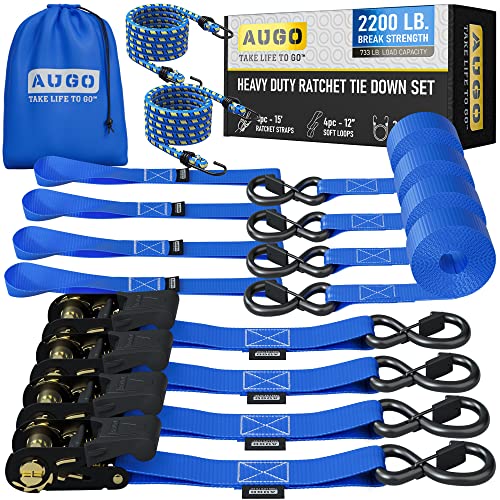
AUGO positions this four-pack as a value-oriented heavy-duty option, and the 2,200-pound break strength with a 733-pound working load limit per strap delivers substantially more rated capacity than similarly priced competitors — a meaningful advantage when you are regularly hauling motorcycles, canoes, kayaks, or furniture and need a strap that leaves real safety margin between your actual load weight and the strap's failure threshold. The 15-foot length provides generous reach for standard truck beds and open trailers, and the extra stitching on high-stress points is a visible construction quality indicator that distinguishes AUGO from purely specification-driven competitors who cut construction corners to hit a price point. The rubber-coated S hooks with safety lock mechanisms serve a dual function: they resist paint chipping and surface damage on your vehicle while the locking mechanism prevents hook vibration from disengaging the anchor point during travel — a failure mode that causes load shifts on rough roads that standard unguarded hooks experience with uncomfortable frequency.
The easy-grip ratcheting mechanisms are designed for comfortable operation across the full tightening range, which matters more than it sounds when you are working in cold weather with gloves or rushing through a pre-trip check with limited visibility. AUGO includes soft loop tie-down straps in the kit, giving you the same paint-protection advantage that makes the FORTEM kit valuable, but at the 15-foot heavy-duty scale that suits larger cargo pieces. This is the right recommendation for buyers who want substantially more strap capability than a light-duty kit provides without paying the premium associated with commercial-grade options that include features and certifications they will never use.
Pros:
Cons:
STANLEY built its reputation on professional-grade tools, and the S1007 ratchet strap carries that brand expectation into the cargo securement category with a 1.5-inch wide, 16-foot strap delivering 1,100 pounds of safe working load and 3,300 pounds of break strength — exactly the performance envelope a DIY hauler or weekend truck user needs for moving appliances, equipment, and recreational gear without the cost or bulk of full commercial straps. The padded ergonomic handle is the most immediately noticeable build quality differentiator: it contours to your grip naturally, with recessed grooves that maintain hand traction even when your palms are sweaty or gloved, making sustained ratcheting significantly less fatiguing than working with bare metal competitors. The premium overmolded finger lever for release is engineered with the same attention — clean, positive engagement with a sure release that functions reliably rather than the mushy, imprecise lever feel that plagues value-tier hardware after a few months of use.
Black-coated steel ratchet components actively resist corrosion through inclement weather exposure, which is a practical advantage for any strap stored in an open truck bed, on a trailer, or in a garage environment where moisture cycling causes rapid oxidation on uncoated steel. WSTDA standard compliance is verified on these straps, giving you documentation of quality that matters for anyone who uses these professionally or needs to demonstrate compliance. The two-pack format is slightly limiting for users who need four-point tie-downs without purchasing two sets, but the quality level per strap makes the value proposition clear for buyers who prioritize build quality over sheer quantity. STANLEY delivers a strap that performs like professional hardware at a price point accessible to weekend haulers who refuse to settle for flimsy consumer-grade alternatives.
Pros:
Cons:
The single most important concept in ratchet strap selection is the distinction between break strength and working load limit, and conflating the two numbers is how buyers end up with straps that fail without warning under loads they assumed were within spec. Break strength is the force required to destroy the strap under laboratory conditions — working load limit is the maximum force you should ever apply in actual use, which is standardized at one-third of break strength by the Web Sling and Tie Down Association (WSTDA). A strap rated at 3,000 pounds break strength has a 1,000-pound working load limit, and exceeding that limit in real-world conditions — where road vibration, dynamic load shifts, and webbing angle all apply additional stress — progressively degrades the webbing long before it reaches the theoretical break point. When calculating how many straps you need for a given load, add the working load limits of all straps together and ensure the total exceeds your cargo weight with meaningful margin, accounting for the fact that uneven loading typically means some straps carry more force than others.
Certified polyester webbing is the only material you should accept in a ratchet strap rated for serious cargo work, and the reasoning is straightforward: polyester does not absorb moisture, maintains consistent stretch characteristics across temperature extremes from sub-freezing winters to desert summers, and resists UV degradation across multiple years of outdoor storage in ways that nylon and polypropylene simply cannot match. Nylon absorbs up to 7% of its weight in water, which causes measurable stretch variation that changes your strap's effective tension between dry and wet conditions — a problem that disappears entirely with polyester. Width determines load distribution and hardware compatibility: 1-inch straps are appropriate for light cargo like motorcycles and recreational equipment, 1.5-inch straps handle medium loads and most DIY applications, and 2-inch straps are the commercial standard for flatbed trailer work where heavy equipment demands maximum webbing surface area and hardware strength. Never use a strap that does not clearly label its webbing material and certifying organization.
The hook design determines where and how reliably your strap connects to the load or trailer, and choosing the wrong hook type for your specific anchor configuration creates both security failure risk and hardware damage to your vehicle's tie-down points. J hooks are the most common design for flatbed and trailer applications, engaging standard D-rings, stake pockets, and frame rails with secure positive retention — but they require open-sided anchor access that some enclosed cargo situations do not provide. Flat hooks with built-in defenders protect anchor point edges from metal-on-metal wear during sustained hauling, which matters when your trailer's D-rings are aluminum or when you are hauling loads over long distances where vibration cycles compound wear damage. S hooks provide quick-attach versatility but should always carry a safety lock mechanism to prevent disengagement, and soft loop connections remain the correct choice for any cargo attachment point that direct metal hook contact would scratch, dent, or structurally compromise. Chain anchors serve professional flatbed operators working with legacy equipment or non-standard anchor configurations where hook designs fall short.
Strap length selection depends on your specific hauling configuration: 10-foot straps work for compact motorcycle and ATV tie-downs in standard pickup beds, 14 to 16-foot straps cover most recreational and DIY applications, and 27 to 30-foot straps are necessary for flatbed trailers where reach across the full trailer width is required. Always buy more length than your minimum need — you can use excess webbing, but you cannot extend a strap that is too short without introducing unsafe improvised connections. Quantity planning follows the four-point minimum rule for most cargo: any load that can shift forward, backward, or sideways during braking, acceleration, or cornering requires independent restraint in each direction, which means a minimum of four straps for most hauls and additional straps for oversized or irregularly shaped cargo. Storage quality directly affects strap longevity — UV exposure, moisture, and heat cycling degrade polyester webbing over time, and straps stored in reusable cases or coiled with keeper straps last substantially longer than those thrown loose in a truck bed and exposed to every weather condition through multiple seasons. If you are building a complete hauling toolkit, our garage storage systems guide covers organized storage solutions that keep your straps and hardware in deployment-ready condition year-round.
Break strength is the force required to physically destroy the strap under controlled laboratory test conditions, while working load limit (WLL) is the maximum load the strap should carry in real-world use — standardized at one-third of break strength by the WSTDA. A strap with 3,000 lb break strength has a 1,000 lb WLL, and you should never exceed the WLL during actual hauling operations. The safety margin between WLL and break strength accounts for dynamic road forces, vibration, and uneven load distribution that add stress beyond the static weight of the cargo.
A properly secured motorcycle requires a minimum of four ratchet straps — two forward and two rear — attached to the frame or solid structural points, never the handlebars or suspension components that can bend or compress under load tension. Soft loop straps are essential for motorcycle tie-downs because direct hook contact damages chrome and painted surfaces, and 1-inch straps at 800 to 1,200 lb break strength provide adequate rated capacity for most motorcycle weights. Tighten until the suspension compresses slightly, creating a stable four-point restraint that prevents forward, backward, and lateral movement during transport.
You can reuse ratchet straps after heavy loads provided you inspect them thoroughly before each subsequent use for webbing fraying, cuts, discoloration, or UV fading that indicates structural degradation. Hardware inspection is equally important — check ratchet pawl engagement, hook tip integrity, and the connection points where webbing meets metal fittings, as these junction areas experience the highest stress concentration during load cycles. Any strap showing visible webbing damage, a sticky or imprecise ratchet mechanism, or bent hook hardware should be retired immediately regardless of how many load cycles it has completed, because failure point prediction on damaged straps is unreliable.
DOT compliance means the strap meets Federal Motor Carrier Safety Administration cargo securement regulations, which mandate minimum WLL ratings, working load limit labeling on the strap, and construction standards that satisfy the Commercial Vehicle Safety Alliance (CVSA) inspection criteria. You need DOT-compliant straps if you operate a commercial vehicle, drive a truck requiring a CDL, or haul cargo professionally in situations where CVSA roadside inspections apply. Recreational users and DIY haulers are not legally required to use DOT-compliant straps for personal cargo transport, but the WSTDA standards that certified straps must meet are a meaningful quality benchmark worth seeking even for non-commercial applications because they guarantee minimum construction and testing accountability.
Store ratchet straps coiled with their keeper strap or in a reusable case away from direct UV exposure, extreme heat, and moisture, as polyester webbing degrades faster under sustained UV radiation and heat cycling than under mechanical load stress alone. Straps stored loosely in an open truck bed experience more UV and weather degradation in a single season than properly stored straps accumulate over several years of regular use. Rinse straps with clean water after salt exposure from coastal environments or winter road salt, and allow them to dry completely before storage to prevent the mildew growth that can weaken webbing fibers even in polyester that resists moisture absorption.
For ATV and UTV tie-downs, the best ratchet straps combine adequate working load limit (minimum 500 lb WLL per strap with four straps deployed), soft loop attachments to protect the frame finish, and 10 to 15-foot length that suits standard pickup bed and trailer configurations without excess webbing. The Rhino USA Retractable Ratchet Straps handle ATV applications cleanly with the retractable mechanism eliminating webbing management hassle between loads, while the AUGO four-pack provides more rated capacity and length at a value price point that suits buyers making their first serious tie-down investment for powersports transport.
The strap that keeps your cargo on the road is never the one you bought to save a few dollars — it is the one you chose because the numbers were right, the hardware was solid, and the rating matched the actual load.
 |
 |
 |
 |

About Liam O'Brien
Liam O'Brien has spent over a decade buying, field-testing, and evaluating automotive tools with a focus on what actually performs in a real DIY garage rather than what markets well on a spec sheet. His hands-on experience spans hand tools, diagnostic equipment, floor jacks, socket sets, and specialty automotive gear across a wide range of brands and price points. At CarCareTotal, he covers automotive tool and equipment reviews, garage setup guides, and buying advice for home mechanics.
Get some FREE car parts & gear.. Or check out the latest free automotive manuals and build guides here.
Disable your ad blocker to unlock all the hidden deals. Hit the button below 🚗
| | | |
