Exterior ›
by Joshua Thomas
Roughly 50,000 trailer-related crashes are reported on U.S. highways every year, and inadequate rear visibility is one of the leading contributing factors — a statistic that makes choosing the right towing mirror one of the most safety-critical decisions you can make before hooking up a trailer. Whether you're hauling a fifth-wheel camper, a boat, or a landscaping trailer, your factory mirrors almost certainly leave massive blind spots the moment a wide load extends beyond your vehicle's body. A good towing mirror pushes your sightlines out far enough to cover those blind spots confidently, and the best ones do it without tools, without rattling, and without scratching your factory glass.
The 2026 market has more options than ever, ranging from no-tools slip-on designs that take about 30 seconds to install to full replacement mirrors with power adjustment and heated glass. That breadth is genuinely useful, but it also makes choosing the right mirror harder than it should be. The wrong choice — a universal clip-on that vibrates loose at highway speed, or a vehicle-specific unit that doesn't quite match your trim level — wastes money and creates a false sense of security. Before you add anything to your cart, it's worth understanding what separates a mirror that holds firm at 70 mph from one that drifts out of position every few miles. If you're already thinking about trailer safety more broadly, our guide to the best trailer tires of 2026 covers another critical piece of the equation.
We evaluated seven of the top-selling towing mirrors available in 2026, looking at fit quality, viewing area, installation ease, vibration resistance, and overall build durability. The picks below span universal clip-ons, vehicle-specific snap-on designs, and full replacement assemblies — so regardless of what you're driving or what you're towing, there's a clear recommendation for your situation. You'll also find a focused buying guide and a comprehensive FAQ section to help you make a fully informed decision before you pull away from the driveway.

Contents







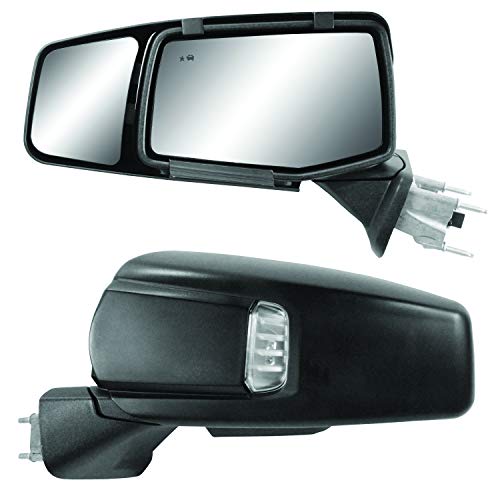


If you own a 2019–2020 GMC Sierra or Chevy Silverado and need a towing mirror that installs in under a minute without a single tool, the Longview LVT-1820 is the definitive answer. Longview engineered this mirror to slip directly over your existing factory mirror housing with a precision-molded fit that leaves no gap, no wobble, and no guesswork about compatibility. The result is a rock-solid extension that adds several inches of lateral sightline, bringing the sides of your trailer into full view at highway speeds without compromising the clarity or adjustment range of your factory glass underneath.
What makes the LVT-1820 stand out beyond its simple installation is the quality of the mirror glass itself, which provides a wide, distortion-free image across a generous viewing area. Because the unit wraps around your existing housing rather than clamping onto it, there's no risk of scratching or warping your factory mirror, and the fit is tight enough that vibration at speed is essentially nonexistent. Longview has been building slip-on mirrors for decades, and the LVT-1820 reflects that experience — the tolerances are tight, the plastic housing is UV-resistant, and the design feels like something that should have shipped with the truck from the factory.
The limitation here is real: this mirror fits only the 2019–2020 Sierra and Silverado with specific factory mirror configurations. If your truck is a different year or trim, this one simply won't work, and you'll need to look at a universal option or another vehicle-specific design. But if your truck is in the compatibility window, you'll be hard-pressed to find a better-performing slip-on mirror at any price point in 2026.
Pros:
Cons:
The Fit System 3891 earns its place as the best universal clip-on towing mirror in 2026 by delivering a genuinely large 5-inch by 8-inch viewing surface — one of the biggest you'll find in the clip-on category — paired with a dual ratcheting strap system that clamps securely to factory mirrors up to 11.5 inches tall. The rubber pads sandwiched between the clamp and your factory glass prevent scratching and dampen vibration effectively, and the ratchet lock mechanism holds position even on rough road surfaces where lesser clip-ons tend to slip and rotate over time.
Installation takes about two minutes without any tools, and because the design is truly universal, you can move this mirror between multiple vehicles — which makes it an excellent choice if you tow infrequently with different trucks or borrow vehicles for hauling. The mirror head adjusts independently of the mounting bracket, letting you dial in the exact angle you need regardless of how your factory mirror sits. At highway speeds, the 3891 holds its position well given its clip-on nature, though you should expect occasional minor repositioning on very rough surfaces, which is simply the physics of a clamp-based design.
The viewing area is the genuine selling point here: 40 square inches of clear glass extends your sightlines far enough to cover a standard boat trailer or cargo trailer with room to spare. If you're looking for a mirror that works across your whole fleet without any vehicle-specific shopping, this is the one to buy. It's also worth noting that the Fit System 3891 is one of the few universal mirrors that actually holds up to repeated use without the straps stretching or losing tension — a common failure mode with cheaper alternatives.
Pros:
Cons:
CIPA has been manufacturing towing accessories for over 50 years, and the 11650 door-mount mirror represents the brand's straightforward, no-frills philosophy — a mirror that fits most cars, trucks, and vans, installs in seconds, and does exactly what a towing mirror needs to do without charging you for features you'll never use. The door-mount design differs from clip-on mirrors in that it attaches at the door frame rather than over the existing mirror, which gives it a more secure anchor point and eliminates the risk of clamping force scratching your factory glass.
The universal mount accommodates both driver and passenger sides with the same hardware, and the ball-joint adjustment allows you to position the mirror head at virtually any angle without loosening any bolts. The black finish is durable enough to handle sun exposure and road grime without fading noticeably over a single season, and the mirror glass itself is flat and clear — not the convex curve that compresses your field of view the way many cheap mirrors do. For occasional towers who don't want to spend money on a vehicle-specific design they'll use a handful of times per year, the CIPA 11650 offers a genuinely reliable solution at a price point that's easy to justify.
The tradeoff you accept with the 11650 is that door-mount designs require a compatible door geometry to attach properly, and on some modern vehicles with sculpted door panels, the fit is less secure than on older trucks with flatter surfaces. Check your door profile before ordering, and if you drive a newer model with aggressive body contours, a clip-on or vehicle-specific design will serve you better. That said, for the price and the breadth of compatibility CIPA claims, this mirror delivers solid value and dependable performance for light to moderate towing duty.
Pros:
Cons:
The K Source Snap & Zap system for the Ford F150 is one of the smartest towing mirror designs on the market in 2026, using a patented clip-on mechanism that molds directly to the factory mirror housing so precisely that the extension feels integrated rather than added-on. You get a matched pair — driver and passenger — that installs without tools in about five minutes, snapping firmly into place around your existing mirrors and extending your rear sightline by several inches on each side without blocking or disrupting the factory glass in any way.
The critical design achievement here is that the Snap & Zap extension clips onto the housing, not the glass, which means there's zero pressure on the mirror surface itself and no risk of cracking or distorting your factory mirror even after years of repeated installation and removal. The extension arm holds the additional mirror glass at the correct angle for immediate usability without adjustment, which means the moment you snap it on, you have a working towing setup — no repositioning required every time you hook up a trailer. For F150 owners who tow regularly, that convenience adds up significantly over time.
The molded fitment also translates directly into superior vibration resistance compared to universal clip-ons — because the contact surface is custom-shaped to the F150's mirror profile, there's no rocking or oscillation even at sustained highway speeds with a loaded trailer behind you. The black finish is UV-stable and matches most factory mirror housings without looking like an afterthought. If you drive a Ford F150 and tow more than once or twice a year, this is simply the right mirror — purpose-built, well-executed, and designed to last through many seasons of use.
Pros:
Cons:

The K Source 80930 takes the same Snap & Zap philosophy applied to the F150 and executes it flawlessly for the 2019–2024 Chevy Silverado 1500 and GMC Sierra 1500 — two of the most popular towing trucks on American roads, and ones where the factory mirrors genuinely need extension whenever you're pulling anything wider than the cab. The patented design clips cleanly around the factory mirror housing without tools, without hardware, and without any modification to your existing mirror setup, and it holds with enough tension to stay locked in place on rough surfaces and at sustained highway speeds.
The 80930's compatibility window is the feature that makes it particularly valuable in 2026 — six model years of coverage means this mirror works across a huge installed base of trucks, and because GM's Silverado 1500 and Sierra 1500 share the same mirror architecture during that period, one product covers two brands simultaneously. The extension doesn't interfere with your factory mirror's power adjustment or fold function, so you can still use your in-cabin controls normally while the Snap & Zap adds its additional viewing area on the outside. That level of integration is something universal clip-ons simply can't offer.
For Silverado and Sierra owners who want a legitimate, purpose-built towing mirror rather than a generic clip-on, the 80930 is the clear recommendation. It installs before you're done drinking your coffee, removes just as quickly when you're not towing, and provides the kind of vibration-free, distortion-free sighting that makes lane changes with a wide trailer feel genuinely safe rather than nerve-wracking. Pair this with a quality set of trailer tires and a car emergency kit, and you're properly prepared for extended towing on any road type.
Pros:
Cons:
For owners of 1999–2007 Ford F250 or F350 Super Duty trucks whose factory tow mirrors have cracked, fogged, or simply worn out after two-plus decades of hard use, the ECCPP replacement mirrors offer a full-function restoration at a fraction of the cost of OEM replacements. These are complete mirror assemblies — not clip-ons, not slip-overs — with large telescoping mirror heads that extend manually and retract, power-adjustable main glass, heated defrost on both surfaces, and manually adjustable convex spotter glasses in the lower corners, giving you both a wide-angle primary view and a spot check for blind zones simultaneously.
The telescoping function is particularly valuable for serious towing duty, allowing you to extend the mirror head outward when pulling wide loads like flatbed trailers or horse trailers, then retract it back to normal position for everyday driving without removing anything from the truck. The heated glass eliminates the fogging and ice buildup that renders standard mirrors useless in cold or rainy conditions — a genuinely safety-critical feature for anyone towing in northern states or at elevation in 2026. The ECCPP mirrors come as a matched pair covering both driver and passenger sides, which simplifies ordering and ensures consistent appearance across the vehicle.
The important caveat ECCPP states clearly is that these mirrors are designed to replace original equipment with the same features — if your factory F250/F350 mirrors didn't have power adjustment, heat, or telescoping function, this replacement may not wire up correctly to your truck's controls. Check your existing mirror specification before ordering, and confirm that the connector pinout matches your truck's harness. For the right truck with the right factory configuration, though, the ECCPP mirrors deliver OEM-equivalent functionality at an aftermarket price that makes restoration economically sensible rather than aspirational.
Pros:
Cons:
The Jeep Wrangler and Gladiator present a unique mirror challenge compared to conventional trucks — the factory door mirrors sit on exposed mounting stanchions rather than integrated door panels, which means universal clip-on designs often fit poorly or not at all on these vehicles. K Source's Snap & Zap solution for the Wrangler and Gladiator is purpose-engineered for that specific mirror architecture, molding precisely to the factory housing so the extension clips on cleanly and holds without any of the rocking or gap issues that plague generic designs on these vehicles.
The pair covers both Jeep Wrangler and Gladiator models — a sensible design decision given that the two vehicles share the same mirror mounting geometry — and provides a meaningful extension of the rear sightline for either platform when you're towing a camp trailer, an off-road utility trailer, or any load that extends beyond the Jeep's body width. Installation follows the standard Snap & Zap pattern: no tools, no hardware, snap on and go, with removal equally quick when you're done towing and want to return to the standard profile for off-road use or tight parking situations.
Jeep owners who also run aggressive tires on their Wrangler know that the vehicle's off-road capability naturally invites use cases that involve trailering equipment to a destination — and those same owners will appreciate that the Snap & Zap doesn't interfere with the fold function on the factory mirrors, which matters when you're navigating narrow trails or parking in tight spaces. The black finish is rugged enough to handle UV exposure and occasional mud splatter without looking deteriorated after one season, which is exactly what you expect from a Jeep accessory in 2026. Check out our exterior accessories guides for more upgrades that work well alongside towing mirrors for the complete setup.
Pros:
Cons:
The single biggest decision when buying a towing mirror is choosing between a universal design and a vehicle-specific one, and the right answer depends almost entirely on how often you tow and with how many different vehicles. Universal clip-on mirrors like the Fit System 3891 and the CIPA 11650 work across a wide range of vehicles and can move between your truck, your spouse's SUV, or a borrowed vehicle without any compatibility research — that flexibility is genuinely valuable for infrequent towers or households with mixed fleets.
Vehicle-specific designs, on the other hand — the K Source Snap & Zap series and the Longview LVT-1820 — offer significantly better fit quality, less vibration, and a more integrated appearance because the mounting interface is precision-molded to your exact mirror housing. If you tow regularly with one vehicle, a vehicle-specific design will outperform a universal clip-on in every measurable way, and the investment is easy to justify. The tradeoff is obvious: compatibility is narrow, and you need to verify model year and trim compatibility carefully before purchasing. Trailers vary considerably in width, so matching your mirror's extension to your typical load width is worth considering during the selection process as well.
Beyond the universal vs. specific question, towing mirrors fall into three mechanical categories that affect installation complexity, removal convenience, and long-term durability in meaningfully different ways. Clip-on mirrors attach to your factory mirror housing using straps, ratchets, or spring clips, and they're the easiest to install and remove — but they're also the most prone to vibration over time as their mounting hardware stretches or loosens with repeated use cycles.
Slip-on mirrors like the Longview LVT-1820 envelop the existing mirror housing completely, providing a larger contact area and therefore greater stability without any strap hardware at all — the friction fit of a precision-molded shell is inherently more vibration-resistant than a clamp. Full replacement mirrors like the ECCPP units are the most permanent solution, requiring installation in place of the factory mirror but providing all the electronic functions — power adjustment, heating, telescoping — of a proper OEM towing mirror. Replacements make the most sense when your factory mirrors are already damaged, obsolete, or functionally inadequate for your regular towing loads.
The whole point of a towing mirror is expanding your rear sightline, so the viewing area of the additional glass is a specification you should pay close attention to before purchasing. A 5-inch by 8-inch surface like the Fit System 3891 provides 40 square inches of additional viewing area — enough to see alongside a standard single-axle trailer at highway speed with confidence. Smaller mirrors, particularly in the 3-inch by 5-inch range common among budget clip-ons, can feel inadequate when you're pulling anything over about 8 feet wide.
Glass quality matters too: flat glass gives you a true-scale, undistorted image of what's behind you, while convex glass compresses the image to show a wider area at the cost of accurate distance perception. For lane changes, flat glass is preferable because you can accurately judge the gap between your trailer and the vehicle in the next lane. Convex glass is better as a supplemental spotter for blind zones near the rear corners of the trailer — which is why full-replacement mirrors like the ECCPP units include both surfaces, giving you the best of both options simultaneously.
A towing mirror that vibrates at highway speed is worse than useless — it's actively dangerous because the blurred image it produces is disorienting and may cause you to misjudge the distance of following vehicles or obstacles alongside your trailer. Vibration resistance is primarily a function of the mounting system quality and the weight of the mirror head itself, and this is where vehicle-specific designs consistently outperform universals because their larger, more precise contact surfaces transmit less oscillation from road inputs through to the mirror glass.
When evaluating any towing mirror for vibration resistance, look for rubber-padded contact points, positive locking mechanisms rather than friction-only retention, and if possible, reviews from drivers who have used the mirror at sustained interstate speeds rather than only around town. Heavier trailer loads amplify road vibration at the hitch, which transmits through the frame and eventually reaches the mirror mounts — a mirror that holds steady pulling a light utility trailer may vibrate noticeably when you're pulling a loaded 30-foot travel trailer at 65 mph on a chip-sealed highway.
In most U.S. states, you are legally required to have rear visibility extending at least 200 feet behind your vehicle when towing a load that's wider than your vehicle's body — and if your factory mirrors don't provide that sightline with the trailer attached, you are required to use auxiliary towing mirrors. Requirements vary by state, so check your specific state's motor vehicle code, but in practice nearly any wide trailer will trigger the requirement regardless of jurisdiction.
Quality towing mirrors from reputable brands use rubber-padded contact points and are designed specifically to avoid damaging factory glass and housings. The risk of damage comes primarily from cheap clip-ons with bare metal contact points, or from overtightening ratchet straps on clip-on designs. Vehicle-specific slip-on and snap-on designs have essentially no damage risk because they contact the housing shell rather than the glass surface directly.
Well-designed vehicle-specific towing mirrors — like the K Source Snap & Zap series — are specifically engineered to not interfere with factory power fold or power adjustment functions. Universal clip-ons, depending on their attachment point, may prevent the factory mirror from folding fully because they block part of the housing. Full replacement mirrors like the ECCPP units replace the entire assembly and integrate with your vehicle's mirror controls natively.
A clip-on mirror uses straps, ratchets, or spring clips that attach to your factory mirror housing from the outside, clamping the extension in place. A slip-on mirror — like the Longview LVT-1820 — envelops the factory mirror housing completely, using the friction of a precision-molded shell to hold position without any external hardware. Slip-ons are generally more vibration-resistant because of their larger, more uniform contact area, but they require vehicle-specific engineering and only exist for a limited range of mirror housings.
The correct mirror size depends on the width of your trailer relative to your vehicle's width. A good rule of thumb is that your extended mirror should allow you to see at least 6 inches outside the widest point of your trailer at a following distance of 150 feet. Measure your trailer's width and your vehicle's body width, calculate the difference on each side, and choose a mirror extension that provides a sightline margin beyond that gap. Most standard towing mirrors are adequate for trailers up to 8 feet wide; anything wider benefits from mirrors with larger glass surfaces or greater extension arms.
Vehicle-specific snap-on and slip-on designs are generally easy to remove and reinstall, and most manufacturers recommend removing them when not actively towing because the wider profile increases wind noise, reduces fuel efficiency marginally, and creates a larger vehicle footprint in parking situations. Universal clip-ons are even easier to remove but also easier to forget — leaving a clip-on mirror on at highway speed without a trailer is just an aerodynamic inefficiency with no safety benefit. Full replacement mirrors, by contrast, are a permanent installation and stay on the vehicle at all times by design.
 |
 |
 |
 |

About Joshua Thomas
Joshua Thomas holds a Bachelor of Science in Mechanical Engineering from San Diego State University and has spent years applying that technical foundation to hands-on automotive work — from routine maintenance to full mechanical repairs. He founded CarCareTotal in 2017 to give car owners the kind of clear, practical guidance that helps them understand what is happening under the hood and make smarter decisions about upkeep and repairs. At CarCareTotal, he oversees editorial direction and covers automotive fundamentals, maintenance guides, and troubleshooting resources for everyday drivers.
Get some FREE car parts & gear.. Or check out the latest free automotive manuals and build guides here.
Disable your ad blocker to unlock all the hidden deals. Hit the button below 🚗
| | | |
