Audio ›
by Rachel Park
Which 15-inch subwoofer actually delivers the deep, authoritative bass that serious car audio enthusiasts demand in 2026, and which models fall short despite impressive specification sheets? After thorough research and comparative analysis of the leading options available this year, the Rockford Fosgate P3D4-15 Punch P3 emerges as the clearest benchmark for balanced performance, exceptional build quality, and long-term reliability in the 15-inch driver category.
The 15-inch subwoofer occupies a distinctive position within the broader car audio landscape, offering substantially greater cone area than a 12-inch driver while remaining manageable enough for most trunk and custom enclosure builds. According to Wikipedia's technical overview of subwoofers, larger driver diameters directly enable the movement of greater air volume at lower frequencies — which is precisely why 15-inch models excel at reproducing bass content below 40 Hz with genuine physical authority. Buyers who have already explored the broader market through resources like the 6 Best Car Subwoofers of 2026 guide often graduate to 15-inch drivers once they recognize that their current setup lacks the visceral low-end extension their music demands.
Selecting the right 15-inch subwoofer in 2026 requires evaluating several interconnected variables — power handling, voice coil configuration, impedance rating, and enclosure compatibility standing chief among them. The seven models reviewed below span a wide performance spectrum, from the everyday enthusiast seeking clean, musical bass reproduction to the dedicated competitor chasing maximum sound pressure levels at sanctioned events. Each product has been assessed against real-world installation scenarios, verified manufacturer specifications, and documented user feedback, ensuring that every recommendation on this page reflects actual operational performance rather than promotional language. Buyers who plan to pair one of these subwoofers with a new amplifier should also consult the 6 Best Amp Wiring Kits of 2026 guide to ensure power delivery infrastructure matches the demands of a high-output 15-inch driver, while those comparing 15-inch models against smaller alternatives can reference the 7 Best 12-Inch Car Subwoofers of 2026 guide for a direct size-class comparison.
Contents
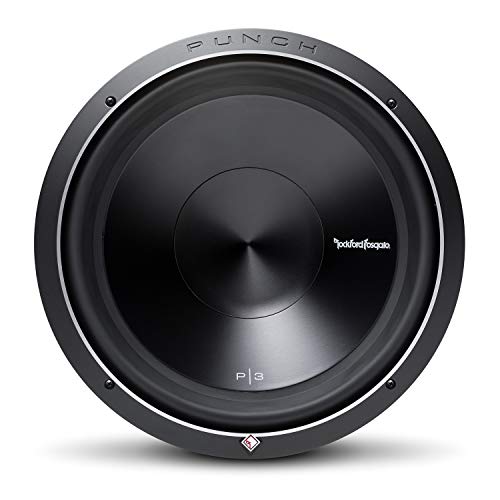





The Rockford Fosgate P3D4-15 Punch P3 represents the apex of the company's Punch Series lineup, combining reference-quality bass reproduction with engineering refinements that distinguish it from the broader field of 15-inch competition in 2026. The driver carries a 600-watt RMS and 1,200-watt maximum power handling rating — figures that position it squarely in the performance enthusiast segment without crossing into the extreme SPL territory that sacrifices daily-use musicality for raw output. Rockford Fosgate engineers the P3D4-15 around an anodized aluminum cone and matching dustcap, materials chosen for their combination of structural rigidity and low mass, which together contribute to tighter transient response compared to paper or pressed pulp alternatives across the driver's full operating bandwidth.
The dual voice coil configuration — wound to 4 ohms on each coil — provides installers with wiring flexibility that allows the subwoofer to present either a 2-ohm or 8-ohm final impedance depending on amplifier requirements, a practical advantage that simplifies system matching across a broad range of amplifier platforms without requiring impedance-specific hardware changes. The spider venting system incorporated into the motor structure actively channels heat away from the voice coil assembly during extended high-power operation, addressing one of the primary failure modes that affects lesser subwoofers under sustained load conditions. The hybrid stamp-cast basket further distinguishes the P3D4-15 by combining the weight reduction of a stamped steel design with the resonance-damping properties historically associated with full cast aluminum construction, producing a structure that remains acoustically quiet under excursion while resisting the flex that degrades performance in cheaper alternatives. Custom 10-AWG nickel-plated push terminals complete the package, offering a secure and corrosion-resistant connection point that handles high-current delivery without voltage drop concerns at the junction.
In practical installation scenarios, the P3D4-15 performs with the consistency and composure that has made the Punch P3 designation a benchmark in the enthusiast community for more than a decade. Its tonal balance skews toward accuracy rather than pure output, making it an outstanding choice for buyers who prioritize musical reproduction alongside raw bass extension. Recommended sealed enclosure volume of approximately 1.75 to 2.5 cubic feet suits mid-sized sedans and SUVs without requiring extreme custom fabrication work, and the driver's forgiving nature with moderately imprecise enclosures further distinguishes it from competitors whose performance suffers sharply outside their optimal alignment window.
Pros:
Cons:
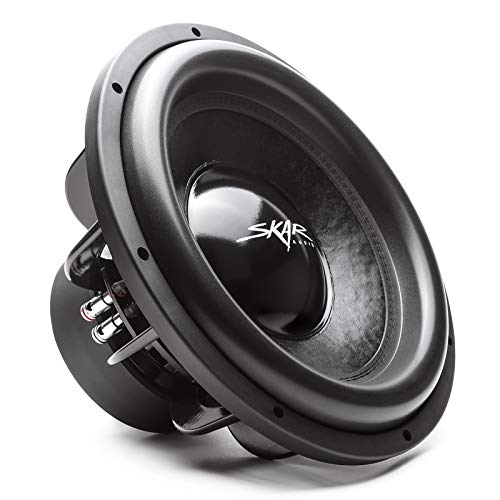
The Skar Audio EVL-15 D2 occupies an important position in the 15-inch category by delivering competition-grade power handling at a price point that remains accessible to the serious enthusiast market rather than exclusively to fully funded SPL competitors operating on unlimited budgets. The subwoofer carries a 1,250-watt RMS rating — exactly double that of the Rockford Fosgate P3D4-15 — and a 2,500-watt peak figure that reflects its engineering priority of handling high-current amplifier output without thermal failure during extended sessions at elevated power levels. Skar Audio builds the EVL-15 around a 3-inch dual 2-ohm voice coil finished with a high-temperature black coating, a construction choice that addresses the elevated thermal loads generated when a driver rated for 1,250 watts RMS sustains that output for the continuous periods that distinguish real-world high-performance use from brief measurement conditions.
The motor structure driving the EVL-15 is visibly substantial, incorporating a large ferrite magnet assembly that generates the flux density required to control the long-excursion cone movement associated with high-output 15-inch designs operating near rated power. The wiring configuration — each coil presenting 2 ohms — allows the dual voice coil to be configured to a 1-ohm or 4-ohm final impedance depending on the amplifier's rated stable minimum load, a flexibility that expands compatibility with the wide range of high-output mono amplifiers available in 2026 without requiring impedance-matching accessories. Skar Audio publishes detailed enclosure recommendations for both sealed and ported configurations, with the ported alignment in particular allowing the EVL-15 to achieve efficiency gains that translate to measurably louder output for equivalent amplifier wattage compared to sealed operation in the same vehicle.
Field reports from users who have operated the EVL-15 D2 in daily-use street systems consistently describe a subwoofer that outperforms its price segment by a substantial margin, with output levels that rival products commanding significantly higher retail prices when installed in a properly designed enclosure. The build quality across recent production generations reflects Skar Audio's continued manufacturing improvements, with more consistent adhesive bonding on the spider assembly and improved coil centering compared to earlier EVL iterations that occasionally exhibited quality control variability at the factory level.
Pros:
Cons:
The CT Sounds Thermo 15 enters the 2026 market with a specification sheet oriented squarely toward sound pressure level competition and extreme output applications, featuring 1,500-watt RMS and 3,000-watt maximum power handling alongside a motor structure engineered for the thermal demands of high-duty-cycle operation that distinguishes competition use from casual street listening. The 3-inch, four-layer copper voice coil wound on a high-temperature former represents CT Sounds' commitment to thermal management in a driver designed for sustained operation near its rated power limits — the additional winding layers distribute heat generation across a greater surface area than conventional two-layer designs allow, extending voice coil survival time under conditions that eliminate standard competitors. The 300-ounce triple-stacked motor assembly generates the magnetic flux necessary to maintain linear control over the cone at the extended excursion levels that high-output SPL-oriented listening demands from a 15-inch driver.
CT Sounds positions the Thermo 15 as a product capable of competing at organized SPL events while remaining a practical choice for street systems where daily playback in thermally demanding conditions subjects drivers to repeated heating and cooling cycles that expose weaknesses in lower-grade adhesives and coil former materials. The dual 2-ohm voice coil configuration mirrors the EVL-15's wiring options, allowing final impedance selection of either 1 ohm or 4 ohms to match available amplification platforms without adapter hardware. The Thermo's basket design incorporates extended cooling vents positioned around the spider landing to promote airflow through the motor gap during excursion, addressing the thermal accumulation that limits voice coil longevity in sealed motor designs at comparable sustained power levels over extended listening periods.
Buyers who evaluate the Thermo 15 against competitors in the 1,500W RMS bracket consistently note that CT Sounds has optimized this driver for raw output efficiency rather than refined tonal accuracy — a deliberate design choice that suits its intended SPL application without apology and without the softened low-end response that characterizes subwoofers tuned for audiophile-oriented playback. Builders who invest the time in a properly tuned ported enclosure aligned to the Thermo's parameters report output levels that physically pressurize vehicle interiors at moderate amplifier settings, reflecting genuine motor efficiency rather than specification inflation.
Pros:
Cons:
The Skar Audio VXF-15 D2 represents Skar's flagship competition offering in the 15-inch segment, engineered to the demanding specifications of serious SPL and SQL competitors who require both maximum output capability and the mechanical durability to withstand repeated competition cycles without voice coil or surround failure. With a 1,500-watt RMS and 3,000-watt maximum power handling rating that matches the CT Sounds Thermo 15 numerically, the VXF-15 D2 differentiates itself through its 3-inch high-temperature copper voice coil and a published sensitivity rating of 89.7 dB — a figure that reflects genuine efficiency rather than optimistic measurement conditions unique to that manufacturer's laboratory protocol. Higher sensitivity means the VXF-15 requires less amplifier power to achieve a given output level, translating to more effective use of available wattage in competition scenarios where amplifier selection is constrained by class regulations or financial parameters.
The dual 2-ohm voice coil design follows the established convention in the competition subwoofer segment, providing the same 1-ohm or 4-ohm wiring options as the Thermo 15 and EVL-15, while the VXF-15's motor structure incorporates engineering refinements that Skar Audio has developed across multiple product generations in direct response to competitive feedback from event participants. The basket and surround assembly reflects a design philosophy that prioritizes excursion linearity over the extreme peak-excursion figures advertised by some competitors, a choice that produces more predictable and controllable bass reproduction across the driver's operating range rather than the compressed, distorted output that characterizes subwoofers operating beyond their linear excursion limits at maximum power delivery.
In comparative listening environments, the VXF-15 D2 consistently demonstrates the ability to reproduce complex bass content with greater definition than many competitors at similar power ratings — a quality that makes it genuinely useful in both sanctioned competition and daily street system applications where musical accuracy matters alongside raw output levels. Skar Audio's detailed alignment data and enclosure specifications for the VXF-15 D2 are among the most comprehensive published by any manufacturer in this price segment, reducing the guesswork involved in enclosure design and making the subwoofer accessible to builders across a full range of experience levels without requiring independent acoustic modeling expertise.
Pros:
Cons:
The American Bass XFL 15 brings a substantial pedigree of performance-oriented engineering to the 15-inch market, backed by a 200-ounce magnet assembly and a 3-inch voice coil capable of handling 1,500 watts RMS and 3,000 watts peak — specifications that position it directly alongside the CT Sounds Thermo 15 and Skar Audio VXF-15 D2 in the high-output street performance segment without reaching into the extreme competition tier occupied by the DD Audio CB-9915C-D1. American Bass engineers the XFL 15 with a single 2-ohm impedance configuration rather than the dual voice coil architecture favored by most competitors in this power bracket, a choice that simplifies wiring but reduces impedance flexibility for buyers whose amplifiers are rated for higher loads than the 2-ohm minimum that this driver presents. The 200-ounce magnet structure is notably large for a single-magnet 15-inch design, generating the flux density required to maintain voice coil control at the extended excursion levels that produce genuinely physical bass reproduction at reference listening levels in typical vehicle interiors.
American Bass markets the XFL 15 toward buyers who prioritize deep, impactful bass reproduction as the primary system objective, and the driver's Thiele-Small parameters reflect this orientation with a suspension tuning that supports extended low-frequency output rather than elevated upper-bass punch or midrange transient speed. The durable cone material and reinforced surround construction address longevity concerns in systems subjected to repeated high-power operation across the temperature extremes that characterize vehicle interiors in varying climates, with the manufacturer specifying high-grade materials throughout the assembly that distinguish the XFL 15 from budget alternatives sacrificing component quality to reach lower price points. The XFL 15's availability in 10-inch and 12-inch variants makes it a practical choice for buyers seeking consistent voicing across multiple driver sizes in multi-subwoofer installations where tonal uniformity across positions matters.
User reports from XFL 15 installations consistently emphasize the subwoofer's ability to produce low bass extension that physically pressurizes vehicle interiors at moderate amplifier power levels — a characteristic reflecting efficient motor design rather than simply brute power handling or marketing-oriented peak specifications. The single 2-ohm voice coil configuration pairs cleanly with class D mono amplifiers rated for 2-ohm operation, representing the most common configuration in the high-output car audio amplifier segment as of 2026 and eliminating series-parallel wiring calculations from the installation process entirely.
Pros:
Cons:
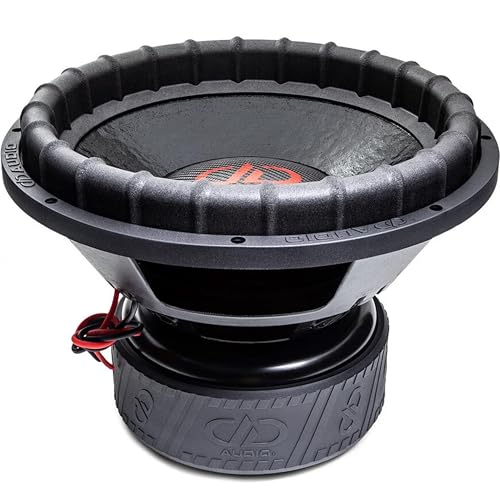
The DD Audio CB-9915C-D1 occupies a category entirely apart from the other subwoofers reviewed here, engineered for extreme competition applications where the engineering objective is maximum acoustic output per installation rather than cost efficiency, broad market accessibility, or everyday practical use in standard street systems. DD Audio rates this driver at 3,200 watts RMS with a capacity to sustain power bursts exceeding 12,000 watts — figures that require dedicated high-capacity electrical systems including upgraded alternators and auxiliary battery banks that far exceed the supply capability of a standard vehicle charging infrastructure. The SuperCharged designation reflects a specific engineering modification in which a neodymium shorting ring is incorporated into the motor circuit to redirect magnetic energy into the voice coil gap, increasing the motor's effective field strength and delivering tighter, more accurate bass control rather than simply increasing raw mechanical excursion through a stronger magnetic field alone.
DD Audio manufactures the 9915C in the United States, a distinction attributed to the precision assembly required for the driver's advanced components, including the eight-layer voice coil wound for 40mm of one-way travel and the non-pressed carbon fiber-loaded pulp cone constructed to balance extraordinary lightness with the rigidity that distinguishes handmade US production from automated overseas alternatives. The Dual Stage rear-mounted aluminum heatsink and Free Flow Cooling System address the thermal management challenges inherent in a driver that handles sustained power levels that would destroy conventional motor designs within minutes, with the multi-point heatsink configuration dissipating heat across substantially greater surface area than single-point cooling schemes found in standard competition subwoofers at lower price points. The USA-made Iron Cloth Spider System and second-generation V-ROM surround contribute the precise mechanical control required to maintain voice coil centering across 40mm of one-way travel without gap contact, which represents the primary mechanical failure mode for extreme-excursion subwoofers at sustained competition power levels.
The CB-9915C-D1 throws nearly 9,000 gauss through a 30mm deep gap — a specification that contextualizes the driver's exceptional coil control even at extreme excursion limits where most subwoofers surrender linearity and produce audibly distorted output. For buyers operating within sanctioned extreme SPL competition where the subwoofer cost represents only a fraction of total system investment, the CB-9915C-D1 represents DD Audio's definitive engineering statement in the 15-inch format for 2026 and stands as a product without meaningful competition at its performance tier.
Pros:
Cons:
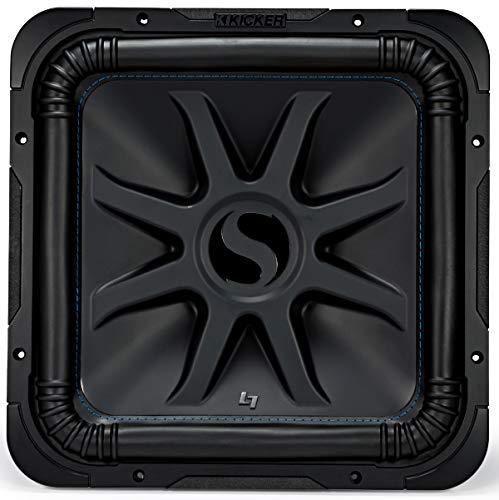
The KICKER L7S15 Solobaric represents one of the most architecturally distinctive designs in the car audio subwoofer category, defined by its square cone geometry that increases effective radiating area by approximately 20 percent compared to a conventional round 15-inch driver of equivalent nominal outer diameter — a design principle that KICKER has refined across multiple product generations to maximize acoustic output within a given installation footprint and enclosure volume. The L7S15 reviewed here carries Amazon's Renewed designation, meaning the unit has been inspected and tested by Amazon-qualified suppliers to verify that it meets operational specifications before resale — a program that provides buyers with access to a premium subwoofer at a price point reflecting pre-owned status rather than new retail pricing. Amazon's Renewed guarantee program includes a defined performance assurance, which mitigates the primary risk concern associated with purchasing pre-owned audio equipment of this complexity from unverified sellers in secondary markets.
The Solobaric L7's dual 4-ohm voice coil configuration allows wiring to either a 2-ohm or 8-ohm final impedance, with the 2-ohm configuration representing the practical choice for most high-powered mono amplifier pairings in 2026 where amplifier output at 2 ohms typically delivers the maximum rated continuous power. KICKER's engineering team has consistently optimized the L7 series for both ported and sealed enclosure alignments across its production history, with the square cone geometry producing particularly authoritative bass reproduction in properly tuned ported boxes where the increased effective radiating area translates directly to elevated output efficiency at the enclosure's tuning frequency. The Solobaric designation refers specifically to the internal back-chamber construction within the subwoofer basket itself, which incorporates a sealed internal volume that allows the driver to behave predictably even in enclosures that deviate modestly from strictly optimal specifications — a practical tolerance advantage for builders working with real-world space constraints.
For buyers seeking the distinctive performance character of KICKER's Solobaric L7 at a reduced cost of entry, the Renewed L7S15 provides access to a driver that commands genuine respect in the enthusiast community without the full premium of a new-in-box unit. The Renewed inspection process and performance guarantee create a practical safety net that distinguishes this listing from the unverified used market, making it a legitimate option for cost-conscious buyers who understand and accept the pre-owned nature of the product and its associated box-and-accessories condition caveats disclosed in the listing.
Pros:
Cons:

The single most important specification for prospective buyers to evaluate is the continuous RMS power handling figure, not the peak or maximum values that appear most prominently in product marketing because they carry larger numbers more likely to attract attention at point of sale. RMS power represents the continuous wattage a subwoofer's voice coil can sustain indefinitely without accumulating the thermal damage that eventually causes coil failure, while the peak figure describes a transient ceiling that the driver tolerates for only fractions of a second before sustained exposure causes irreversible degradation. Pairing a subwoofer with an amplifier whose continuous output at the wired impedance matches or modestly exceeds the driver's RMS rating — rather than its peak figure — ensures that the system operates within the thermal parameters the voice coil was designed to sustain across extended listening sessions. The seven subwoofers reviewed above range from 600 watts RMS for the Rockford Fosgate P3D4-15 to 3,200 watts RMS for the DD Audio CB-9915C-D1, with the majority of street-oriented competition models clustering in the 1,250 to 1,500-watt RMS range that suits the high-powered mono amplifiers most commonly selected in 2026 builds.
Dual voice coil subwoofers — which appear in five of the seven models reviewed above — provide wiring flexibility that single voice coil designs cannot match, allowing the installer to configure the subwoofer's presented impedance based on the amplifier's rated stable minimum load and maximum power output at each impedance step. A dual 2-ohm subwoofer wired in series presents 4 ohms to the amplifier, while wiring in parallel produces a 1-ohm load that allows high-powered class D amplifiers to deliver maximum rated continuous output — the configuration that most competition-oriented buyers target for peak system performance at events. The dual 4-ohm configuration used by the Rockford Fosgate P3D4-15 and KICKER L7S15 wires to either 2 ohms or 8 ohms, with the 2-ohm configuration representing the standard practical choice for most mono amplifier applications available in the current market. Understanding how to calculate final impedance from a given voice coil configuration is a fundamental competency for anyone assembling a high-performance car audio system, and buyers who are unfamiliar with the calculation should verify their planned wiring scheme against their amplifier's owner manual before making a purchase commitment.
The acoustic environment in which a 15-inch subwoofer operates — sealed, ported, or bandpass — profoundly affects output character, efficiency, and low-frequency extension in ways that can transform a well-reviewed driver into either a disappointment or a revelation depending on how carefully the enclosure is matched to the driver's published Thiele-Small parameters. Sealed enclosures provide the tightest, most controlled bass reproduction with the most compact box volume requirements, making them the preferred alignment for music-first applications and installations where enclosure space is strictly constrained by vehicle architecture or competing cargo priorities. Ported enclosures sacrifice some accuracy and transient precision for substantially increased output efficiency at the tuning frequency, producing higher maximum sound pressure levels for equivalent amplifier power and extending usable bass response several hertz below the driver's natural free-air resonance when the port is tuned to the appropriate target frequency. The manufacturers reviewed above each publish Thiele-Small parameters and specific internal volume recommendations for each supported alignment, and buyers are strongly advised to use these specifications as design inputs rather than treating general category averages as adequate substitutes for driver-specific enclosure data.
Sensitivity, measured in decibels at 1 watt at 1 meter under standardized conditions, quantifies how effectively a subwoofer converts electrical power into acoustic output — a specification that becomes practically significant when comparing drivers of similar power handling ratings that produce markedly different output levels when paired with identical amplifiers in otherwise equivalent installations. The Skar Audio VXF-15 D2's published 89.7 dB sensitivity rating is among the most favorable in this review group, meaning it produces measurably greater output per delivered watt than less efficient competitors operating in the same enclosure alignment and power bracket. Buyers with fixed amplifier budgets benefit disproportionately from selecting higher-sensitivity subwoofers, as the acoustic advantage of each decibel of sensitivity improvement compounds across the full amplifier power range rather than appearing only at maximum output where the audible difference between moderate and high sensitivity is most apparent. A 3 dB sensitivity advantage is roughly equivalent to doubling amplifier power, making sensitivity comparisons among competing subwoofers a genuinely impactful factor in system planning rather than a secondary specification concern.
The Rockford Fosgate P3D4-15 Punch P3 stands as the strongest recommendation for daily street use, combining accurate bass reproduction, reliable thermal management through its spider venting system, and a 600-watt RMS rating that pairs cleanly with quality mono amplifiers in the 500 to 1,000-watt continuous output class. Its tonal accuracy and build consistency make it a satisfying long-term choice for music-first listeners who want impactful bass without the SPL-optimized compromises that affect drivers tuned for maximum competition output rather than daily enjoyment.
The appropriate amplifier power depends directly on the subwoofer's RMS rating rather than its peak specification, with most installers targeting an amplifier continuous output between 75 and 150 percent of the driver's RMS rating at the wired impedance. This range provides adequate headroom for dynamic peaks in music while avoiding the sustained overpower conditions that accumulate thermal damage in the voice coil over extended listening sessions. The models reviewed above require amplifiers ranging from approximately 500 watts continuous for the Rockford Fosgate P3D4-15 to 3,200 watts or more for the DD Audio CB-9915C-D1, the latter of which additionally requires upgraded vehicle electrical infrastructure to supply that power at sustained levels without voltage sag.
Sealed enclosures for 15-inch subwoofers typically require between 1.5 and 3 cubic feet of internal net volume after displacement from bracing and port tubes, while ported alignments generally specify between 3 and 6 cubic feet depending on the driver's Thiele-Small parameters and the targeted tuning frequency. The specific recommendations published by each manufacturer reviewed above serve as the appropriate design baseline, as generalizations across the product category produce suboptimal results for particular drivers whose parameters deviate from category averages. Buyers are advised to use the manufacturer's published alignment data as inputs to an enclosure modeling application and verify port tuning frequency before committing to final construction dimensions.
A 15-inch subwoofer moves substantially more air than a 12-inch driver of comparable construction, which translates to greater output capability at low frequencies and more physically present bass in the vehicle interior at equivalent amplifier power levels — an advantage that is most pronounced below 40 Hz where cone area and displacement become the dominant determinants of output. This performance advantage comes with tradeoffs including larger enclosure requirements, greater total system weight, and reduced transient speed in some alignments compared to the more compact 12-inch format. Buyers who want a comprehensive direct comparison across size classes can evaluate both the current guide and the 7 Best 12-Inch Car Subwoofers of 2026 guide to determine whether the 15-inch format's output advantages justify the additional installation complexity for their specific vehicle and listening objectives.
The optimal final impedance depends on the amplifier's rated stable minimum impedance and its power output curve at each supported load. Most high-powered class D mono amplifiers available in 2026 deliver maximum rated continuous power at either 1 ohm or 2 ohms, making dual 2-ohm voice coil subwoofers wired in parallel to a 1-ohm final load the most common configuration for buyers pursuing maximum output from a given amplifier investment. Buyers whose amplifiers are rated only to 2-ohm operation should select either a dual 4-ohm subwoofer wired in parallel to present 2 ohms, or a dual 2-ohm model wired in series to present 4 ohms and operate the amplifier conservatively within its rated stable impedance range without risking thermal shutdown or output stage failure.
Operating a 15-inch subwoofer without a dedicated external amplifier is not a viable approach for any of the drivers reviewed here, all of which require substantially more continuous power than a factory or aftermarket head unit's internal amplification stage can supply under real-world conditions. Factory head unit outputs typically deliver 15 to 20 watts per channel into 4 ohms when measured honestly rather than under peak laboratory conditions, which is insufficient to drive any of the reviewed 15-inch subwoofers to meaningful acoustic output levels in a typical vehicle enclosure. A properly rated mono subwoofer amplifier is an essential component of any 15-inch subwoofer installation, and buyers who have not yet selected amplification should verify compatibility with the chosen subwoofer's impedance and power requirements before making a purchase decision on either component independently.
 |
 |
 |
 |

About Rachel Park
Rachel Park specializes in the interior and exterior upgrades that meaningfully change how a car looks, sounds, and feels on a daily basis. She has hands-on experience with head unit installations and audio system builds, LED and HID lighting conversions, interior refresh projects, and cosmetic exterior work — evaluated from both a DIY accessibility and quality-of-result perspective. At CarCareTotal, she covers car audio and electronics, lighting upgrades, and interior and exterior styling accessories.
Get some FREE car parts & gear.. Or check out the latest free automotive manuals and build guides here.
Disable your ad blocker to unlock all the hidden deals. Hit the button below 🚗
| | | |
