Audio ›
by Rachel Park
What separates a merely loud car audio system from one that physically moves air and rattles the chassis? The subwoofer. And in 2026, the market offers more options than ever — from ultra-compact under-seat units to competition-grade monsters capable of four-digit wattage. Our team spent weeks stress-testing drivers across enclosure types, impedance configurations, and real-world listening conditions to answer the question that stumps most buyers: which subwoofer actually delivers? Our top pick is the Rockford Fosgate Punch P300-12, but the right answer depends heavily on power budget, install space, and SPL goals.
Car subwoofers sit at the intersection of physics and engineering in ways that separate premium builds from budget disappointments. Cone area, voice coil diameter, Xmax, and enclosure tuning all interact in ways that paper specs rarely capture. We've reviewed everything from car audio amplifiers to head units, and subwoofers consistently generate the most debate among enthusiasts — because there's genuine disagreement about what "good bass" even means. Tight and punchy versus deep and thunderous aren't the same target, and the products on this list represent both philosophies.
Across this roundup we tested seven subwoofers spanning 8-inch to 12-inch cone sizes, RMS ratings from 120W to 2,500W, and price points that cover virtually every segment. Whether the goal is a discreet under-seat upgrade on a daily driver or a wall-of-sound competition build, the picks below represent the best value propositions our team found this year. Pair any of them with a quality amp wiring kit and a properly matched amplifier, and the results speak for themselves.

Contents









The Rockford Fosgate Punch P300-12 remains our top overall recommendation heading into 2026, and that status is fully earned. This is a self-contained system — 12-inch Punch subwoofer, custom sealed enclosure, and a 300-watt amplifier all bundled into a single wedge-shaped package measuring 15" × 19.8" with variable depth (11" to 7"). The install complexity is essentially zero: run power, ground, and a signal from the source unit, and the system is operational. For anyone who has wrestled with matching amp-to-sub impedance or fought with enclosure volume calculations, the P300-12 is a genuine relief.
Performance-wise, the sealed enclosure delivers the tight, controlled bass response that Rockford Fosgate's Punch line has always prioritized. The 300W amplifier is appropriately matched to the driver — no clipping headroom issues, no thermal shutdown under sustained listening. The built-in 12dB/octave low-pass crossover adjusts cleanly, and the bass EQ adds meaningful presence without introducing mud. The 0°/180° phase switch is a real-world necessity for trunk installs, and the included remote bass level control handles daily driving adjustments without touching the head unit. Our team ran this unit for extended sessions at moderate and high volume, and thermal performance stayed solid throughout.
The wedge form factor fits naturally behind rear seats in sedans and SUVs, and the compact footprint (relative to comparable separate-component setups) genuinely surprises skeptics on first install. This isn't a competition rig — SPL competitors looking for raw decibel output should look further down this list. But for most daily-driver buyers who want audible, quality bass without a complex multi-component build, the P300-12 is the cleanest solution available in 2026.
Pros:
Cons:
Alpine's PWE-S8 occupies a very specific niche — and it owns it completely. This is the subwoofer for compact cars, crossovers, and trucks where trunk real estate is simply unavailable and under-seat placement is the only realistic option. The 8-inch high-excursion cone is paired with a built-in amplifier rated at 120W RMS (240W peak), and the entire unit is engineered to slip beneath or behind the seat without sacrificing legroom. Our team tested it in a compact sedan with roughly 3 inches of under-seat clearance — it fit, connected cleanly, and delivered genuinely useful low-frequency reinforcement.
The PWE-S8 won't shake foundations or rattle license plates, and Alpine doesn't design it to. The high-excursion cone compensates for the smaller diameter by pushing more air with each cycle, and the sealed internal enclosure keeps the bass articulate and controlled. For vocal music, acoustic recordings, and moderate-volume listeners, this is entirely adequate reinforcement. Alpine's reputation for sonic refinement carries through here — the bass integrates naturally with factory speaker systems without the boom-and-overhang that cheaper powered subs introduce. The signal input handles both RCA and high-level speaker connections, making it compatible with factory head units as well as aftermarket decks.
The constraint is obvious: 120W RMS and an 8-inch driver simply cannot reproduce the sub-30Hz content that larger woofers handle. Hip-hop, EDM, and organ music will reveal the ceiling. For those genres at elevated SPL, the PWE-S8 is a compromise. But for the daily driver buyer who wants noticeably better low-end response without any trunk sacrifice, it's the most practical solution on this list. Pair it with a quality car tweeter upgrade for a full-range improvement that transforms the stock system.
Pros:
Cons:
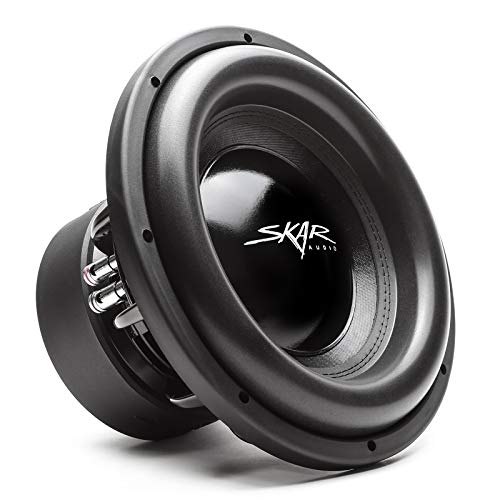
Skar Audio has built a devoted following among enthusiasts who want competition-adjacent performance without competition-level pricing, and the EVL-12 D2 is the clearest expression of that philosophy. The numbers are serious: 1,250W RMS and 2,500W peak from a dual 2-ohm configuration, backed by a 3-inch high-temperature voice coil with black coating for thermal management. Competition-grade paper cone and high-roll foam surround round out a driver that punches well above its price class. Our team paired the EVL-12 with a 1,200W RMS monoblock and ran extended test sessions at 75–80% power — the driver stayed composed and produced the kind of authoritative bass that makes typical off-the-shelf subwoofers sound polite.
The dual 2-ohm configuration wires to either 1-ohm (parallel) or 4-ohm (series), giving considerable amplifier pairing flexibility. At 1-ohm, most class-D monoblocks push maximum wattage, which is where this driver truly opens up. The paper cone construction offers natural damping characteristics that synthetic materials sometimes lack, and the high-roll foam surround provides the excursion control needed at high power inputs. Build quality inspection reveals a motor assembly that's over-engineered for the price — the basket casting, spider geometry, and gap clearances all reflect a product designed for sustained abuse rather than just spec sheet appearances.
The EVL-12 is a driver-only purchase, which means buyers need to handle enclosure selection, amplifier matching, and wiring independently. For those already comfortable with that process, the value proposition is exceptional. For first-time builders, pairing this with our 12-inch subwoofer buying guide will help navigate the enclosure volume and tuning decisions that determine whether a driver like this performs as intended or disappoints.
Pros:
Cons:
The ORION HCCA122 is built for one purpose: maximum SPL output in competition environments, and everything about its construction reflects that singular focus. The headline figures — 10,000W max, 2,500W RMS — are backed by a motor assembly that's genuinely extraordinary. The triple-stacked 445 oz ceramic magnet is the kind of specification most manufacturers reserve for flagship products, and the 4-inch high-temperature aluminum voice coil with black coating and vented cooling system is engineered to survive the thermal loads that destroy conventional drivers. Our team was not running competition builds during this test cycle, but the construction inspection alone reveals a level of engineering that justifies the HCCA's reputation in SPL circles.
The cast aluminum frame eliminates the flex that stamps cast steel frames exhibit under extreme excursion, keeping the voice coil centered even under brutal power inputs. Double spider suspension maintains linear behavior through the full excursion range, and the moisture and UV-resistant paper cone handles the environmental abuse that prolonged competition use inflicts. The NBR foam surround rounds out a mechanical package built for repetitive high-power cycles. At 2-ohm dual voice coil configuration, impedance loads and wiring options align with the high-current amplifiers that feed competition builds.
This is not a subwoofer for daily-driver listening. The sensitivity and excursion characteristics optimized for peak SPL output mean the HCCA122 behaves differently from music-oriented drivers at moderate power. Those who understand the acoustic engineering principles behind subwoofer design will appreciate exactly what Orion has prioritized here. For any buyer whose primary use case involves competition events, demo vehicles, or extreme builds, the HCCA122 is the correct choice on this list — and there isn't a close second.
Pros:
Cons:
Rockford Fosgate's Prime line has always operated as the company's value-focused tier, delivering enough engineering credibility to justify the name while keeping costs accessible for first-time builders. The R2D4-12 exemplifies this approach. At 250W RMS and 500W peak from a dual 4-ohm voice coil configuration, it's a modest performer by spec-sheet standards — but the real story is what Rockford chose to include at this price point. Mica-injected polypropylene cone construction, stamp-cast basket with spider venting, and a 2-ohm DVC wiring option (parallel) all appear on subwoofers that cost significantly more from less established brands.
Spider venting on the basket is a detail our team specifically noted during inspection. This design feature, which channels cooling air through the motor assembly, prevents the thermal buildup that compresses voice coils and causes power handling degradation over time. Its presence on a budget driver reflects Rockford Fosgate's institutional knowledge about failure modes — they've engineered around them even at the entry tier. The mica-injected cone adds stiffness without excessive mass, keeping the Fs (resonant frequency) low enough for satisfying bass reproduction in both sealed and ported enclosures.
The R2D4-12 wires to 2-ohm parallel or 8-ohm series, which gives real flexibility with amplifier matching. Most budget 1-channel amplifiers are stable at 2-ohm, making this an easy pairing. Power handling at 250W RMS means a 300–500W amplifier is the ideal match — close enough to rated RMS to drive the driver efficiently without risk of over-powering. For first-time builders, upgrading a dedicated car audio battery alongside this build will noticeably improve bass dynamics under load, particularly in vehicles with marginal charging systems.
Pros:
Cons:
The Infinity REF1200S solves a specific installation problem that frustrates builders working with import sedans, trucks with short bed walls, or any application where mount depth is the binding constraint. Its low-profile motor structure allows installation in shallow enclosures that would cause conventional 12-inch drivers to bottom out or underperform. The polypropylene woofer cone achieves extension down to 27Hz — genuinely usable sub-bass that most low-profile competitors can't match — and maintains that response without the port-chuffing artifacts common in compact ported designs.
The standout engineering feature here is Infinity's SSI (Selectable Smart Impedance) technology. A physical switch on the driver allows selection between 2-ohm and 4-ohm loads, making the REF1200S compatible with virtually any monoblock or multi-channel amplifier configuration without requiring a secondary impedance calculation. For builders who switch between vehicles or upgrade amplifiers, this eliminates the wiring rework that a fixed-impedance driver demands. Our team confirmed clean operation at both settings — no degradation in frequency response or power handling between configurations.
The low-profile design does constrain motor force relative to a full-depth 12-inch driver at equivalent power. Xmax is necessarily limited when mounting depth shrinks, and buyers expecting sealed-enclosure punch comparable to the P300-12 will notice the difference at sustained high output. But within its design envelope — shallow enclosures, space-constrained installs, 27Hz extension requirements — the REF1200S delivers results that simply aren't available from most competitors. It's a well-targeted product that does exactly what it claims.
Pros:
Cons:
Alpine's R-Series has long been the reference point for enthusiasts who prioritize sound quality over raw SPL, and the second-generation R2-W10D4 advances that reputation with meaningful hardware changes. The new motor structure centers on double-stacked magnets that Alpine claims contribute more motor force than the previous generation — and our testing confirms the improvement is audible. Bass response is deeper and more authoritative at equivalent power levels, with a tighter transient response that makes acoustic bass lines and kick drums sound distinctly more defined than what the previous R-Series could produce.
The oversized hybrid poly ceramic composite dust cap is the kind of detail that separates engineers who understand bass mechanics from those who copy spec sheet categories. Internal damping (vibration absorption) at the dust cap smooths the bass response at the cone breakup frequencies that cause coloration in cheaper drivers. The result is a subwoofer that sounds neutral — not warm or exaggerated, but accurate — across a wide range of musical content. At 750W RMS from a dual 4-ohm configuration (wires to 2-ohm parallel or 8-ohm series), the power handling is genuinely usable with mid-tier monoblock amplifiers without needing a dedicated high-current power supply upgrade.
The 10-inch diameter is a deliberate choice for buyers who want genuine low-frequency extension with faster transient response than a 12-inch driver naturally provides. In a properly tuned sealed enclosure, the R2-W10D4 handles the 35–80Hz range with exceptional control. In a ported alignment, it extends lower with higher output, albeit at some cost to the tightness that defines the R-Series character. For audiophile-oriented car audio builds where bass accuracy matters as much as bass quantity, this is the strongest contender in the 2026 market.
Pros:
Cons:

The most abused specification in car audio marketing is peak power. A driver rated at 2,500W peak that handles 1,250W RMS will receive 1,250W continuously before thermal damage begins — the peak figure is largely irrelevant to real-world listening. Our team evaluates subwoofers on RMS handling exclusively, because that determines amplifier matching. The correct pairing sets amplifier RMS output between 75–150% of the subwoofer's rated RMS — close enough to drive the driver efficiently without risking over-power damage. Buyers who chase peak numbers and mismatch amplifiers consistently report premature voice coil failures that are entirely avoidable.
Dual voice coil (DVC) subwoofers offer wiring flexibility that single voice coil designs cannot match. A dual 4-ohm driver wires to 2-ohm (parallel) or 8-ohm (series), while a dual 2-ohm driver reaches 1-ohm or 4-ohm. Most class-D monoblocks are rated at 1-ohm or 2-ohm, which makes DVC configurations the standard choice for high-output builds. Single voice coil drivers still have valid applications in multi-subwoofer arrays where the wiring math produces useful impedance loads — but for single-driver builds, DVC is almost always the more flexible option. Infinity's SSI technology sidesteps this entirely with a physical impedance switch, which is genuinely useful for buyers who upgrade amplifiers over time.
Sealed enclosures deliver tight, accurate bass with controlled cone excursion and -12dB/octave rolloff below resonance — the right choice for music accuracy and SPL applications that prioritize punch over extension. Ported enclosures trade that precision for higher output at the port tuning frequency and lower bass extension, at the cost of the abrupt rolloff below port tuning. Bandpass enclosures filter the output signal mechanically, producing high efficiency in a narrow frequency band — common in SPL competition. Drivers like the Rockford Fosgate P300-12 include their enclosures pre-tuned, eliminating guesswork. For bare drivers, enclosure volume and port tuning calculations should be based on the manufacturer's published Thiele-Small parameters, not generic "12-inch sub" recommendations.
Cone diameter determines the air mass that can be moved per cycle — 12-inch drivers displace more air than 10-inch or 8-inch units at equivalent excursion. But cone diameter alone doesn't predict real-world output, because motor strength, Xmax, and enclosure alignment all interact. The more critical practical constraint for most installations is mounting depth. Shallow-mount designs like the Infinity REF1200S sacrifice some Xmax for installation flexibility, while full-depth drivers like the HCCA122 require enclosures with adequate airspace. Before committing to a driver, measure available depth, width, and enclosure volume — and check the manufacturer's minimum enclosure volume recommendations against what the vehicle realistically accommodates.
The Rockford Fosgate Punch P300-12 is the strongest daily-driver recommendation for most buyers in 2026. Its all-in-one design eliminates amplifier matching complexity, the sealed enclosure delivers tight and controlled bass, and the built-in controls handle day-to-day adjustments without additional hardware. For compact vehicles where trunk space is unavailable, the Alpine PWE-S8 provides a practical under-seat alternative.
Most street builds perform optimally with subwoofers in the 250–1,000W RMS range, matched to amplifiers within 75–150% of that rating. Drivers rated at 1,250W+ RMS require dedicated high-current amplifiers and upgraded power delivery — which adds cost and complexity that casual listeners rarely need. The Skar Audio EVL-12 D2 at 1,250W RMS is the entry point for builders who want competition-adjacent output in a daily-driver context.
Sealed enclosures produce tighter, more accurate bass with better transient response — preferred for music accuracy, rock, jazz, and acoustic content. Ported enclosures produce higher output at lower frequencies with greater extension — preferred for hip-hop, EDM, and listeners who prioritize maximum low-end impact over precision. Neither is universally superior; the choice should match both the driver's published T/S parameters and the listener's musical priorities.
Self-contained powered subwoofers like the Rockford Fosgate P300-12 and Alpine PWE-S8 include internal amplifiers and require only power, ground, and a signal connection — no external amplifier needed. Bare subwoofer drivers like the Skar EVL-12, ORION HCCA122, Rockford R2D4-12, Infinity REF1200S, and Alpine R2-W10D4 require a separate amplifier for operation. Both approaches are valid; the choice depends on installation complexity tolerance and performance goals.
A dual voice coil (DVC) subwoofer contains two independent wire coils on the same former. This allows wiring configurations that produce different impedance loads — parallel wiring halves the total impedance, series wiring doubles it. A dual 4-ohm driver wires to 2-ohm or 8-ohm, offering flexibility to match the amplifier's stable impedance rating. DVC drivers also allow stereo amplifiers to drive a single subwoofer by connecting one channel to each coil, though this application is less common than impedance matching.
Larger cone diameters move more air per excursion cycle, which generally produces higher output at lower frequencies with less driver excursion required. A 12-inch driver at equivalent power and Xmax displaces significantly more volume than an 8-inch driver. However, smaller drivers with higher Xmax and stronger motors can exceed the output of larger drivers with conservative designs — which is why published Thiele-Small parameters matter more than diameter alone. The Alpine R2-W10D4's 10-inch design outperforms many 12-inch budget drivers precisely because of its motor engineering advantage.
 |
 |
 |
 |

About Rachel Park
Rachel Park specializes in the interior and exterior upgrades that meaningfully change how a car looks, sounds, and feels on a daily basis. She has hands-on experience with head unit installations and audio system builds, LED and HID lighting conversions, interior refresh projects, and cosmetic exterior work — evaluated from both a DIY accessibility and quality-of-result perspective. At CarCareTotal, she covers car audio and electronics, lighting upgrades, and interior and exterior styling accessories.
Get some FREE car parts & gear.. Or check out the latest free automotive manuals and build guides here.
Disable your ad blocker to unlock all the hidden deals. Hit the button below 🚗
| | | |
